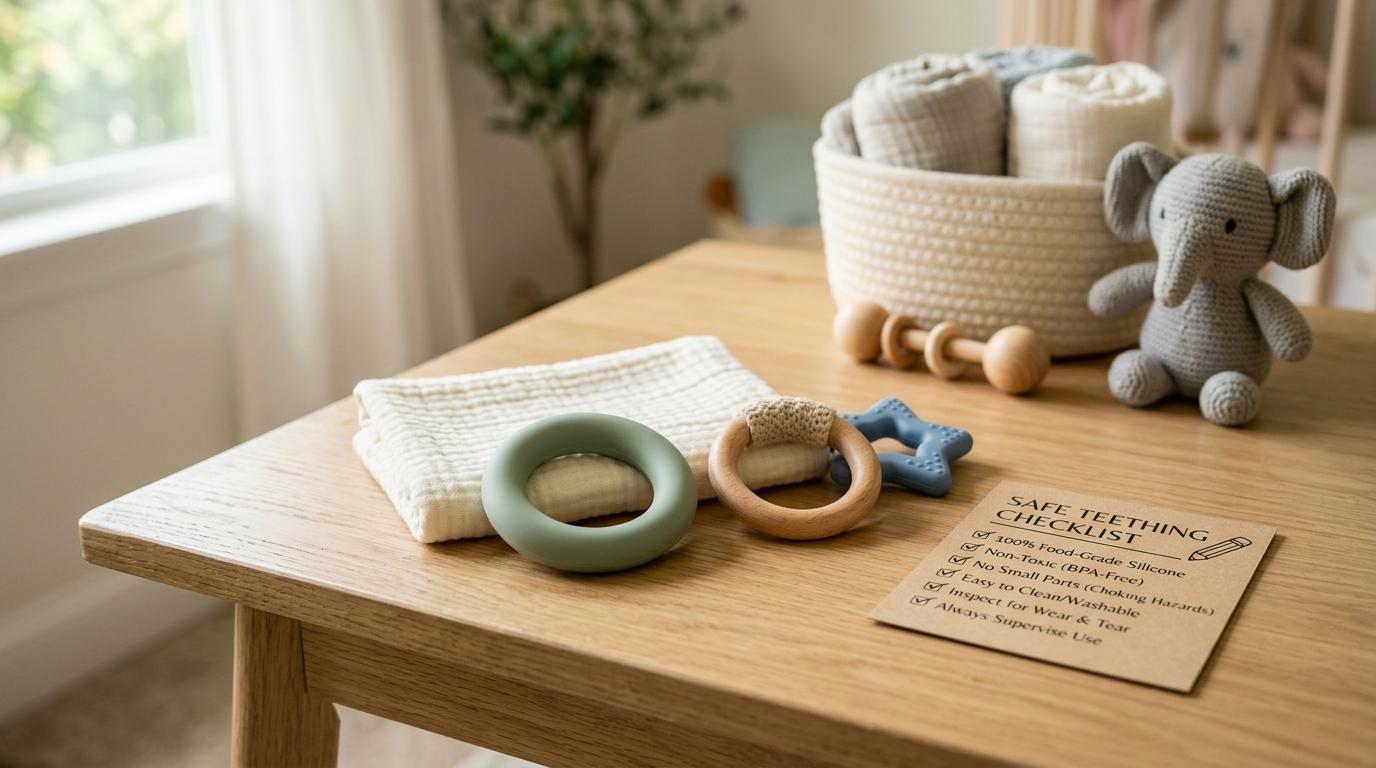
A practical teething toy safety checklist doesn’t have to be complicated. Choose a firm, one-piece teether that’s too large to fit completely inside your baby’s mouth. Avoid teething jewelry, liquid-filled teethers, and anything frozen rock-hard. Wash teethers with mild soap and clean water, dry them fully, and check them often for cracks, peeling, loose parts, stickiness, strange smells, or mold. If you’re unsure whether a teether is still safe, it’s best to replace it.
Teething can make an ordinary day feel very long.
Your baby wants to chew on everything. You want to help. Then you look at teething products and suddenly there are silicone rings, cooling toys, mittens, wooden shapes, bead bracelets, amber necklaces, “natural” options, and a hundred cute little things that all claim to soothe sore gums.
It’s a lot.
The good news is that the safest choice is usually simple. A safe baby teether should be sturdy, easy to clean, age-appropriate, and used only when an adult is watching. It should not have tiny parts, jewelry-style beads, leaking liquid, or a frozen-hard surface that could hurt your baby’s gums.
This guide keeps things practical: what to buy, what to skip, how to clean teething toys, how to inspect them, and when it’s time to throw one away.
Safety note: This article is for general education only and is not medical advice. If your baby has a fever, trouble feeding, an injury, unusual crying, mouth swelling, or anything else that worries you, please speak with a pediatrician or pediatric dentist.
Why Teething Toys Need Extra Care
#Babies explore the world with their mouths. That’s completely normal, but it also means a teether gets exposed to saliva, dust, floor germs, lint, food, pet hair, and whatever else it meets during the day.
And babies can chew surprisingly hard.
A tiny crack can become a tear. A loose piece can become a choking risk. A damp teether left inside a closed pouch can start to smell musty or grow mold. Sometimes a teether looks perfect when you buy it, but daily chewing, washing, heat, and storage slowly wear it down.
A few important safety points are worth knowing:
- The FDA warns against teething necklaces, bracelets, anklets, and other teething jewelry, including amber, wood, marble, and silicone jewelry.
- The CPSC covers teethers under toy safety rules, including requirements that address hazards such as small parts.
- The AAP and HealthyChildren guidance recommends firm teethers, not liquid-filled ones, and advises against giving babies items that are frozen hard.
For parents in India and other humid or dusty places, cleaning and drying becomes even more important. Monsoon weather, hard water, dust, travel, and diaper bags can make teethers dirty quickly. It may feel like one more chore, but a simple clean-and-dry routine really helps.
What Makes a Safe Baby Teether?
#A safer teething toy usually has these features:
- One-piece or solid design
- No detachable beads, caps, bells, charms, or glued-on decorations
- Too large to fit fully inside your baby’s mouth
- Firm, but not rock-hard
- Clear age guidance on the packaging
- Easy to wash and dry
- Material details on the label, such as BPA-free silicone or rubber
- No cords, necklace loops, bracelets, or anklets
- No big medical claims like “guaranteed pain relief” or “cures teething pain”
A teether does not need to be fancy. In fact, the best one is often the plain one your baby can hold easily, you can wash properly, and you can inspect without struggling.
Teething Toys to Avoid
#Some teething products are simply not worth the risk. These are the main teething toys to avoid.
1. Teething Necklaces, Bracelets, Anklets, and Beaded Jewelry
#Avoid teething jewelry, even if it is sold as natural, amber, handmade, wooden, or silicone.
The FDA has warned against these products because they can create choking and strangulation risks. A necklace can catch during sleep, crawling, rolling, or play. A bracelet or anklet can break. If beads come loose, they can go straight into your baby’s mouth.
A simple rule helps here: babies should not wear teething products.
2. Liquid-Filled Teethers
#Liquid-filled teethers may look soothing, especially when chilled, but they are not the safest option.
AAP and HealthyChildren guidance recommends firm teethers instead of liquid-filled ones. If a baby’s teeth puncture the outer layer, the liquid can leak out. Once punctured, the toy can also become harder to clean properly.
A solid teether is usually a better choice, such as a firm silicone teether or another age-appropriate solid design.
3. Frozen-Hard Teethers
#A cool teether can feel nice on sore gums. A frozen-solid teether is different.
When a teether is kept in the freezer, it can become too hard and may hurt delicate gums. HealthyChildren advises against frozen-hard items for babies.
If the product label allows chilling, put the teether in the refrigerator instead of the freezer. It should feel cool, not icy, stiff, or stone-hard.
4. Toys With Small Parts or Weak Attachments
#Avoid teethers with small add-ons that could loosen. This includes beads, little rings, decorative eyes, caps, tags, charms, and anything glued on.
Before giving a teether to your baby, gently tug and twist it. If any part moves oddly, stretches, separates, or looks weak, do not use it.
Also avoid toys with deep holes, narrow grooves, or hidden spaces that are difficult to clean and dry.
5. Products With Medical-Sounding Claims
#A teether is for chewing. That’s really it.
Be cautious with products that claim to cure teething pain, reduce fever, boost immunity, or guarantee better sleep. These claims are not helpful, and they can distract from what actually matters: safe design, proper cleaning, and supervision.
Simple, washable, easy-to-check teethers are usually the better choice.
Comparison Table: Common Teether Types
#No material stays safe forever. The design, size, condition, cleaning routine, and supervision all matter.
How to Clean Teething Toys
#Parents often ask how to clean teething toys without turning it into a huge job. The basic routine is simple:
Wash, rinse, dry, inspect, store.
Different materials need different care, so always check the manufacturer’s label too.
Step 1: Wash After Use
#Use warm water and mild dish soap. Rub all surfaces with clean fingers or a dedicated soft brush. Pay extra attention to ridges, bumps, corners, handles, and textured areas.
If the teether falls on the floor, lands outside, sits in a pram basket, gets near pets, or touches a public surface, wash it before giving it back to your baby.
Step 2: Rinse With Clean Water
#Rinse away all soap properly. Soap residue should not be left on something your baby is going to chew.
In many Indian homes, tap water may be hard or may leave mineral marks. If needed, use filtered water or boiled and cooled water for the final rinse, especially if the teether is going straight back into your baby’s mouth.
Avoid strong-smelling cleaners, harsh disinfectants, and soaps that leave residue.
Step 3: Sterilize Only If the Label Allows It
#Not every teether can handle boiling water, steam, dishwashers, or UV sterilizers.
Heat can warp plastic, damage rubber, weaken joints, or spoil the material. So don’t guess.
If the label says a silicone teether can be boiled, steamed, or placed in the dishwasher, follow the exact time and temperature instructions. If the label does not clearly allow heat cleaning, stick to soap, water, and proper drying.
Step 4: Dry Completely
#This step is easy to skip, but it matters more than people think.
Damp teethers stored inside closed boxes, diaper bags, or drawers can start to smell musty. In humid weather, they may even grow mold.
After washing:
- Shake off extra water
- Place the teether on a clean drying rack
- Let air move around it
- Pat it dry with a clean cloth if the weather is very humid
- Do not store it while it is still damp
Step 5: Store Clean and Dry
#Use a clean, dry pouch or container. Ideally, it should not trap moisture.
If you keep a teether in a diaper bag, wash it again if it touches snack crumbs, wipes, dusty clothes, coins, keys, or other random bag items. Because let’s be honest, diaper bags get messy fast.
For travel, carry two teethers if possible: one for use and one clean backup in a dry pouch.
Daily Teething Toy Safety Checklist
#Use this quick check before giving your baby any teether. It only takes a few seconds.
- Size check: The teether is too large to fit completely inside your baby’s mouth.
- Surface check: There are no cracks, cuts, peeling, punctures, splinters, sharp edges, or rough patches.
- Part check: There are no loose beads, rings, caps, tags, decorations, or attachments.
- Tug check: Joined areas feel secure and do not stretch, loosen, or separate.
- Cleanliness check: There is no dust, hair, lint, food, sticky residue, or visible dirt.
- Smell check: There is no sour, moldy, chemical, or stale smell.
- Temperature check: If chilled, it is cool from the fridge, not frozen hard.
- Supervision check: Your baby will use it while an adult is watching.
If the teether fails even one of these checks, do not use it.
Weekly Deep Inspection Checklist
#Once a week, check teethers more closely in good light.
- Check all bite zones: Look for deep tooth marks, thinning, tearing, or punctures.
- Inspect seams and joints: Seams, grooves, and joined parts should still feel firm and clean.
- Look for mold: Check holes, textures, and crevices. If spots do not wash off, throw the toy away.
- Feel the texture: Rubber that has become sticky, brittle, or crumbly should be replaced.
- Check for shape changes: Warping, swelling, or bending may mean the material is breaking down.
- Review the care label: Make sure your cleaning method still matches the manufacturer’s instructions.
- Replace when unsure: If you are not sure whether damage is safe, treat it as unsafe.
A teether is not meant to last forever. Babies chew a lot, and replacing worn teethers is part of using them safely.
Cooling Teethers Safely
#A cool teether can help some babies, but avoid extremes.
If the manufacturer allows chilling, place a solid teether in the refrigerator for a short time. Do not freeze it until hard. Do not give babies ice cubes or hard frozen objects to chew.
The goal is a cool surface, not a rigid one.
After chilling, check the teether again. It should not have cracks, leaks, brittle spots, or icy patches. Wash it after use and dry it fully before putting it away.
Simple Buying Checklist for Parents
#Before buying a teether, ask yourself:
- Is it one solid piece, or at least a very simple, secure design?
- Is it too large to fit fully inside my baby’s mouth?
- Does it avoid beads, cords, jewelry-style parts, and detachable decorations?
- Is it firm and not liquid-filled?
- Can I clean and dry every part of it?
- Does the label give age guidance and care instructions?
- Does it avoid exaggerated medical or health claims?
- Will I be able to inspect it easily every day?
A plain teether that passes these checks is usually better than a complicated one that looks cute but is hard to clean.
Final Takeaway
#A safe teether does not need to be complicated.
Choose a firm, one-piece design that your baby cannot fit fully inside their mouth. Avoid teething jewelry, liquid-filled products, and frozen-hard toys.
Wash it well, dry it fully, check it often, and replace it when it starts to wear out.
That is the heart of a practical teething toy safety checklist: simple, calm, and protective.