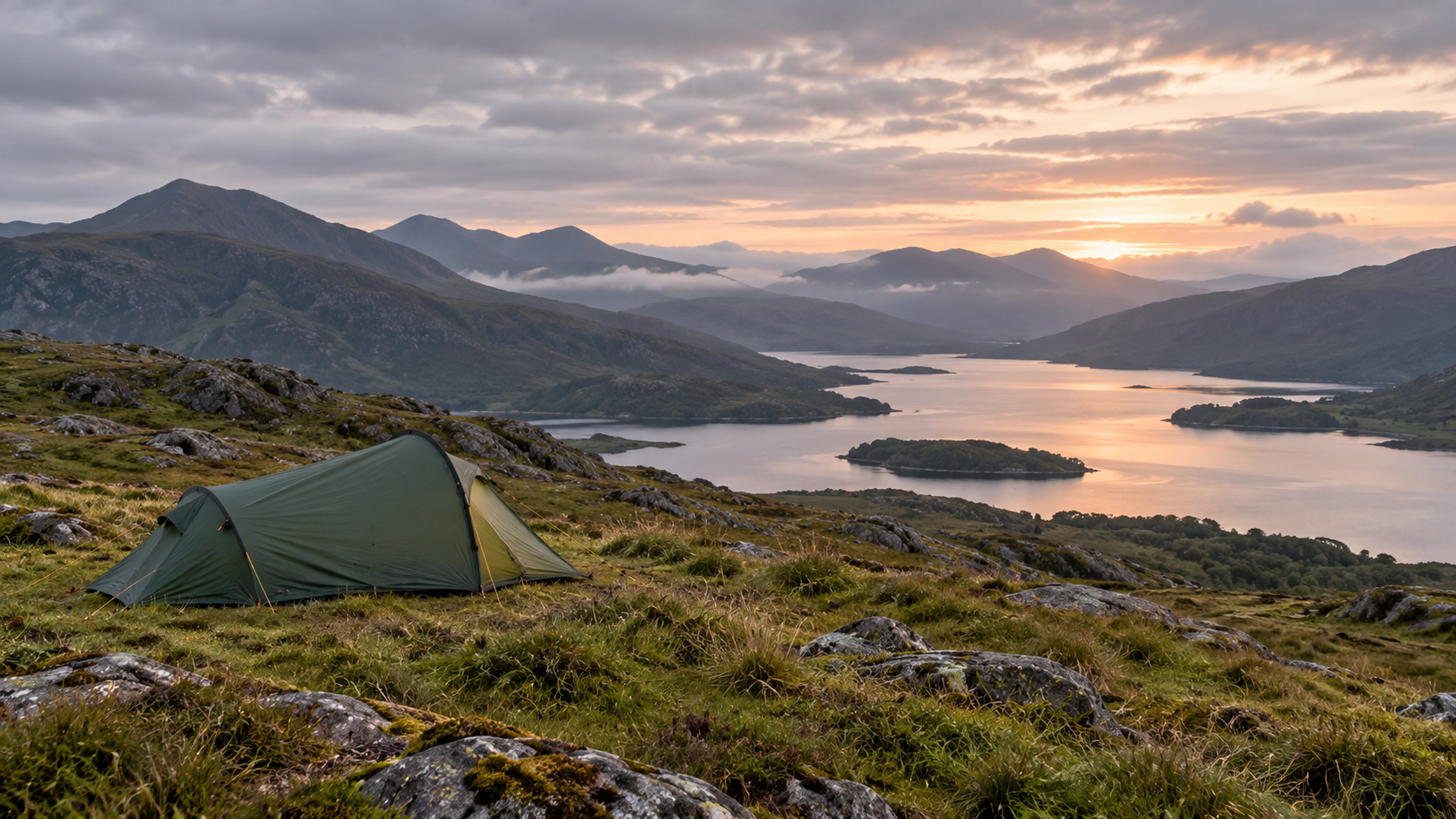
Scotland allows responsible lightweight camping in many places where public access rights apply. That does not mean every patch of ground is suitable, or that a car, a large group and a long stay are covered by the same rules. Choose a quiet place away from homes and roads, check local restrictions, carry everything out and be ready to change plans when weather or ground conditions make a pitch unsuitable.
For a first trip, think of wild camping as a short journey with an overnight stop, not a campsite without a booking desk. You need to plan water, warmth, navigation and waste before you leave. A managed campsite is a good alternative when you want facilities, are learning your equipment or cannot find a responsible pitch.
What counts as wild camping in Scotland?
#The Scottish Outdoor Access Code describes responsible wild camping as lightweight camping in small numbers, in tents, for two or three nights in one place. Access rights apply to much of Scotland, but they come with responsibilities to other people, land managers and the environment. The question is not only “Can I pitch here?” but also “Can I camp here without damaging the place or interfering with someone else?”
A small tent carried on a walking or cycling trip is different from parking a motorhome by a loch. Access rights do not include motor vehicles. Parking and overnight vehicle stays have their own rules; check the landowner, car park and local authority guidance for the exact place. Do not assume that a space beside a road is available for an overnight stay just because a tent may be permitted elsewhere.
This guide covers Scotland. Access arrangements differ elsewhere in the UK, so do not carry the same assumptions across a border.
Choose a place with care
#Start with a broad area and a realistic route, then make the final decision on the ground. Open hills, woodland and other countryside can offer opportunities where access rights apply. The legal boundary and a good pitch are separate questions: ground can be accessible and still be too wet, exposed, crowded or sensitive for a responsible camp.
Keep well away from buildings, roads and historic structures. Avoid enclosed fields with crops or farm animals, gardens and ground where your presence would affect privacy or work. If you hope to camp close to a house or building, ask the owner for permission. Leave gates as you find them and avoid damaging fences or vegetation.
Look for a small, already durable area where the tent can sit without digging, moving stones or clearing plants. Avoid pitching on fragile vegetation or a site already worn by repeated use. If others are already there, moving on can protect both the ground and the quiet experience everyone came for. Keep the group small and avoid treating a popular lochside as a gathering place.
A pretty view is not enough. Check for exposed ridges, drainage channels and signs that the ground floods. Do not pitch on a riverbank that could become unsafe if water rises. Choose a spot you can leave safely in poor visibility and identify your route out before dark. The location of a photograph does not tell you whether that place is appropriate today.
Check local rules before setting out
#Local byelaws can restrict camping in particular places. A national access rule is a starting point, not a substitute for checking the location and dates of your trip. Consult the relevant park or local authority for current maps, notices and conditions, and save the information while you have a connection.
A useful example is Loch Lomond and The Trossachs National Park. Its camping management zones apply from 1 March to 30 September. Within those zones during that period, the park says you need a permit or a campsite. The zones cover specific areas rather than the entire park, so use the park's current map instead of assuming the rule is the same everywhere inside its boundary. Outside those zones, responsible access still requires care for the land and other people.
A permit is not a promise of a sheltered pitch or a weather-safe night. Read its conditions, understand where it applies and carry a backup plan. If no permit is available for your chosen zone and dates, choose an appropriate campsite or another place where camping is allowed. Do not rely on an old screenshot, a social media pin or another traveller's account of a previous season.
Build a first-night plan
#For your first trip, keep the walk short enough that you can return or reach an alternative in daylight. Choose an area with a clear route, an accessible exit and a managed campsite or other accommodation option if conditions deteriorate. Check opening and booking arrangements directly before relying on a backup.
Plan the journey in three parts: how to reach the starting point, how to get to a suitable area on foot, and how to leave if the planned route becomes impractical. If using public transport, check the current service and the last practical return. If driving, use a suitable authorised parking place without blocking gates, passing places, access tracks or emergency access. Remember that parking permission does not automatically authorise camping beside the vehicle.
Tell a trusted person your intended area, route and expected return, and agree when they should raise concern if you do not check in. Carry an offline map and know how to navigate with it. A phone is useful, but reception and battery life are not guaranteed. A power bank helps, but it is not a substitute for route knowledge or appropriate equipment.
An example decision
#Imagine a first-time camper planning a single October night near a walking route. They check the park's zone map and current notices, choose a route within their ability, and identify a nearby campsite as a fallback. On arrival, strong wind makes the attractive open lochside feel exposed and the ground is saturated. The sensible choice is to move to a suitable sheltered area if one can be reached safely, or use the campsite. The goal is a safe, low-impact night, not reaching a particular pin.
That is an illustration rather than a recommended site or a guarantee of conditions. The same process works in another season, but daylight, weather, travel options and any local rules may change.
Pack for conditions, not just the forecast icon
#Scotland's weather can change quickly. Check a detailed forecast for your actual area and elevation shortly before departure, then decide whether your skills and equipment fit it. Rain, wind and cold are easier to manage before you commit to a remote pitch. If severe weather is forecast, postpone or choose a sheltered indoor or managed alternative.
Bring a tent you can pitch securely in the conditions you expect. Practise pitching it before the trip, including in wind and rain if you can do so safely. A suitable sleeping bag and insulating mat matter as much as the tent: the ground can draw heat away even when the air does not feel especially cold. Keep a dry set of sleep layers protected inside your pack.
Carry waterproof layers, warm clothing, a headtorch with spare power, food, drinking water and a suitable way to treat additional water. Do not assume water from a clear stream is safe to drink. Plan how you will treat it and where you can obtain it without trampling sensitive banks. Keep a map, compass and the skills to use them; pack a basic first-aid kit and any personal medication.
Keep the load manageable. A heavy bag can turn a short route into an exhausting one and make it harder to change plans. At the same time, cutting essential warm or waterproof layers to save weight is a poor trade. Test the packed bag on a short walk and adjust before travelling.
Leave no trace: water, waste and cooking
#Pack out all litter, food scraps and hygiene products. Bring a durable bag for rubbish and another for anything that needs to stay separate from clean kit. Small items such as wrappers, ties and bits of tissue are easy to miss; check the ground carefully before you leave.
Use public toilets when available. Away from facilities, carry a trowel and follow the Outdoor Access Code's guidance for burying human waste. Choose a discreet place well away from water, paths and buildings. Pack out toilet paper and hygiene products in a sealed bag. Urinate well away from open water, rivers and burns. Where ground conditions or local guidance make burial unsuitable, use an appropriate carry-out system.
Use a camping stove rather than an open fire, and follow local fire-risk advice. Open fires can scar the ground and spread, especially in dry conditions. The Access Code says never to light open fires, barbecues or fire bowls during dry periods or near forests, moorland, farmland, buildings or historic sites. Do not cut or damage trees. If using a stove, place it on a stable surface away from vegetation and follow its instructions; never cook inside an enclosed tent.
Keep washing water and food waste away from lochs and streams. Use as little water and cleaning product as practical, and do not leave scraps to attract wildlife. Before leaving, look around from several angles: the aim is that the next person cannot tell you camped there.
Wildlife, livestock and other people
#The countryside is lived and worked in. Keep a respectful distance from livestock and wildlife, avoid disturbing nesting areas and follow local signs or reasonable advice about land management. The park also asks visitors to take care not to disturb deer stalking or grouse shooting. If an area is busy with activity, adjust your route or choose another place.
If you bring a dog, keep it under proper control and avoid farm animals. The Access Code advises releasing a dog and taking the shortest safe route out if cattle act aggressively. Carry out bagged dog waste when bins are unavailable. A dog also needs its own warmth, water and sleeping arrangement; check that your planned route suits it.
Camping quietly and in small numbers is part of the experience. Keep noise low, respect other campers' space and avoid lighting that disturbs nearby people or wildlife. If someone explains a practical issue with your chosen spot, listen and look for a workable alternative. Responsible access depends on considering the effect of your actions, not simply asserting a right.
Midges, ticks and seasonal tradeoffs
#The best month depends on what you can manage. Longer daylight can make navigation and pitching easier, but popular places may be busier. Colder or shorter days demand more preparation, especially when wind, rain or snow are possible. Check the forecast, available daylight and transport separately; a calendar season alone cannot guarantee a comfortable trip.
Midges can make still evenings uncomfortable. A head net and suitable clothing can help, and a tent with intact mesh offers somewhere to retreat. Wind may reduce their nuisance, but do not choose an unsafe exposed pitch just to avoid insects. Follow product directions for any repellent and consider how you will cook and pack up if insects are persistent.
Ticks can be present in outdoor areas. Wear appropriate clothing, check yourself and any companions after being outdoors, and learn the current public-health advice for removal and symptoms before you go. A health concern is a reason to seek appropriate medical advice, not to rely on a travel guide for diagnosis.
When a campsite is the better choice
#A managed campsite can make sense for a first night, a family group, a vehicle-based trip or anyone who wants toilets and a known place to pitch. It also gives you a way to practise your kit without committing to a remote night. Check what facilities are actually open, whether reservations are required, and the site's rules for tents, dogs and cooking.
A permit area in a camping management zone is another distinct option where available. Read its specific conditions and do not assume it has the same facilities as a staffed campsite. Both choices still require careful waste disposal and respect for the landscape.
Wild camping becomes a stronger choice when you are comfortable carrying your equipment, navigating independently, managing waste and changing your plans. If any of those pieces is uncertain, practise close to facilities first. There is no prize for choosing the most remote location.
Before you leave
#Check the exact location and dates against current access guidance and any local byelaws. Recheck the weather and transport. Tell someone your route, pack for a safe exit and decide what conditions will make you turn back. Once you arrive, use the same judgment again: a responsible pitch is small, discreet, away from sensitive places and left as you found it.