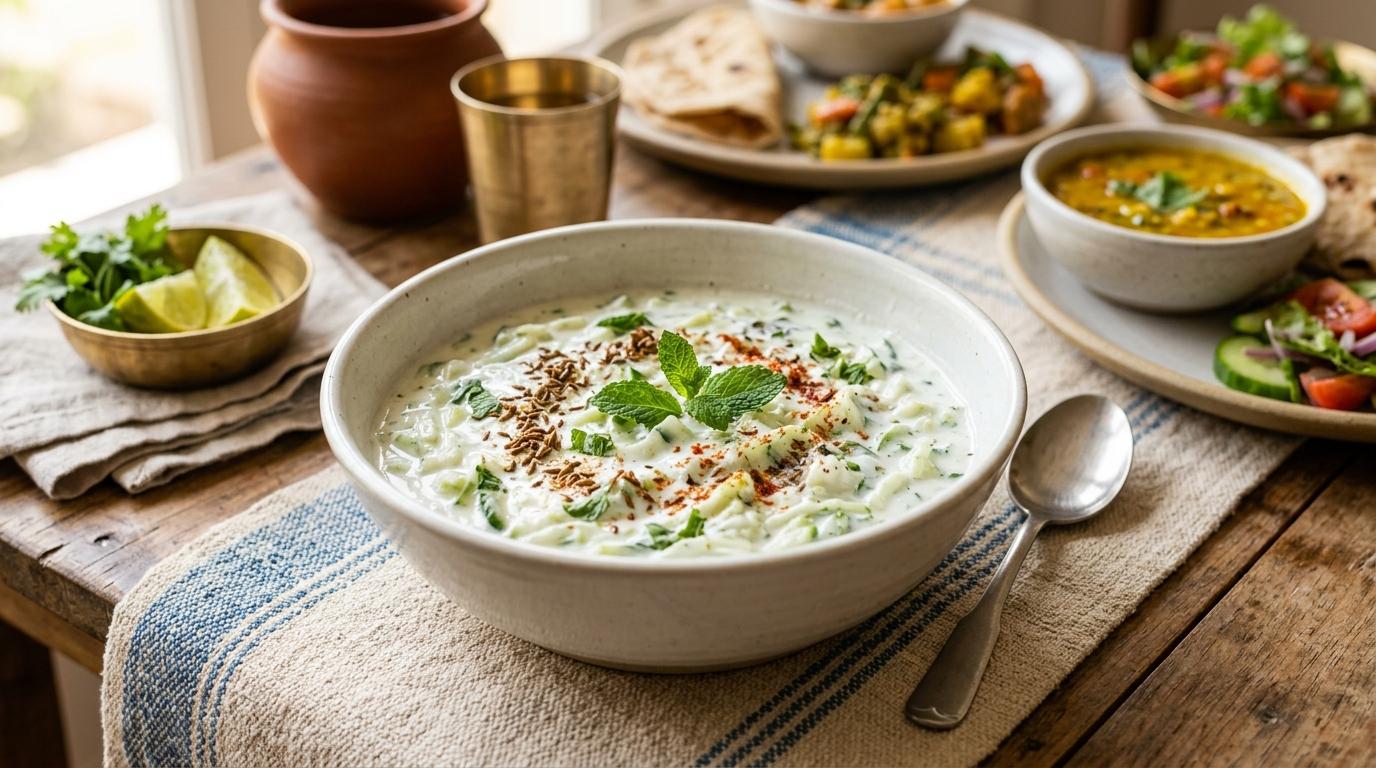
You pack lunch at 8 in the morning. By 1:30, you open your dabba, and the raita has turned watery, extra sour, maybe even a little bubbly.
At that point, you don’t really need a food safety lecture. Your nose already knows something is wrong.
Raita is such a perfect summer food. It is cool, light, comforting, and it goes with almost everything: paratha, pulao, dal-rice, biryani, roti-sabzi, khichdi, or a regular office lunch. But raita is still made with curd. And curd is dairy. It cannot sit around for hours in May-June heat and still be treated like nothing happened.
So, can raita stay outside in summer?
Not for long. Especially not in Indian summer.
Here is the practical answer: how long raita can safely stay out, what happens when you add cucumber or boondi, how to pack it in tiffin, what to do for parties and travel, and when it is better to stop negotiating with yourself and throw it away.
Quick Answer
#No, raita should not be left outside for long in summer.
For curd-based foods like raita, a common food safety rule is:
- Up to 2 hours at normal room temperature.
- Only up to 1 hour if the temperature is around 32°C or higher.
And honestly, many Indian summer kitchens, school bags, office desks, train compartments, buses, cars, and tiffin bags easily cross that temperature.
So during peak summer, it is safer to think of 1 hour outside the fridge as the real-life limit.
If raita has been sitting out in the heat for several hours, do not put it back in the fridge and plan to eat it later. Refrigeration can slow down further spoilage, but it cannot reverse what already happened while the raita was warm.
When in doubt, throw it out. With dairy, that is usually the wiser choice.
Why Raita Spoils Faster in Summer
#Raita spoils quickly because it has everything bacteria and yeast like: moisture, food, and warmth.
Curd is fermented, yes. But that does not mean it is heat-proof. The good bacteria in curd give it that tangy taste and creamy texture. But once curd sits in a warm place for too long, unwanted bacteria and yeasts can also start growing.
Food safety advice often talks about the “danger zone,” roughly 5°C to 60°C, where bacteria multiply more easily. Indian summer room temperature often falls right inside this range, especially in:
- Kitchens
- Lunch bags
- Parked cars
- Railway compartments
- School bags
- Buffet tables without cooling
- Non-AC rooms and offices
Raita becomes even more delicate than plain curd when you add things like:
- Chopped cucumber or onion
- Salt
- Roasted jeera powder or masalas
- Boondi
- Coriander, mint, tomato, or other vegetables
- Water to thin it down
Every extra ingredient means more handling, more moisture, and more surface area. That does not mean freshly made raita is unsafe. It simply means it should be kept cold and eaten soon.
A small bowl on the dining table for 20 minutes is fine. A steel dabba sitting in a school bag from morning till afternoon is a completely different situation.
Plain Curd vs Cucumber Raita vs Boondi Raita
#All raita starts with curd, but the add-ins change how it behaves. Some versions turn watery faster. Some become sour faster. Some just become sad and mushy.
Plain curd
#Plain curd is usually the simplest option because nothing much has been added to it. But it is still dairy, so it should not sit outside for hours in summer.
If plain curd stays out too long, it may become very sour, watery, yeasty-smelling, or unpleasant. Homemade curd may naturally release a little whey, and that is normal. But if it has been out in the heat for too long, the time matters more than the look.
For summer, always start with chilled curd and keep it cold until you are ready to eat.
Cucumber raita
#Cucumber raita is one of the trickier ones in summer.
Cucumber releases water, especially after salt is added. That is why cucumber raita often becomes thin and watery if it sits for a while.
Fresh cucumber raita is perfectly fine when made and eaten soon. The problem starts when it sits in a warm lunchbox or buffet bowl for hours. The chopped cucumber adds moisture, salt pulls out even more water, and the raita separates faster. It also loses that fresh, cooling taste.
If you are packing cucumber raita for later, the better way is to keep the curd and cucumber separate. Mix them just before eating.
Boondi raita
#Boondi raita has its own issue.
Boondi absorbs curd, swells up, becomes soft, and then slowly turns mushy. In summer heat, the curd can become too sour, and the boondi may start tasting stale or odd.
Dry boondi by itself is more stable. But once it goes into curd, it becomes part of a perishable dairy dish.
For better taste and safer handling, carry boondi separately and mix it into cold curd just before eating. Also, let’s be honest, nobody is excited about sad, swollen, soggy boondi raita.
Tiffin Rules: Packing Raita Safely for Work, School, or Hostel
#Raita in tiffin needs extra care in summer.
A regular steel dabba packed at 8 AM and eaten at 1 or 2 PM may stay warm for too long, especially if there is no fridge in school, college, hostel, or office.
If your lunch is not going to stay cold, do not treat raita like dry sabzi. Either pack it properly or skip it.
1. Use chilled curd from the fridge
#Start cold.
Do not make raita with room-temperature curd and pack it straight away. Take the curd out of the fridge just before packing. If you prepare raita early in the morning, keep it in the fridge until the last possible minute.
2. Use an insulated container
#A vacuum-insulated food jar or small insulated container is much better than a thin steel box for curd-based foods.
You can also pre-chill the container. Fill it with ice water for a few minutes, throw the water out, dry it, and then add cold raita. This will not keep raita safe forever, but it does help it stay cooler for longer.
3. Add an ice pack if lunch will sit for hours
#If you are packing raita for office, school, or travel, keep the container inside an insulated lunch bag with a frozen gel pack or ice pack.
This is especially useful for school tiffins and office lunches that sit on a desk until afternoon. For more summer packing tips, you can also see AllBlogs’ guide on office lunch food safety.
4. Pack everything separately and mix later
#This is often the best method.
Pack:
- Thick chilled curd in one small container
- Cucumber, onion, coriander, or boondi separately
- Salt and roasted jeera powder separately
Mix everything just before eating.
This works very well for cucumber raita, boondi raita, and mixed vegetable raita. It keeps the curd thicker, prevents early water release, and the texture is much better.
5. Skip raita if there is no cooling
#If the tiffin will sit for hours in a hot classroom, school bag, scooter storage box, bus, train seat, or non-AC office, skip raita.
Carry something safer instead, like dry boondi, roasted chana, a small pickle portion, dry chutney, or another low-moisture side. If you are planning more summer meals, you may also like these cooling Indian lunch recipes for summer.
Summer Buffets, Lunch Parties, and Family Gatherings
#Raita is almost compulsory at summer lunches. It balances spicy food beautifully. But parties and buffets are also where raita often sits out much longer than it should.
Here is how to serve it more safely.
Keep the main bowl in the fridge
#Do not put the full bowl of raita on the table one hour before guests eat.
Keep it in the fridge until serving time. If you need to set up early, place only a small bowl outside and refill it with chilled raita when needed.
Use an ice bath
#Place the raita bowl inside a bigger bowl filled with ice and a little water. This helps keep it cold while people serve themselves.
It is not as good as a fridge, of course, but it is much better than leaving curd raita on a warm dining table.
Do not mix old and fresh raita
#If one bowl has been sitting outside, do not pour fresh chilled raita into the same bowl.
Use a clean bowl.
Fresh food can also become unsafe if it is mixed with food that has already been sitting warm.
Throw away leftovers that sat out too long
#If raita stayed on the table through a long lunch, especially in a non-AC room, do not save it as leftovers.
Leftover raita is only worth keeping if it stayed cold and did not sit outside beyond the safe time limit.
Raita During Train, Road, and Bus Travel
#Summer travel is rough on dairy foods.
A train compartment, bus journey, road trip bag, or car boot can heat up quickly. If you cannot keep raita cold with an insulated bag and ice pack, it is better not to carry it.
For short travel, you can carry:
- Chilled plain curd in an insulated container
- Add-ins separately
- An ice pack in the lunch bag
- A clean spoon for mixing
For long journeys without cooling, skip raita. Curd-based foods need temperature control. For related guidance, read AllBlogs’ note on curd rice travel safety.
Can You Refrigerate Raita After It Has Been Outside?
#Yes, but only if it has not crossed the safe time window.
If raita was outside briefly during serving, and the room was not too hot, put it back in the fridge quickly in a covered container. Do not leave it on the counter “for later”.
But if it has been outside for:
- More than 1 hour in hot summer conditions
- More than 2 hours in cooler indoor conditions
- Several hours in a tiffin, car, train, or school bag
- Overnight at room temperature
Throw it away.
Cooling it after that will not reliably make it safe again.
Signs Your Raita Has Gone Bad
#The safest rule is simple: do not taste raita to check if it is spoiled.
If the time and temperature were unsafe, discard it even if it looks normal. Some unsafe food does not show obvious signs.
Still, these are warning signs that raita should be thrown away:
- Strong sour or yeasty smell: Curd is naturally tangy, but spoiled raita smells sharp, unpleasant, alcoholic, or simply wrong.
- Bubbles or fizzing: Tiny bubbles, foam, or a fizzy sound can mean unwanted fermentation.
- Too much separation: A little whey is normal, but a big watery layer with bad smell or slimy texture is not.
- Sliminess: Sticky, stretchy, or slimy raita should not be eaten.
- Colour changes: Pink, grey, yellowish patches, or fuzzy spots can mean spoilage or mold.
- Bad taste: Ideally, do not taste it. But if you already did and it tastes off, spit it out and discard the rest.
The timeline matters most. Raita left in heat for too long is not worth the risk.
Safer Raita Habits for Indian Summer
#A few small habits can save you a lot of trouble.
- Make raita close to mealtime.
- Use chilled curd.
- Keep chopped vegetables separate until serving.
- Add salt just before eating, especially for cucumber raita.
- Use clean spoons and containers.
- Keep raita covered in the fridge.
- Serve small portions instead of one big bowl.
- Use an ice bath for buffets.
- Do not pack raita in tiffin unless you can keep it cold.
- Throw away leftovers that sat outside too long.
Raita is not the problem. Warm storage is.
Fresh, cold raita is a lovely summer food. Warm, forgotten raita is not.
Final Takeaway
#Can raita stay outside in summer? Only for a short time.
Use 1 hour as the safer limit in hot Indian weather, especially when the temperature is around 32°C or higher. In cooler indoor conditions, the general limit is up to 2 hours. After that, especially with cucumber raita or boondi raita, it is safer to discard it.
For tiffin, pack chilled curd in an insulated container with an ice pack, or carry the ingredients separately and mix at lunchtime. For buffets, keep raita on ice and serve small batches.
Cool raita is comforting. Warm, forgotten raita is not worth saving.