The short answer from my own flights: yes, but don’t be casual about it
#If you’re flying from India and wondering whether you can carry ice packs on a flight, the simple answer is: usually yes, but it depends on what type of ice pack it is, whether it’s frozen solid, whether you’re carrying it in cabin baggage or check-in, and honestly, how the security officer reads the situation that day. That last part sounds annoying, I know. But anyone who has gone through security at Delhi T3, Mumbai T2, Bengaluru, Kochi, Hyderabad, Chennai… you already know the vibe. Rules are rules, but the final call at the screening belt is very much in the hands of security staff.
I’ve carried ice packs from India a few times now, mostly for food and once for medicines for a family member. The first time I did it, I was going from Delhi to Bengaluru with homemade theplas, paneer rolls, and a small insulated pouch because my mother was convinced airport food would “spoil my stomach.” Typical Indian mom logic, and she was not fully wrong. I had two gel ice packs in the pouch, both frozen hard when I left home. By the time I reached security, one had started sweating but was still mostly solid. The CISF guy pressed it, looked at me, looked at the food, and let it go. No drama. But another time at Mumbai, a half-melted gel pack got pulled out and questioned properly. So yeah, experience matters here.
The most useful rule to remember is this: if the ice pack is completely frozen at the time of security screening, it is much less likely to be treated as a liquid or gel problem. If it has melted and become slushy or liquid, then it can fall under liquid/gel restrictions, especially on international flights where the 100 ml liquid rule is taken more seriously. In checked luggage, ice packs are usually easier, but you still need to pack them properly because leaking gel inside a suitcase is just… no. I’ve seen one suitcase at baggage belt with some mysterious wet corner and everyone nearby was judging silently.
Cabin baggage vs checked baggage — where should you keep ice packs?
#For most normal travellers, checked baggage is the safer option for ice packs. If you are carrying frozen gel packs to keep sweets, medicines, breast milk, insulin, seafood, chocolates, or perishable snacks cool, putting them in check-in luggage reduces the chance of security arguing about liquids. But there is a catch. Once you check in your bag, you lose access to it for hours. So if you need the medicine during the flight, or you need to keep something cold with you, cabin baggage becomes necessary.
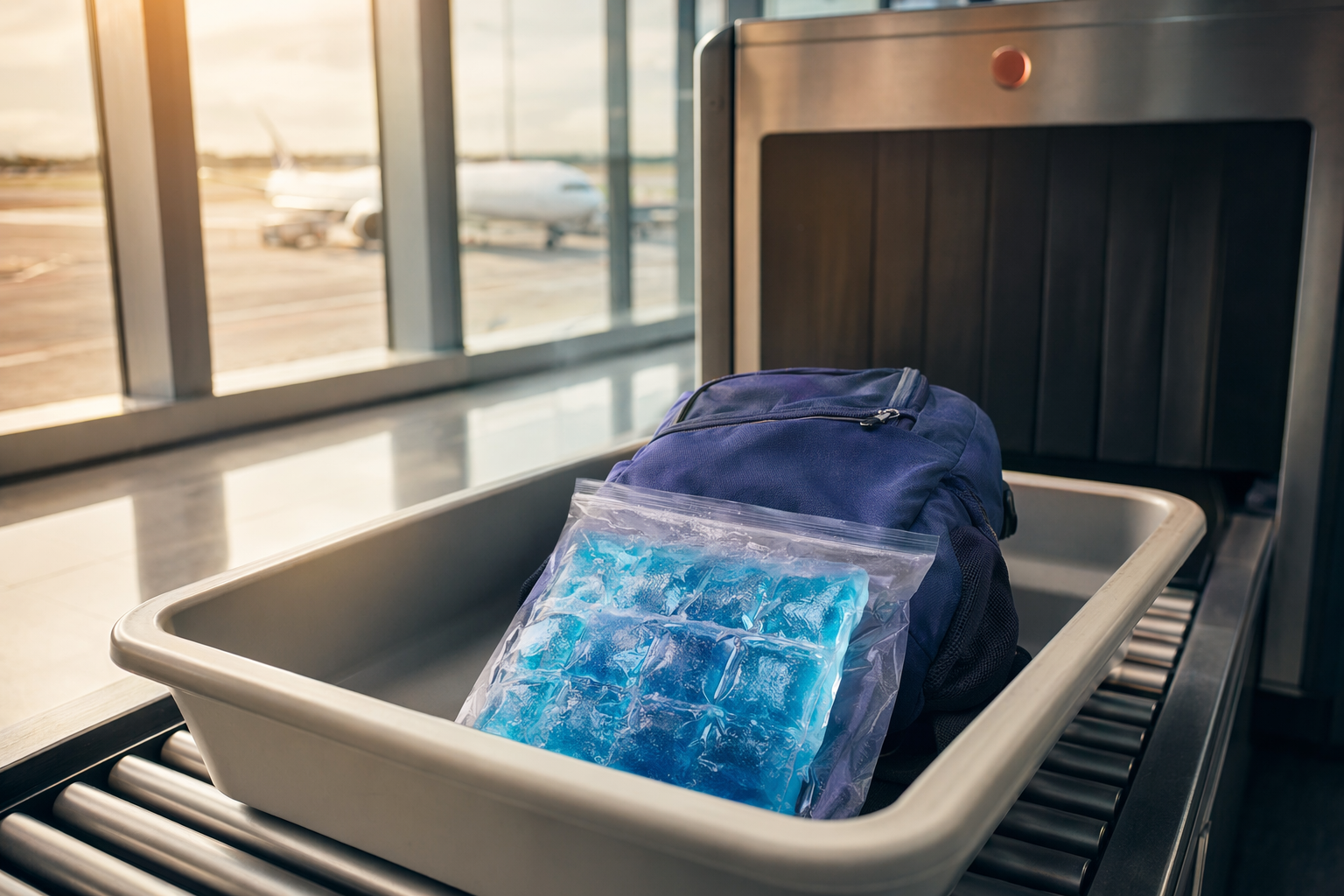
In cabin baggage, you should treat gel ice packs like liquids/gels unless they are frozen solid. This is where many Indian passengers get stuck. We leave home from Gurgaon or Navi Mumbai or Whitefield thinking, “haan haan frozen hai,” then Ola gets stuck, airport entry takes time, check-in queue is slow, and by the time you reach security it’s half water. Then the officer sees a squishy gel pack and says it can’t go. Not always, but it can happen. So timing is actually a travel hack here, not just packing.
- If it’s for regular food: freeze the ice pack hard, use an insulated lunch bag, and reach security before it turns soft.
- If it’s for medicine: keep the prescription, doctor note, and medicine label handy. Don’t bury it inside the bag like I did once, bad idea.
- If it’s in checked luggage: double pack the ice pack in zip pouches or leak-proof bags, because pressure and rough handling can make things messy.
- If it’s international travel: be stricter with yourself. Liquids, gels, customs, food rules — sab combined headache ban sakta hai.
One small thing I learnt the hard way: don’t put loose ice cubes in a normal plastic bag and think it’s the same as an ice pack. It melts, leaks, and creates unnecessary suspicion at security. Use proper freezer packs, or frozen water bottles only if your airline/security route allows it and it stays frozen solid. But frozen bottles can become a liquid issue quickly, so I don’t rely on them anymore.
What Indian airport security usually cares about
#In India, airport security screening is handled seriously, especially after check-in and before boarding. For cabin baggage, officers are mainly looking for restricted items, sharp objects, suspicious liquids, aerosols, gels, batteries, power banks in wrong bags, and all those things we pretend we didn’t know were inside. Ice packs are not automatically banned, but gel packs can be treated like gels if they are not frozen.
On domestic flights from India, I’ve found security a little more practical about food and small cooling packs, especially if it’s clearly for snacks or medicine. On international flights, the rules feel tighter. The standard liquid rule for international cabin baggage is generally 100 ml containers packed inside a clear resealable bag, and anything gel-like can get questioned. A melted ice pack is not exactly your shampoo bottle, but to the screening process it may look like a gel/liquid item.
Also, don’t argue aggressively. I’m saying this as someone who has seen uncles at security counters giving full TED Talk about “I am frequent flyer.” It does not help. Explain calmly: “This is a frozen ice pack for medicine/food. It is sealed. Here is the prescription if needed.” If they still say no, you may have to surrender it. Better to carry cheaper ice packs and not your imported fancy one that costs more than your airport dosa.
My Delhi airport medicine-cooler episode, and what I changed after that
#The medicine trip was the one that made me take this topic seriously. We were flying from Delhi to Kochi for a family function, and one injectable medicine had to stay cool. Not frozen, just cool. My cousin had packed it in a small medical cooler pouch with two gel packs. Everything looked neat at home. Then Delhi traffic happened. Then the check-in line moved like it was doing meditation. By security, the gel pack had softened slightly.
The officer asked what it was. My cousin started explaining too much — medicine name, doctor, family function, why Kochi, everything. I quietly pulled out the prescription and the medicine carton. That helped. They checked it, asked us to open the pouch, and allowed it. But the lesson was very clear: documentation matters. If your ice pack is supporting a medical item, don’t treat it like picnic packing. Keep it professional, labelled, and easy to inspect.
Now I pack medical cooling items like this: medicine in original packaging, prescription printed or saved offline on phone, doctor note if possible, gel packs fully frozen, and everything inside a transparent or easy-open pouch. I also reach the airport earlier than I normally would. Which is painful, because I’m that person who thinks boarding gate closing time is a suggestion. But for medical cold-chain stuff, don’t play games.
Food with ice packs: Indian snacks, sweets, baby food, and the risky items
#This is where most of us get emotional. Indians don’t just travel with luggage, we travel with food responsibility. Someone’s mom sends parathas, someone’s wife packs curd rice, someone is taking Bengali sweets, someone is carrying homemade pickles wrapped in three newspapers and one prayer. Ice packs come into the picture when the food is perishable — paneer, cream cakes, dips, cooked meat, dairy sweets, cut fruits, baby food, or anything that can spoil in heat.
If you’re carrying fruits with ice packs, be careful about whether the fruit is whole or cut. Whole apples, oranges, bananas are usually simpler. Cut fruit can release liquid, spoil faster, and may create both hygiene and security issues if packed badly. I’d suggest reading Can You Bring Fruit on a Plane? Whole vs Cut Rules if you’re planning chilled fruit boxes, because the difference between whole and cut fruit sounds small but during airport security and customs it becomes quite big.
For bakery items, dry is safer than creamy. Plain bread, khari, cookies, tea cakes, rusk, nankhatai, croissants without cream — these usually don’t need ice packs and travel better. Cream-filled pastries, cheesecakes, mousse cakes, and fresh cream items are more delicate. If you are comparing what to pack without cooling, Can You Bring Bakery Items on a Plane? Bread, Pastries, Cookies, and Packing Rules is useful, especially if you’re that person taking snacks for relatives abroad.
Dips and spreads are another tricky thing. Hummus, mayonnaise-based dips, chutneys with coconut, curd-based dips — they need temperature control, but they can also count as liquids/gels/pastes in cabin baggage. Also food safety is not a joke on long travel days. If you’re carrying hummus or similar chilled dips, check Can Hummus Stay Outside? Safe Timing and Storage Rules before assuming “airport AC hai, kuch nahi hoga.” Airport AC doesn’t save food sitting in a taxi, queue, aircraft hold, and hotel room later.
International flights from India: the ice pack is only half the story
#If you’re flying from India to Dubai, Singapore, London, Bangkok, Doha, Toronto, Sydney, or anywhere international, the ice pack question becomes bigger because you also have customs and biosecurity rules at arrival. The airport security in India may allow your frozen ice pack, but the destination country may not allow the food you are cooling. This is where many people get confused.
For example, carrying packed chocolates with an ice pack is normally less problematic than carrying homemade meat curry or fresh dairy sweets. Some countries are strict about fresh fruits, seeds, meat, dairy, homemade food, and unpackaged items. Australia and New Zealand are famously strict. Singapore is organised but still has rules. Gulf countries may be practical, but don’t assume everything is okay. Declare where required. Don’t hide food. Getting fined abroad for achar or mithai is not the travel memory anyone wants.
Also, transit matters. If you fly India to Europe via Doha or Dubai, and you have to clear security again during transit, your ice pack may have melted by then. At that second security check, it may be treated as liquid/gel. This happened to a friend carrying baby food cooling packs. India security allowed it because frozen. Transit security questioned it because it had gone soft. Finally they allowed because baby-related items had some flexibility, but it took time and stress. So for long international routes, use better insulation and fewer risky items.
What about dry ice? Sounds smart, but please don’t casually use it
#Some travellers ask if they can use dry ice instead of regular ice packs. Dry ice keeps things very cold, but it is not a normal household travel item. It is regulated because it releases carbon dioxide gas. Airline rules based on dangerous goods guidance usually allow limited dry ice, commonly up to 2.5 kg per passenger, but only with airline approval and proper packaging that allows gas to escape. The package may need marking and labelling.
My honest suggestion? Unless you are shipping something important, or carrying medical/scientific material with proper guidance, avoid dry ice. For normal food, mithai, chocolates, or medicines, good gel packs and an insulated pouch are easier. Also many airline call centre people don’t explain dry ice rules clearly, and airport staff may ask questions. If you still need it, speak to your airline before travel, not at the airport counter when your cab driver is waiting outside and your blood pressure is already high.
Packing method that has worked for me on Indian flights
#My packing style is not fancy, but it works. I freeze the gel packs for at least overnight so they are rock hard. I use a small insulated lunch bag or medical cooler, not a huge picnic box. Inside, I keep the food or medicine in a sealed container, then the ice pack, then one absorbent layer like tissue or cloth, then an outer zip pouch. For checked luggage, I add one more plastic layer because baggage handling can be rough. You know how suitcases come out with new scratches like they went to war.
- First, freeze the ice packs completely. Not “thoda cold,” properly frozen.
- Second, pre-chill the food or medicine pouch before leaving home, so the ice pack doesn’t waste energy cooling a warm dabba.
- Third, keep the pouch accessible if it’s in cabin baggage. Security may ask you to remove it.
- Fourth, don’t overpack liquids with it. If your bag already has shampoo, chutney, lotion, ghee, and then gel packs, you’re inviting extra checking.
- Fifth, carry a backup plan. If security takes the ice pack, can the item survive? If not, rethink the travel plan.
One very desi but useful trick: wrap the ice pack in a thin towel and then put it inside the insulated pouch. It reduces sweating and keeps the surrounding items dry. But don’t wrap it so deeply that security can’t understand what it is. Transparent packing is better than mystery packing. Airport security does not enjoy mystery parcels, obviously.
Airline differences: IndiGo, Air India, Vistara-style experience, and the real thing
#People often ask, “Does IndiGo allow ice packs?” or “Can I carry ice pack in Air India cabin baggage?” The truth is, airlines may have their own baggage policies, but the main cabin screening decision happens at airport security. So even if the airline says something is generally okay, CISF or airport security can still stop it if they think it violates liquid/gel rules or looks unsafe. Airline staff at check-in may also ask what is inside if the bag is unusual.
On Indian domestic routes, I’ve personally found smaller gel packs for food or medicine to be accepted when frozen and sealed. But I never pack them loosely. I also avoid large blocks, unlabeled gel packs, or anything that looks like a chemical pouch. If you have a branded medical ice pack, keep the label visible. If it’s a random blue freezer pack from Amazon, fine, but make sure it’s clean, sealed, and not bulging.
For international airlines leaving India, I’d check directly with the airline if the ice pack is for medical reasons, baby food, breast milk, or temperature-sensitive injections. Many airlines are used to these requests, but they may ask you to carry documentation. Some may not provide onboard refrigeration, so don’t assume cabin crew will keep your medicine in their fridge. Sometimes they can help, sometimes they can’t. Plan like you’ll get no help, and then if they help, bonus.
Season matters more than people think
#Flying from India in May is not the same as flying in December. In peak summer, your frozen ice pack starts losing its battle the moment you leave home. Delhi, Jaipur, Ahmedabad, Nagpur, Hyderabad, Chennai humidity, Mumbai traffic heat — all of it matters. Even winter flights can be tricky if you have long airport waits, but summer is the real test. If I’m carrying chilled food in summer, I try to take early morning or late evening flights. Afternoon flights plus city traffic plus security queue is just asking for melted gel.
Monsoon has its own problem: moisture everywhere. Your bag may already be damp from rain, then the ice pack sweats more, then food containers get slippery. Not a big legal issue, but practically irritating. Use leak-proof boxes, not those weak disposable plastic containers that crack when you look at them. For medicines, monsoon delays can be a bigger concern, so keep extra cooling time. Flights get delayed, roads flood, and suddenly your 4-hour plan becomes 9 hours.
Winter is easiest, especially north India early morning flights where even your soul is frozen before the ice pack is. Still, don’t get careless. Security rules don’t change just because it’s cold outside.
Airport stays, delays, and what to do if your cold item can’t wait
#Sometimes the issue is not the flight but the travel day around it. Say you’re coming from Pune to Mumbai airport, or Mysuru to Bengaluru airport, or Noida to Delhi airport in evening traffic. You may spend 3–5 hours before even boarding. If your item needs cooling, this matters. In bigger Indian airports, you’ll find lounges, cafés, pharmacy counters, and sometimes airport hotels nearby. Mumbai T2 and Delhi Aerocity have plenty of hotels, from budget-ish business hotels to expensive ones. Aerocity rooms can range widely, often from around a few thousand rupees to much higher depending on season and brand. Near Bengaluru airport also, hotels are there but not cheap cheap.
If you have an overnight layover and medicine must stay cold, book accommodation with a mini-fridge or ask the hotel in advance. Don’t assume every budget hotel fridge works. I once stayed near Chennai airport where the fridge was basically a cupboard with confidence. For important medicines, call and confirm. If it’s food, honestly, sometimes it’s better to eat it or skip carrying it rather than fight temperature for 18 hours.
At airports, you can ask cafés for ice in an emergency, but they may refuse or charge, and loose ice creates cabin security problems if you haven’t cleared screening yet. After security, it may help temporarily, but again, melting and leaking become your headache. A proper insulated pouch is still the best jugaad that is not too jugaadu.
Mistakes I see Indian travellers making with ice packs
#The biggest mistake is assuming “allowed” means “no one will ask anything.” Airport security can ask. They should ask. That’s their job. So if you get questioned, don’t panic and don’t act offended. Another mistake is carrying too much food that needs cooling. We love feeding people, but flights are not refrigerators. If the journey is long, choose foods that survive better: dry snacks, sealed packaged items, whole fruits where allowed, plain bakery, roasted makhana, khakra, thepla without wet stuffing, dry fruits, chikki. These are boring compared to malai sandwich, yes, but they don’t create drama.
Also, never carry leaking ice packs. If the pack is old, cracked, swollen, or smells chemical-ish, throw it. Don’t take chances. And please don’t pack ice packs next to electronics in cabin baggage. Condensation and laptops are not friends. I keep my cooler pouch separate from laptop and chargers, because one sweaty gel pack can ruin your whole productive-flight fantasy.
- Don’t carry half-melted gel packs through international security and expect no questions.
- Don’t hide food items inside clothes. It looks weird in scanning and makes checking slower.
- Don’t carry homemade liquidy chutneys or gravies in cabin baggage with ice packs unless you understand liquid rules.
- Don’t depend on airline crew for refrigeration unless the airline has clearly confirmed it.
- Don’t forget arrival customs if flying abroad. Security clearance in India is not the final permission for food.
So, can you carry ice packs on flights from India? My practical answer
#Yes, you can usually carry ice packs on flights from India, especially in checked baggage, and often in cabin baggage if they are frozen solid and clearly for food, medicine, baby items, or similar needs. But melted gel packs can be treated as liquids/gels, mainly on international routes. Medical use gets more understanding if you carry documents. Food use is accepted more easily when it’s simple, sealed, and not suspiciously liquid. Dry ice is possible only with airline approval and proper packaging, so don’t casually use it.
If you want the least stressful version, put frozen gel packs in checked baggage with leak-proof packing. If you need them in cabin baggage, freeze them hard, use a small insulated pouch, keep documents ready if medical, and reach security before they melt. For international travel, check both airline rules and destination food/customs rules. And mentally prepare that the final decision may still be made at screening. That’s just how travel works, not only in India actually, but here we feel it more because we’re usually carrying 11 extra things for relatives.
My personal rule now is simple: if the item can’t survive without cooling, I plan the ice pack like a serious travel document. If it’s just snacks, I pack something dry and save my peace of mind.
Honestly, carrying ice packs is not difficult once you understand the logic. Frozen is better. Sealed is better. Documented is better. Checked-in is easier. International is stricter. And Indian moms will still pack food no matter what any aviation rule says, so we might as well do it properly. If you’re planning more practical travel packing stuff, airport rules, and these small-but-important desi travel doubts, I’d say keep browsing AllBlogs.in — I keep finding handy guides there when I’m stuck between “allowed hai kya?” and “arre risk mat le.”