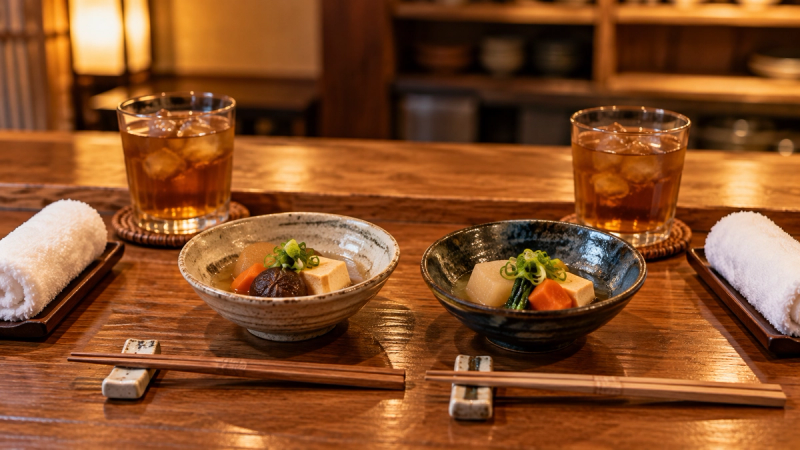
A small bowl arrives before you have ordered anything. Later, there is an extra line on the bill. At many izakaya in Japan, that is otoshi: a small starter served automatically, with a charge that functions as a cover or seating charge.
Do not assume it is a free welcome snack. The useful question is what this particular place charges per person and whether the charge is compulsory. Ask before sitting down, especially if you only want a quick drink or cannot eat the starter.
Once you understand that, the extra bowl becomes much less confusing. You can decide whether the place suits your evening instead of trying to decode the bill after dinner.
What otoshi actually means
#Otoshi is a small appetizer commonly associated with izakaya, Japan's casual drinking-and-dining establishments. You may receive it without choosing it from a menu. GO TOKYO's dining guidance describes it as an automatically served dish, usually associated with a cover charge.
There is no single standard dish. It might be vegetables, tofu, fish or another small preparation. Its appearance does not tell you whether it is included in the price of your order or charged separately.
An otoshi charge is also different from leaving a tip. Tipping is not the usual restaurant custom in Japan. Paying a venue's stated cover charge does not mean you then need to add a gratuity.
Do not confuse otoshi with oshibori, the small wet hand towel. A towel appearing on the table is not the same thing as a starter being served.
Is otoshi compulsory?
#Treat it as potentially compulsory until staff explain the venue's policy. JNTO's Japan etiquette guidance describes otoshi as a mandatory appetizer that serves as a cover charge at izakaya. That is a useful warning against assuming you can remove the charge simply by leaving the food untouched.
However, do not turn a common practice into a rule for every restaurant in Japan. Ask whether this place has an otoshi or seating charge, how much it is, and whom it applies to. The policy matters more than a general travel tip.
If you would rather avoid the charge, clarify it before taking a table. You can then choose somewhere with a different pricing arrangement. If you are already seated, ask staff calmly to explain the item before assuming it is an error.
Three questions before you take a seat
#You do not need an elaborate conversation. Keep the questions short enough that staff can answer clearly, or show them on your phone.
- Is there an otoshi or seating charge, and how much is it per person?
- Is it compulsory, or can we order without it?
- Are there any other minimum orders or charges we should know about?
For a group, confirm how many people will be charged rather than assuming one small bowl means one charge for the table. If you are traveling with children or someone who will not eat, ask about their case too.
If the answer is unclear, ask to see the relevant part of the menu. A photo is useful for remembering the amount later. You are checking the price of the meal, just as you would anywhere else.
Work out the whole bill, not just the snack
#There is no universal otoshi price to plug into every Japan food budget. Use the amount quoted by the venue and check how tax and any other charges are shown.
Here is an illustrative calculation, not a restaurant quote. Suppose two adults are told the charge is ¥500 each. The cover portion is ¥1,000 before adding the dishes and drinks they order, plus any other applicable charges. If their order is ¥3,000, they should not expect the final bill to be ¥3,000 merely because they did not choose the starter.
That also explains why a short stop can feel unexpectedly expensive. A fixed charge has more impact when you order very little. For a longer meal, you can still judge the venue on its total cost, food and atmosphere. The point is to make that choice with the price visible.
Do not count on sharing one otoshi to reduce the charge, or on not drinking alcohol to remove it. Ask how the venue applies its policy to your group.
Vegetarian, vegan or allergic: ask before the bowl arrives
#Tell staff about dietary restrictions when you enter, rather than after you have eaten the starter. A small vegetable-looking dish is not enough information to decide whether it suits you.
JNTO's vegetarian and vegan guide to Japan advises asking about stocks and base ingredients, including dashi that may contain fish. Explain what you avoid specifically; a broad label such as vegetarian may not communicate every ingredient restriction.
Ask whether the starter can be changed to something suitable and whether the charge would still apply. These are separate questions. A replacement dish, skipping the dish and removing the cover charge are not necessarily the same arrangement.
If you have a food allergy, communicate the specific allergen and ask staff about the ingredients and preparation. A translated travel food-allergy card can help you explain the restriction, but it does not itself confirm that a dish is safe. If staff cannot establish suitability, do not eat it.
What if you notice the charge only at the end?
#Start by asking what the line refers to and how it was calculated. Check the number of people, the quoted amount and whether the menu showed another separate fee. An explanation may resolve it; a genuine billing mistake still deserves a correction.
If the charge surprises you, say that clearly without treating staff as though they deliberately hid it. Ask whether it was the otoshi charge and whether its amount was shown on the menu. That gives you a specific point to discuss.
Avoid relying on a blanket claim that refusing the appetizer always cancels the charge. Establish the restaurant's policy and what was communicated to you. For your next meal, ask at the entrance, before the table and starter have been arranged.
Otoshi is a small part of eating out in Japan, but knowing about it can save an awkward conversation. Check the cover charge, explain dietary needs early, and compare the whole meal price. Then you can get on with choosing what you actually want to eat.