The mason jar that ruined coffee shop cold brew for me
#I didn’t plan to become the kind of person who has Opinions about cold brew concentrate ratio, but here we are. It started in my old apartment, the one with the tiny galley kitchen and a fridge that made a weird clicking sound at night like it was judging me. I was spending way too much money on cold brew from a cafe down the street, the kind of place with good espresso but chairs so uncomfortable you could only stay 18 minutes before your spine filed a complaint. Their cold brew was gorgeous though. Smooth, chocolatey, not bitter, and somehow it made my sad weekday toast feel like brunch.
Then one summer morning I did the math. Bad idea. Two cold brews a day, sometimes three if it was humid and I was being dramatic, and suddenly my “little treat” was basically a grocery bill. So I bought a bag of beans, dumped grounds into a mason jar, filled it with water, and hoped for the best. The first batch tasted like wet cardboard wearing perfume. The second was so strong I could hear colors. But eventually, after many over-caffeinated mistakes, I landed on ratios that actually work. Not perfect-perfect, because coffee is moody, but dependable.
Okay, so what is cold brew concentrate actually?
#Cold brew concentrate is just coffee brewed with cold or cool water at a stronger ratio than ready-to-drink cold brew. That’s it. No secret cafe wizardry. You steep coarse coffee grounds in water for a long time, strain it, and what you get is a rich coffee base you can dilute with water, milk, oat milk, tonic, coconut water if you’re that person, or pour over ice cream if dinner has gone off the rails in a good way.
The key word is concentrate. If you brew it strong, you control the final drink later. I love that. It’s like having a sauce in the fridge. A little concentrate, a little milk, maybe maple syrup, maybe a pinch of salt if I’m feeling chef-y, and you’ve got something that tastes like a cafe drink without leaving the house in real pants. Concentrate also stores better than a pre-mixed latte because you’re not adding dairy, sugar, or flavorings until serving. That matters for fridge life, which we’ll get into because I have learned the hard way. More than once, unfortunately.
My go-to cold brew concentrate ratio, after too many weird batches
#If you only take one ratio from this whole ramble, use 1:4 by weight for a strong concentrate. That means 1 part coffee to 4 parts water. So, 100 grams of coarse ground coffee to 400 grams of water. It gives you a bold concentrate that usually dilutes beautifully with equal parts water or milk. If you want something slightly softer, use 1:5. If you want a drink that barely needs diluting, use 1:8 or 1:10, but at that point I’d call it regular cold brew, not concentrate.
And yes, weight is better than cups. I resisted this for ages because I thought kitchen scales were for people who make sourdough and say “hydration” at parties. But coffee grounds are fluffy and uneven, so cup measurements can be all over the place. If you don’t have a scale, roughly 1 cup coarsely ground coffee to 4 cups water makes a lighter concentrate, but depending on the grind and bean it can swing around. Not the end of the world. Coffee forgives you more than baking does.
| Style | Coffee to water ratio | Example batch | How I usually drink it |
|---|---|---|---|
| Strong concentrate | 1:4 by weight | 100 g coffee + 400 g water | Dilute 1:1 with milk or water |
| Medium concentrate | 1:5 by weight | 100 g coffee + 500 g water | Dilute with a splash less liquid |
| Mellow cold brew | 1:8 by weight | 100 g coffee + 800 g water | Serve over ice, maybe no dilution |
| Cafe-ish ready drink | 1:10 to 1:12 by weight | 80 g coffee + 800 to 960 g water | Straight from the fridge over ice |
The ratio I use depends on the bean, which sounds fussy but it’s true
#Darker roasts usually give me a roasty, cocoa-heavy concentrate at 1:4, and it can get intense fast. Like, delicious but also slightly “am I drinking a brownie that joined a motorcycle club?” Medium roasts are my favorite for concentrate because they keep some sweetness without getting sour. Light roasts can be amazing, all berries and florals, but they’re trickier cold brewed. Sometimes they taste thin unless I steep longer or grind just a smidge finer. Not fine-fine. Please don’t make cold brew mud. I’ve done it. It clogs the filter, it stains your soul, nobody wins.
One of my favorite batches ever came from a bag I bought after breakfast at a little cafe in Portland. I can’t remember the name, which is annoying because I remember the almond croissant in spiritual detail. The beans had this cherry-chocolate thing going on, and at 1:5 they made a concentrate that tasted almost like coffee liqueur, minus the booze. I drank it with whole milk and a tiny spoon of brown sugar while standing barefoot in my kitchen, and for a second I felt richer than I was.
How long to steep cold brew concentrate without making it taste tired
#For concentrate, I like 16 to 18 hours at room temperature or 20 to 24 hours in the fridge. Room temperature extraction is faster, fridge extraction is slower and sometimes a little cleaner tasting. In summer, when my kitchen feels like soup, I just brew in the fridge. It takes longer, but it makes me feel safer and the flavor is less aggressive. If your home is warm, don’t leave a jar sitting out forever because “cold brew” is not magic. It’s coffee and water, and life finds a way, as the dinosaur movie warned us.
Under 12 hours can taste weak or grassy, especially at a strong ratio. Over 24 hours can get woody, bitter, or dusty. Some people love a 30-hour steep, and I’m not here to fight strangers about coffee on the internet, but for my mouth it starts tasting like the inside of an old cupboard. Also, grind size matters. Coarse like raw sugar or sea salt is the sweet spot. Too fine and you get sludge, over-extraction, and that chalky finish that makes your tongue feel like it needs a shower.
My lazy jar method that works even when I’m half awake
#- Add coarse coffee to a clean jar or pitcher. I usually do 120 g coffee if I want enough for a few days, because apparently I am a small cold brew animal.
- Pour in water using your ratio. For 1:4, that’s 480 g water for 120 g coffee. Stir really well, more than you think, because dry pockets hide like little jerks.
- Cover and steep. Room temp 16 to 18 hours, or fridge 20 to 24 hours. I put a sticky note on the jar because I will absolutely forget when I started it.
- Strain through a coffee filter, nut milk bag, fine mesh strainer lined with paper towel, or one of those cold brew makers with a built-in filter. Don’t squeeze too hard if using a bag unless you like grit.
- Move the concentrate into a clean sealed bottle and refrigerate right away. Label the date. Future-you deserves kindness.
Diluting concentrate: the part people make too complicated
#Start with 1 part concentrate to 1 part water or milk. Taste it. That’s the whole method. If it punches you in the forehead, add more liquid. If it tastes like coffee waved from across the street, add more concentrate. Ice counts as dilution too, and this is where people mess up. If you pour a perfectly balanced cold brew over a mountain of ice and then answer emails for 20 minutes, it will become sad coffee water. For big ice cubes, I dilute a little more aggressively because they melt slower. For crushed ice, I keep it stronger because crushed ice is basically a beverage thief.
- For a classic iced cold brew: 1/2 cup concentrate + 1/2 cup cold water + ice.
- For a creamy one: 1/2 cup concentrate + 1/3 cup milk or oat milk + ice, then adjust. Oat milk makes it taste rounder, dairy makes it more dessert-like.
- For a not-too-sweet treat: add 1 to 2 teaspoons maple syrup or simple syrup. Granulated sugar just sinks and acts stubborn.
- For a weirdly good version: add a tiny pinch of salt. I know. But it smooths bitterness, especially with darker roasts.
Fridge life: how long cold brew concentrate actually lasts
#Here’s the answer I use in my own kitchen: homemade cold brew concentrate tastes best within 7 days, and I try to finish it by day 10. If everything was very clean, it stayed refrigerated, and nothing funky got introduced, it may still be okay up to about 2 weeks, but the flavor usually gets flatter and less charming. Like leftovers that are technically fine but have lost their sparkle. Commercial bottled cold brew is different because brands may use pasteurization, filtration, preservatives, or special packaging, so follow the label. Once opened, treat it like the label says and don’t freestyle food safety because you saw a pretty bottle.
Food safety folks, including the USDA and FDA in their general home food storage guidance, commonly point to keeping refrigerators at 40°F / 4°C or below. That temperature matters. A fridge that runs warm can shorten the life of your concentrate, and honestly, a lot of fridges are liars. Mine used to be. I only found out because lettuce kept freezing in the back while yogurt felt suspiciously warm in the door, which is rude behavior from an appliance. If you’re trying to dial in storage, this piece on Fridge Thermometer vs Smart Temperature Sensor: What Should You Buy for Food Safety? is actually useful, especially if you make big batches of cold brew or meal prep.
The simple fridge-life rule I follow
#Plain concentrate, strained well, stored in a clean sealed container, kept cold: 7 to 10 days for best flavor. Diluted cold brew with just water: I’d drink it within 3 to 4 days because it tastes tired faster. Cold brew mixed with milk, cream, or plant milk: same day is best, next day if you must, and keep it cold. Sweetened syrups don’t automatically make things safe forever, and flavored creamers bring their own rules. I know that’s not glamorous, but neither is sniffing a bottle of questionable coffee at 7 a.m. and bargaining with the universe.
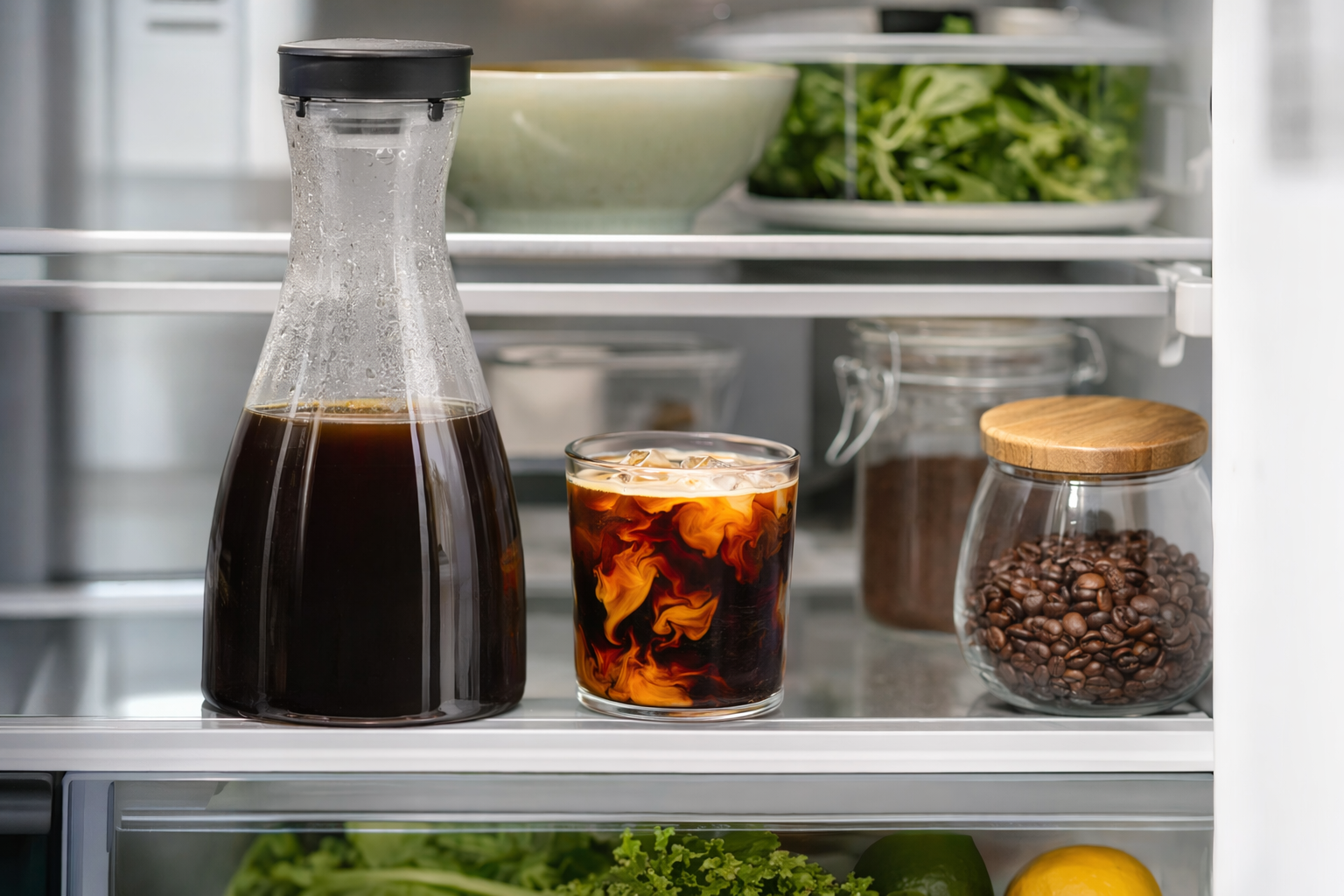
Also, don’t store concentrate in the fridge door if you can avoid it. The door is warmer because it opens constantly, especially in my house where everyone apparently needs to stare into the fridge before deciding they wanted the same cheese they always wanted. Put cold brew toward the back or middle shelf where the temperature is steadier. Glass bottles are my favorite because they don’t hold smells, but any food-safe container with a tight lid is fine. If your container smells like onions, your coffee will know. Coffee absorbs odors like gossip.
How to tell cold brew concentrate has gone bad, because yes it can
#Cold brew doesn’t always spoil in a dramatic way. Sometimes it just tastes dull, stale, or oddly sharp. But there are signs where you should not negotiate. Mold, cloudiness that wasn’t there before, fizzing, a yeasty smell, sour funk, slime around the lid, or pressure build-up in a sealed bottle. Toss it. Don’t be heroic over three dollars of coffee grounds. I used to push leftovers too far because I hate waste, but the older I get, the more I realize the trash can is sometimes a health tool. Annoying, but true.
One time I made a batch before a weekend trip and forgot about it for, I don’t know, maybe 15 or 16 days. The bottle looked fine, which is how it gets you. But when I opened it, there was this little pffft sound and a smell like coffee kombucha having an identity crisis. Absolutely not. Down the drain it went, and then I cleaned the bottle with hot soapy water like I was erasing a crime scene. Since then I date every bottle with masking tape. Ugly? Yes. Effective? Also yes.
The mistakes that make cold brew taste bad or expire faster
#The biggest mistake is using dirty gear. I don’t mean visibly filthy, I mean the lid you rinsed quickly because you were in a hurry, the strainer that has old coffee oils clinging to it, the bottle that sat in the cupboard with a mystery smell. Coffee oils go stale. They cling to plastic especially. Wash everything with hot soapy water, rinse well, and let it dry. If you’re making a big batch to last a week, start clean. It’s boring advice, but so is “chop your onions evenly” and that’s also correct.
- Grinding too fine: this makes the concentrate muddy and bitter, and it’s a nightmare to strain. Coarse is your friend.
- Using old beans: cold brew is forgiving, but it can’t resurrect beans that smell like cardboard. Fresh-ish beans make a huge difference.
- Steeping too long: more time does not always mean more flavor. Sometimes it means woody, stale, overdone coffee.
- Adding milk before storage: make plain concentrate and mix drinks as you go. Your future iced latte will taste better.
- Leaving it on the counter after straining: once it’s strained, get it into the fridge. Don’t let it hang out while you reorganize your life.
A quick word on caffeine, because concentrate is sneaky
#Cold brew concentrate can be strong. Like, very strong. Caffeine depends on bean type, ratio, grind, steep time, and how much you dilute it, so there isn’t one neat number. This is why I don’t drink concentrate straight unless I want to become a hummingbird with anxiety. If you’re sensitive to caffeine, start with a smaller serving and dilute more. I usually do about 3 to 4 ounces of concentrate in a drink, not a full glass of the stuff. Learned that lesson after cleaning my entire kitchen at midnight while listening to one song on repeat. Great productivity, terrible sleep.
If you’re serving cold brew to brunch guests, put the concentrate on the table with water, milk, and ice so people can mix their own. My friend Mara likes hers practically beige with oat milk and vanilla. My brother drinks it so dark it looks like a warning. Both are correct, somehow. That’s the fun of concentrate. It’s not one drink, it’s a base for ten different personalities.
Flavor ideas when plain cold brew starts feeling too responsible
#I love plain cold brew, but sometimes I want it to flirt a little. Orange peel in the glass, not during storage, is fantastic with chocolatey beans. A splash of coconut milk makes it taste vacation-adjacent. Brown sugar syrup gives that deep caramel thing without being as loud as caramel sauce. In summer I’ll shake concentrate with ice, oat milk, and a tiny bit of vanilla until it gets foamy and dramatic. It’s not exactly a coffee shop drink, but it scratches the itch.
Travel ruined me in the best way here. Thai oliang, that dark roasted iced coffee often served sweet, got me thinking beyond my usual cold brew routine, and if you like chilled coffee-style drinks, this guide to Thai Dessert Drinks for Non-Drinkers: Cha Yen, Nom Yen, Oliang and What to Order is a fun rabbit hole. Same with Indonesian iced dessert drinks, where texture and sweetness are part of the whole joy, not an afterthought. I still think about the first es cendol I had, all green jelly and coconut and palm sugar, and it made my iced coffee feel very uptight. For more cold drink inspiration, especially if you’re traveling hungry, I liked this one on Indonesian Iced Dessert Drinks for Travelers: Es Cendol, Es Teler, Soda Gembira, and What to Order.
My favorite cold brew concentrate “recipes” that aren’t really recipes
#The weekday version is boring and perfect: 1/2 cup concentrate, 1/2 cup cold water, big ice, splash of milk. Done. The weekend version is 1/2 cup concentrate, 1/3 cup oat milk, 1 tablespoon brown sugar syrup, pinch of salt, shaken with ice until frothy. Pour it into a glass and pretend you’re not going to drink it in four minutes. My dessert version is concentrate over vanilla ice cream with toasted almonds. If you have never poured cold brew concentrate over ice cream, please do. It’s like affogato’s relaxed cousin who moved somewhere with better weather.
One more that sounds odd but works: cold brew concentrate with tonic water and orange. Use 2 ounces concentrate, 4 ounces tonic, lots of ice, orange peel. It’s bitter, fizzy, and refreshing in a grown-up way. Not everyone likes it. My mom said it tasted “like medicine but expensive,” which, fair. I love it anyway. Food opinions don’t need universal approval. Some of the best stuff is divisive.
Troubleshooting your batch without spiraling
#If your concentrate tastes bitter, shorten the steep, use a coarser grind, or try a lighter roast. If it tastes sour or weak, steep longer, use a slightly finer coarse grind, or increase coffee. If it tastes flat, your beans may be stale or your water might be doing you dirty. Filtered water helps, especially if your tap water smells like swimming pool. If the concentrate has lots of sediment, strain twice. I usually do a mesh strainer first, then a paper filter if I’m feeling patient. Paper filters make it cleaner but slower, and sometimes I stand there staring at it drip like it owes me money.
Don’t change everything at once. That’s my big cooking lesson across basically every kitchen disaster I’ve had. Change one thing, taste, write it down if you’re organized, or text yourself like I do because notebooks disappear. “1:5, 18 hr fridge, good with oat milk” is enough. After a few batches, you’ll know your house ratio. It’s weirdly satisfying, like finding your perfect pancake batter or finally learning how much salt your soup wants.
The final fridge note I wish someone had told me
#Make less than you think at first. I know big jars look beautiful in the fridge, very meal-prep influencer, very “I have my life together.” But cold brew is best fresh-ish. A smaller batch every few days often tastes better than one giant batch that limps into week two. For one person, 100 g coffee to 400 or 500 g water is a nice test batch. For two coffee people, double it. If you’re hosting brunch, make a bigger batch the day before and strain it in the morning, then serve with ice, water, milk, and syrups so everyone can fuss with their own glass.
My cold brew concentrate rule: brew strong, store clean, keep it cold, drink it within a week if you can, and don’t let anyone shame you for adding milk and sugar. Coffee is supposed to make your day better.
So, what ratio should you use tomorrow morning?
#Start with 1:4 if you want true concentrate, 1:5 if you want something gentler, and 1:8 if you don’t want to think about dilution much. Steep 16 to 18 hours at room temp or about 20 to 24 hours in the fridge. Strain well, store in a clean sealed bottle, keep it at 40°F / 4°C or below, and aim to enjoy it within 7 to 10 days. That’s the practical answer. The emotional answer is: make it how you actually like it. Not how the coffee person with the tiny beanie says you should like it.
Cold brew concentrate has become one of those little kitchen rituals that makes my week feel softer. The jar in the fridge, the clink of ice, the first sip when it’s still quiet and nobody has asked me a question yet. It’s simple, but it feels generous. And if you mess up a batch, congratulations, you’re now a coffee person with a story. If you’re into these kinds of practical food adventures and cozy drink rabbit holes, I’ve found plenty more to wander through over on AllBlogs.in.