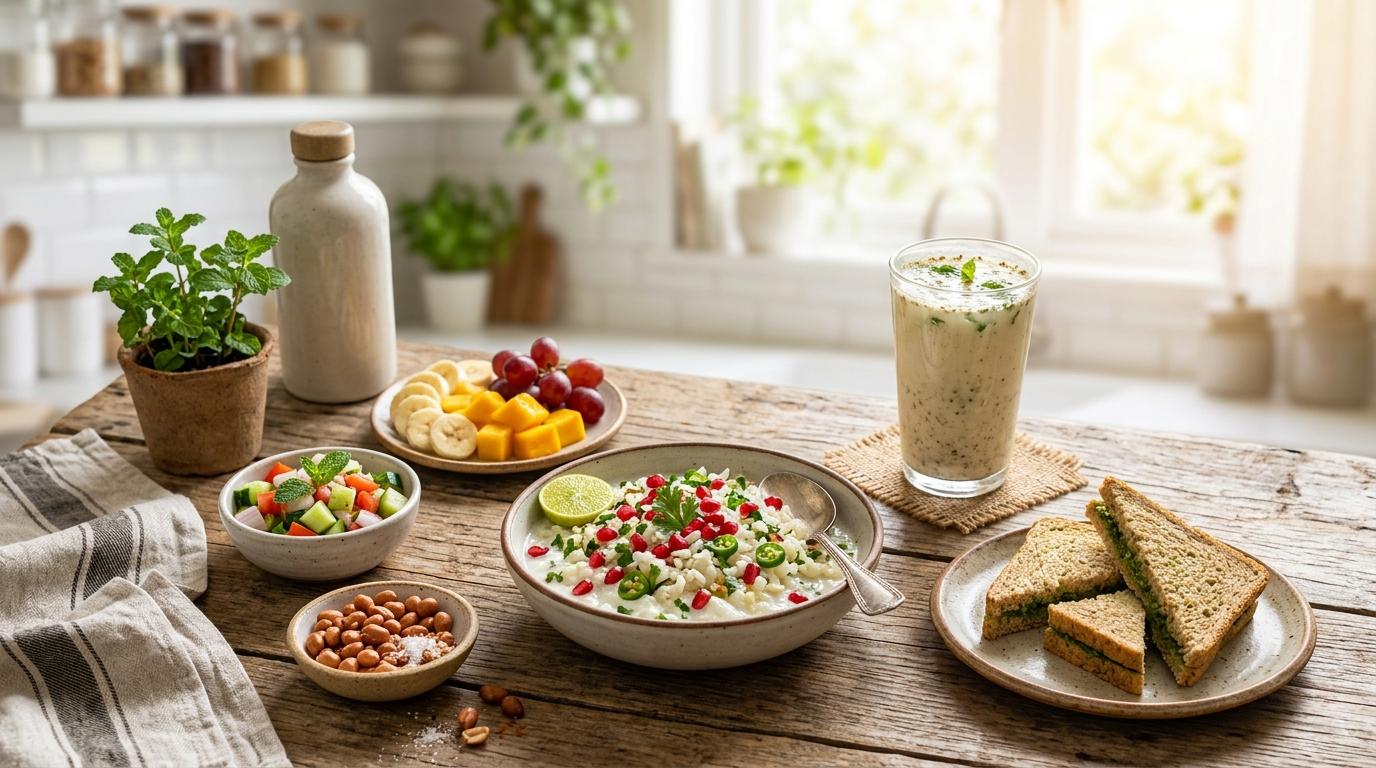
Some mornings are simply too hot for upma, parathas, poha with tadka, or anything that asks you to stand near a stove. You wake up, the kitchen already feels warm, and the idea of cooking breakfast feels like a punishment.
But you still need to eat.
Skipping breakfast may feel convenient in the moment, but by 11 am you may be tired, cranky, distracted, or suddenly hungry in that urgent, annoying way. That is exactly where cold Indian breakfast ideas help.
And no, cold breakfast does not mean eating only curd every day. It also does not mean chewing through a boring plate of raw salad. A good summer breakfast should feel light, cooling, and easy to digest, but still keep you full enough to get through the morning.
This guide includes practical summer breakfast ideas India style, using everyday ingredients like curd, poha, sattu, fruits, sprouts, bread, chutneys, leftover rotis, and a few safe make-ahead options.
The Hot-Weather Breakfast Framework: Cold, Low-Heat, and Make-Ahead
#Before getting into the ideas, it helps to think of summer breakfasts in three simple categories. Some mornings you want a fully no-cook Indian breakfast. On other days, you may be fine with five minutes of light cooking. And sometimes, the best breakfast is the one you quietly prepared the night before.
1. Cold and No-Cook Breakfasts
#These need no stove time at all. You rinse, soak, mix, chill, spread, or assemble.
They are perfect for:
- Very hot mornings
- Hostel or PG life
- Office-goers in a rush
- Students with limited kitchen access
- Anyone who does not want to start the day sweating in the kitchen
Common ingredients include:
- Thin poha
- Curd or buttermilk
- Sattu
- Fruits
- Bread
- Soaked nuts and seeds
- Chutneys
- Cucumber, tomato, onion, coriander, and mint
2. Low-Heat Breakfasts
#These need a little cooking, but not enough to heat up the whole kitchen. Think quick tempering, brief boiling, or blanching.
They work well for:
- People who do not enjoy fully cold food
- Anyone who finds raw sprouts difficult to digest
- Families who still want a “proper breakfast” feeling
- Mornings when five minutes near the stove is manageable, but anything more feels like too much
Examples include:
- Blanched sprout chaat
- Curd rice with a quick tadka
- Poha with only light tempering
- Boiled potatoes made the previous evening
- Steamed or boiled ingredients cooled before serving
3. Make-Ahead Breakfasts
#These are prepared in the evening or during cooler hours, then stored safely in the fridge.
They are useful for:
- Busy weekdays
- School tiffin planning
- Office breakfast boxes
- People who cannot cook in the morning
- Homes where everyone eats at different times
Good make-ahead bases include:
- Boiled potatoes
- Cooked rice, stored safely
- Green chutney
- Overnight oats with curd
- Soaked poha
- Sprouts, blanched if needed
- Hung curd
- Roasted peanuts or seeds
Cold Indian Breakfast Ideas for Hot Mornings
#These are not strict recipes. Think of them as flexible breakfast ideas you can adjust based on what is already in your kitchen, how hungry you are, and what your stomach can comfortably handle.
1. Soaked Poha Salad
#Poha does not always need a kadhai, mustard seeds, curry leaves, peanuts, and potatoes. On very hot mornings, thin poha can become a light, refreshing breakfast with almost no effort.
Rinse thin poha gently, drain it well, and let it sit for a few minutes until soft. Mix it with chopped cucumber, tomato, coriander, roasted peanuts, lemon juice, salt, and roasted cumin powder. You can also add grated carrot, pomegranate, or a little chopped mint.
Keep it fully no-cook, or add a tiny tadka if you miss the familiar flavour of regular poha.
Why it works:
- Light but still filling
- Ready quickly
- Easy to customise
- Good for mornings when cooked poha feels too heavy
Tip: Thin poha works best here. Thick poha usually needs more soaking and can feel chewy in cold versions.
2. Dahi Poha or Doi Chira Style Bowl
#Curd and poha is one of those simple combinations that quietly makes sense in summer. In Assam and parts of eastern India, curd with flattened rice is eaten as a light, cooling meal.
For a sweet version, soften poha and mix it with cool curd. Add banana, jaggery, mango, or any seasonal fruit you like.
For a savoury version, mix softened poha with curd, cucumber, roasted cumin, black salt, coriander, and a little green chilli if you enjoy it.
Why it works:
- Uses basic home ingredients
- Needs no cooking
- Can be sweet or savoury
- Feels cooling without much effort
If your stomach is sensitive in the morning, do not eat it straight from the fridge. Let it sit for 5 to 10 minutes first. Cool is pleasant; icy cold may not suit everyone.
3. Overnight Dahi Oats
#If you like oats but cannot face hot porridge in summer, soak them overnight in curd. By morning, you get a creamy, filling breakfast without cooking anything.
Mix rolled oats with curd and a little water or milk if needed. Refrigerate overnight. In the morning, add banana, mango, apple, nuts, seeds, or a small pinch of cardamom.
For a savoury Indian-style bowl, mix oats with curd, salt, roasted cumin, grated cucumber, coriander, and a little crushed pepper.
Why it works:
- Great for make-ahead mornings
- Filling without being oily
- Easy to carry to office or college
- Works with both fruit and savoury toppings
Keep it refrigerated. If the curd smells off or has turned unpleasantly sour, do not force yourself to eat it.
4. Sattu Drink or Sattu Buttermilk
#Sattu is one of the most sensible ingredients for Indian summers. It is already roasted, so it does not need cooking. It is filling, quick, and especially helpful on days when you do not feel like eating a full plate of breakfast.
For a savoury sattu drink, mix sattu with cool water, black salt, roasted cumin powder, lemon juice, and mint. You can also mix sattu into thin buttermilk for a cooling, tangy version.
Why it works:
- No cooking needed
- Filling enough for light breakfast days
- Ready in minutes
- Useful when the heat reduces your appetite
Whisk it properly so there are no dry lumps. If you are new to sattu, start with a smaller amount. It can feel heavy for some people.
5. Fruit and Curd Breakfast Bowl
#A fruit bowl sounds refreshing, but for many people, fruit alone does not keep them full for long. Add curd, and it becomes much more satisfying.
Use thick curd and add banana, mango, apple, papaya, chikoo, or any seasonal fruit you tolerate well. Top with roasted nuts, seeds, or a few soaked raisins.
If fruit with curd does not suit you, keep the fruit separate and make a cucumber-curd bowl instead.
Why it works:
- Cooling and quick
- Good when you want something light
- Easy for both children and adults
- Can be made in small or large portions
Avoid mixing too many fruits at once if your digestion is sensitive. Simple combinations are often better, especially in the morning.
6. Cucumber Curd Bowl
#This is basically a thicker, more filling version of raita. On a hot morning, it can feel much better than a heavy cooked breakfast.
Whisk curd with salt, roasted cumin powder, chopped cucumber, coriander, and mint. To make it more filling, add softened poha, cooked and cooled rice, roasted makhana, or a few soaked nuts.
Why it works:
- Very cooling
- Gentle for many people
- Takes about five minutes
- Useful when paratha, dosa, or fried breakfast feels too much
If you are using cooked rice, be careful. Do not use rice that has been sitting outside all night at room temperature.
7. Sprout and Veggie Chaat
#Sprouts are common in many Indian homes, but raw sprouts can be hard on the stomach for some people. If that happens to you, blanch them quickly, cool them, and then turn them into chaat.
Use moong sprouts or moth sprouts. Pour hot water over them or blanch briefly, then drain and cool. Mix with cucumber, tomato, onion if you tolerate it, coriander, lemon juice, chaat masala, and roasted cumin.
Why it works:
- Fresh and crunchy
- Can be low-heat instead of fully raw
- Works as breakfast or a mid-morning snack
- Easy to pair with curd or toast
If sprouts make you bloated, reduce the portion, blanch them properly, or choose another breakfast. There is no need to suffer just because something is considered “healthy”.
8. Cold Green Chutney Sandwich
#A chutney sandwich is one of those summer breakfast ideas India has loved for years. It is familiar, quick, and needs no cooking if the chutney is already made.
Spread green chutney on bread and layer cucumber, tomato, boiled potato, beetroot, or onion. Add chaat masala or roasted cumin. You can keep it simple, or add hung curd as a spread if you want it creamier.
Why it works:
- Portable
- Good for office, college, and school
- Needs no stove time
- Easy to make for the whole family
If you are using boiled potatoes, cook them the previous evening and refrigerate them. Do not leave boiled potatoes out overnight, especially in hot weather.
9. Hung Curd Sandwich or Curd Spread Toast
#If mayonnaise-heavy sandwiches feel too rich in summer, hung curd is a lighter, fresher option.
Mix hung curd with salt, pepper, grated carrot, cucumber, capsicum, coriander, and a little green chutney. Spread it on bread and serve cold. You can also use it as a wrap filling if you have leftover rotis stored safely.
Why it works:
- Creamy but not too heavy
- Easy to customise
- A good way to add vegetables
- Works for lunchbox-style breakfasts too
Use fresh curd and keep the sandwich cool if you are not eating it immediately.
10. Leftover Roti Wrap, Served Cool
#Leftover rotis can make a very practical breakfast if they were stored properly. Use them as wraps with curd spread, chutney, cucumber, grated carrot, paneer, or leftover dry sabzi that has been refrigerated safely.
Keep the filling light. A very oily or spicy leftover sabzi may not feel great first thing in the morning, especially when it is hot.
Why it works:
- Reduces food waste
- Needs no cooking in the morning
- Easy to pack
- More filling than fruit or drinks alone
Safety note: Use only rotis and fillings that were stored safely. If something smells sour, looks slimy, or was left out for too long, throw it away.
11. Curd Rice, Served Cool
#Curd rice is comfort food, and it can also work beautifully as breakfast, especially when you want something soft, simple, and calm on the stomach.
Use cooked rice that has been cooled and refrigerated safely. Mix it with curd, salt, and a little water or milk if needed. Add grated cucumber, coriander, roasted cumin, or a light tadka if you want more flavour.
Why it works:
- Soft and filling
- Cooling for many people
- Good if you dislike raw breakfasts
- Can be plain or lightly spiced
Be careful with leftover rice. Rice should not be left at room temperature for long. Refrigerate it quickly and reuse it safely.
12. Buttermilk With a Small Solid Breakfast
#Some mornings, a big cold bowl just does not appeal. In that case, pair spiced buttermilk with a small solid breakfast.
Try buttermilk with:
- A chutney sandwich
- A small bowl of soaked poha
- A banana and a few nuts
- A small sprout chaat
- A plain leftover roti wrap
Why it works:
- Hydrating
- Light on hot mornings
- Easy to digest for many people
- Helps you avoid an overly heavy breakfast
Do not make the buttermilk too spicy if you get acidity easily.
How to Build a Balanced Cold Breakfast
#A good cold breakfast should not be only watery, and it should not be so heavy that you feel sleepy afterwards. Try to include three simple parts.
1. A filling base
#Choose one:
- Poha
- Oats
- Bread
- Roti
- Rice
- Sattu
- Sprouts
2. A cooling or fresh element
#Choose one or two:
- Curd
- Buttermilk
- Cucumber
- Mint
- Coriander
- Seasonal fruit
- Lemon, if it suits you
3. A little protein or crunch
#Choose one:
- Roasted peanuts
- Soaked almonds
- Seeds
- Sprouts
- Paneer
- Curd
- Sattu
This helps you avoid the common summer breakfast problem: eating something too light and then feeling hungry again an hour later.
What to Prepare the Night Before
#If mornings are chaotic, do a little prep at night. Even 15 minutes can make the next day much easier.
You can:
- Make green chutney
- Boil potatoes and refrigerate them
- Set overnight dahi oats
- Wash and chop cucumber, if using soon
- Blanch sprouts and refrigerate them
- Cook rice and refrigerate it safely
- Make hung curd
- Keep roasted peanuts or seeds ready
- Chill curd or buttermilk
Do not chop all fruits too early. Some fruits become watery, brown, or mushy. Bananas, for example, are usually better cut fresh.
Leftovers and Food Safety in Summer
#Cold and make-ahead breakfasts are convenient, but summer makes food safety more important. Food can spoil faster than we expect, especially in warm kitchens.
Keep these points in mind:
- Refrigerate cooked and perishable foods quickly.
- Do not leave cooked rice, boiled potatoes, curd dishes, or sandwiches out for hours.
- Store food in clean, covered containers.
- Use clean spoons for curd, chutney, and spreads.
- Avoid leftovers that smell odd, look slimy, taste too sour, or were stored carelessly.
- Be extra careful with rice-based leftovers, including curd rice.
- If carrying breakfast to office, college, or school, keep curd-based items cool as much as possible.
Traditional dishes like curd rice or water rice can be part of summer eating, but they still need clean handling and safe storage.
Who Should Avoid Very Cold or Heavy Breakfasts?
#Cold breakfasts are useful, but they are not perfect for everyone.
You may want to avoid very cold, raw, or heavy breakfasts if:
- You often feel bloated after raw salads or sprouts
- Cold curd in the morning causes discomfort
- You have frequent acidity or reflux
- You are recovering from a stomach infection
- Your doctor has asked you to avoid certain foods
- You feel sluggish after large bowls of curd, fruit, or sattu
What you can do instead:
- Eat breakfast cool or at room temperature, not straight from the fridge.
- Choose soaked poha instead of a large raw salad.
- Blanch sprouts before eating.
- Keep spices mild.
- Avoid too much lemon, chilli, onion, or chaat masala if you have acidity.
- Eat a smaller portion and have a mid-morning snack if needed.
If you regularly have acidity, stomach burning, bloating, loose motions, vomiting, or recurring digestive problems, speak to a doctor. Food changes can help, but they are not a replacement for medical advice.
Simple Breakfast Pairing Ideas
#Use these combinations when you do not want to think too much.
For office-goers
#- Green chutney sandwich with buttermilk
- Overnight dahi oats with banana
- Curd rice with cucumber
- Sattu drink with a small roti wrap
For students
#- Cold poha salad
- Fruit and curd bowl
- Chutney sandwich
- Sattu buttermilk
For families
#- Dahi poha with fruit on the side
- Hung curd sandwiches
- Sprout chaat with toast
- Curd rice with mild tadka
For light appetite mornings
#- Sattu drink
- Buttermilk with banana and nuts
- Cucumber curd bowl
- Small fruit and curd bowl
For more filling mornings
#- Cold sandwich with boiled potato
- Overnight oats with curd and nuts
- Roti wrap with curd spread
- Poha salad with peanuts and vegetables
Final Takeaway
#Hot mornings do not have to mean skipping breakfast or forcing yourself to cook something heavy. With a little planning, cold Indian breakfast ideas can be cooling, filling, and genuinely practical.
Rotate between no-cook, low-heat, and make-ahead meals. Keep curd, poha, sattu, fruit, sprouts, chutney, bread, or rotis in your summer breakfast plan. Most importantly, store leftovers safely and listen to your digestion.
A good summer breakfast should leave you refreshed, not sweaty, sleepy, or uncomfortably full.