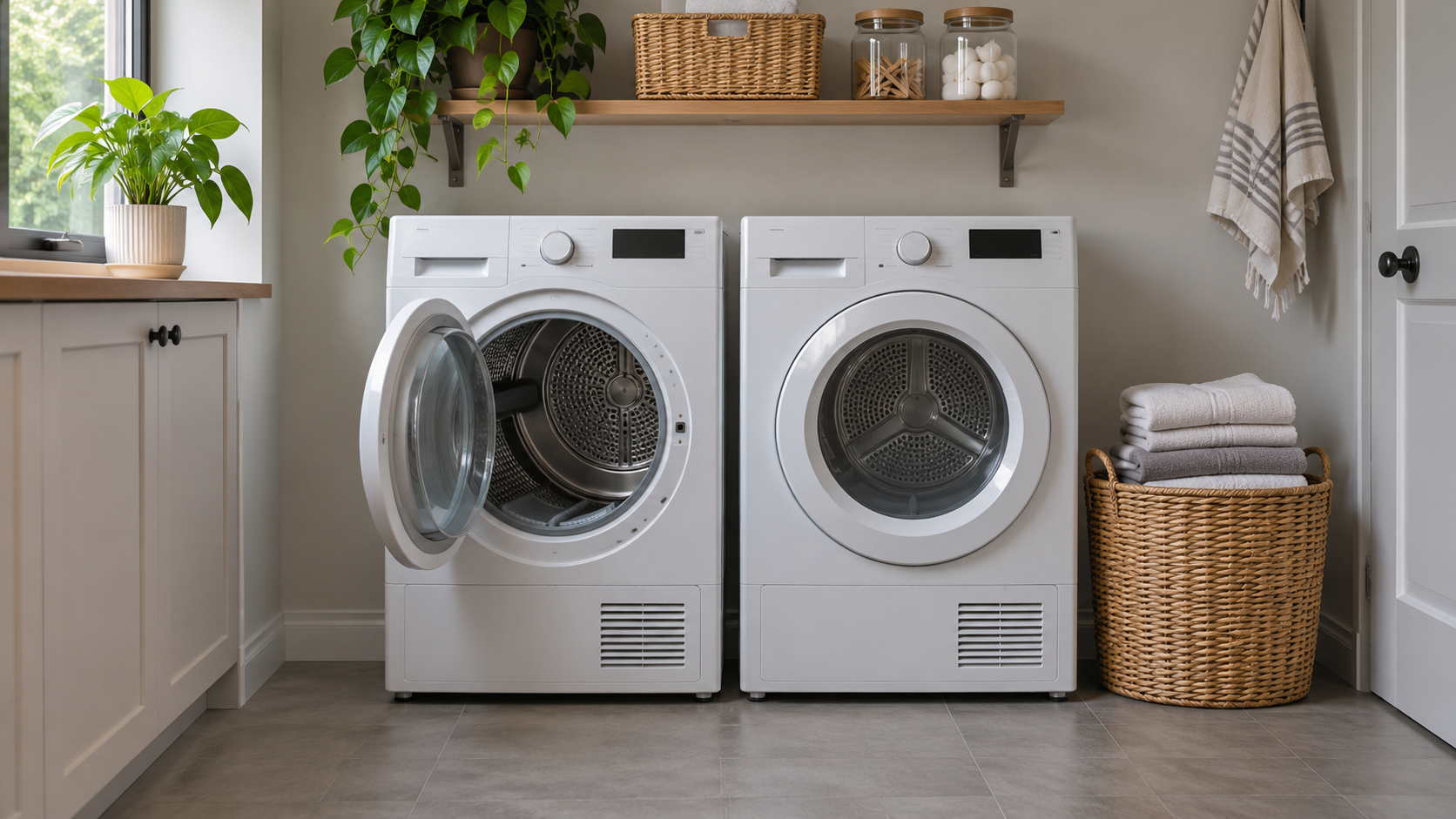
A heat-pump dryer generally uses less electricity than a conventional condenser dryer because it recovers heat instead of continually producing it with a heating element. Whether it is worth paying more depends on how often you dry clothes, the actual programmes you use and whether the machine suits the room.
Start with those three things. The cheapest dryer to buy and the cheapest dryer to own may be different machines, but a running-cost claim is only useful when its assumptions match your laundry.
Heat-pump dryers also collect water
#The names cause unnecessary confusion. A heat-pump tumble dryer is also a condensing dryer: it removes moisture from the circulating air and collects the water. In shop comparisons, “condenser dryer” usually means the conventional type heated by an electric resistance element.
Both types can collect water in a tank, with a direct drain option on suitable models. Neither normally needs the outside exhaust hose used by a vented dryer. That does not mean either can be pushed into any closed cupboard without checking its installation requirements.
The heating method is the important difference. A conventional condenser model heats air, passes it through wet laundry and condenses the moisture. A heat-pump system recovers and reuses heat in a loop, usually drying at lower temperatures with less energy.
That lower-energy process can take longer on comparable programmes. But the type name cannot tell you the duration of every cycle. Capacity, load, starting moisture and selected dryness all affect the comparison, and manufacturers offer different programme options.
Think of the decision as choosing between complete appliances rather than two labels. You need a model that handles your laundry properly, fits the room and makes sense over the period you expect to keep it.
Compare like-for-like before looking at price
#Choose a realistic capacity first. Dryer capacities describe a dry laundry load, not the weight of a dripping basket. Check whether the programme you intend to use accepts the headline capacity; a specialist setting may have a smaller limit.
A larger drum is useful only if you need it and can use it appropriately. A household drying bedding and towels has a different pattern from someone drying a few shirts once a week. Buying the largest machine available is not automatically the efficient choice.
Compare similar loads and dryness targets. “Ready to iron” and “cupboard dry” are different outcomes. A machine that stops with more moisture left in the clothes cannot fairly be judged against one drying the same load further.
Check the actual programme duration and energy figure together. A fast small-load setting is not the same thing as drying a full drum of towels quickly. If the brochure quotes an impressive time, look for the allowed load and starting conditions beside it.
For your shortlist, record these facts in one place:
- Exact model and purchase price, including delivery and required installation.
- Capacity and the load limit of the programme you will use.
- Energy consumption and the programme to which it applies.
- Duration and target dryness under those same conditions.
- Dimensions, installation limits, tank or drain arrangement and maintenance needs.
This gives you a meaningful comparison before features such as an app or extra display start competing for attention.
Read the right energy label
#Do not compare an old A++ label with a newer letter grade as if both use the same scale. Energy-label systems and testing arrangements change. Find the label and product information sheet for the exact model and market.
In the EU, tumble-dryer labels changed to an A–G scale from 1 July 2025. The newer label includes weighted energy use per 100 eco drying cycles, programme duration, capacity, noise and condensation information. The eco values are standardised comparison data; another programme can use a different amount of energy.
Great Britain has its own 2026 regulations with staged implementation. The consolidated rules contain dates in April and September 2026 and January 2027, including transition provisions. Do not apply the EU timetable automatically to England, Scotland or Wales, or treat Great Britain and Northern Ireland as the same regulatory market.
For buying purposes, ask the retailer for the current label and information sheet rather than trying to resolve conflicting product-page badges yourself. Check the units printed beside the number. An annual figure, a per-cycle figure and a per-100-cycle figure cannot be compared directly.
If a label states 120 kWh per 100 cycles, dividing by 100 gives a weighted average of 1.2 kWh per cycle under that test basis. It does not promise that every actual load uses exactly 1.2 kWh. The division helps with budgeting while keeping the test conditions visible.
Availability is changing too. EU ecodesign requirements favour heat-pump technology for newly placed products. That concerns market requirements; it is not an instruction to throw away a working conventional machine. Old stock, used appliances and existing household dryers need their own assessment.
Work out cost per load and payback
#Use energy in kilowatt-hours, not the power rating alone. Watts describe power at a moment. Your electricity bill depends on how much energy the whole programme uses, including its duration and changing operation.
The basic calculation is energy per comparable cycle multiplied by your electricity unit rate. Then multiply by the number of loads you expect to dry. Use the variable unit rate for this comparison; a standing charge you pay regardless of the dryer is not an extra cost created by each load.
Here is an illustrative comparison in pounds. These are invented planning inputs, not current tariffs, tested products or live retail prices.
| Assumption | Heat-pump example | Conventional condenser example |
|---|---|---|
| Purchase price | £550 | £350 |
| Energy per comparable cycle | 1.4 kWh | 3.2 kWh |
| Assumed electricity rate | £0.25 per kWh | £0.25 per kWh |
| Calculated electricity per cycle | £0.35 | £0.80 |
| Assumed annual use | 160 cycles | 160 cycles |
| Calculated annual drying electricity | £56 | £128 |
In this example, the heat-pump machine saves £0.45 per cycle, or £72 over 160 cycles. Its £200 higher purchase price takes about 2.8 years to recover through the assumed electricity saving alone.
Now change only the usage. At 40 cycles a year, the saving is £18 and the simple payback is about 11.1 years. At 300 cycles, the saving is £135 and the payback is about 1.5 years. The machine has not changed; the household has.
That is why a blanket “pays for itself” claim is not enough. Put your likely use into the calculation. If you line-dry most clothes and use the dryer only for emergencies, do not borrow a frequent-user saving to justify the purchase.
Simple payback also leaves things out. It does not predict repairs, future electricity prices, financing costs or how long either appliance will last. Include known installation differences and any other relevant costs, and treat the result as a comparison under stated assumptions.
If you already own a working dryer, the calculation changes again. You are comparing the full cost of replacing it now with the likely operating saving, not merely a £200 difference between two new purchases. That distinction can make an immediate replacement much harder to justify financially.
Match the cycle time to your laundry day
#Time matters most when loads queue behind one another. A dryer that uses little electricity but cannot handle your required turnaround may push you into unsuitable quick programmes or several small loads. Look at the week you actually live, not an ideal one.
Imagine a household doing three loads on one weekend morning. Even if each machine has enough capacity, the duration of a full suitable programme determines how long the last basket waits. Check whether the washing and drying schedules can overlap without leaving wet clothes sitting unnecessarily.
For another household, drying can happen across several days. A longer eco cycle may be easy to accommodate, making energy use more important than maximum speed. Both choices can be reasonable because the constraints differ.
Check fabric care before choosing a setting. Lower-temperature drying can be useful, but it does not make every garment suitable for tumble drying. Follow the clothing label and the appliance programme instructions, especially for delicate or treated fabrics.
Separate items when their drying needs differ substantially. Thick towels and thin shirts can finish at different times. A sensor programme helps only when the load and selected setting suit its intended use; it cannot remove every consequence of a poorly matched load.
Before drying, use an appropriate washing-machine spin setting for the fabrics. Removing more water mechanically can reduce the work needed in the dryer. That does not mean using the highest spin on everything; garment care still comes first.
Check the room before the delivery arrives
#Measure more than the rectangle occupied by the appliance. Include the open door, access to the filter and water tank, hose routing and the clearances required by the exact manual. A machine that fits between two cupboards may still be awkward or unsuitable to use there.
Check the route into the room as well. Doorways, tight turns and stairs can make delivery difficult even when the final space is large enough. Record the dimensions with doors and fittings considered rather than relying on a quick photograph.
For an unheated garage or outbuilding, confirm the permitted operating temperature in the model instructions. Do not assume that every heat-pump dryer has the same cold-weather limits. “No outside vent needed” does not establish suitability for a cold, damp or enclosed location.
Decide how you will handle water. A collection tank needs accessible removal and emptying. A direct drain requires the right connection and installation method. Do not improvise a hose route that conflicts with the manufacturer's directions just to avoid the tank.
Stacking needs another check. Use a compatible arrangement and the approved kit for the appliances involved; a similar width is not enough. Have the installation completed according to the manufacturer's requirements rather than treating stacking as ordinary shelf storage.
Noise also deserves a practical look. The published rating helps compare specified conditions, but placement beside a bedroom or in an open-plan living area affects how noticeable operation is. Consider when you will run the machine and where you spend that time.
Care, repairs and an existing working dryer
#Look at the maintenance instructions before buying. Identify the lint filter, any user-cleanable condenser or additional filter, and what the manufacturer expects you to do. A feature called self-cleaning does not necessarily remove every maintenance task.
Access matters. If you cannot comfortably reach a filter or remove the tank in the planned space, routine care becomes harder. Solve that before installation, not after the appliance is surrounded by storage boxes.
Compare service arrangements and warranty terms for the exact product and seller. Do not assume that a higher purchase price guarantees fewer faults or that a simpler machine will always be cheaper to repair. Those claims need evidence beyond the technology name.
If your current dryer is performing badly, check the user-maintenance steps permitted by its manual before deciding it needs replacement. Restricted airflow, unsuitable loading or the wrong programme can distort your impression of running time. Leave internal electrical or refrigeration-system work to qualified service.
For a working conventional dryer, estimate its use and consider how long you plan to stay in the home. A large replacement cost is harder to recover if the appliance is used occasionally or may not suit your next space. Convenience and comfort still have value, but keep them separate from a claimed financial saving.
Choose the machine that fits your actual use
#A heat-pump dryer makes a stronger case when you dry frequently, can accommodate the suitable cycle times and have an appropriate location. Its higher initial cost can be easier to justify when the energy saving repeats across many loads.
A lower-priced conventional condenser option, where available and suitable, may still meet an occasional user's needs. Compare the actual ownership cost and accept the operating tradeoff openly. A low purchase price does not erase electricity use, just as efficiency does not erase the purchase bill.
If you do not need a dedicated tumble dryer, keep that option on the table. A suitable rack or another indoor-laundry arrangement may fit your space and use better. That is a different decision from choosing between two tumble-dryer technologies.
Before ordering, you should be able to explain the choice in ordinary language: this model handles our loads, its programme fits our day, the room meets its instructions, and the cost works under our assumptions. That is a better buying reason than either the lowest sticker price or a vague promise of future savings.