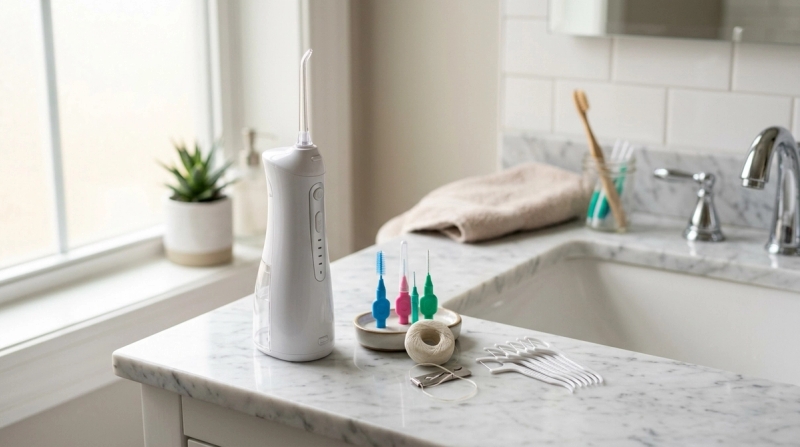
If your teeth are tight together, start with regular dental floss or floss picks. If you have noticeable gaps, receding gums, braces, bridges, or implants, interdental brushes are often the better fit. And if you absolutely hate flossing, struggle with hand movement, or have braces that make cleaning awkward, a water flosser may be worth the extra cost.
The “best” tool is not the fanciest one. It is the one that fits your mouth, feels manageable, and is easy enough that you will actually use it most days.
Because here is the honest truth: cleaning between your teeth matters. Your toothbrush cannot reach every little space where plaque and food get trapped. But that does not mean you need every dental gadget on the shelf either.
This guide breaks down water flosser vs interdental brush, interdental brush vs floss, and dental floss vs floss picks so you can make a practical first purchase without getting pulled into marketing hype.
Quick dental note: This guide is for general education and shopping help only. It is not a diagnosis and does not replace advice from your dentist or hygienist. If you have gum disease, bleeding, braces, implants, pain, or recent dental work, ask your dental professional which tool and size is safest for you.
Quick Summary: Which Interdental Tool Should You Buy?
#String dental floss — best for tight teeth, low budgets and travel. Low cost, moderate effort, best first buy for tight spaces.
Floss picks — best for beginners, quick use and easier grip. Low-to-moderate cost, low effort, best habit-builder.
Interdental brushes — best for wider gaps, braces, bridges and implants. Moderate cost, low-to-moderate effort, best where they fit properly.
Water flosser — best for braces, limited hand movement and people who hate flossing. Higher cost, low effort but can be messy, best upgrade if manual tools fail.
Simple rule: Start with the cheapest tool that fits comfortably. Upgrade later if you cannot stick with it or your dentist recommends something different.
The Short Buying Answer
#For most people, this is the easiest order to follow:
- Try string floss first if your teeth are close together.
- Try floss picks if regular floss feels awkward or you never use it.
- Try interdental brushes if you have wider gaps, gum recession, braces, bridges, or implants.
- Buy a water flosser if you need something easier, gentler, or better for braces and hard-to-reach areas.
There is no single winner for every mouth. Fit and consistency matter more than the product looking impressive.
1. Traditional Dental Floss and Floss Picks
#Dental floss is the classic option for cleaning between teeth. It works by sliding between tight contacts and wiping along the sides of each tooth.
It is cheap, easy to find, easy to pack, and does not need batteries, charging, counter space, or replacement parts. That is why it is still one of the most practical first buys.
Floss picks do something similar, but the floss is stretched across a small plastic handle. They are not quite as flexible as regular floss, but they are much easier for many people to hold.
And sometimes that is the difference between “I should floss” and “I actually flossed.”
Who Should Buy String Floss?
#String floss is a good first choice if:
- Your teeth are tightly packed.
- You want the cheapest option.
- You travel often.
- You do not want another bathroom gadget.
- You are willing to learn the technique.
- Interdental brushes do not fit between your teeth.
Floss is especially useful for tight spaces where even the smallest interdental brush feels too large.
Who Should Buy Floss Picks?
#Floss picks may be better if:
- Regular floss annoys you.
- You hate wrapping floss around your fingers.
- You want something quick and simple.
- You are trying to build the habit from zero.
- You need something easier to use after meals.
- You have trouble reaching the back of your mouth with string floss.
Floss picks are not always the “perfect” tool, but they are realistic. And realistic matters. If a floss pick gets you cleaning between your teeth more often, that is a win.
Who Should Be Careful With Floss?
#String floss may not be ideal if:
- You have arthritis or limited hand movement.
- You have larger spaces where thin floss does not clean well.
- You tend to snap floss hard into your gums.
- Your dental work catches, traps, or shreds floss.
Floss picks may not be ideal if:
- You want to use a fresh section of floss between every tooth.
- You are trying to avoid single-use plastic.
- The shape still makes your back teeth hard to reach.
2. Interdental Brushes
#Interdental brushes look like tiny bottle brushes. They slide into the spaces between teeth and gently scrub the sides.
When comparing interdental brush vs floss, the main issue is spacing. If the brush fits comfortably, it can work very well. If it does not fit, it is either the wrong size or the wrong tool.
These brushes come in different sizes, and that part matters. You may need one size for the front teeth and another size for the back. Some people even need two or three sizes across the mouth.
A little annoying? Yes. Normal? Also yes.
Who Should Buy Interdental Brushes?
#Interdental brushes are often a smart buy if:
- You have visible gaps between teeth.
- Your gums have receded.
- Food gets stuck in the same spots again and again.
- You have braces, bridges, implants, or other dental work.
- You dislike string floss but still want a manual tool.
- Your dentist or hygienist has shown you the right size.
For people with wider spaces, interdental brushes can feel easier and more satisfying than floss. You can often feel them cleaning, which makes the routine less frustrating.
Who Should Be Careful With Interdental Brushes?
#Do not force an interdental brush if:
- Your teeth are very crowded.
- The brush bends when you try to insert it.
- You feel sharp pain.
- Your gums bleed heavily or stay sore.
- You are guessing the size around implants, bridges, or recent dental work.
A brush should slide in with gentle pressure. If you have to shove it, stop. Try a smaller size or ask your dentist what size you need.
3. Water Flossers
#A water flosser, also called an oral irrigator, uses a focused stream of water to clean between teeth and along the gumline.
It usually costs more than floss or interdental brushes, but it can be much easier for people who struggle with manual cleaning.
This is where a water flosser buying guide becomes useful. The wrong model can be bulky, loud, splashy, weak, hard to refill, or annoying to clean. Plenty of people buy one, use it for a week, and then let it sit by the sink collecting dust.
So before buying, it is worth asking whether it actually solves your problem.
Who Should Buy a Water Flosser?
#A water flosser may be worth it if:
- You have braces or orthodontic hardware.
- String floss feels frustrating or gets stuck.
- You struggle with finger control or hand movement.
- You are more likely to use a device than regular floss.
- You want something that feels gentler.
- You have complex dental work and your dentist says it is suitable.
- You keep failing to stick with floss or interdental brushes.
For some people, a water flosser turns interdental cleaning from “I hate this” into “Okay, I can do this.” That matters.
Who Should Think Twice?
#A water flosser may not be the best first choice if:
- You want the cheapest option.
- You have very limited bathroom space.
- You travel often and pack light.
- You hate wet counters.
- You do not want another device to charge or clean.
- You expect it to magically fix all dental problems.
A water flosser is useful, but it is still just a tool. It only helps if you use it regularly and correctly.
Water Flosser vs Interdental Brush: Which Is Better?
#If you are choosing between water flosser vs interdental brush, start with the shape of your mouth.
Choose interdental brushes if the spaces between your teeth are wide enough for the brush to fit comfortably. They physically touch the tooth surface, they are relatively affordable, and they are easy to store or travel with. They are a strong choice for gaps, receding gums, braces, bridges, and some implant situations.
Choose a water flosser if manual tools are hard to use or if you have braces and awkward areas to clean. A water flosser can flush around brackets, wires, and tricky corners without as much finger work. It can also be a better fit if you simply cannot stand string floss.
The trade-off is simple:
- Interdental brushes are cheaper, smaller, and more direct.
- Water flossers are easier for some people, but cost more and need water, charging, storage, and cleaning.
If both options work for your mouth, interdental brushes are usually the more practical first purchase. A water flosser makes more sense as an upgrade when comfort, braces, hand movement, or consistency is the real issue.
Interdental Brush vs Floss: The Real Difference
#The interdental brush vs floss decision mostly comes down to gap size.
Floss is best for tight contacts. If your teeth are close together, floss can slide through spaces that a brush cannot safely enter.
Interdental brushes are better for wider spaces. If there is enough room, the brush can fill the gap and scrub more of the tooth surface.
You do not have to treat them like rival products. Many people use floss in tight areas and interdental brushes in wider areas. That is completely normal, and for some mouths, it is the best setup.
Dental Floss vs Floss Picks: Which Should Beginners Choose?
#When comparing dental floss vs floss picks, both use string to clean between teeth. The main difference is handling.
String floss gives you more control. You can curve it around each tooth and use a cleaner section as you move through your mouth.
Floss picks are easier to hold. They are quick, simple, and less intimidating if you are just getting started.
If you already floss well, regular string floss is hard to beat. But if you keep buying floss and never using it, floss picks may be the smarter real-life choice.
For oral care tools for beginners, ease matters. Start with the tool that removes the most friction from the habit.
What to Check Before Buying
#Before you add anything to your cart, think through these basics.
1. Your Tooth Spacing
#Look honestly at your teeth.
- Tight spaces usually suit floss.
- Wider spaces may suit interdental brushes.
- Braces or complex dental work may suit interdental brushes or a water flosser.
If you are unsure, ask your dentist or hygienist to show you the right size and technique. It takes very little time and can save you from buying the wrong thing.
2. Your Hand Comfort
#If wrapping floss around your fingers feels awkward or painful, do not force yourself into a routine you will quit.
Consider:
- Floss picks for easier grip.
- Interdental brushes for simple in-and-out cleaning.
- Water flossers if hand movement is a major barrier.
3. Your Budget
#Approximate cost levels:
- String floss: lowest cost.
- Floss picks: low to moderate ongoing cost.
- Interdental brushes: moderate ongoing cost, depending on replacement.
- Water flosser: higher upfront cost, plus possible replacement tips.
Do not buy the most expensive tool just because it looks more advanced. Expensive does not automatically mean better for your mouth.
4. Your Bathroom Space
#Water flossers need space. Countertop models usually take up more room than cordless models. Cordless versions are easier to store, but they often have smaller water tanks.
If your sink area is already crowded, manual tools may be easier to live with.
5. Replacement Needs
#Check how often parts need replacing.
- Floss is single-use.
- Floss picks are usually single-use.
- Interdental brushes can often be rinsed and reused briefly, then replaced when worn.
- Water flosser tips may need periodic replacement.
A cheap starter pack is only useful if you can comfortably keep buying the refills.
6. Pressure Settings on Water Flossers
#If you are buying a water flosser, look for adjustable pressure.
Start low, especially if your gums are sensitive. Stronger is not automatically better, even if it feels more powerful.
7. Tip Attachments
#Some water flossers include different tips for braces, implants, or dental work.
Do not pay extra for a pile of attachments you will never use. But do make sure the box includes the tip you actually need.
Comparison: Which Tool Fits Your Situation?
#- Very tight teeth: choose string floss because it is thin enough to slide between close contacts.
- You hate string floss: choose floss picks because they are easier to hold and faster to use.
- Visible gaps: choose interdental brushes because they fit wider spaces better.
- Braces: choose interdental brushes or a water flosser because they are easier around wires and brackets.
- Limited hand movement: choose floss picks or a water flosser because they need less finger control.
- Travel: choose string floss or floss picks because they are small and easy to pack.
- Small bathroom: choose floss or interdental brushes because they need no charging or tank space.
- Higher budget but low motivation: consider a water flosser because some people find it easier to use consistently.
- Dental implants or bridges: ask your dentist first; interdental brushes or a water flosser may fit, but technique matters.
Common Mistakes to Avoid
#1. Forcing an Interdental Brush
#Never push a brush into a space that is too tight. It should not feel like you are jamming metal between your teeth. Try a smaller size or switch to floss.
2. Starting a Water Flosser on Maximum Pressure
#More pressure does not always mean better cleaning. Start on the lowest comfortable setting and increase only if needed.
3. Snapping Floss Into the Gums
#Ease floss gently between teeth. If you snap it down hard, you can hurt your gums and make yourself dread flossing even more.
4. Buying a Water Flosser Before Knowing the Problem
#A water flosser is not automatically better because it is electronic. If your main issue is tight teeth, simple floss may still be the better first tool.
5. Using the Wrong Interdental Brush Size
#One size may not fit your whole mouth. Some areas may need a smaller brush, while others may need a larger one.
6. Quitting Because of Mild Early Bleeding
#Mild bleeding can happen when you start cleaning between your teeth, especially if your gums are inflamed. Be gentle and consistent.
But if bleeding is heavy, painful, or does not improve, see a dentist.
7. Chasing Perfection Instead of Consistency
#The best tool is the one you will actually use. A perfect product used once a month is not going to help much.
So, What Should You Buy First?
#Here is the simplest buying decision:
- Buy string floss first if your teeth are tight and you want the cheapest proven option.
- Buy floss picks first if you are a beginner and need something easy.
- Buy interdental brushes first if you have gaps, receding gums, braces, bridges, or implants, as long as the brush fits gently.
- Buy a water flosser first if braces, hand difficulty, or a strong dislike of flossing keeps you from cleaning between your teeth at all.
If you are still unsure, start cheap. Try floss or a small multi-size pack of interdental brushes. If you cannot stick with either, then consider a water flosser.
For most everyday buyers, that is the most practical path.