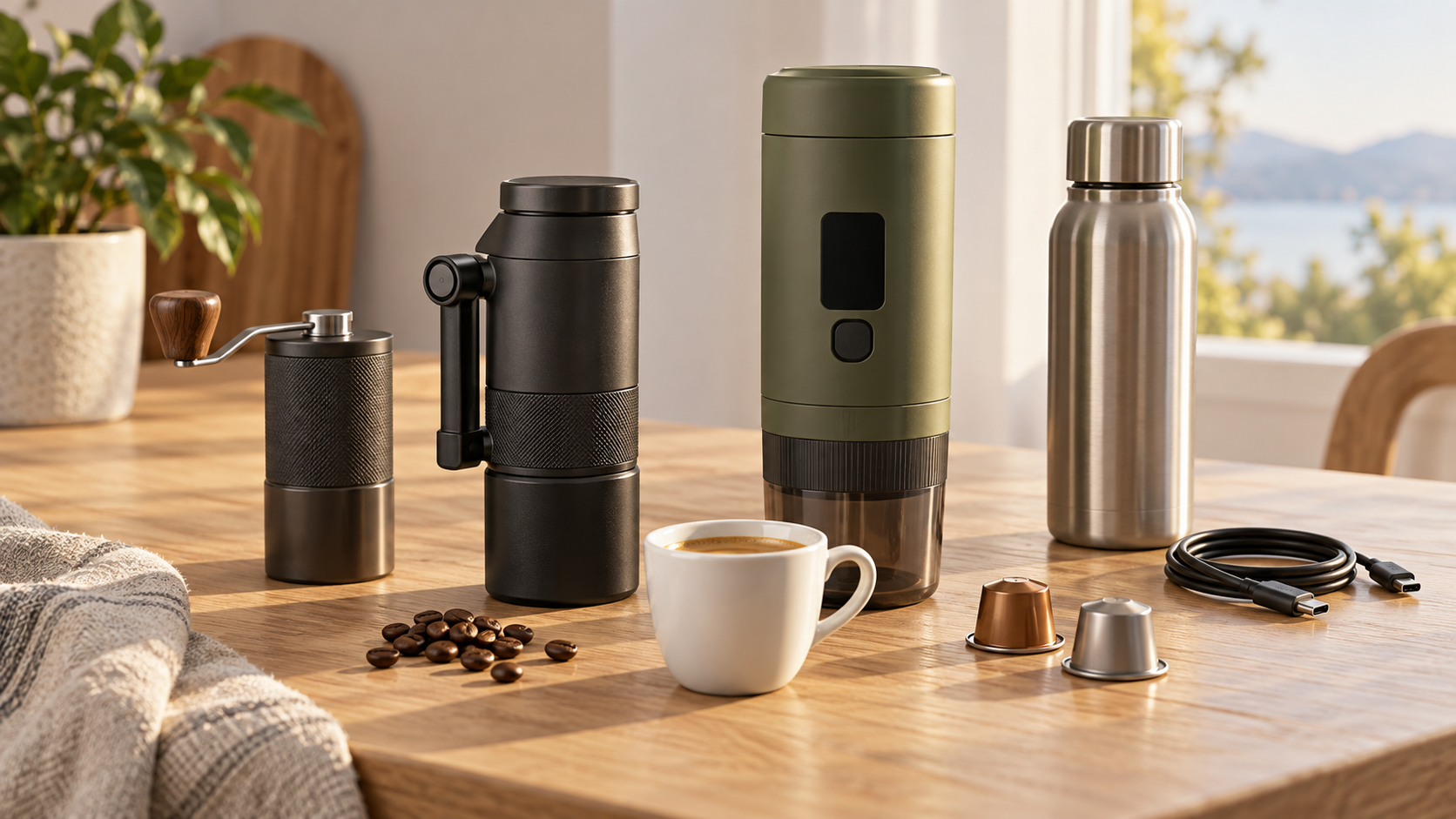
Choose a manual portable espresso maker if you already have reliable hot water and are happy to pump by hand. Choose a self-heating model if your main problem is getting a hot espresso where there is no kettle. Then check the coffee format, the complete weight you will carry, and how many heated brews you need between charges.
That first decision matters more than the biggest pressure number on the box. A small machine can be a useful travel companion, but only if the rest of your coffee routine fits around it.
This guide compares the types and uses current manufacturer specifications for real examples. It is a buying guide, rather than a hands-on taste or durability test. Product details were checked on 14 October 2026; confirm the exact model and bundle before ordering.
Start with your hot-water plan
#Picture the place where you will actually make coffee. A hotel room with a kettle, a campsite where someone already boils water, and a roadside stop with no hot-water source create three different buying decisions.
For the hotel or established camp kitchen, a manual brewer can make sense. You supply hot water and generate pressure yourself. For the roadside stop, a self-heating machine removes the need to arrange a separate kettle, provided its battery is charged.
Read the listing carefully: an electric pump and a water heater are separate features. “Electric,” “cordless,” and “portable” do not, by themselves, tell you that a device heats cold water.
| What to check | Manual brewer | Self-heating electric brewer |
|---|---|---|
| Hot-water source | Arrange it separately | Built-in heating, within the model's limits |
| Extraction | Hand pumping | Motor-driven pump |
| Energy planning | Plan how to heat water | Plan charging and heated brews |
| Work between drinks | Refill, prepare coffee, pump and clean | Refill, prepare coffee, run a cycle and clean |
| Most useful starting point | Hot water is already part of your routine | Hot water is the missing part of your routine |
A self-heating brewer still needs drinking water, coffee and somewhere suitable to use it. For car trips, brew after parking on a stable surface. Convenience does not remove the preparation.
Four real examples show the differences
#The following figures are manufacturer-listed specifications, not measured results. Water-tank capacity is a container specification; it should not be read as the volume of espresso you will get in the cup. Accessories, water and coffee also add to the stated device weight.
| Model | Type | Listed device weight | Water tank | Coffee format to check |
|---|---|---|---|---|
| Wacaco Nanopresso | Manual; no water heater | 336 g | 80 ml | Grounds; Original-compatible capsules with the NS Adapter |
| Wacaco Picopresso | Manual; no water heater | 350 g | 80 ml | Grounds; standard 18 g basket |
| Wacaco Pixapresso | Electric with water heater | 755 g | 120 ml | Grounds or Original-compatible capsules |
| OutIn Nano 2 | Electric with water heater | 740 g | 85 ml | Grounds or Original Line-compatible capsules |
Nanopresso: check the adapter before buying capsules
#The Wacaco Nanopresso is hand-powered and requires hot water. Its standard ground-coffee basket holds 8 g. The NS Adapter adds compatibility with Nespresso Original capsules and most compatible alternatives; check whether it is included in the bundle you are considering.
It is a useful example of why the machine name alone is not enough. A listing for the base brewer and a listing for a capsule bundle can describe different things you receive. If capsule convenience is your main reason to buy, include the correct adapter in both your cost and packing plan.
Picopresso: a choice for people who want to adjust the shot
#The Wacaco Picopresso uses a non-pressurized portafilter and an 18 g basket. Wacaco specifies ultra-fine coffee and explains that grind size, tamping and pumping technique need adjustment. It does not heat water.
This suits a buyer who wants to work on the brewing process and already has suitable grinding equipment, or intends to buy it. It is less compelling if your priority is a quick capsule with very little preparation. Check the grind requirement before assuming your existing grinder will do the job.
Pixapresso: heating and more coffee-format flexibility
#The Wacaco Pixapresso heats water and pumps electrically. Its published features include three temperature settings, an adjustable 8–16 g basket, and compatibility with Nespresso Original-style capsules. Wacaco cautions that some compatible capsules may not work well.
Its larger listed tank may appeal if that fits your drinks, but compare the whole routine: filling, coffee preparation, heating, extraction and cleanup. Wacaco also says the machine cannot brew while charging. If you forget to recharge it, plugging it in does not immediately solve your coffee problem.
Nano 2: check the generation and charging requirements
#The OutIn Nano 2 supports grounds and Nespresso Original Line-compatible capsules. OutIn lists 45 W USB-C PD fast charging and an 8 g ground-coffee basket. It also states that the original Nano 1 Basket Plus does not fit Nano 2.
That last detail matters when comparing bundles or buying used equipment. A familiar brand name does not establish accessory compatibility across generations. Write down the exact model before ordering a basket, case or adapter.
Compare the kit you will pack
#A lighter brewer is not automatically a lighter coffee setup. Start with what you already carry, then count what the purchase would add.
For a manual ground-coffee setup, your packing list may include a brewer, hot-water container or heating equipment, grinder, beans, cup and small cleaning supplies. A capsule setup can remove the grinder, but may add an adapter and a capsule container. For a self-heating setup, include the charger and cable you need, even if you expect to use a charger already in your bag.
Here is a hypothetical packing example, using the listed Nanopresso and Nano 2 weights above. The accessory weights are invented assumptions for the calculation, not measurements of products:
| Added item | Manual ground-coffee kit | Self-heating capsule kit |
|---|---|---|
| Brewer | 336 g | 740 g |
| Grinder, assumed | 450 g | None |
| Extra insulated flask, assumed | 300 g | None |
| Charger and cable, assumed | None | 120 g |
| Subtotal of these items | 1,086 g | 860 g |
This is a partial comparison: cups, coffee, cases, cleaning supplies and water are excluded. It shows how a 336 g device could become the heavier added kit if it makes you carry two extra items.
Change the assumptions and the decision changes. If you already pack a stove and grinder, the manual brewer might add only its own weight. If you use capsules and already have a hot-water flask, the manual setup could be much simpler. Weigh your actual bag rather than choosing from the device number alone.
Read battery claims as a brewing budget
#Check whether a battery figure describes heating cold water or merely pumping water that is already hot. These are different jobs, so a large extraction count may tell you little about a trip without a kettle.
OutIn claims up to nine heated brews for Nano 2 when each brew heats 50 ml of water from 25°C to 93°C. Those are its stated test conditions; actual performance varies. Wacaco lists up to five espresso brews from cold water for Pixapresso, compared with over 200 extractions using preheated water.
Use the heated-brew figure for planning if you will start with cold water. Also compare the conditions behind the figures before treating one device as having better endurance.
For a hypothetical three-day trip, two people each wanting one separately brewed coffee every morning would need six heating cycles. One person wanting the same would need three. Six is already above a five-brew claim, and it leaves only nominal headroom under a nine-brew claim. Larger servings, different conditions and actual battery performance can change the result. Arrange charging or a backup instead of relying on the maximum figure.
USB-C describes the connection, not every charging requirement. Confirm the manufacturer's required charger output and protocol. Keep a note of charging time as well: a stop with a socket is only useful if you can stay long enough to charge.
Choose coffee format before chasing pressure
#Capsules reduce the grinding and dosing work. Grounds give you more choice over coffee and preparation, but the machine's basket and grind requirements still matter. A hand grinder with fine adjustment can be useful for espresso; verify that the particular grinder is designed for it.
For capsules, copy the exact supported system from the product page. “Original-compatible” should not be expanded into “all Nespresso capsules.” Check the adapter, included accessories and any warning about compatible capsules. Buying a machine and a box of pods together is frustrating if they do not fit.
For grounds, ask whether you want a brewing hobby or a quick drink. A non-pressurized setup that rewards careful adjustment may be appealing at home and inconvenient during a rushed departure. Neither preference is wrong; choose for the morning you actually have.
Treat advertised maximum pump pressure as one specification. The numbers in these examples do not establish which makes the best-tasting coffee. Temperature, coffee preparation and the brewing procedure need attention too. If taste is your deciding factor, look for a credible test of the exact model and coffee format you intend to use.
Check cleanup and support before paying
#Open the manual and find the cleaning section. Work out where you will rinse the washable parts, dispose of the used coffee and leave parts to dry. If that routine feels awkward now, a small brewer will not make it disappear.
Do not assume every portable brewer can go in a dishwasher or be submerged. Wacaco says Picopresso is not dishwasher-safe and describes rinsing its basket and shower head. It says Pixapresso should not be submerged and is not dishwasher-safe. Follow the instructions for the exact machine, including which parts must stay dry.
Before ordering, check these practical details:
- The exact model, generation, adapters and basket supplied.
- The complete manual, including charging and cleaning instructions.
- The return policy for the seller and your country.
- Where warranty service happens and who pays any return shipping.
- Whether replacement seals, baskets or other relevant parts are available.
- The complete price of the usable kit, including necessary accessories and delivery.
Match the purchase to your mornings
#For a hotel stay with reliable hot water, start by comparing manual options and the coffee format you prefer. For a campsite where water is already being boiled, consider whether the manual brewer integrates with that setup. For stops without hot water, compare self-heating models against your actual charging opportunities and number of drinks.
If you mainly want several large mugs for a group, reconsider the category before buying. Repeating a small brewing cycle for every person may be more work than you want. If you rarely travel and already enjoy your home coffee, keeping that setup and buying coffee while away may also be the more sensible choice.
The useful purchase is the one whose entire routine fits: getting water, preparing coffee, brewing, cleaning and packing again. Start there, and the specification sheet becomes much easier to read.