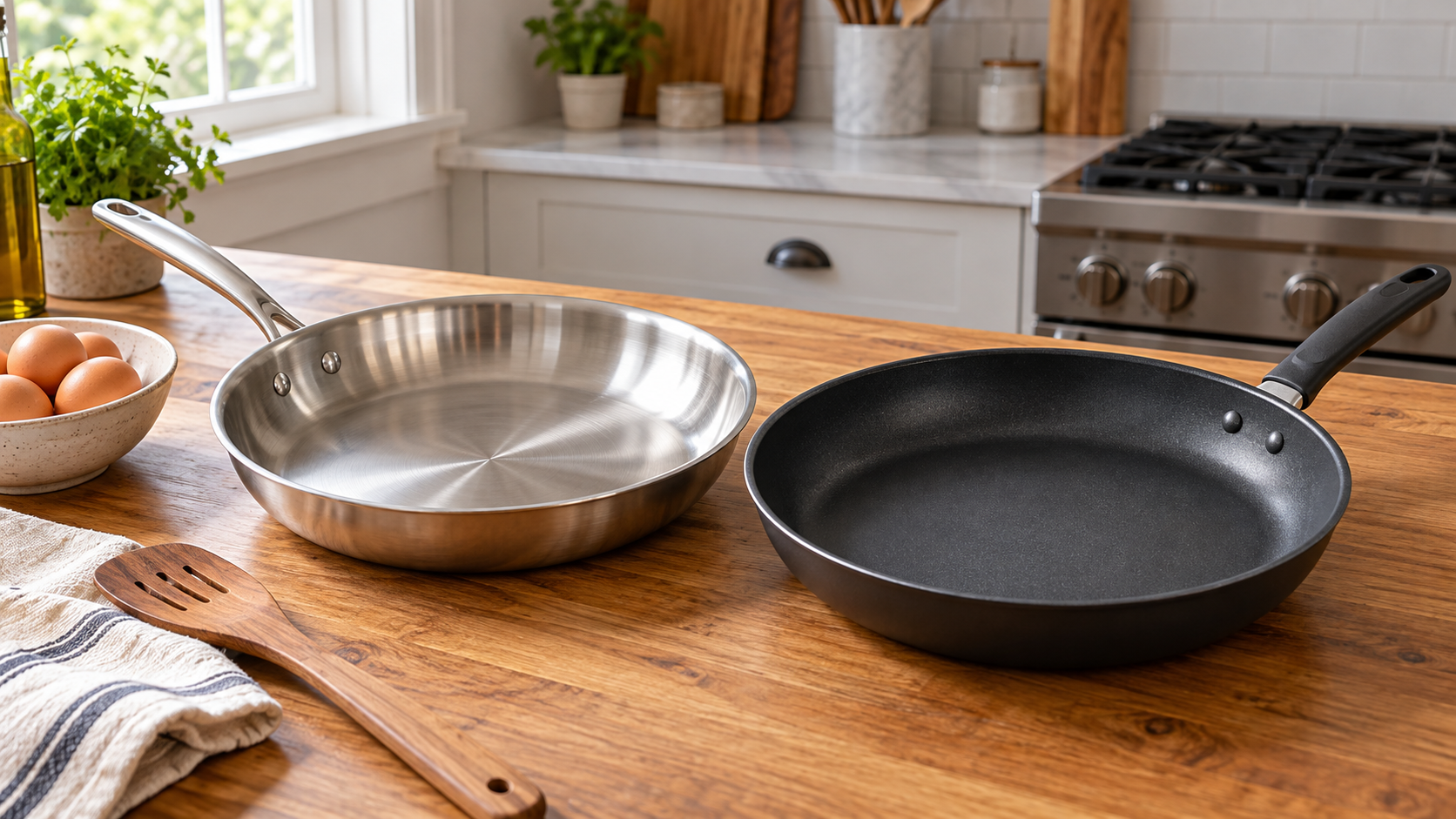
Choose nonstick if most of your frying-pan meals are eggs, pancakes and delicate foods that you want to lift out easily. Choose uncoated stainless steel if you regularly brown ingredients, build a pan sauce and want a cooking surface without a nonstick coating to maintain.
If your week includes both, one of each can make sense. But you do not need to buy a matching set to find that out. Start with the job your current kitchen struggles with most.
The stainless steel vs nonstick decision becomes easier when you separate three questions: what touches the food, how the pan is built underneath, and whether that exact model works with your stove. A shiny exterior does not answer all three.
Start with the meals you actually make
#Write down five meals you cooked recently. Count the ones that need easy release, and the ones where browning and a sauce matter. Include breakfast if you cook it every day; a pan used for two eggs six mornings a week has a real job, even if it never makes an impressive dinner.
Use this table as a buying guide rather than a rule about what a pan is capable of. Both surfaces can cook many of the same foods. The difference is how much care the result asks from you.
| Food or cooking goal | Practical first choice | What changes the decision |
|---|---|---|
| Scrambled eggs, omelets and pancakes | Nonstick | Easier lifting and turning are useful when the food is fragile |
| Delicate fish you want to keep in one piece | Nonstick | Stainless can work, but release and heat control need more attention |
| Browned chicken pieces followed by a pan sauce | Stainless steel | The browned deposits left on the pan can become part of the sauce |
| Mushrooms or vegetables where browning matters | Stainless steel | Pan space and moisture still matter; the material alone cannot prevent steaming |
| Paneer, firm tofu or other pieces prone to tearing | Nonstick for easier handling | Choose stainless if you want to learn its release behaviour; a new pan will not fix wet ingredients or early turning |
| A meal that finishes in the oven | Either, if explicitly rated | Check the pan, handle and lid separately, including the actual temperature |
| Strong direct overhead grill or broiler heat | A specifically approved pan | Do not infer permission from an oven-safe label |
For example, a household making omelets, pancakes and lightly cooked fish has a strong reason to buy nonstick first. A household making browned vegetables, chicken and quick sauces has a stronger reason to choose stainless.
Someone who already owns a usable stainless pan may get more benefit from one modest nonstick pan than from a more expensive stainless replacement. Start by identifying the missing task, not the missing brand.
Construction and cooking surface are different things
#“Stainless steel” sometimes describes the outside of a pan that has nonstick on the inside. Le Creuset, for example, sells a stainless steel fry pan with a nonstick interior. That is still a coated cooking surface for the purposes of this decision.
Read the product description for the interior, then read the construction separately.
An uncoated stainless cooking surface does not provide the same easy-release finish as nonstick. Layered pans commonly combine stainless steel with another metal such as aluminium. In a fully clad pan, those layers continue through the walls; a base-bonded design concentrates its layered construction at the bottom. All-Clad describes both approaches in its cookware guidance.
Those terms help you understand what you are buying. They do not establish that every five-layer pan cooks better than every three-layer pan. Thickness, shape, weight and the heating element are also part of the experience. Without comparable testing, a layer count is a specification, not a performance ranking.
Nonstick is a surface category too. Traditional PTFE coatings and ceramic nonstick coatings are different materials. “Hard-anodised” describes the treatment of an aluminium body; it does not, by itself, identify everything applied to its cooking surface.
If a listing says only “stone,” “granite” or “premium coating,” ask what the food-contact surface actually is. A colour or pattern is not enough information to make a maintenance decision. The useful answer is the coating type, compatible heat sources and care instructions for that particular model.
What you gain and give up with stainless steel
#Stainless is particularly useful when the deposits left after browning are part of dinner. Those browned bits are often called fond. Adding a suitable liquid and loosening them is deglazing; it lets you build a sauce in the cooking vessel.
That matters if you want to brown chicken, remove it, then make a quick sauce in the same pan. Easy release is not the only useful property here. You want controlled browning and a surface you can work with according to its instructions.
Stainless also asks you to learn the relationship between your burner, oil and food. A piece that grips the pan immediately is not automatically a failed meal or a defective pan. It may need time to set before turning. Excessive heat, crowding and a poorly cleaned surface can also create problems.
Keep the learning manageable. Begin with a familiar meal rather than your most delicate omelet. Follow the pan's heating instructions, use appropriate cooking fat, and leave room to turn the food. Change one thing at a time if the result disappoints you. Raising the burner to its maximum is not a reliable fix.
All-Clad's stainless guidance recommends moderate heat for ordinary frying and searing. That is a useful correction to the idea that buying stainless means cooking everything on high. A pan can brown food without the stove being at its highest setting.
The tradeoff is effort. If breakfast already feels rushed and sticking is the problem you want to remove, stainless may be the less comfortable first purchase. There is no prize for choosing a surface that makes a frequent meal harder than it needs to be.
What you gain and give up with nonstick
#Nonstick earns its place when food needs to slide, fold or turn with less resistance. Think of a thin pancake, soft scrambled eggs or a fish fillet that breaks when lifted. That convenience is a valid buying reason.
It can also make cleanup less demanding. But the easy-release surface needs protection. Your normal utensils, cleaning method and heat habits are part of the purchase. A pan is a poor fit if its care instructions conflict with how everyone in the household uses the kitchen.
Use compatible wood, silicone or other utensils approved for the pan. Keep knives away from its cooking surface. Some manufacturers permit limited metal-utensil use on particular ranges; that permission should come from the exact product instructions, not a general claim that modern nonstick cannot scratch.
Nonstick can brown food at suitable temperatures. It does not need to be reserved for pale eggs. The limitation is that you must stay within the coating's instructions, even when a recipe or video asks for a hotter pan. If hard searing or overhead grilling is central to your cooking, choose equipment explicitly suited to it.
Do not buy on a promised number of years. Tefal says coating life varies with conditions and frequency of use. A pan used gently twice a week and one used for every meal do not have the same workload. Price and a long warranty do not remove that difference.
Heat limits belong to the exact pan
#Avoid treating a general material comparison as a manual. Even manufacturer instructions can differ between collections, and lids may have a lower limit than the pan beneath them.
For a concrete example, All-Clad's current care page lists its uncoated stainless cookware as oven and broiler safe up to 600°F, about 316°C. Its section for stainless cookware with nonstick gives a 500°F, or 260°C, oven limit for the pan, a 350°F, or 177°C, lid limit, and says to avoid the broiler. These are examples from that manufacturer's guidance, not limits for every stainless or nonstick pan.
Before buying, find the instructions for the exact product code. Check ordinary oven use, broiler permission, handle restrictions and the lid. If one part is unclear, resolve it before planning a stove-to-oven meal.
Preheating needs the same care. Do not copy an empty-pan routine from one surface to another. The German Federal Institute for Risk Assessment advises against heating empty PTFE-coated cookware because overheating can release hazardous gases. Some pan manuals also specify how to add oil or food during warming.
There is no need to chase a temperature threshold at home to see how close you can get. Use the product's lower operating limits, stay with the pan and keep the food ready before starting. Smoke is a reason to stop overheating, not a target to reach.
Check induction, size and handling before the price
#Either cooking surface may be available in an induction-compatible model. Neither the silver colour of stainless nor the word “nonstick” guarantees compatibility.
Bosch explains that induction requires a suitable magnetic base. A magnet sticking to the bottom is a useful screening check, but still confirm the product's induction label and the hob's requirements. Match the base to the cooking zone; the broad upper rim is not the part being detected underneath.
Size labels need a second look as well. A nominal 10-inch pan is roughly 25 cm across; 12 inches is roughly 30 cm. Those conversions do not tell you how much flat cooking floor is available. Two pans with similar top diameters can have different usable space because their sides slope differently.
Look for the flat base or cooking-area dimensions. If they are missing, inspect the pan in person or ask for them. Imagine your usual portions lying flat with room for a spatula. A large rim is not helpful if the cooking floor is too small for your food.
Also check the total length, including the handle, against your cupboard, sink and oven. Hold the pan if possible. Imagine lifting it with food inside, pouring from it and washing it. A helper handle may matter more to you than an extra construction layer.
For a small hob, a larger pan is not automatically a better family purchase. Its footprint must suit the appliance, and you still need room for neighbouring cookware. Compare the whole setup before choosing the largest diameter on sale.
Buy for the cleaning routine you will follow
#For either surface, begin with the product's normal washing instructions. Let the pan cool before cleaning and avoid plunging a hot pan into cold water. Both All-Clad and Tefal warn that abrupt temperature changes can warp cookware.
For uncoated stainless, a food mark or rainbow tint does not automatically mean the pan needs replacing. Manufacturers provide cleaning methods for different residues. Use a cleaner specifically approved for your pan, and distinguish the stainless exterior from a coated interior before applying it.
For nonstick, begin gently with the recommended soap, water and soft cleaning tool. If food starts sticking, check for residue and follow the maker's cleaning guidance before assuming the coating has failed. Do not use a harsh stainless-cleaning routine on nonstick just because both surfaces belong to the same brand.
Read the difference between “dishwasher safe” and the recommended care method. Le Creuset's guidance, for example, recommends handwashing its nonstick pans to preserve their performance. If you know a pan will go into the dishwasher after every meal, compare models on that basis before paying for one that asks for a different routine.
Inspect structural problems separately from cosmetic ones. A wobbling base, insecure handle or peeling coating deserves attention. Stop using a pan with a structural fault and contact the manufacturer about repair or replacement. Do not sand a coating off or attempt a home recoating project; Tefal says its nonstick coating is applied during manufacturing.
Compare ownership cost without inventing a lifespan
#The useful cost question is how much you may spend to keep the cooking job covered. That includes the initial pan, possible replacements and any necessary utensils. It also includes whether the purchase saves enough effort for you to use it regularly.
Here is an illustrative five-year budget, using invented prices in generic currency units. These are not product quotes or predicted replacement schedules. Assume the stainless pan remains usable throughout the period; vary the number of nonstick pans bought to see how the result changes.
| Assumption over five years | Total purchase cost | Average per year |
|---|---|---|
| One stainless pan at 90 units | 90 units | 18 units |
| One nonstick pan at 35 units | 35 units | 7 units |
| Two nonstick pans at 35 units each | 70 units | 14 units |
| Three nonstick pans at 35 units each | 105 units | 21 units |
Under these assumptions, one or two nonstick purchases cost less than the stainless purchase; three cost more. That is the calculation, not proof that either surface is always cheaper. Change the actual prices, or include a stainless replacement, and the comparison changes.
The table excludes energy, cleaning products, your time and residual value. Those costs are hard to estimate honestly without your own habits. If nonstick makes daily breakfast easier, that benefit can matter even when another option has a lower hypothetical replacement cost.
Check warranty exclusions too. All-Clad's US and Canada cookware warranty covers manufacturing defects under its conditions and excludes normal wear. Its customer guidance specifically names reduced nonstick release among wear-related exclusions. Read the terms for your country and seller; “lifetime warranty” does not mean a coating is promised to keep releasing food forever.
Make the purchase in a sensible order
#If you need one pan now, choose the surface that fits most of your regular dishes, then filter for stove compatibility, cooking area and manageable weight. Compare the remaining choices on construction, care requirements, warranty and price.
If you already have one useful pan, buy the second only when it solves a repeated problem. A nonstick pan can handle the omelets that frustrate you in stainless. An uncoated stainless pan can handle the browning-and-sauce meals you keep avoiding with your coated pan.
Before paying, you should be able to finish this sentence: “This pan is for these meals, on this burner, and I can follow these care instructions.” That is a more useful buying decision than choosing a winner for every kitchen.