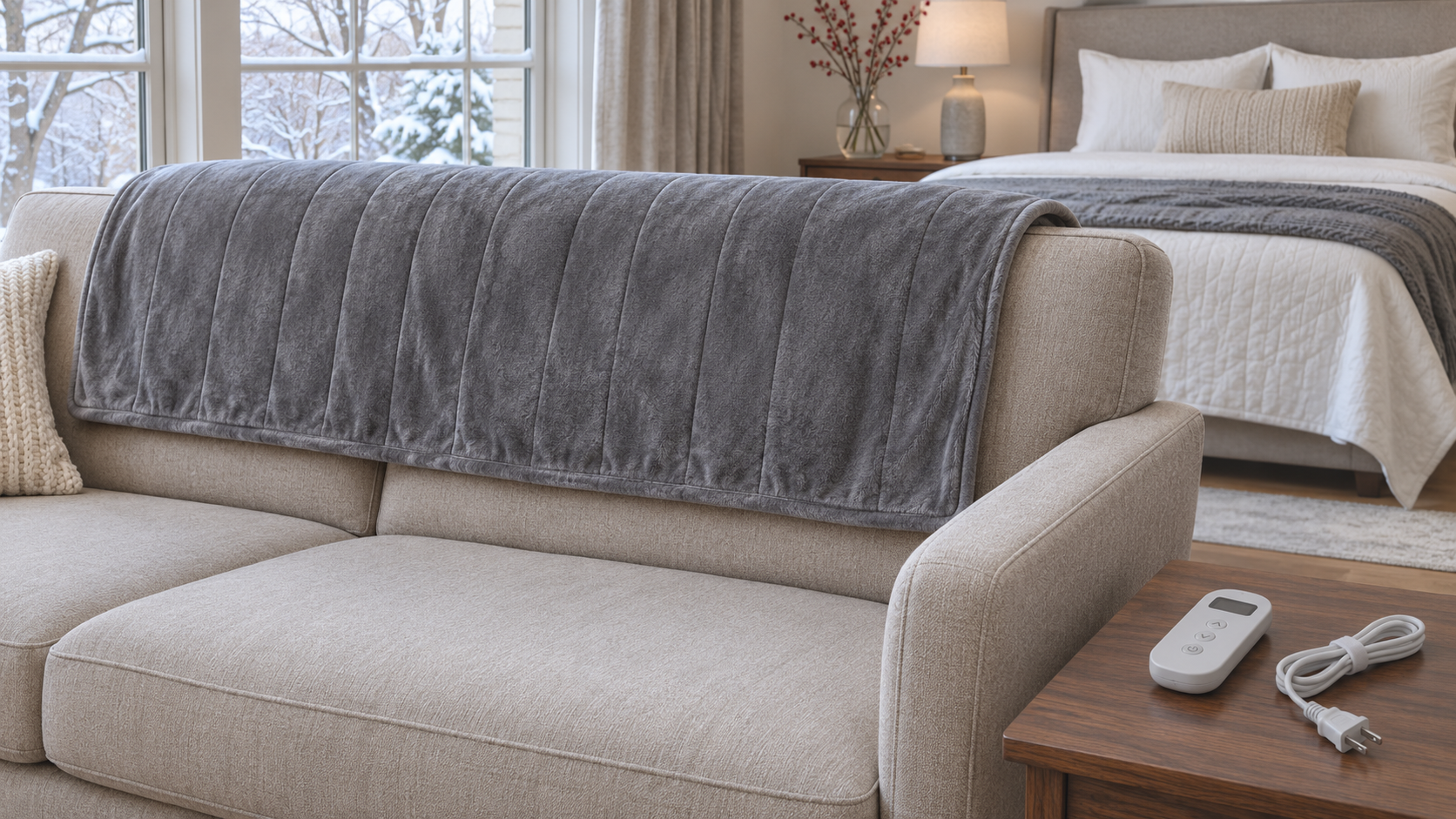
Choose a heated throw if you want warmth while sitting on the sofa. Choose a heated mattress pad or underblanket if you want to warm the bed from beneath the fitted sheet. If you want the warmth above you in bed, look for a heated overblanket whose manual explicitly allows that use.
“Electric blanket” can describe more than one of those products. The name in a listing is a starting point. The diagram in the manual showing where the blanket goes is a better buying tool.
Picture the place you want to warm
#Think about the last time you wanted extra warmth. Were you reading on the sofa with cold legs? Getting into a cold bed at the end of the day? Sharing a bed with someone who wanted the other side to stay cooler? Each situation makes a different feature useful.
| Product | Where it goes | What to check before buying |
|---|---|---|
| Heated throw | Over your lap or body, in a setting the manual allows | Size across your legs, controller reach, and whether the instructions allow use anywhere besides the sofa |
| Heated overblanket | Over the body in the bed arrangement specified by the maker | Bed and cover placement, controller access, and permitted use before or during sleep |
| Heated mattress pad or fitted underblanket | On the mattress beneath the sheet if the manual shows that setup | Mattress fit, cable position, bed type restrictions and separate controls if needed |
Some shops use “electric blanket” for a fitted bed warmer. Others sell electric overblankets and sofa throws under the same search term. Beurer, for example, describes its UB 74 as an underblanket secured underneath the standard fitted sheet. Its HD 75 is an overblanket that the manufacturer describes for sofa or bedroom warmth. Those examples illustrate why the product instructions matter. They are not blanket rules for every item with a similar name.
The most useful photo in a listing is often the least attractive one. Look for a diagram showing the fabric, fitted sheet, mattress and controller. If it is missing, find the instructions for the exact model. It is hard to tell from a photo of neatly arranged bedding whether you are supposed to lie on the heated layer or have it above you.
Pick by how you will use it on an ordinary evening
#For one person reading on a sofa, a throw should cover the parts that get cold without leaving its cord across a walkway. Measure from where your shoulder or lap starts to where you want the fabric to reach. Then look at the total size and the maker's instructions. A throw's outer dimensions do not tell you exactly where the heating elements are.
For a bed that feels cold only when you first get in, look at options designed to warm it before use. In that case, a straightforward control you can reach and a suitable preheat setting may matter more than having many temperature levels. Follow the specific switch-off instructions when you get into bed. Think through how you would use the product in practice instead of counting modes on the listing.
For two people who prefer different temperatures, check whether the exact size has two independent zones and whether those zones work the way you expect. Two controllers can be helpful when the bed and wiring allow both occupants to reach them. Look at the layout from both sides. A double-bed product with one control is a different purchase from a dual-zone model even if both fit the mattress.
For a renter or someone moving between rooms, check whether the product can be used in those places under its instructions. It may be better to buy one that suits the place you use most often. A fitted warmer stays with the bed. A throw may move with you, provided the next seat offers a suitable setup and the product is used as directed there too.
Check the fit before the feature list
#Measure the mattress width, length and depth for a fitted model. “Double” or “queen” may tell you the general size without telling you whether the corners can sit correctly on a deep mattress. Find the dimensions and fitting method. Check the maker's instructions for the mattress and bed frame if you have an adjustable bed, an unusual topper or a specialist mattress. Moveable parts and pressure-sensitive materials can change which setups the manufacturer allows.
Look at where the plug and controller need to sit. Picture the route between the bed and wall, with the furniture in its usual position. The cable should stay where the instructions allow and clear of hinges, heavy furniture and places people walk. If the only available route requires trapping or stretching a cord, keep looking for a setup that can be installed as instructed.
Next, check the size of the controller and its controls. Someone who already struggles with tiny labels will notice that every time they change the temperature. A controller that tucks into bed out of sight is also a poor solution when the manual says to leave it uncovered. Beurer's HD 75 instructions, for example, tell users to keep its controller uncovered during operation. Look for a clear resting place alongside the seat or bed.
If you live with a pet that jumps onto the sofa or bed, read the instructions on pets and check where the cord would be when the product is stored. A cable hanging from the arm of the sofa is hard to protect in a busy room. Also check where you will put the throw after use. Having a shelf or drawer that allows the recommended storage method is easier than forcing a heated layer into the same small basket as an ordinary fleece.
Consider what happens on laundry day. Some designs have a detachable control and allow a particular wash cycle. Others give different care instructions. Read the complete sequence, including disconnecting what the instructions say to remove, drying, and reconnecting only when permitted. If the care routine sounds awkward in your household, discover that before you buy it. “Machine washable” on its own leaves most of the practical questions unanswered.
Read the overnight instructions as a separate decision
#A timer, heat settings and overheating protection describe different features. A timer may switch power off after a set period. Heat settings let you choose a level. Overheating protection responds to conditions defined by the product design. The presence of any of these does not settle whether the manufacturer permits use while asleep.
London Fire Brigade advises unplugging an electric blanket before getting into bed unless it has a thermostat control intended for safe use throughout the night. Look for explicit instructions for the exact product and follow the stricter instructions that apply. An allowance printed in the manual for one mattress warmer does not carry over to a heated throw with a similar control.
Think about what would happen if you felt sleepy on the sofa. If the product instructions limit it to awake use, switching it off belongs in the routine before bedtime. Be particularly careful if a person cannot sense heat well, cannot operate the controller, or cannot move the bedding away unaided. Follow the maker's warnings on who can use the product and choose a suitable non-powered option when necessary.
Keep the product in the position specified in its instructions while it is on. Avoid adding a hot water bottle to the setup. Check what the instructions say about other covers, folding, storage and controller placement. Extra soft layers can make a display photo look inviting while covering parts the manual says to leave free.
Estimate running cost from your own tariff
#The rating helps you compare an illustrative session. If a product is rated at 100 watts and actually draws that amount continuously for two hours, it uses 0.2 kilowatt-hours. At an example unit price of 30 pence per kilowatt-hour, that session costs six pence in electricity. Twenty identical sessions would cost £1.20 at that illustrative rate.
| Step | Example value |
|---|---|
| Convert watts to kilowatts | 100 watts equals 0.1 kilowatts |
| Multiply by hours drawing that power | 0.1 kilowatts for two hours equals 0.2 kilowatt-hours |
| Multiply by the unit price on your bill | 0.2 kilowatt-hours at 30 pence equals six pence |
Use your actual tariff if you want an estimate for your home. The example excludes the fixed charges you already pay and assumes continuous draw at the selected example rating. A controller may vary or cycle power. Size, setting and zone use can change what a product draws in practice. It would take suitable measurement to report actual consumption for a particular model and session.
A personal warmer and the heating for a room also do different work. The throw can help keep one seated person comfortable. It does not solve why a room is damp or why the rest of the household is cold. Compare the job you want the product to do before comparing the power numbers on two unrelated appliances.
Look beyond electricity when comparing two listings. Check what happens if the controller fails, whether the maker offers a compatible replacement, and what is covered under the warranty. Keep the model number. If you later need help, a support team can do more with it than with a description like “grey double electric blanket.”
Make a quick inspection part of using it again
#If you take a product out of storage, look at the fabric, plug, cord, connector and controller before using it. The London Fire Brigade flags frayed fabric, scorch marks, exposed wires, cable damage and an unusual smell or sound from the controller. If you find damage or signs of overheating, stop using it and follow the manufacturer or fire service's advice. Do not open the controller or try to repair embedded wiring yourself.
A used electrical blanket can arrive without a manual or a reliable history of how it was folded, washed or stored. London Fire Brigade advises against buying them second-hand. If you are shopping for a gift, check fit and return terms before ordering and give the recipient the full instructions. A good return window is more useful than a slightly cheaper product that cannot be checked or returned.
Look up any recall using the exact model number through the relevant recall authority in your market. Product names and photos can be reused across different versions. Match the identifying details on the item and follow the recall notice if it applies. When a safety issue is present, trying another temperature is not the next step.
Use the room and routine to make the final choice
#Imagine two people living in the same flat. One reads on the sofa for an hour and wants a warm layer over their legs. The other is comfortable sitting in the living room and dislikes getting into a cold bed. The first person should compare sofa throws by coverage, ease of reaching the control and allowed placement. The second should compare underblankets or approved bed overblankets using the mattress and preheat instructions. The identical “electric blanket” search can lead them to two different products.
Write down your intended location, the exact size you need and where the control will sit. Then find the page in the manual that explains that use. Check how it switches off, what the instructions allow overnight, and how you will wash and store it. If you cannot match the product to the arrangement in your home, keep the purchase open until you have a clear answer.
If a regular throw, warm sleepwear or an extra non-powered bedding layer already solves the problem, that may be enough. It is also the simpler choice when there is no suitable cord route or the person using the product cannot use it as instructed. The best purchase here is the one you can use comfortably in your actual space, with the same simple setup each time.