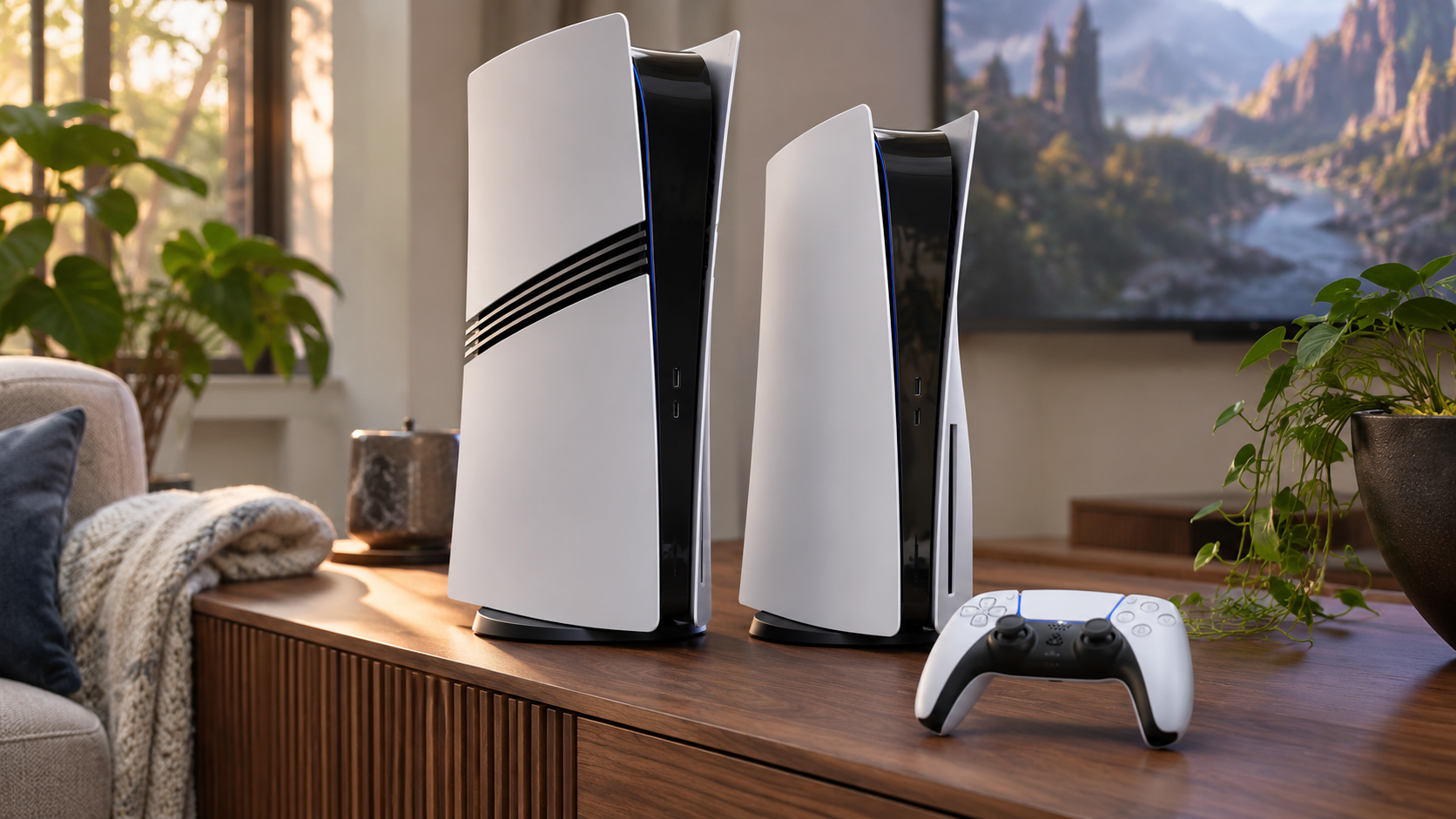
When Sony unveiled the PlayStation 5 Pro at a retail price of $699.99, it triggered an immediate debate across the gaming community. On paper, it represents the most powerful home console ever engineered. In practice, it asks players to spend significantly more money on a machine that plays the exact same library of games as the original PlayStation 5 that launched in 2020.
For prospective buyers and current console owners, the question is straightforward: what does that extra money actually buy, and will you notice the difference on your television? 
The short answer depends almost entirely on how sensitive your eyes are to frame rates, the display technology in your living room, and your willingness to pay a premium for visual polish. The PS5 Pro does not introduce a new generation of games. Instead, it eliminates the frustrating compromise between visual sharpness and fluid movement that has defined this console generation.
The Mid-Generation Dilemma: Why the PS5 Pro Exists
#During the early years of the PS5 generation, developers faced a technical ceiling. Modern rendering techniques like dynamic lighting, volumetric fog, and ray tracing demand immense computing power. To run games at a fluid 60 frames per second, studios routinely cut internal rendering resolutions down to 1080p or 1440p, relying on basic software upscalers like AMD FSR2 to stretch the image onto 4K screens.
The result was a permanent fork in game options:
- Fidelity Mode: Sharp native or near-native 4K resolution, full geometric detail, and rich lighting, but locked to an unforgiving 30 frames per second that feels sluggish and juddery in fast-paced action.
- Performance Mode: Smooth, responsive 60 frames per second gameplay, but often at the cost of muddy textures, shimmering edges, ghosting motion artifacts, and aggressive blur on large television screens.
According to telemetry data shared by Sony, roughly three out of four PS5 players consistently choose Performance Mode over Fidelity Mode. Gamers overwhelmingly prefer smooth movement over still-frame beauty. The PS5 Pro was engineered specifically to solve this dilemma by delivering Fidelity-grade image quality while maintaining a rock-solid 60 frames per second.
Hardware Breakdown: The Big Three Architectural Upgrades
#To bridge this performance gap without breaking compatibility with existing game engines, Sony focused its engineering budget on three core pillars: an expanded graphics processing unit, dedicated hardware for machine learning upscaling, and an overhauled ray tracing architecture.
| Specification | Base PS5 / PS5 Slim | PlayStation 5 Pro | Practical Impact |
|---|---|---|---|
| GPU Architecture | AMD RDNA 2 (36 Compute Units) | Upgraded AMD RDNA (60 Compute Units) | 67% more compute units deliver up to 45% faster rendering |
| Memory Bandwidth | 16 GB GDDR6 at 448 GB/s | 16 GB GDDR6 at 576 GB/s + 2 GB DDR5 | 28% faster bandwidth feeds complex 4K assets smoothly |
| Ray Tracing Performance | Standard RDNA 2 hardware acceleration | Advanced custom ray tracing pipelines | Ray intersections calculate 2x to 3x faster |
| AI Upscaling Engine | Software-based TAA / AMD FSR 2 | PSSR (PlayStation Spectral Super Resolution) | Reconstructs 4K from lower base resolution without blur |
| Internal SSD Storage | 825 GB (Original) / 1 TB (Slim) | 2 TB High-Speed Custom NVMe SSD | Over double the usable space for modern 100GB+ installs |
| Disc Drive | Included (Standard) / Modular (Slim) | Not included (sold separately for $79.99) | Digital-only out of the box; extra cost for physical media |
| Vertical Stand | Included (Original) / Sold separately (Slim) | Not included (sold separately for $29.99) | Stand sold separately; horizontal clips included |
| Wireless Networking | Wi-Fi 6 (802.11ax) | Wi-Fi 7 (802.11be) | Lower latency and faster local network transfers |
| Launch Price | $449.99 (Digital) / $499.99 (Disc) | $699.99 (Digital only) | Significant price jump before modular add-ons |
1. The Upgraded GPU
#The central processing unit (CPU) in the PS5 Pro remains largely identical to the base console: an 8-core, 16-thread AMD Zen 2 chip, with an optional 10% frequency boost taking it from 3.5 GHz up to 3.85 GHz. Because CPU architecture remained stable, games that are strictly CPU-bound—such as open-world simulations with complex crowd logic—will not see doubling frame rates.
The heavy lifting happens entirely in the GPU. Sony expanded the compute unit count from 36 on the base model to 60 on the Pro, representing a 67% hardware expansion. Combined with a 28% increase in memory speed, the Pro renders raw graphical scenes up to 45% faster. This extra muscle gives developers the headroom needed to sustain higher baseline resolutions before upscaling.
2. Advanced Ray Tracing
#Ray tracing simulates the physical behavior of light rays as they bounce off surfaces, creating photorealistic reflections, glass refractions, and ambient shadows. On the base PS5, enabling ray tracing almost always forces a game into 30fps mode because tracing hundreds of light paths per pixel bottlenecks the graphics pipeline.
The PS5 Pro incorporates advanced ray tracing features derived from newer AMD architectures, allowing rays to be cast at two to three times the speed of the base console. Games like Gran Turismo 7 and Alan Wake 2 can now render realistic vehicle reflections, mirror surfaces, and complex light bounces in real time while maintaining fluid 60fps targets.
3. PSSR: PlayStation Spectral Super Resolution
#The most transformative feature on the PS5 Pro is not raw brute-force rendering, but artificial intelligence. PSSR is Sony's proprietary machine learning upscaling algorithm, functioning similarly to NVIDIA's Deep Learning Super Sampling (DLSS) on high-end gaming PCs.
Under previous methods like AMD FSR2, the console attempted to fill in missing pixels using mathematical heuristics and temporal motion vectors. When games moved quickly, this frequently caused shimmering, blurred fine details, and disorienting ghost trails behind characters. 
PSSR utilizes a dedicated custom neural network processor built directly into the Pro's silicon. The neural network analyzes every frame on a pixel-by-pixel basis, comparing low-resolution inputs against millions of trained reference images to intelligently reconstruct fine edges, foliage, clothing textures, and text. A game rendering internally at 1080p or 1200p can be reconstructed by PSSR into an output that looks virtually indistinguishable from native 4K, all without placing enormous strain on the rendering cores.
Fidelity vs Performance: How the Pro Solves the 30fps Problem
#The tangible benefit of these hardware upgrades becomes clear the moment you boot an enhanced title. On the base PS5, switching between modes always felt like an uncomfortable trade-off.
Consider an open-world title like Final Fantasy VII Rebirth. On the base PS5, playing in Graphics Mode produced crisp characters and gorgeous panoramic views of the planet, but panning the camera caused noticeable motion stutter. Switching to Performance Mode made combat feel responsive and fluid, but the entire screen became bathed in a vaseline-like blur that degraded fine facial details and distant terrain.
On the PS5 Pro, the dedicated "Pro Enhanced" mode effectively gives you the razor-sharp visual fidelity of Graphics Mode running at the silky 60fps responsiveness of Performance Mode. You no longer have to sacrifice visual clarity for gameplay comfort.
For competitive and fast-action games, the Pro also opens the door to 120Hz modes with cleaner resolutions and fewer frame drops, provided your television supports high-bandwidth input.
The Hidden Costs: Disc Drives, Vertical Stands and Total Price
#While the hardware improvements are substantial, the packaging and pricing structure of the PS5 Pro requires careful scrutiny before opening your wallet.
The baseline price of $699.99 USD (£699.99 in the UK, €799.99 in Europe) only covers the console itself, a single DualSense wireless controller, an HDMI cable, and two small plastic feet designed to stabilize the machine when lying horizontally.
If you are an owner of physical game discs or 4K Blu-ray movies, you must budget for modular add-ons:
- Detachable Ultra HD Blu-ray Disc Drive: $79.99 USD. The PS5 Pro uses the same snap-on modular disc drive introduced with the PS5 Slim. If you already own physical discs, this is an unavoidable expense.
- Official Vertical Stand: $29.99 USD. If you prefer to display your console vertically on your entertainment center, Sony no longer includes the circular metal stand that shipped with the 2020 launch console.
When you combine the base console, the modular disc drive, the vertical stand, and applicable sales tax, the total financial investment approaches $850 to $900 USD. That is nearly double the street price of a standard PS5 Slim Disc Edition.
Display Requirements: Do You Need an HDMI 2.1 TV?
#Buying a high-end console without an appropriate television is one of the most common mistakes consumers make. The PS5 Pro will output an image to any standard 1080p or 4K screen with an HDMI port, but you will not experience its full capabilities on older hardware.
To get the full return on your investment, your television should feature:
- True 4K Resolution (3840 x 2160): PSSR's reconstruction algorithms are designed to resolve ultra-fine sub-pixel details onto 4K panels. On a 1080p monitor or television, the visual difference between base and Pro will appear negligible.
- 120Hz Refresh Rate with HDMI 2.1: Modern Pro Enhanced games frequently utilize 40fps balanced modes or uncapped 60-to-120fps performance targets. These high-bandwidth modes require an HDMI 2.1 port capable of handling 4K at 120Hz.
- Variable Refresh Rate (VRR): VRR synchronizes your TV's refresh rate directly with the console's frame output, eliminating screen tearing and smoothing out small frame drops. On the Pro, VRR allows games with unlocked frame rates to float comfortably between 70 and 100fps without visual hitching.
- Quality HDR (OLED or Mini-LED): Because the Pro pushes significantly more advanced ray tracing and lighting effects, high dynamic range displays with deep black levels and high peak brightness make atmospheric lighting pop in ways budget edge-lit LED panels cannot replicate.
If you are currently gaming on a standard 60Hz 4K TV without VRR, or on an older 1080p screen, upgrading your television will produce a far more dramatic visual upgrade than buying a PS5 Pro.
Who Should Buy the PS5 Pro (and Who Should Stick with Base)
#The PS5 Pro is not a mass-market console designed for casual players. It is an enthusiast-tier device aimed at dedicated gamers with high-end audiovisual setups.
You Should Buy the PS5 Pro If:
#- You own a high-end 4K OLED or Mini-LED TV with 120Hz, HDMI 2.1, and VRR support.
- You hate 30fps frame rates but get annoyed by the soft, blurry resolutions of standard Performance Modes.
- You play visually ambitious action games and RPGs where image clarity and fluid motion directly impact your enjoyment.
- You do not already own a PS5 and want the most future-proof console available for the next four years.
You Should Stick with the Base PS5 / PS5 Slim If:
#- You game on a standard 60Hz television, an older screen, or sit more than eight to ten feet away from a moderate-sized display where pixel-level resolution differences are impossible for human eyes to resolve.
- You are satisfied with the performance and visuals of current PS5 games, which remain visually stunning on the base hardware.
- You have a strict budget and want the best price-to-performance value in modern console gaming.
- You heavily rely on physical discs and object to paying extra for modular add-ons.
Final Verdict
#The PlayStation 5 Pro delivers on its core technical promise: it effectively banishes the 30fps compromise, offering crisp 4K fidelity powered by PSSR alongside responsive 60fps action. For hardware enthusiasts who demand uncompromised visuals on modern displays, it represents the pinnacle of living room gaming.
However, at $699.99 without a disc drive or stand, it remains an expensive luxury rather than an essential upgrade. If you already enjoy your base PS5, there is no urgency to replace it; every major upcoming game will continue to run well on the machine already sitting in your entertainment center.