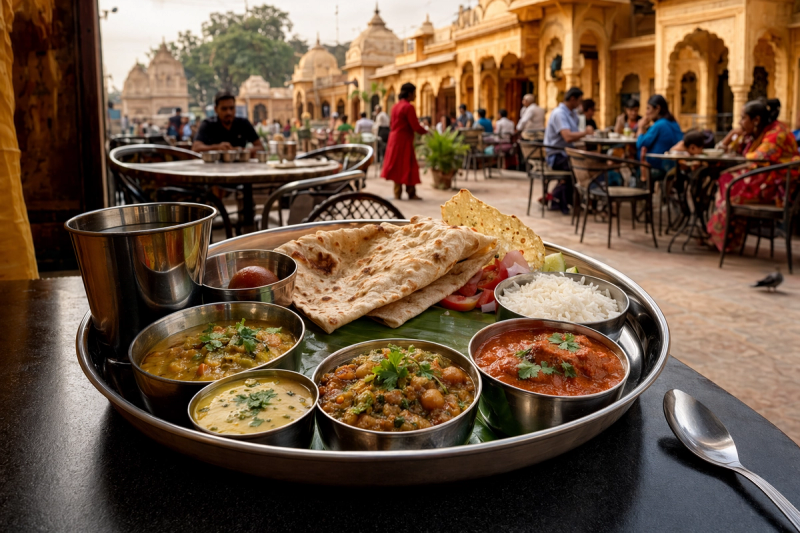
The first time I sat in front of a proper Indian thali, I honestly thought I had made a mistake. Not a small one either. A big, metal-plate, twelve-little-bowls kind of mistake. I was in Jaipur, sweating through my linen shirt like a tragic tourist, and this waiter kept arriving with more food. Dal, sabzi, kadhi, chutney, pickle, rice, roti, papad, something sweet, something sour, something that looked innocent but later tried to murder my tongue. I remember thinking, wait… is this all for me? And yes. It was. That’s the thing about a thali. It looks like a meal, but actually it’s a tiny edible map of a region, a family kitchen, a climate, a religion, and sometimes somebody’s grandmother’s very strong opinions.
I’ve travelled across India a few times now, usually planning my day around lunch instead of monuments, which probably says something about me. Delhi, Mumbai, Ahmedabad, Bengaluru, Kochi, Jaipur, Chennai, Udupi, even a rainy little stop near Guwahati where I had an Assamese-style plate that completely changed how I thought about “Indian food.” And if you’re a foreigner coming to India in 2026, the thali is still one of the best ways to understand the country fast. Like, faster than any museum audio guide. But it can also be confusing. Spicy? Sometimes. Hygienic? Depends where you eat and what you choose. Overwhelming? Oh absolutely. Worth it? Every single time.
So What Actually Is a Thali?
#A thali is basically a full meal served on one big plate, often with small bowls called katoris. But that description is kind of boring and doesn’t do it justice. A good thali is about balance. You’ll usually get something spicy, something cooling, something crunchy, something sweet, something fried if luck is smiling at you, rice, bread, lentils, vegetables, maybe yogurt, maybe pickle, and sometimes a dessert that arrives before you understand what’s happening.
The word “thali” also means the plate itself, so yes, the dish is named after the plate. Which feels very Indian in the most practical way. In many places, servers keep refilling your food until you surrender. In Gujarat and Rajasthan especially, they can be beautifully aggressive about it. You say “bas, bas,” meaning enough, and they smile like they didn’t hear you and add more dal. I respect this deeply.
For foreigners, the best thing about a thali is that you don’t have to decode a giant menu. You sit down, order one thing, and suddenly you’ve got a whole regional spread. It’s like a tasting menu, except not precious, not tiny, and usually much cheaper than anything calling itself a tasting menu in Europe or North America.
Why Thalis Are Having a Moment With Food Travellers in 2026
#Food travel has shifted a lot lately. People aren’t just chasing famous restaurants anymore. They want regional plates, homestays, cooking classes, temple meals, farm lunches, millet dishes, women-led kitchens, and walking tours where someone explains why a chutney tastes smoky or why one dal is made for summer and another for monsoon. I’ve noticed this especially in India. The big glossy “best restaurants” list still matters, sure, but a lot of travellers I meet now are more excited about a banana-leaf meal in Kerala or a Gujarati thali in Ahmedabad than a fancy hotel buffet.
There’s also this big push toward hyperlocal and sustainable eating. Millets are everywhere after India’s recent millet revival, and in 2026 you’ll see ragi, jowar, bajra, and little millet popping up in thalis, hotel breakfasts, airport snacks, and even modern cafes in Bengaluru and Mumbai. QR menus and UPI payments are common in cities now, which makes ordering easier, though some tiny places still run on cash and head wobbles. Food walks in Old Delhi, Jaipur, Mumbai’s Khau Gallis, Fort Kochi, and Kolkata are still popular, but the newer trend I love is regional thali trails. Not just “eat Indian food,” but eat a Malvani seafood thali in Mumbai, a Sadya in Kerala, a Bohri thaal if you can find a hosted meal, a Rajasthani thali in Jaipur, a Bengali plate in Kolkata.
My First Real Thali: Jaipur, Too Much Ghee, Zero Regrets
#My thali baptism happened in Jaipur after I’d spent the morning pretending I wasn’t tired at Amber Fort. I ducked into a thali restaurant because the sign said “Rajasthani Special” and the room was full of local families. Good sign. The plate came with dal baati churma, gatte ki sabzi, ker sangri, kadhi, rotis, rice, chutneys, papad, and a sweet churma that tasted like toasted wheat, sugar, and childhood, even though it was not my childhood.
Rajasthani food can be rich. Like, royal-family-rich. Ghee is not shy there. The baati, a hard baked wheat ball, gets cracked open and flooded with ghee. The dal is earthy and peppery. Ker sangri is made from desert beans and berries, and it has this tangy, slightly wild flavor that I still crave. I thought the red garlic chutney was a harmless dip. It was not harmless. I put a heroic spoonful on my roti and spent the next five minutes quietly blinking at the ceiling fan.
But that meal taught me the first foreigner rule of thali eating: sample before committing. Don’t scoop a huge amount of anything bright red until you know what it is. Indian food is generous, but it is not always gentle.
How to Handle Spice Without Acting Brave and Ruining Your Day
#Let’s talk about spice, because this is what most first-time visitors worry about. Indian food is not all “hot” in the same way. Some dishes are chili-hot, some are peppery, some are warm from cumin and coriander, some are sour and fermented, some are smoky, some are just aromatic. Also, spice levels change wildly by region and restaurant. A tourist-friendly place in Delhi may serve a mild butter paneer, while a local Andhra meal in Hyderabad or Bengaluru can hit like a small controlled explosion.
- Learn the phrase “kam mirchi” or “less chili.” It helps, though it doesn’t guarantee Western-level mild.
- Start with rice, dal, curd, and mild vegetable dishes before touching the pickle and red chutney.
- If your mouth burns, don’t chug water like I did in Chennai. Eat yogurt, rice, bread, or something sweet. Water just moves the fire around.
- Ask for “not spicy” and then mentally prepare for “still a little spicy,” because definitions are different.
- Avoid proving yourself. Nobody cares if you can eat the hottest thing. Actually some people will encourage you, but don’t listen to them.
In South India, especially Andhra and parts of Telangana, chili can be serious business. In Rajasthan, the laal maas crowd knows what heat is. In Gujarat, the thali may be sweeter and less fiery, although pickles can still surprise you. Kerala meals often balance chili with coconut, curry leaves, tamarind, and buttermilk. Bengali meals feel gentler to me, more mustardy and fish-forward, but one green chili hiding in dal can still ambush you. India keeps you humble.
Hygiene: The Stuff Nobody Wants to Talk About Until Their Stomach Does
#I love eating in India. I really do. But I also travel with oral rehydration salts, hand sanitizer, and a very realistic view of my stomach. Hygiene is not about being paranoid or insulting local food. It’s about being smart while your body adjusts to new water, oils, bacteria, spices, and cooking styles. Locals have grown up with this food environment. You haven’t. That’s just biology, not drama.
The safest thali is usually one served hot, at a busy restaurant with high turnover. Busy is important. Food that sits around for ages is where trouble starts. I look for families eating there, office workers, clean tables, visible hand-washing areas, and staff who seem organized rather than chaotic. Fancy doesn’t always mean safe, by the way. Some of my best and cleanest meals were in simple canteen-style places where food moved quickly and everyone knew exactly what they were doing.
- Drink sealed bottled water or properly filtered water. Check the seal if you’re buying bottles.
- Avoid ice unless you trust the place. In big hotels and good cafes it’s usually fine, but roadside stalls? I skip it.
- Be careful with raw salads, cut fruit, and watery chutneys at unknown places.
- Hot food is your friend. Freshly cooked dal, rice, roti, sabzi, sambar, rasam, all good signs.
- Wash hands before eating. Many thalis are eaten partly with the hand, and honestly it tastes better that way.
- Carry tissues. Not every small restaurant has napkins, and this is one of those tiny travel truths nobody puts on postcards.
North Indian Thali: Rich, Comforting, and Usually a Bit Dramatic
#A North Indian thali often includes roti or naan, rice, dal, paneer or a vegetable curry, yogurt or raita, pickle, salad, papad, and dessert like gulab jamun, kheer, or halwa. In Delhi, you’ll see everything from simple lunch thalis in Connaught Place canteens to elaborate hotel versions. Delhi is a fantastic thali city because it pulls from Punjab, Uttar Pradesh, Rajasthan, and beyond. But Delhi can also be heavy. Cream, butter, and paneer show up like enthusiastic relatives.
If you’re in Delhi, I still think the best food experiences are often around older neighborhoods, but for thali-style meals I usually suggest starting somewhere established and busy before going full street-food explorer. Saravana Bhavan in Connaught Place is technically South Indian and not North Indian, but I mention it because it’s reliable, popular, and a gentle first landing for many foreign visitors. For North Indian comfort, look for busy vegetarian restaurants around Karol Bagh, CP, or family dining places recommended by locals. Ask your hotel staff where they eat lunch, not where tourists eat. Big difference.
Gujarati Thali: Sweet, Savory, Unlimited, and Dangerous if You Have Plans After
#Ahmedabad is one of my favorite food cities in India. People talk about Jaipur and Delhi more, but Ahmedabad has this incredible vegetarian food culture that feels both disciplined and indulgent. A Gujarati thali can include dal, kadhi, farsan snacks like dhokla or khandvi, several vegetable dishes, rotli, puri, rice, khichdi, pickle, chutney, buttermilk, and sweets. The flavors are often sweet-sour-spicy, and at first I wasn’t sure if I liked sugar in dal. Then, halfway through my second Gujarati thali, I realized I had stopped questioning and started reaching for more.
Agashiye in Ahmedabad is a well-known heritage thali experience, set in a beautiful old house, and it’s popular for a reason. It’s not the cheapest meal in town, but if you want atmosphere and a polished introduction, it works. In Mumbai, Shree Thaker Bhojanalay in Kalbadevi is famous for Gujarati thali and still one of those places food people whisper about with hungry eyes. Go early, go hungry, and don’t act shocked when the refills come. They will come.
South Indian Thali: Banana Leaves, Sambar, Rasam, and Pure Joy
#South Indian meals were where I learned that “thali” doesn’t always mean a metal plate. In Tamil Nadu, Kerala, Karnataka, and Andhra, meals are often served on banana leaves, especially in traditional places. There’s rice, sambar, rasam, poriyal or vegetable stir-fry, kootu, appalam, pickle, curd, and sometimes payasam. The order matters, the mixing matters, and if you’re new, just watch the locals for two minutes. You’ll learn more than from any guidebook.
In Chennai, I had a lunch meal where the server ladled sambar onto my rice with the speed of someone who had done this 9 million times. Then came rasam, thin and peppery and somehow medicinal in the best way. Then curd rice at the end, cooling everything down. I left feeling full but not wrecked. That’s the magic of a good South Indian meal. It can be generous without making you feel like you swallowed a sofa.
Bengaluru has become a serious food-travel base in 2026 because you can eat traditional Karnataka meals one day, modern millet bowls the next, then go find a fiery Andhra meals place that makes you question your life choices. MTR in Bengaluru is historic and famous for South Indian food, though expect crowds. For a coastal Karnataka or Udupi-style experience, look for old-school vegetarian restaurants where office workers queue at lunch. Those queues are basically Michelin stars, but louder.
Kerala Sadya: The Feast I Still Think About When It Rains
#A Kerala sadya is not just lunch. It’s choreography. Served on a banana leaf, usually vegetarian, with rice and many sides: avial, olan, thoran, erissery, sambar, rasam, pachadi, kichadi, pickle, banana chips, pappadam, and payasam. During Onam it becomes even more elaborate, but you can find sadya-style meals year-round in many Kerala restaurants and homestays.
My best sadya was near Kochi, at a homestay where the auntie cooking kept saying “little more?” and then giving me not a little more. Coconut was everywhere but never boring. Curry leaves crackled in oil, the pachadi was cool and slightly sweet, the avial was creamy and vegetable-packed, and the payasam at the end made me weirdly emotional. Maybe I was tired. Maybe it was the jaggery. Travel does that to you.
Hygiene-wise, Kerala was one of the easier places for me because many meals are freshly cooked, rice-based, and served hot. Still, same rules apply. Choose busy places, be cautious with water, and don’t eat raw things from random roadside stalls on day one. Give your stomach a chance to negotiate.
Maharashtrian, Bengali, Assamese, and Other Thalis You Shouldn’t Miss
#India is too big for one thali story, which is exactly why it’s fun. In Mumbai, I love a Maharashtrian thali with varan bhaat, amti, batata bhaji, usal, chapati, rice, pickle, solkadhi if it’s coastal, and maybe shrikhand or puran poli. If you eat seafood, a Malvani fish thali is one of Mumbai’s great pleasures: fried fish, curry, rice, solkadhi, and that deep coconut-chili flavor that tastes like the Konkan coast.
In Kolkata, a Bengali meal might bring rice, dal, bhaja, shukto, fish curry, chutney, mishti doi, and sweets that make you understand why Bengalis are so proud of dessert. The mustard oil flavor can be new for foreigners. I hated it for about four seconds, then loved it. In Assam, the plate I had was lighter, more herbal, with rice, dal, leafy greens, mashed potato with mustard oil, fish tenga, and fermented or smoked flavors that felt completely different from the restaurant Indian food I grew up seeing abroad.
This is my biggest advice: don’t come to India looking for one “Indian thali.” Come looking for many. A Punjabi thali and a Tamil meal and a Gujarati thali and an Assamese plate are not variations of the same thing. They’re different worlds sharing a border.
How to Eat a Thali Without Looking Too Lost
#First, relax. Nobody expects foreigners to know everything. Usually people are happy if you’re curious and respectful. If you want to eat with your hand, use your right hand. Mix small portions of rice with dal or curry using your fingertips, not your whole palm. It feels awkward for five minutes, then suddenly it makes sense. Bread like roti, puri, or chapati is used to scoop curries. Don’t dump all the bowls together immediately unless that’s clearly how locals are eating. Taste things one by one first.
- Start with mild items: dal, rice, bread, vegetables.
- Use pickle like a condiment, not a side dish. Trust me on this.
- Save curd or buttermilk for cooling your stomach toward the end.
- If servers refill your plate, say “bas” or gently cover the bowl with your hand if you’re done.
- Try the sweet even if you’re full. This is not medical advice, it’s just how happiness works.
Also, thali portions can be huge. If you’re travelling in hot weather, a massive lunch can knock you out. I’ve lost entire afternoons to “just one thali.” Plan accordingly. Maybe don’t schedule a fort climb or three-hour walking tour right after an unlimited Rajasthani lunch. I say this as someone who has made that exact bad decision.
Vegetarian, Vegan, Gluten-Free, and Allergy Notes
#Vegetarians will have an easy time in most of India, especially Gujarat, Rajasthan, Karnataka, Tamil Nadu, and many pilgrimage towns. Vegan travellers can manage too, but you need to watch for ghee, butter, curd, paneer, and milk-based sweets. Say “no ghee, no butter, no milk, no curd” clearly. In Hindi, “doodh” is milk, “dahi” is curd, “makhan” is butter, and “ghee” is ghee. In South India, coconut-based dishes can be vegan, but ghee may still appear on rice or sweets.
Gluten-free is trickier but possible. Rice is everywhere. Many South Indian meals are rice-based, and dishes made with ragi or millet are increasingly common in 2026 because of the ongoing millet trend. But wheat rotis, puris, and some fried snacks are common, and cross-contamination can happen. If you have celiac disease or serious allergies, carry translated allergy cards. Don’t rely on a rushed waiter during peak lunch to understand every detail. That’s not fair to them or safe for you.
Where I’d Send a First-Time Visitor for Thali in 2026
#If a friend was landing in India for the first time and asked me how to begin, I’d build the trip around cities that give you variety without making the logistics too wild. Delhi for the grand messy introduction, Jaipur or Udaipur for Rajasthani food, Ahmedabad for Gujarati thali, Mumbai for regional diversity and coastal meals, Bengaluru or Chennai for South Indian meals, and Kochi for Kerala sadya and seafood if they eat fish. That route is not “all of India,” because nothing is, but it gives you a beautiful spread.
For reliable starts, choose places with established reputations: Agashiye in Ahmedabad for a heritage Gujarati thali, Shree Thaker Bhojanalay in Mumbai for Gujarati food, MTR in Bengaluru for classic South Indian dishes, Saravana Bhavan branches for a predictable South Indian vegetarian meal in several cities, and good Kerala restaurants or homestays around Kochi for sadya-style meals. In Jaipur, thali restaurants and heritage dining spots are everywhere, but ask locally because quality shifts and tourist traps exist. The best current tip is still the oldest one: eat where locals are eating.
A thali is the closest thing I’ve found to travelling across a region without leaving your chair. It’s geography with rice, memory with pickle, and occasionally, yes, a chili that humbles you.
My Personal Thali Safety Kit
#I don’t travel India with fear, but I do travel prepared. My little food kit is boring but useful: hand sanitizer, oral rehydration salts, activated charcoal sometimes, basic stomach meds from a doctor, tissues, a refillable bottle with a good filter for certain trips, and mints because raw onion chutney is powerful. I also try not to eat ten new things on the first day. Jet lag plus chili plus street snacks plus beer equals a sad hotel bathroom story, and I’m not trying to collect more of those.
One thing I’ve learnt is that your stomach adapts. Day one, be gentle. Day two, maybe a proper thali. Day three, maybe a food walk. Don’t go from airport to pani puri stall in two hours unless you are either very brave or very foolish. I’ve been both, and foolish has more evidence.
Final Thoughts: Let the Thali Teach You
#The best Indian thalis are not just meals. They’re conversations. Sometimes with the waiter who insists you need more kadhi, sometimes with the auntie at a homestay who explains which pickle is homemade, sometimes with yourself when you realize you’ve been eating “Indian food” abroad for years and barely knew anything. That’s what I love about food travel. It corrects you, kindly but firmly. It says, here, taste this, you don’t know everything yet.
So if you’re a foreigner heading to India in 2026, don’t be scared of the thali. Respect it. Go slow with spice, choose clean and busy places, drink safe water, ask questions, and don’t be shy about saying “less chili” or “no more, please.” You’ll mess up a little. You’ll probably burn your tongue at least once. You may overeat because the refills are sneaky. But you’ll also remember these meals long after the palaces, beaches, markets, and hotel rooms blur together. And if you want more food-travel rambles and practical guides like this, have a look at AllBlogs.in sometime. It’s the kind of rabbit hole I fall into when I’m hungry and pretending to plan responsibly.