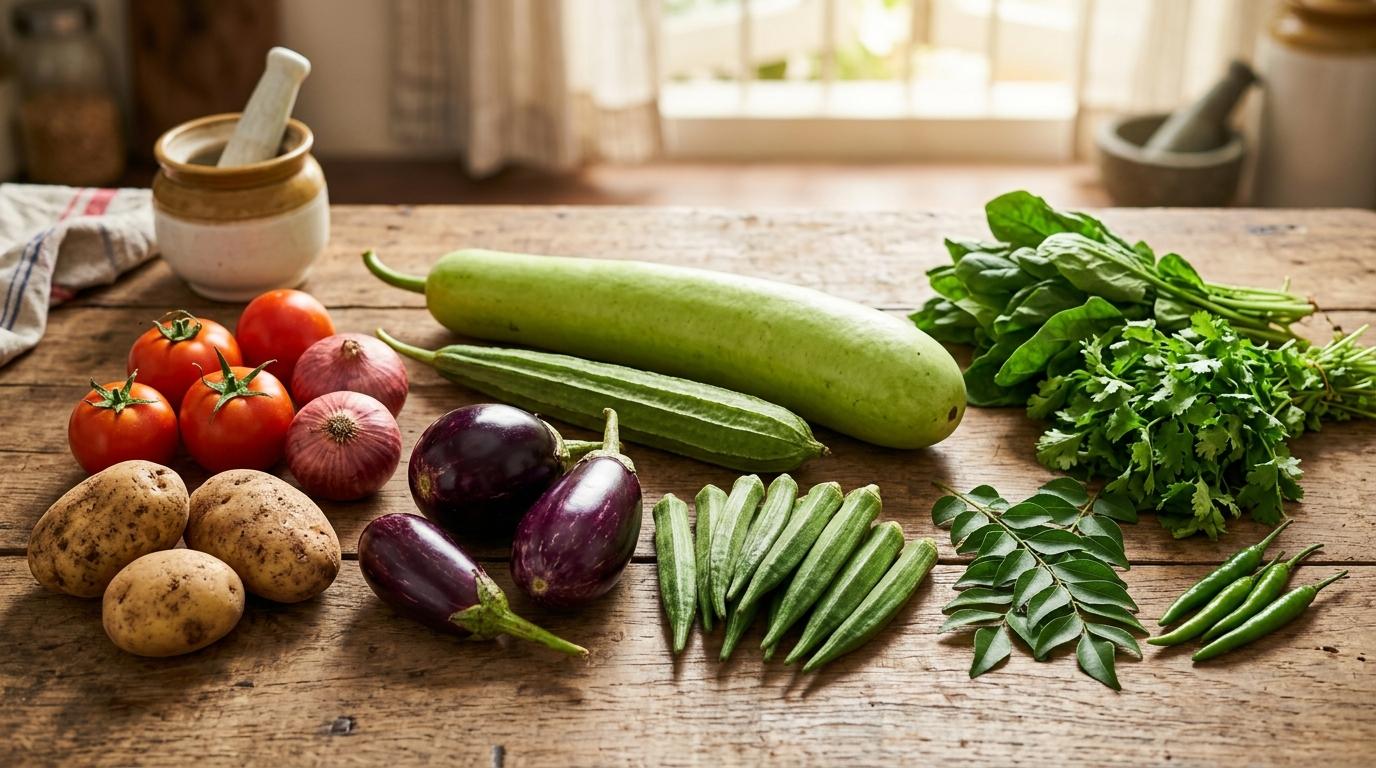
If you cook Indian food, you’ve probably had this moment at least once: a recipe says dudhi, sorakaya, vazhuthananga, peerkangai, or dodka… and you know exactly what it looks like, but you’re not sure what to call it in English.
Or the opposite happens. You’re standing in a grocery store, staring at a label that says “bottle gourd” or “okra,” and wondering, “Is this the same as lauki? Is lady’s finger okra?”
This guide is meant for exactly those everyday kitchen situations.
Below, you’ll find common Indian vegetables in English along with their names in Hindi, Gujarati, Marathi, Tamil, Telugu, and Malayalam. Use it while reading regional recipes, making grocery lists, shopping abroad, or simply matching the name your family uses with the one written in a cookbook.
One quick note before we start: Indian vegetable names vary a lot. The same vegetable may have different names from one region to another, and sometimes even from one family to another. So think of this as a helpful kitchen guide, not a rigid dictionary. When in doubt, match the name with the vegetable’s appearance and how it is used in the dish.
Quick Answer: Common Indian Vegetables in English
#Some of the most common Indian vegetable names are:
- Potato — Hindi: aloo; Gujarati: bataka; Marathi: batata; Tamil: urulaikizhangu; Telugu: bangaladumpa; Malayalam: urulakizhangu.
- Onion — Hindi: pyaaz; Gujarati: dungli; Marathi: kanda; Tamil: vengayam; Telugu: ullipaya; Malayalam: ulli.
- Tomato — Hindi: tamatar; Gujarati: tameta; Marathi: tomato; Tamil: thakkali; Telugu: tomato; Malayalam: thakkali.
- Brinjal / Eggplant — Hindi: baingan; Gujarati: ringan; Marathi: vangi; Tamil: kathirikai; Telugu: vankaya; Malayalam: vazhuthananga.
- Bottle gourd — Hindi: lauki or doodhi; Gujarati: dudhi; Marathi: dudhi; Tamil: suraikkai; Telugu: sorakaya; Malayalam: churakka.
- Ridge gourd — Hindi: turai or tori; Gujarati: turia; Marathi: dodka; Tamil: peerkangai; Telugu: beerakaya; Malayalam: peechinga.
- Ash gourd — Hindi: petha or safed petha; Gujarati: petha or kohlu; Marathi: kohala; Tamil: neer poosanikai; Telugu: boodida gummadikaya; Malayalam: kumbalanga.
- Okra / Lady’s finger — Hindi: bhindi; Gujarati: bhinda; Marathi: bhendi; Tamil: vendakkai; Telugu: bendakaya; Malayalam: vendakka.
If you’re also learning fruit names, you may find this AllBlogs guide to Indian fruits in English useful too.
Common Confusions in Indian Vegetable Names
#Some vegetables are easy to identify in the market but confusing on paper. That’s usually because one vegetable may have several English names, or because Indian English, British English, and American English use different terms.
Brinjal, Eggplant, and Aubergine
#These are three names for the same vegetable.
In India, we usually say brinjal. In American English, it is called eggplant. In British English and many international cookbooks, you may see aubergine.
Regional names include:
- Hindi: baingan
- Gujarati: ringan
- Marathi: vangi
- Tamil: kathirikai
- Telugu: vankaya
- Malayalam: vazhuthananga
So if a recipe says baingan bharta, vangi bhaji, ennai kathirikai, or vankaya curry, it is talking about brinjal.
Bottle Gourd vs Ridge Gourd
#These two are often mixed up because both are green gourds used in everyday Indian cooking.
Bottle gourd is smooth, pale green, and mild in taste. It is called lauki, doodhi, dudhi, sorakaya, or churakka, depending on the language. It is used in dals, simple sabzis, curries, kofta-style dishes, and even sweets.
Ridge gourd has visible ridges running along its length. It is called turai, tori, turia, dodka, peerkangai, beerakaya, or peechinga. It has a slightly more fibrous texture, and in many homes, even the peel is used to make chutney.
A simple way to remember it: bottle gourd is smooth; ridge gourd has ridges.
Ash Gourd vs Bottle Gourd
#Ash gourd and bottle gourd are not the same.
Ash gourd is also called winter melon. It is usually larger, with pale skin that may look whitish or powdery. The flesh inside is firm and white. In India, it is used in curries, stews, and sweets like petha.
Bottle gourd is smoother, softer, and more tender when young. In most Indian kitchens, lauki and dudhi mean bottle gourd, not ash gourd.
Okra and Lady’s Finger
#In India, okra is commonly called lady’s finger. Both names refer to the same vegetable.
Regional names include bhindi, bhinda, bhendi, vendakkai, bendakaya, and vendakka.
If you are shopping outside India, especially in Western supermarkets, the label will usually say okra.
Indian Vegetable Names in English and Regional Languages
#Use these grouped lists when reading recipes, writing shopping lists, or explaining vegetables across languages. The names may not cover every regional variation, but they work well for most home cooking.
1. Everyday Base Vegetables
#These are the vegetables most Indian kitchens use almost every week, if not every day.
- Potato — Hindi: aloo; Gujarati: bataka; Marathi: batata; Tamil: urulaikizhangu; Telugu: bangaladumpa; Malayalam: urulakizhangu.
- Onion — Hindi: pyaaz; Gujarati: dungli; Marathi: kanda; Tamil: vengayam; Telugu: ullipaya; Malayalam: ulli.
- Tomato — Hindi: tamatar; Gujarati: tameta; Marathi: tomato; Tamil: thakkali; Telugu: tomato; Malayalam: thakkali.
- Carrot — Hindi: gajar; Gujarati: gajar; Marathi: gajar; Tamil: carrot; Telugu: carrot; Malayalam: carrot.
- Radish — Hindi: mooli; Gujarati: mula; Marathi: mula; Tamil: mullangi; Telugu: mullangi; Malayalam: mullangi.
- Beetroot — Hindi: chukandar; Gujarati: beet; Marathi: beet; Tamil: beetroot; Telugu: beetroot; Malayalam: beetroot.
- Cucumber — Hindi: kheera or kakdi; Gujarati: kakdi; Marathi: kakdi; Tamil: vellarikkai; Telugu: keera or dosakaya; Malayalam: vellarikka.
2. Gourds and Squashes
#Gourds are a big part of Indian cooking, especially in dals, kootu, sabzi, sambar, pachadi, and light everyday curries.
- Bottle gourd — Hindi: lauki or doodhi; Gujarati: dudhi; Marathi: dudhi; Tamil: suraikkai; Telugu: sorakaya; Malayalam: churakka.
- Ridge gourd — Hindi: turai or tori; Gujarati: turia; Marathi: dodka; Tamil: peerkangai; Telugu: beerakaya; Malayalam: peechinga.
- Bitter gourd — Hindi: karela; Gujarati: karelu; Marathi: karle; Tamil: pavakkai; Telugu: kakarakaya; Malayalam: pavakka.
- Ash gourd / Winter melon — Hindi: petha or safed petha; Gujarati: petha or kohlu; Marathi: kohala; Tamil: neer poosanikai; Telugu: boodida gummadikaya; Malayalam: kumbalanga.
- Pumpkin — Hindi: kaddu; Gujarati: kolu; Marathi: bhopla; Tamil: poosanikai or parangikkai; Telugu: gummadikaya; Malayalam: mathanga.
- Snake gourd — Hindi: chichinda or padwal; Gujarati: padwal; Marathi: padwal; Tamil: pudalangai; Telugu: potlakaya; Malayalam: padavalanga.
- Ivy gourd — Hindi: kundru or tindora; Gujarati: tindora; Marathi: tondli; Tamil: kovakkai; Telugu: dondakaya; Malayalam: kovakka.
3. Brinjal, Okra, and Other Common Vegetables
#These are common in stir-fries, curries, dry sabzis, gravies, and everyday lunch boxes.
- Brinjal / Eggplant — Hindi: baingan; Gujarati: ringan; Marathi: vangi; Tamil: kathirikai; Telugu: vankaya; Malayalam: vazhuthananga.
- Okra / Lady’s finger — Hindi: bhindi; Gujarati: bhinda; Marathi: bhendi; Tamil: vendakkai; Telugu: bendakaya; Malayalam: vendakka.
- Capsicum / Bell pepper — Hindi: shimla mirch; Gujarati: simla marcha; Marathi: dhobli mirchi; Tamil: kudai milagai; Telugu: capsicum; Malayalam: capsicum.
- Green chilli — Hindi: hari mirch; Gujarati: marcha; Marathi: hirvi mirchi; Tamil: pachai milagai; Telugu: pachi mirapakaya; Malayalam: pachamulaku.
- Cauliflower — Hindi: phool gobi; Gujarati: phoolkobi; Marathi: phulkobi; Tamil: cauliflower; Telugu: cauliflower; Malayalam: cauliflower.
- Cabbage — Hindi: patta gobi or bandh gobi; Gujarati: kobij; Marathi: kobi; Tamil: muttaikose; Telugu: cabbage; Malayalam: cabbage or muttakoos.
- Mushroom — Hindi: mushroom; Gujarati: mashroom; Marathi: mashroom; Tamil: kaalan; Telugu: puttagodugu; Malayalam: koon.
4. Beans, Pods, and Drumstick
#These vegetables are used in dals, poriyal, sambar, curries, and mixed vegetable dishes.
- Green peas — Hindi: matar; Gujarati: vatana; Marathi: vatana; Tamil: pattani; Telugu: batani; Malayalam: pattani.
- French beans — Hindi: beans or sem; Gujarati: fansi; Marathi: farasbi; Tamil: beans; Telugu: beans; Malayalam: beans.
- Cluster beans — Hindi: gawar phali; Gujarati: guvar; Marathi: gavar; Tamil: kothavarangai; Telugu: goruchikkudu; Malayalam: kothamara.
- Broad beans / Field beans — Hindi: sem; Gujarati: val papdi or valor; Marathi: val papdi or pavta; Tamil: avarakkai; Telugu: chikkudukaya; Malayalam: avara.
- Drumstick / Moringa pod — Hindi: sahjan; Gujarati: saragvo; Marathi: shevga; Tamil: murungakkai; Telugu: munagakaya; Malayalam: muringakka.
5. Roots, Tubers, and Starchy Vegetables
#These are filling vegetables often used in curries, fries, stews, and festive dishes.
- Sweet potato — Hindi: shakarkand; Gujarati: ratalu or shakkariya; Marathi: ratale; Tamil: sakkaravalli kilangu; Telugu: chilakada dumpa; Malayalam: madhura kizhangu.
- Elephant foot yam / Yam — Hindi: jimikand or suran; Gujarati: suran; Marathi: suran; Tamil: senai kizhangu; Telugu: kanda gadda; Malayalam: chena.
- Colocasia / Taro root — Hindi: arbi; Gujarati: arbi or alvi; Marathi: arvi; Tamil: seppankizhangu; Telugu: chamagadda; Malayalam: chembu.
- Raw banana / Plantain — Hindi: kachcha kela; Gujarati: kacha kela; Marathi: kacchi keli; Tamil: vazhakkai; Telugu: aratikaya; Malayalam: kaya or pacha kaya.
6. Leafy Greens and Herbs Used in Cooking
#Leafy greens can be especially regional, so names may change from place to place. These are some of the commonly used names.
- Spinach — Hindi: palak; Gujarati: palak; Marathi: palak; Tamil: pasalai keerai; Telugu: palakura; Malayalam: cheera or palak.
- Fenugreek leaves — Hindi: methi; Gujarati: methi; Marathi: methi; Tamil: vendhaya keerai; Telugu: menthi kura; Malayalam: uluva ila.
- Amaranth leaves — Hindi: chaulai; Gujarati: tandaljo; Marathi: math; Tamil: arai keerai or thandu keerai; Telugu: thotakura; Malayalam: cheera.
- Coriander leaves — Hindi: dhania; Gujarati: kothmir; Marathi: kothimbir; Tamil: kothamalli; Telugu: kothimeera; Malayalam: malli ila.
- Curry leaves — Hindi: kadi patta; Gujarati: mitho limdo; Marathi: kadipatta; Tamil: karuveppilai; Telugu: karivepaku; Malayalam: kariveppila.
- Mint leaves — Hindi: pudina; Gujarati: fudino; Marathi: pudina; Tamil: pudina; Telugu: pudina; Malayalam: pudina.
7. Common Aromatics in Indian Cooking
#These may not always be listed under “vegetables,” but they are everyday essentials in Indian kitchens.
- Garlic — Hindi: lahsun; Gujarati: lasan; Marathi: lasun; Tamil: poondu; Telugu: vellulli; Malayalam: veluthulli.
- Ginger — Hindi: adrak; Gujarati: adu; Marathi: ale; Tamil: inji; Telugu: allam; Malayalam: inji.
How to Use This Guide While Reading Recipes
#Indian recipes often use the regional vegetable name instead of the English one. Once you get used to the pattern, it becomes much easier to understand what the dish is asking for.
For example:
- Aloo sabzi means potato sabzi.
- Baingan bharta means mashed roasted brinjal.
- Vangi bhaji means a brinjal preparation in Marathi.
- Sorakaya pappu means bottle gourd dal in Telugu cooking.
- Peerkangai kootu means ridge gourd kootu in Tamil cooking.
- Vendakkai poriyal means okra stir-fry in Tamil cooking.
- Kumbalanga curry means ash gourd curry in Malayalam cooking.
If you’re reading a regional blog, an old family recipe, or a local cookbook, search for the regional name first. Then compare it with the English name and the way the vegetable is cut or cooked.
Shopping Tips for Indian Vegetables
#Knowing the name is one thing. Picking the right vegetable is another. Here are a few simple tips that help in most Indian grocery stores and vegetable markets.
Check gourds for tenderness
#For bottle gourd, ridge gourd, snake gourd, and bitter gourd, choose vegetables that feel firm but not dry. The skin should look fresh, not wrinkled or dull.
For bottle gourd and ridge gourd, many home cooks gently press a fingernail into the skin. If it goes in easily, the gourd is usually tender. If the skin feels tough and leathery, it may be too mature and seedy inside.
Look closely at brinjal
#Brinjal should feel firm and look glossy. Avoid pieces with large soft patches, wrinkled skin, or visible holes.
Small brinjals are often used whole in stuffed dishes. Larger brinjals are usually better for bharta or chopped curries.
Choose potatoes and onions carefully
#Pick potatoes that are firm and free from soft spots. Avoid potatoes with a greenish tinge.
For onions, look for dry outer skins. Avoid onions that feel soft, damp, or sprouted.
Match the vegetable to the dish
#Indian recipes often depend a lot on texture.
- Lauki or dudhi works well when you want a soft, mild vegetable.
- Ridge gourd gives a tender but slightly fibrous texture.
- Ash gourd holds its shape better in some simmered dishes.
- Okra can turn sticky if cut and cooked with too much moisture, so many recipes cook it uncovered or fry it first.
Ask by more than one name
#At Indian grocery stores, labels can vary. The same vegetable may be marked as “okra,” “lady’s finger,” or “bhindi.” Brinjal may be labelled as eggplant. Bottle gourd may appear as lauki, dudhi, doodhi, or even opo squash in some stores.
If you’re unsure, try another regional name or describe what the vegetable looks like. In many Indian stores, shopkeepers understand several names for the same vegetable.
Storage Tips for Indian Kitchens
#Storage depends on the weather, how fresh the produce is, and how soon you plan to cook it. Still, these basic tips work well in most homes.
Keep onions and potatoes separate
#Do not store onions and potatoes together for too long. Keep them in separate, cool, dry, dark places with some ventilation.
Refrigerate tender gourds
#Bottle gourd, ridge gourd, snake gourd, ivy gourd, and okra usually keep better in the refrigerator. Store them in the crisper drawer and avoid trapping too much moisture around them.
A loose paper wrap or breathable bag can help reduce dampness.
Dry leafy greens before storing
#Leafy greens spoil quickly when stored wet. Remove damaged leaves, wrap the greens loosely in a cloth or paper towel, and refrigerate. If possible, wash them just before cooking.
Be extra careful during monsoon
#During rainy and humid weather, vegetables can spoil faster. Check for dampness, slime, bruises, and mold before storing or cooking.
For more seasonal kitchen guidance, you can read this AllBlogs guide to rainy-season vegetable safety.
A Note on Regional Name Variations
#Indian vegetable names are deeply local, and honestly, that’s part of their charm. The same vegetable may have two or three names in one language. In many cities, English names are also mixed naturally into everyday speech.
For example:
- Tomato is often just called tomato in Marathi, Telugu, and many urban kitchens.
- Cauliflower and cabbage are used as English loanwords in several Indian languages.
- Lauki, doodhi, and dudhi are all widely understood for bottle gourd in different regions.
- Brinjal, eggplant, and aubergine all mean the same vegetable, though Indian recipes usually say brinjal or baingan.
So if your family uses a slightly different name, that’s completely fine. The aim here is not to replace local names. It is simply to make shopping, cooking, and recipe reading a little easier.