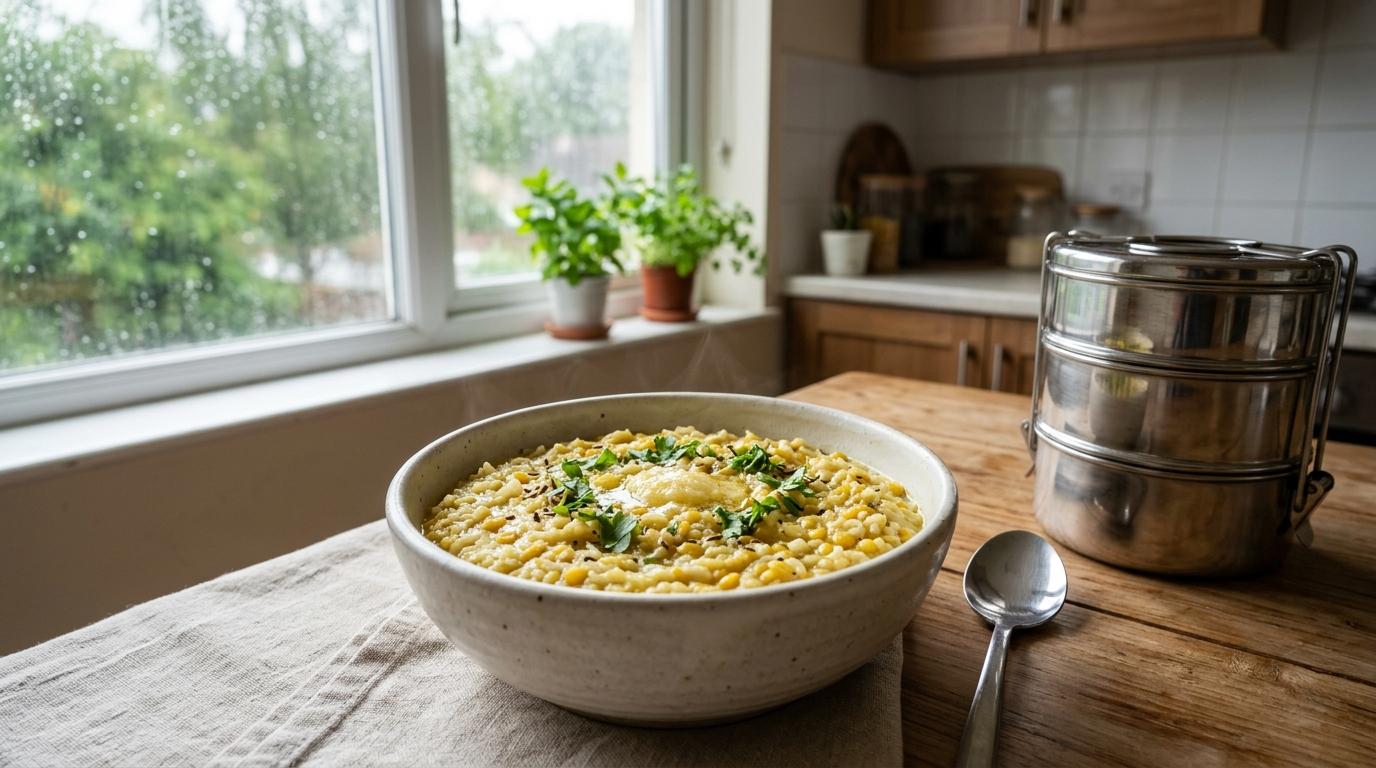
Khichdi in the monsoon hits differently, doesn’t it? Rain outside, a warm bowl of soft khichdi, a spoon of ghee, maybe some papad or pickle on the side. It feels simple, safe, and comforting.
But there’s one small catch.
The same rainy weather that makes khichdi so tempting can also make it spoil faster. Monsoon kitchens are often humid, lunch bags get warm, and closed tiffin boxes can trap steam for hours. And because khichdi is made with cooked rice, dal, and plenty of moisture, it needs a little extra care.
This matters even more if you’re packing khichdi for office, school, travel, or saving leftovers for the next day.
Here are the practical khichdi food safety monsoon rules worth remembering.
Why Khichdi Spoils Faster in Monsoon
#Khichdi is soft, warm, and moist. That’s exactly why we love it. Unfortunately, bacteria like those same conditions too.
During monsoon, the air is already damp. If you pack hot khichdi in a closed tiffin, the steam gets trapped inside. That steam turns into water and settles back into the food. So the khichdi stays warm and wet for longer, which can make spoilage more likely.
Cooked rice also needs special care. Rice can contain spores of bacteria like Bacillus cereus. Cooking may not destroy all of these spores. If cooked rice sits warm for too long, the spores can grow and produce toxins. Reheating later may not always make the food safe again.
That’s why rice dal khichdi spoilage can happen quickly, especially in monsoon. It’s not always about the food being “old.” Sometimes it’s simply because it sat too long in warm, humid conditions.
Most food safety advice says the same thing: cooked food should not be left at room temperature for more than 2 hours. In hot and humid weather, it’s better to be even more careful.
The 2-Hour Rule, and When to Make It 1 Hour
#For khichdi, remember this simple rule:
Eat it, refrigerate it, or pack it properly within 2 hours of cooking.
This 2-hour window includes the time it sits out for cooling. It doesn’t restart when you shift the khichdi from the cooker to a container.
During hot, sticky monsoon days, use 1 hour as the safer limit if:
- Your kitchen is warm
- The khichdi is going into a school bag or office bag
- There is no fridge at work
- You’re travelling by bus, train, or car
- The khichdi is watery
- Lunch may be eaten late
A few everyday examples:
- Khichdi left on the stove after lunch? Refrigerate it within 2 hours.
- Khichdi cooked early morning for tiffin? Eat it by lunchtime, not late afternoon.
- Khichdi forgotten overnight? Throw it.
- Morning tiffin khichdi left until evening? Don’t keep it for dinner.
It may still smell okay, but smell alone doesn’t prove it is safe.
Khichdi Tiffin Safety for Office, School, and Travel
#Good khichdi tiffin safety comes down to three things: timing, moisture, and cleanliness.
1. Don’t Seal Steaming Hot Khichdi Immediately
#This is one of the most common lunchbox mistakes.
If you put boiling hot khichdi into a tiffin and shut the lid tightly, all that steam gets trapped. By lunchtime, the steam has turned into extra water, and the khichdi becomes wetter, stickier, and more likely to spoil.
Do this instead:
- Let the heavy steam reduce for a few minutes.
- Pack the khichdi while it is still warm, not completely cold.
- Don’t leave it open on the counter for too long.
- Use a clean, dry spoon.
- Use a clean, dry tiffin box.
A few minutes of cooling is fine. Leaving it out for a long time is not.
2. Keep Tiffin Khichdi Slightly Thick
#Watery khichdi is lovely when eaten fresh at home. But for a lunchbox, especially during monsoon, it’s better to keep it slightly thick.
Moong dal khichdi, masala khichdi, or pulao-style khichdi travels better when it isn’t too soupy.
It doesn’t have to be dry. Just avoid packing khichdi that is already loose and watery in the morning.
3. Don’t Mix Curd into Khichdi Before Packing
#Curd khichdi tastes great when it’s fresh. But curd mixed into warm khichdi and kept in a tiffin for hours is not a good monsoon habit.
If you want curd with khichdi:
- Pack the curd separately.
- Use a clean airtight container.
- Keep it cool if possible.
- Mix it only when you’re ready to eat.
Avoid packing curd-mixed khichdi in the morning and eating it after many hours.
4. Go Easy on Raw Toppings
#Raw onion, chopped tomato, coriander, grated coconut, cucumber, and wet chutneys can all add moisture. They also involve extra handling, which can increase risk during rainy weather.
For packed khichdi, simple is better. Add a cooked tadka during cooking instead of raw garnish later.
If you really want coriander or onion, add it fresh just before eating, not in the morning before packing.
5. For Office Lunch
#If you leave home around 8 AM and eat by 1 PM, khichdi can work well. Just pack it properly and don’t let it sit too long.
Better choices include:
- Slightly thick moong dal khichdi
- Rice-dal khichdi with fully cooked vegetables
- Jeera, ginger, hing, turmeric, or cooked tadka
- A dry side like papad, pickle, or roasted vegetables
Avoid:
- Curd mixed into khichdi
- Coconut milk khichdi
- Raw chutney mixed in
- Very watery khichdi
- Keeping leftover tiffin khichdi for dinner
If your office has a fridge, keep the tiffin there after reaching. If not, eat the khichdi as early as practical.
6. For School Tiffins
#Children’s lunchboxes often sit in bags for hours. Sometimes they eat late, sometimes they don’t finish everything. So monsoon khichdi for school should be extra simple.
Pack:
- A small portion
- Thick khichdi, not soupy khichdi
- Fully cooked vegetables
- A dry side instead of chutney
Avoid sending khichdi if the school day is long, the classroom gets hot, or your child usually eats lunch very late.
7. For Short Travel
#Khichdi can be carried for short travel, but it should be eaten early.
If you’re taking it in a train, bus, or car:
- Pack it fresh.
- Use a clean, tightly closed container.
- Eat within 2 hours, or within 1 hour if it’s hot and humid.
- Don’t keep opening the box.
- Avoid curd, coconut, and watery gravy.
For long travel or likely delays, dry snacks or dry meals are usually safer than wet khichdi.
Safer Khichdi Variations for Monsoon
#Some khichdi types are better for tiffin than others. The safer ones are simple, fully cooked, and not too watery.
Good monsoon tiffin options include:
- Plain moong dal khichdi, cooked slightly thick
- Rice and dal khichdi with cooked vegetables
- Masala khichdi with cooked tadka
- Pulao-style khichdi, soft but not soupy
- Freshly cooked khichdi packed in a clean, dry lunchbox
The exact type of khichdi matters less than how wet it is, how cleanly it is packed, and how long it stays outside.
Risky Add-Ins During Monsoon
#Some ingredients are fine when eaten fresh, but not ideal if khichdi has to sit in a dabba for hours.
Be careful with:
- Curd or buttermilk: Don’t mix before packing.
- Fresh coconut or coconut milk: These can spoil faster in warm, humid weather.
- Raw onion, tomato, coriander, cucumber: These add moisture and need extra handling.
- Wet chutneys: Especially if mixed into the khichdi.
- Paneer or milk-heavy additions: Better eaten fresh.
- Leftover khichdi used for next-day tiffin without proper refrigeration: Not safe.
If you’re eating khichdi fresh at home, you can be more relaxed. If it’s going into a tiffin, keep it simple.
Leftover Khichdi Storage Rules
#Good leftover khichdi storage starts soon after cooking. Don’t leave the cooker on the stove till bedtime and then think about storing it.
How to Cool Khichdi Safely
#A large, deep pot takes a long time to cool. The top may feel normal, but the center can stay warm for too long.
Do this:
- Transfer leftover khichdi into shallow containers.
- Let the heavy steam reduce for a short time.
- Close and refrigerate within 2 hours.
- In hot, humid weather, try to refrigerate within 1 hour.
- Never leave khichdi out overnight.
If the khichdi is very thick, spread it slightly in the container so it cools faster. Always use clean containers and clean spoons.
How Long Does Khichdi Last in the Fridge?
#Properly cooled and refrigerated khichdi usually lasts 3 to 4 days.
Store it:
- In an airtight container
- Inside the fridge, not on the kitchen counter
- In small portions
- Away from repeated touching or opening
If your fridge is overcrowded, or there are frequent power cuts, be more cautious. If the fridge was off for many hours, don’t take chances.
Can You Freeze Khichdi?
#Yes, you can freeze khichdi.
Freeze it in small portions and use it within 1 to 2 months. The texture may change a little after thawing, but it can still make a quick, simple meal.
When reheating frozen khichdi, add a little water and heat it properly.
Reheating Khichdi Safely
#Reheating doesn’t mean just warming the top layer.
When reheating refrigerated khichdi:
- Heat only the portion you plan to eat.
- Add a splash of water if it has become too thick.
- Stir well while heating.
- Make sure it is steaming hot throughout.
- Don’t keep reheated khichdi outside for hours.
- Don’t reheat and refrigerate the same batch again and again.
If khichdi was already left outside for too long, reheating may not make it safe. When in doubt, throw it out.
Spoilage Signs: When to Throw Khichdi Away
#The sniff test helps, but it’s not perfect. Food can become unsafe even before it smells terrible.
Throw khichdi away if you notice:
- Sour smell: Sharp, fermented, or acidic smell.
- Slimy texture: Stringy, slippery, or unusually sticky feel.
- Bubbles or froth: Bubbles at the edges or frothy patches.
- Mold: White, green, grey, black, or fuzzy growth.
- Bad smell with watery separation: A clear warning sign.
Don’t taste spoiled khichdi to “check.” If it looks wrong or smells wrong, it goes in the bin.
Common Monsoon Lunchbox Mistakes to Avoid
#Small habits make a big difference with wet foods like khichdi.
Avoid these:
- Packing steaming hot khichdi and closing the lid immediately
- Making tiffin khichdi too watery
- Mixing curd, chutney, coconut, or raw garnish before packing
- Leaving cooked khichdi outside “to cool” for hours
- Sending leftover khichdi in tiffin without proper refrigeration
- Eating morning-packed khichdi late in the evening
- Reheating the same batch many times
- Trusting smell alone after long room-temperature storage
Monsoon food safety is not about being scared of food. It’s simply about not giving warm, wet food too much time to sit around.
Simple Rule to Remember
#For khichdi in monsoon, keep this quick checklist in mind:
- Freshly cooked? Good.
- Packed in a clean, dry tiffin? Better.
- Not too watery? Safer.
- Eaten within a few hours? Good.
- Left out overnight? Throw it.
- Refrigerated within 2 hours, or 1 hour in hot weather? Safe for leftovers.
- Sour, slimy, bubbly, or moldy? Discard immediately.
Khichdi is still one of the best rainy-day meals. Just remember that it is a moist cooked food. Treat it with a little care, especially when it has to sit in a tiffin.