Rain, red mud, and that first hot bite of pithla
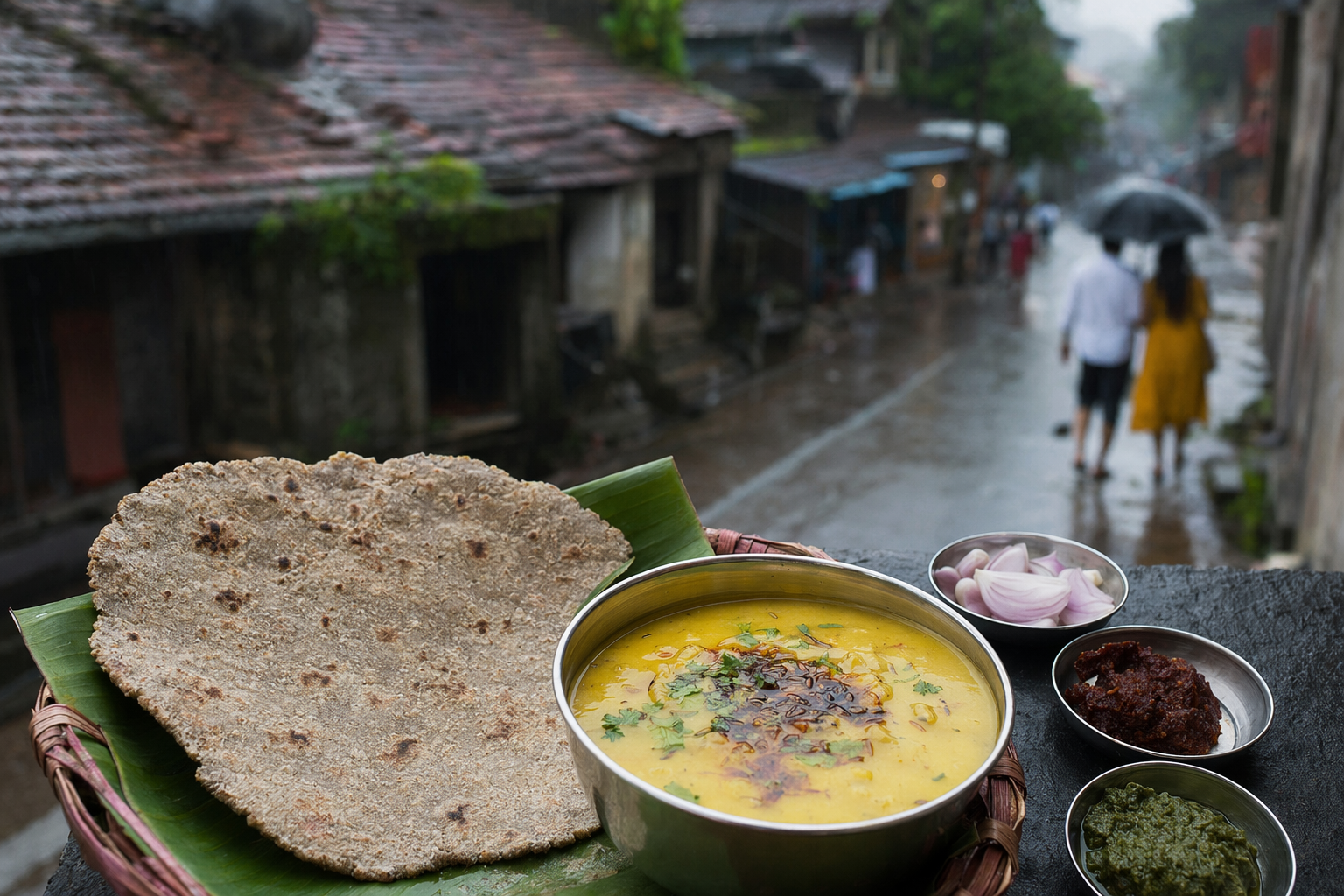
#The thing about Maharashtra in monsoon is that it doesn’t just rain, it kind of takes over your whole mood. Your shoes get muddy, phone screen goes useless, hair does whatever it wants, and then suddenly you’re sitting under a tin roof somewhere between two green hills, eating hot pithla with bhakri, and life feels sorted. Like actually sorted. I’ve eaten bhakri-pithla in city restaurants too, and some of them are nice, no doubt, but monsoon road bhakri-pithla is different. It has smoke in it. Rain noise in it. That slightly impatient hunger you get after driving through fog and potholes and waterfalls that appear from nowhere.
My own obsession started on a wet drive out of Pune, one of those trips where we said “let’s just go till Tamhini and come back” and then obviously did not come back on time. Me and my friend had packed chips, biscuits, all the usual nonsense, but by noon the rain had gone from cute to serious, and we were freezing in wet sleeves. We stopped at a small roadside place, more shed than restaurant, where the menu was basically what the aunty in the kitchen felt like making. She said, “pithla-bhakri aahe, garam aahe.” That was enough. Five minutes later there was a steel thali in front of me with yellow pithla, two rough jowar bhakris, thecha, raw onion, a green chilli, and a bowl of thin taak. I still remember the steam coming up. I burned my fingers tearing the bhakri and didn’t even care.
What makes bhakri-pithla such a monsoon meal, honestly?
#Pithla is simple, but not plain. That’s the trick. It’s usually made with besan, which is gram flour, cooked with garlic, mustard seeds, cumin, turmeric, green chilli, sometimes curry leaves, sometimes onions, sometimes nothing much at all. Some versions are runny and spoonable, some are thick and rustic, almost like a soft mash. In rural Maharashtra, pithla has long been that dependable meal you can make when vegetables are scarce or the market is too far, and during heavy rain, that makes perfect sense. Besan sits in the tin, onions are around, garlic is around, and bhakri dough can be slapped onto the tawa without fuss.
Bhakri is where the region starts talking. Around western Maharashtra you’ll get jowar bhakri a lot, pale and earthy, with that dry warmth that makes pithla taste better. In some cooler hill belts and tribal areas, nachni or ragi bhakri shows up, darker, denser, slightly nutty. Bajra bhakri is more of a winter comfort in many homes, but you’ll still find it depending on the cook and the area. And then there’s the way it’s eaten. Not neatly. You tear a piece, press it into the pithla, touch it to the thecha, maybe add onion. It’s messy. Good messy.
A fancy meal can impress you, but a hot bhakri-pithla thali after a rain-soaked ghat road can fix your entire personality for a while.
The Pune side: Tamhini, Mulshi, Paud, and those foggy little stops
#If someone asks me where to begin a bhakri-pithla monsoon hunt, I usually say the Pune-Mulshi-Tamhini belt, mainly because it’s easy enough to reach and still feels wild once the rain thickens. The roads curve past Mulshi lake, little waterfalls start spilling onto black rock, and every few kilometres there’s some small food stop with plastic chairs, steel tumblers, and a smell of woodsmoke hanging around. Not all of them are great, obviously. Some are just reheating things. But the good ones are very good, and you can usually tell by watching what locals order. If everyone is asking for vada pav and chai, fine. If two farmers are eating bhakri with pithla or zunka quietly in a corner, sit down.
My favourite kind of stop here isn’t a named famous place. It’s the family-run stall that has one person making bhakri fresh and another person doing endless chai. The bhakri comes uneven, sometimes with one edge thicker than the other, and that’s what you want. A too-perfect bhakri in a rainy roadside place makes me suspicious, I don’t know why. The pithla in this belt often comes with more garlic and green chilli, and the thecha can be brutal. I once underestimated a bright green thecha near Paud and spent ten minutes pretending I was totally fine while my eyes watered like I had recieved tragic news.
- Ask if the bhakri is being made fresh, not pulled from a stack that’s been sitting since morning.
- Order pithla, zunka, or usal before ordering fried snacks if your stomach gets moody in the rain.
- Chai is compulsory. I don’t make the rules, but rain does.
Sinhagad and the old-school pithla-bhakri feeling
#Sinhagad is famous for pithla-bhakri in a way that’s almost too obvious to mention, but I’m mentioning it because sometimes obvious things are obvious for a reason. The climb, the mist, the fort walls, the wind that hits your face like it has personal issues with you, and then those rustic food stalls selling pithla-bhakri, kanda bhaji, taak, dahi, and sometimes bhaji made with seasonal greens. I’ve gone there in monsoon and also just after monsoon, and honestly the rainy version is more dramatic, though also more slippery and crowded on weekends.
The pithla at Sinhagad-side stalls is not always delicate, and that’s okay. It’s meant to be filling. It’s the kind of food you eat with cold fingers. The bhakri usually has a nice char if you’re lucky, and the raw onion somehow tastes sweeter in that mountain air. One thing I’ll say, because I learnt it the hard way: don’t reach there starving at peak lunch time and expect peaceful service. Everyone else had the same brilliant idea. Go a bit early, or go with patience. Also, carry cash. Network in the hills behaves like a moody teenager.
Satara, Kaas, and the thali that tastes like wet fields
#Satara side has a different monsoon personality. The Kaas Plateau area, Thoseghar waterfalls, Sajjangad, the roads towards Bamnoli and Tapola... it all becomes very green, almost unreal green. If you go around the flower season near Kaas, the crowd gets heavier, but even outside that, the monsoon landscape is stunning. What I love here is how the food feels tied to farming country. You’ll see jowar bhakri, pithla, matki usal, bharli vangi if the kitchen has it, curd, pickles, and lots of simple thalis that don’t try to be touristy.
One afternoon near Satara, after a long detour because Google Maps and rain had conspired against us, we found a small eating house with a handwritten board. No English, no big branding, no Instagram wall. Just thalis. The woman serving us asked if we wanted “lasun jasta ka kami,” more garlic or less, and my friend said more before I could stop him. The pithla came with so much garlic that the whole car smelled like it later, but in the best way. The bhakri was softer than what I’d eaten near Tamhini, and the thecha was red, made with dry chilli and garlic, rough crushed. I still think about that meal whenever rain starts in June.
A quick Satara-style plate I’d happily eat again
#| Plate item | Why it works in monsoon | My very biased opinion |
|---|---|---|
| Jowar bhakri | Filling, dry enough to scoop curry, doesn’t feel oily | Best when it has smoky brown spots |
| Pithla | Hot, garlicky, easy on the wallet | Needs enough chilli, otherwise it becomes boring |
| Thecha | Cuts through the earthy bhakri and besan | Dangerous but addictive |
| Taak | Light, salty, cooling after spice | Only if it’s fresh and served cold |
| Onion or pickle | Adds crunch and sharpness | Raw onion with rain food is underrated |
Kolhapur and Panhala: where pithla gets company
#Kolhapur is usually spoken about in one loud breath: tambda rassa, pandhra rassa, misal, mutton thali, spice, spice, more spice. Fair. But if you go towards Panhala or the villages around Kolhapur in rain, bhakri-pithla has its own quiet place there too. It may not be the star dish on every menu, because Kolhapuri food has so many attention-grabbing items, but when you do get a proper pithla with bhakri, it comes with confidence. More chilli, more garlic, sometimes a little oil floating on top, and the side dishes are not shy.
I once made the mistake of treating Kolhapuri thecha like normal chutney. It was not normal. It was a small edible explosion. But with a thick bhakri and pithla, it made sense. That’s the thing about local food: eaten in isolation, some elements feel too much, but together they balance out. The pithla softens the chilli, the bhakri grounds it, taak saves you, and then you go back for another bite because apparently humans learn nothing.
Panhala in monsoon can be gorgeous, with clouds moving over the fort and those old stone edges turning dark with rain. After walking around in damp weather, I don’t want pizza or cafe pasta there, no offence to cafes. I want a steel plate, something hot, and a place where nobody cares that my jeans are muddy. That’s the luxury actually.
Nashik, Igatpuri, and the rainy highway hunger
#The Mumbai-Nashik side, especially around Igatpuri, Trimbak, and the ghats, is another lovely route for monsoon food stops. This belt gets those dramatic cloud scenes where the hills vanish and reappear like a magic trick. Highway food can be hit or miss, and I’m not going to romanticise every dhaba because some are frankly not worth the stomach risk. But the good rural-style stops, especially slightly away from the busiest highway clusters, can serve satisfying bhakri-pithla, zunka-bhakri, varan-bhaat, kanda bhaji, and hot tea that tastes better because your socks are wet.
One of my small rules on this route is to choose places where food is moving fast. If the pithla is being cooked in small fresh batches, excellent. If it’s sitting in a large vessel looking tired, I skip. Monsoon humidity is not kind to food left around, and I’ve had one too many “why did I eat that” evenings. For families travelling with kids, this matters even more. I like the practical checks in Monsoon Dhaba Stops With Kids: Safe Food Guide, especially the bits about toilets, timing, and choosing safer dishes. Not glamorous advice, but very useful when you’re on a wet road and everyone is hungry.
Chikhaldara and Vidarbha: bhakri after misty forest roads
#Chikhaldara is far from the usual Pune-Mumbai monsoon chatter, and maybe that’s why I like bringing it up. In the Satpura ranges of Amravati district, Chikhaldara has that forested, misty, slightly old-hill-station feeling. The food here can lean into Vidarbha flavours, and depending where you eat, you’ll find jowar bhakri, pithla, zunka, varhadi-style spice, simple dal, rice, and lodge meals that are more practical than polished. After winding through wet forest roads, polished is not what I’m looking for anyway.
On one trip, we stayed at a modest lodge where dinner was served at a fixed time, and the kitchen uncle looked personally offended when we asked if there was a menu. “Aaj jevan aahe,” he said, meaning food is there, basically eat what’s cooked. It was bhakri, pithla, a dry sabzi, rice, dal, and pickle. The pithla was thinner than western Maharashtra versions I’d had, less showy, more home-like. I ate more than I planned, then sat outside listening to rain on leaves for half an hour. If you’re planning that side in wet weather, the Chikhaldara & Satpura Monsoon Lodge Meal Guide is a handy read because lodge meals, drinking water, and road snacks need a bit more planning there than on the usual highway circuits.
The small things that make a stop memorable
#Food travel people sometimes get too focused on “best places” and ranking everything. I do it too, I’m guilty. But bhakri-pithla stops don’t really work like that. The most memorable one may not have a name you can search later. It might be a blue tarpaulin roof near a ghat bend, or a village home that serves meals to travellers, or a basic thali place beside a sugarcane field. The plate matters, but the weather matters just as much. The mood. The timing. The fact that you’ve been looking at waterfalls all morning and now your stomach is making rude noises.
I remember a stop near Bhor where the rain was coming sideways. The bhakri took time, so we stood near the tawa watching the cook pat it by hand. There was no performance, no “live counter” drama, just skill. She rotated it, puffed it, pressed the edges, moved it to flame, and tossed it onto a plate like it was nothing. I tried making jowar bhakri at home after that and produced something between a map of Australia and a cracked coaster. So yes, respect.
A few signs I trust when choosing a rainy-day bhakri-pithla place
#- There are local families eating there, not only tourists taking selfies with chai.
- The bhakri is made after you order, or at least being made continuously.
- The pithla smells of fresh garlic and tadka, not stale oil.
- They serve simple sides like onion, chilli, pickle, curd, taak, or usal without making the plate too fussy.
- The place is busy but not chaotic enough that hygiene goes out the window.
Monsoon food safety, because romance is nice but stomach ache is not
#I love roadside eating, but I’m not reckless about it anymore. In my early travel years I would eat anything, anywhere, with the confidence of a fool. Then one rainy trip taught me humility. I won’t go into details, but let’s just say I saw more of a lodge bathroom than the waterfall I had travelled for. So now I’m boring in some ways. I avoid cut fruit sitting outside. I don’t drink random water unless I’m sure it’s filtered or sealed. I prefer hot dishes that are cooked in front of me. Pithla is great for this because it’s usually cooked hot and fast, and bhakri on a tawa is easy to judge.
Also, don’t ignore toilets. I know, nobody wants toilet talk in a food blog, but monsoon travel is not a curated reel. Wet floors, muddy shoes, crowded stops, kids needing the loo at the worst possible moment... all real. If a place has a reasonably clean handwash area and a kitchen that looks active, I relax a little. If the sink is scary and flies are having a conference near the food, I leave. Even if the view is beautiful. Especially if the view is beautiful, because scenic places get away with too much sometimes.
- Carry your own water, especially on hill roads where stops are spread out.
- Eat early lunches on weekends, before the crowd hits and food starts getting rushed.
- Keep ginger candy, ORS, and basic meds if you’re prone to travel sickness. Ask your doctor for real medical advice, not your overconfident friend.
- Don’t overdo thecha before a long drive. This is not cowardice, it is strategy.
What to order besides pithla-bhakri
#Even though this whole trip idea revolves around bhakri-pithla, the supporting cast is half the fun. Zunka is pithla’s drier cousin, also made with besan, more crumbly and often spicier. It travels well on the plate and goes beautifully with bhakri. Kanda bhaji is the monsoon cliché we all pretend to be above, then order anyway. Matki usal adds protein and a bit of texture. Varan-bhaat is what I order when my stomach wants peace. Bharli vangi, if available, can steal the show. And if someone offers fresh white butter with bhakri, say yes unless you have a reason not to.
Tea deserves its own paragraph. Rain chai in Maharashtra has a particular comfort. Sometimes too sweet, sometimes boiled to death, sometimes served in tiny glasses that require three refills, but perfect in the moment. I’ve had elegant single-origin coffees in pretty cafés and enjoyed them, sure, but a cutting chai beside a foggy road while someone fries bhaji in the background? Different league. Not better every time, but more alive.
Planning a bhakri-pithla monsoon route without overplanning it
#The nicest way to do this trip is not to create a military itinerary. Pick a region, check road conditions, leave early, and keep room for stops. From Pune, you can do Sinhagad, Mulshi-Tamhini, Bhor-Varandha side, or Satara as different day trips or overnighters. From Mumbai, Igatpuri, Malshej side, and Nashik routes work better, though Malshej can get heavy rain and traffic, so don’t be casual about it. Kolhapur-Panhala is lovely if you’re already heading south. Chikhaldara needs more time and planning, not a random last-minute dash unless you live closer.
If you enjoy comparing rainy hill food across regions, Maharashtra’s bhakri-pithla has a cousin-like comfort with other mountain staples in India. Mandua roti and bhatt dal in Uttarakhand, for example, gives me that same “simple food after wet roads” feeling. I wrote about a similar mood while reading through the Kumaon Rainy-Day Food Guide for Travelers, and it reminded me that rainy travel food everywhere has one job: warm you up without showing off too much.
My rough monsoon bhakri-pithla loop ideas
#| Starting point | Route mood | Best food bet |
|---|---|---|
| Pune | Sinhagad or Tamhini for mist, quick hunger, lots of small stops | Pithla-bhakri, kanda bhaji, taak |
| Pune or Satara | Kaas, Thoseghar, Bamnoli for slower countryside meals | Jowar bhakri, pithla, matki usal, curd |
| Mumbai or Nashik | Igatpuri and Trimbak side for highway rain and hill views | Zunka-bhakri, pithla, chai |
| Kolhapur | Panhala and nearby villages for spice and fort weather | Bhakri, pithla, thecha, maybe rassa if you eat meat |
| Amravati side | Chikhaldara for forest roads and lodge meals | Bhakri, pithla, simple dal, pickle |
Why this meal stays with you
#I think bhakri-pithla stays in memory because it doesn’t try too hard. It’s not plated with tweezers. It doesn’t need a story printed on the menu. The story is right there: grain from the region, besan from the kitchen tin, garlic crushed rough, chilli, rain, hunger, hands. It’s a meal of labour and weather. Farmers eat it, travellers eat it, fort walkers eat it, truck drivers eat it, office people escaping the city for one damp Sunday eat it. And somehow everybody looks equally happy for those ten minutes.
There’s also something grounding about eating with your hands when the world outside is all water and wind. You tear the bhakri, scoop the pithla, adjust the thecha amount because you are not as brave as you thought, sip taak, repeat. Your phone stays aside because your fingers are busy. Maybe that’s why I like it so much. It forces you to be present, even if only until the plate is empty.
Final bites, and a little advice from someone who has burnt fingers many times
#If you’re chasing Maharashtra bhakri-pithla stops in monsoon, don’t chase only famous names. Chase steam rising from a fresh tawa. Chase the smell of garlic tadka. Chase the place where rainwater is dripping from the roof but the kitchen is warm. Go early, drive slow, respect the hills, and don’t argue with locals about road conditions because they usually know better than your app. Carry cash, a towel, spare socks if you’re fancy, and enough appetite to eat a second bhakri even when you said you wouldn’t.
And when you find that perfect plate, don’t overanalyse it too much. Some meals are meant to be eaten hot, with wet hair and muddy shoes, while someone at the next table asks for extra thecha like a hero. That’s the Maharashtra monsoon I keep going back for. For more food-travel ramblings and practical trip ideas, I keep browsing AllBlogs.in when I’m planning my next hungry little escape.