I used to think a workout had to be this whole event. Cute outfit, 45-minute playlist, mat rolled out, maybe a protein smoothie if I was being extra. If I couldn't do all that, I figured it didn't count. Which, honestly, is such an all-or-nothing trap. The older I get, and the busier life gets, the more I've realized that 10 minutes here and there can do a lot more than one perfect workout I keep postponing until... next Monday. Always next Monday.
So this post is for the people who are tired, busy, a little overwhelmed, maybe working from home, maybe chasing kids, maybe sitting too much and feeling it in their hips and lower back. Been there. Still there some days. What I've found is that "strength snacks" — tiny little bursts of resistance training, often around 5 to 10 minutes — are weirdly effective when you do them consisently. And yes, I know, everyone says consistency is the secret and it's annoying because it's true.
Quick responsible note before I get too chatty: if you have heart issues, uncontrolled blood pressure, recent surgery, severe joint pain, are pregnant/postpartum with complications, or you've been told to limit exercise, check with a qualified clinician first. This isn't medical advice, just practical wellness stuff from someone who's spent a lot of time trying to make movement fit into normal human life.
Why 10-minute strength snacks are having a big moment in 2026
#A lot of the current wellness convo in 2026 is less about grinding harder and more about "exercise snacking," movement breaks, and what some people are calling minimum-effective-dose fitness. Basically, doing enough to matter, without pretending everybody has an hour a day and endless motivation. Wearables are nudging people to stand, move, and do short muscle-building sessions. Physical therapists are talking more about movement variety during the day, not just one gym visit. And honestly? I love that. It feels more humane.
The reason this trend has stuck around isn't just because it's convenient. Recent exercise research keeps pointing in the same direction: small bouts of activity add up. Public health guidance still supports the idea that weekly movement can be accumulated in shorter sessions, and strength training remains a huge deal for healthy aging, blood sugar control, insulin sensitivity, bone health, balance, and maintaining muscle mass. That's especially important because adults start losing muscle gradually with age if they don't use it. Not trying to be dramatic, but strength is one of those things that's easier to keep than to rebuild later.
One thing I had to unlearn: a workout doesn't have to leave you destroyed to be useful. Sometimes the best session is the one you can actually repeat tomorrow.
What the research is basically saying, in normal-person language
#Here's the non-boring version. Short resistance sessions can improve strength and function when they're done regularly and with enough effort. You don't need a giant gym setup. Bodyweight moves, resistance bands, dumbbells, a backpack with books in it... all fair game. A lot of current sports medicine guidance still comes back to the same fundamentals: work the major muscle groups at least twice a week, gradually increase challenge over time, and recover enough so your body can adapt. That's the magic, not the duration by itself.
Also, for metabolic health, brief activity after long sitting periods seems useful. Not magical, not a cure-all, but useful. There've been ongoing studies in recent years showing that breaking up sedentary time with short movement bouts can help with glucose control and energy regulation, especially for people who sit most of the day. And if your 10-minute strength snack happens after lunch or in the late afternoon slump? Even better maybe, at least for some people. I started doing a quick circuit around 3:30 p.m. instead of grabbing another coffee and wow, my brain actually comes back online.
My own very unglamorous experience with micro-workouts
#I started because my back was getting stiff from too much laptop time, and because I was in one of those phases where every "real workout" felt too big to start. Ten minutes sounded almost insultingly small. Like, what is that gonna do? But I made a rule: before showering, I'd do one tiny strength circuit. Some days it was squats and wall push-ups. Some days glute bridges in pajama shorts. Once I literally did split squats while waiting for pasta water to boil. Was it elegant? No. Did it work? Kinda, yeah.
After a few weeks, the biggest difference wasn't that I suddenly looked shredded lol. It was that stairs felt easier, my shoulders sat better, and I didn't have that fragile, creaky feeling after long days at my desk. My mood improved too, which I wasn't expecting. There is pretty decent evidence that resistance exercise can help with symptoms of stress, anxiety, and low mood in some people. Not instead of proper mental health care if you need it, obviously. But as support? Absolutely. I can feel the shift almost every time.
What makes a 10-minute strength snack actually work
#This part matters. You can't just wave your arms around for 10 minutes and call it progressive overload, sadly. A useful micro-workout usually has a few things going for it: it targets major muscle groups, it feels moderately hard by the end, and it progresses over time. That progression could mean more reps, slower tempo, better range of motion, stronger bands, heavier dumbbells, or less rest. It does not have to mean suffering.
- Pick 3 to 5 moves that cover squat, push, hinge, core, and maybe a pull if you've got bands or weights
- Work for about 30 to 45 seconds per move, or aim for 8 to 15 controlled reps
- Repeat the circuit 2 or 3 times if time allows
- Stop with 1 to 3 reps left in the tank most of the time — hard-ish, not wrecked
- When it gets easy, make it harder on purpose. That's the bit people forget, me included
A few 10-minute strength snacks I keep coming back to
#I'm not gonna pretend there's one perfect format. Sometimes I like timed intervals, sometimes straight sets. Depends on my energy and whether my knees are feeling cranky. But these are simple and pretty effective.
1) The desk-break reset
#Great if you've been sitting forever and your hips are mad at you. Do 40 seconds each, 20 seconds rest. Two rounds. Bodyweight squats, incline push-ups on a counter or desk, glute bridges, dead bugs, and a plank or elevated plank. That's it. If you're newer to exercise, this is such a solid place to start. It hits a lot without being too much.
2) The dumbbell mini-strength session
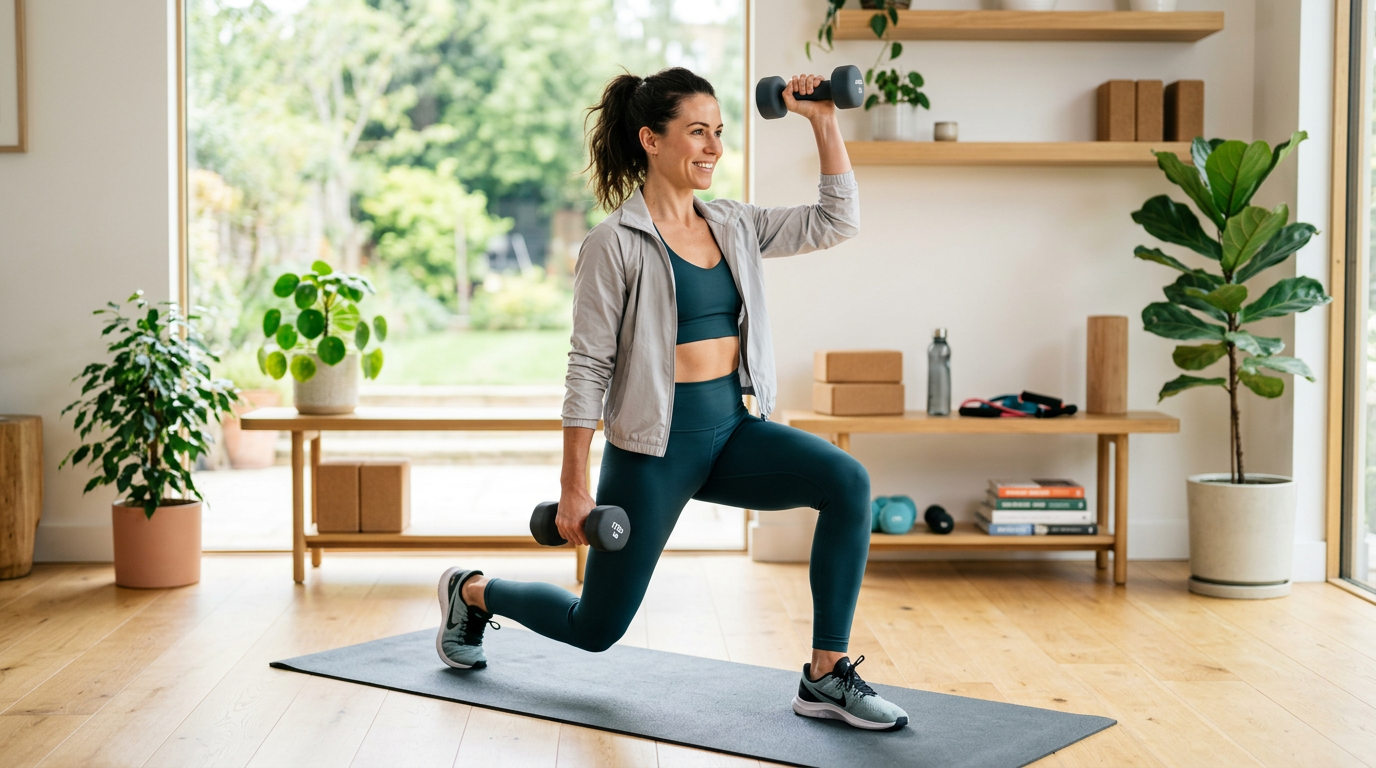
#Set a timer for 10 minutes and cycle through goblet squats, one-arm rows, Romanian deadlifts, overhead press, and a suitcase carry if you have room. If not, march in place holding one weight. Keep the load challenging enough that the last few reps require actual focus. This one makes me feel oddly powerful for the rest of the day, not even kidding.
3) The no-equipment hotel-room workout
#When I'm traveling, I do reverse lunges, wall sits, push-ups against a bed or wall, hip hinges with slow tempo, and side planks. It's not fancy but it saves me from that weird travel stiffness. Plus, current travel-wellness advice is all about reducing long periods of inactivity when you can, especially if you're flying or driving a lot.
4) The post-walk strength add-on
#This is very 2026 wellness-core, but in a good way. People are pairing zone 2 cardio with short strength blocks, and I actually think that combo is smart. After a brisk walk, do 2 rounds of step-ups, calf raises, band pull-aparts, split squats, and bird dogs. Lower body plus posture muscles. Sneakily tough.
How often should you do these?
#The broad goal for adults is still to get regular aerobic activity across the week and strength work at least two days weekly for major muscle groups. But if you're using micro-workouts, you can spread that strength work across more days. Like 10 minutes on Monday, 10 on Wednesday, 10 on Friday, maybe a bonus session on Sunday. That's already meaningful. Three short sessions done for months will beat one heroic 60-minute workout done once and then never again. Ask me how I know... actually don't, it's embarrasing.
If muscle gain is your main goal, longer sessions can be useful because you can fit in more total volume. So I don't wanna oversell micro-workouts like they're identical to full gym programming. They're not. But for general strength, function, habit-building, and health? They're legit. And for beginners or people returning after a break, they can be way less intimidating, which matters more than fitness people sometimes admit.
Common mistakes people make with strength snacks
#I've made all of these, by the way.
- Going too easy. If every set feels like a warm-up forever, your body doesn't have much reason to adapt.
- Doing random exercises with no pattern. Variety is fun, but some repeatability helps you get stronger.
- Skipping pulling movements. So many home workouts are push and squat heavy. Your upper back would like a word.
- Ignoring recovery. Tiny workouts still count as training. Sleep, food, hydration... boring, yes, but important.
- Thinking soreness equals success. It doesn't. Honestly soreness is kind of a liar.
A few wellness trends from 2026 I think are actually useful
#Not every trend deserves our attention. Some of it is just repackaged nonsense with better lighting. But a few current shifts in wellness are, in my opinion, pretty helpful. First, the move toward "movement snacks" for people with sedentary jobs. Love this. Second, more focus on strength for women through midlife and beyond, especially around perimenopause and menopause, because muscle, bone density, and power really matter there. Third, wearable data being used a little more intelligently — less obsession with calorie burn, more prompts for recovery, consistency, and mobility. Finally, the rise of ultra-short guided sessions in fitness apps. Not because apps are magic, but because lowering friction helps people follow through.
There's also more discussion now around protein distribution across the day to support muscle repair, especially for active adults and older adults. You don't need to become weird about it, please don't. But getting enough total protein and spreading it somewhat evenly can support strength goals. Pair that with resistance training and your body has a better reason to hold onto lean mass. Again, very not glamorous, very effective.
Who benefits the most from this approach?
#Honestly? A lot of people. Beginners. Busy parents. Office workers. Older adults who need strength and balance work but get overwhelmed by long workouts. People coming back after illness or burnout. Folks managing blood sugar who want to break up long sitting periods. Even pretty fit people can use 10-minute sessions as maintenance on chaotic days. The only catch is that you still need to tailor the moves to your body. If lunges hurt your knees, that's not a sign to push through dramatically. Swap them. Chairs, walls, bands, and shorter range of motion are your friends.
The best workout routine is the one that fits your real life, not your fantasy life.
A simple 7-day example if you want to try this without overthinking it
#Monday: lower-body snack — squats, glute bridges, calf raises, side steps with a band. Tuesday: walk and mobility. Wednesday: upper-body snack — incline push-ups, rows, overhead press, dead bug. Thursday: nothing fancy, just get up every hour and move for 2 minutes. Friday: full-body 10-minute circuit. Saturday: longer walk, bike ride, or whatever feels nice. Sunday: optional balance and core session. That's enough. Really. You can always build from there once the habit feels settled.
And if your week blows up and you only do two 10-minute sessions? Still good. Still counts. This has been the biggest mindset shift for me. I used to treat imperfect weeks like failures, and then I'd quit for three days because I "fell off." Now I just do the next small thing. It's less dramatic and way more effective.
Final thoughts, and the part where I try not to sound preachy
#Micro-workouts work because they remove excuses — or at least most of mine. They respect the reality that energy, time, hormones, stress, jobs, caregiving, and plain old life can make long workouts hard to pull off. A 10-minute strength snack won't solve every health issue. It's not a substitute for medical care, and it won't replace a more structured program if you have advanced performance goals. But it can make you stronger, steadier, more mobile, and more likely to keep showing up for yourself. Which is kind of the whole point, isn't it?
If you're curious, start stupidly small. Like five minutes small. Put a band by your desk. Do squats while dinner's in the oven. Try wall push-ups before your shower. Let it be a little messy. You do not need perfect conditions to build a stronger body. You just need a beginning, and maybe a reminder that tiny things done often have this sneaky way of changing your life. Also, if you like reading wellness stuff that's a bit more down-to-earth, poke around AllBlogs.in sometime. I've found some good reads there when I'm in my health-nerd mood.