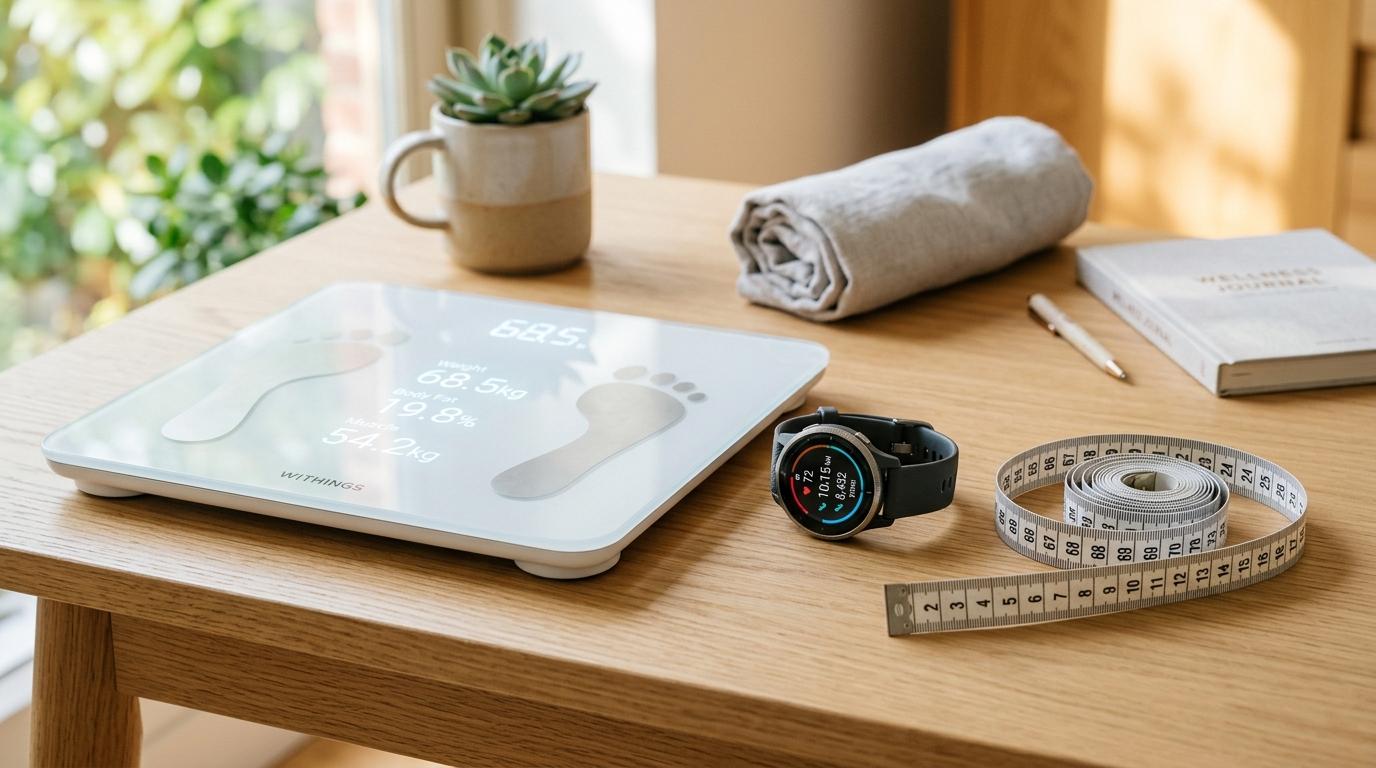
Smart Scale vs Fitness Tracker vs Measuring Tape: What Should You Buy First?
If you’re just getting started, buy a measuring tape first. It’s cheap, easy to use, and doesn’t ask you to download an app, charge another device, create an account, or stare at a dashboard full of numbers.
It also catches progress a regular scale can miss completely.
That said, the “best” first tool depends on what you actually need help with. If your biggest challenge is moving more, sleeping better, or building a daily routine, a fitness tracker may be the better first buy. If you already feel comfortable with weight data and want automatic long-term tracking, a smart scale can make sense.
But for most beginners, the smartest starting point is still the simplest one: a tape measure.
Short Answer Box
#If you want the safest first-purchase order, it’s usually:
- Measuring tape
- Fitness tracker
- Smart scale
That order gives you useful feedback without dumping too much data on you right away. And honestly, too much data too soon is where a lot of people start feeling overwhelmed.
Who This Is For
#This guide is for beginners who want to track fitness progress at home without buying every gadget that shows up in their social feed.
You might be:
- Getting back into workouts after a long break
- Trying to lose fat, build muscle, or simply move more
- Unsure whether weight, steps, sleep, or body measurements matter most
- Comparing smart scale vs fitness tracker options before spending money
- Looking for beginner fitness tracking tools that don’t make health feel like another full-time job
It’s also for anyone who has a complicated relationship with the bathroom scale.
If a random weight fluctuation can ruin your mood for the day, your first tool probably should not be a smart scale. More data is not always better. Sometimes it’s just more noise.
The Big Difference: Outcomes vs Habits
#Before choosing a tool, it helps to understand what each one is really tracking.
A measuring tape and a smart scale mostly track outcomes. They show what has changed in your body over time. Your waist is smaller. Your weight is up or down. Your hip measurement changed. Your trend line is moving.
A fitness tracker mostly tracks behaviors. It shows what you did today. You walked more. You slept less. You got a workout in. You sat for too long. Your heart rate stayed elevated during a run.
Both types of tracking can be useful.
But beginners often do better when they focus on behaviors first, because behaviors are easier to control.
You can choose to go for a walk today. You can choose to go to bed a little earlier. You can choose to do your workout.
You can’t fully control what the scale says tomorrow morning.
That’s why the best first buy is not always the most advanced device. It’s the tool you’ll actually use without making yourself miserable.
Smart Scale vs Fitness Tracker vs Measuring Tape: Quick Comparison
#There’s no universal winner here. No fake “best for everyone” answer.
The right choice depends on your goal, your budget, and how you personally react to numbers.
Option 1: Measuring Tape
#A measuring tape is the least flashy tool on this list, but it may be the most useful one to buy first.
When people start exercising, the scale can get confusing fast. You might lose fat, gain a little muscle, hold more water, eat more carbs, feel sore from training, or deal with normal hormonal changes.
Your weight might stay the same for weeks even though your clothes fit better.
That’s where body measurement tracking can help.
A tape measure can track areas like:
- Waist
- Hips
- Chest
- Upper arm
- Thigh
- Neck, if you want to include it
You don’t need to measure every body part. For most beginners, waist and hips are enough. If you’re strength training, you may also want to track chest, arms, and thighs.
The key is consistency.
Measure the same spots each time, around the same time of day, under similar conditions. Try not to pull the tape tighter one week because you want a “better” number. Most of us have been tempted, but it makes the measurement pretty useless.
Best for
#- Beginners who want the lowest-cost tracking tool
- People who care about body shape changes, not just body weight
- Anyone starting strength training
- People who don’t want another app or device
- Anyone comparing smart scale vs measuring tape and wanting the simpler option first
Avoid if
#- Body measurements feel emotionally triggering
- You know you’ll measure too often
- You don’t want to write anything down manually
- You need daily reminders to stay active
How often to use it
#Once every two to four weeks is enough for most people.
Weekly measuring is fine if you can stay relaxed about small changes, but daily measuring is not helpful. Body measurements do not change in a meaningful way overnight.
Option 2: Fitness Tracker
#A fitness tracker is the better first buy if your real challenge is not measuring progress, but staying consistent.
Maybe you sit for long stretches during the day. Maybe you forget to walk. Maybe your sleep schedule is all over the place. Maybe you like having a small nudge to move more.
In that case, a wrist-based tracker may help more than a scale.
A basic fitness tracker may track:
- Steps
- Active minutes
- Workouts
- Heart rate trends
- Sleep duration or sleep patterns
- Reminders to move
This is why many people lean toward a tracker when comparing smart scale vs fitness tracker.
A smart scale tells you what happened.
A fitness tracker can help you change what happens next.
You also don’t need the most expensive model. For beginners, the best fitness tracker is usually the one you’ll actually wear, charge, and understand.
Advanced recovery scores, readiness scores, and detailed performance metrics can be interesting, but they are not required if your main goal is to walk more, work out consistently, or get to bed at a reasonable time.
Here’s the simple fitness tracker buying guide version: buy for habits first, advanced data second.
Best for
#- People who want daily motivation
- Beginners trying to walk more
- Anyone building an exercise routine
- People who want basic sleep and activity awareness
- Those who prefer tracking actions instead of body size or weight
Avoid if
#- Constant reminders make you anxious
- You dislike wearing something on your wrist
- You’ll obsess over every score
- You mainly want to track body size changes
- You don’t want another device to charge
What to watch out for
#Fitness trackers can make healthy habits feel like a game. For some people, that’s genuinely helpful.
But they can also make you feel like you “failed” because you missed a step goal, skipped a workout, or got a bad sleep score.
Try to treat the data as feedback, not a grade.
A tracker should support your routine. It should not run your entire day.
Option 3: Smart Scale
#A smart scale looks like a regular bathroom scale, but it connects to an app through Bluetooth or Wi-Fi. It automatically logs your weight and, depending on the model, may estimate body composition numbers like body fat percentage, water weight, or muscle mass.
That sounds useful, and it can be.
But smart scales also need the most caution.
Most smart scales are good enough for everyday weight tracking. The tricky part is body composition. Those numbers are usually estimates, and they can change based on hydration, timing, algorithms, and the specific app or scale you’re using.
So your body fat percentage might jump around from one day to the next, even if your actual body composition has not meaningfully changed.
So, should you buy a smart scale first?
Only if you want convenient long-term weight tracking and you’re comfortable seeing weight data regularly.
A smart scale is not a moral scoreboard. It is not a medical-grade body composition test. It is a trend tool.
Best for
#- People who already weigh themselves calmly
- Anyone who wants automatic app syncing
- People tracking long-term weight trends
- Tech-friendly users who like connected health data
- Those who don’t want to manually enter weight into an app
Avoid if
#- Daily weight changes affect your mood
- You may treat body fat estimates as exact truth
- You already feel overwhelmed by health metrics
- You only need basic progress tracking
- You dislike sharing health data with apps
Smart scale vs measuring tape
#If your main goal is body shape progress, start with the tape.
A smart scale may show no major change while your waist measurement changes. That can happen when you’re losing fat, gaining muscle, holding water, or changing your training routine.
The tape can sometimes tell the story more clearly than the scale.
Smart scale vs fitness tracker
#If your goal is automatic weight trend logging, a smart scale makes sense.
If your goal is to move more, sleep better, build a routine, or stay motivated day to day, a fitness tracker is usually more useful.
What to Check Before Buying
#Before buying any fitness tracking tool, ask yourself a few honest questions.
1. What do I actually want to improve?
#If you want to move more, buy a fitness tracker.
If you want to see body size changes, buy a measuring tape.
If you want automatic weight logs, buy a smart scale.
Don’t buy the tool with the longest feature list. Buy the tool that matches the problem you’re actually trying to solve.
2. Will this tool make me calmer or more obsessive?
#This matters more than people like to admit.
If seeing your weight every morning ruins your day, don’t start with a smart scale.
If step goals make you feel motivated, a tracker may help.
If body measurements feel neutral and practical, a tape measure is probably a good first step.
The best tool is the one you can use without turning fitness into punishment.
3. Does it work with the apps you already use?
#For smart scales and fitness trackers, check compatibility before buying.
Look for:
- Phone compatibility
- App support
- Bluetooth or Wi-Fi syncing
- Whether it connects to your preferred health app
- Whether data export is possible, if that matters to you
A device with solid hardware but a frustrating app can get annoying quickly.
4. What data does it collect?
#Smart scales and fitness trackers can collect personal health data. Before buying, check the privacy settings and app permissions.
You don’t need to become a privacy expert, but you should know what account you’re creating, what data is stored, and how much control you have over it.
A measuring tape wins here because it collects nothing unless you write the numbers down.
5. How much effort will it take?
#Be honest with yourself.
A measuring tape is simple, but manual.
A fitness tracker is automatic, but needs charging.
A smart scale is convenient, but may pull you into checking your weight more often than you planned.
The easiest tool on paper is not always the easiest tool for your personality.
Best First Buy by Goal
#If your goal is fat loss
#Start with a measuring tape.
Add a fitness tracker if you need help increasing daily activity. Consider a smart scale later if you want automatic weight trend tracking and can handle the numbers calmly.
If your goal is building muscle
#Start with a measuring tape.
Body weight alone can be misleading when you’re strength training. You might gain muscle, lose fat, and see very little movement on the scale.
A fitness tracker can help with workout consistency, but measurements may show progress better than weight alone.
If your goal is walking more
#Buy a fitness tracker first.
Step awareness can be surprisingly helpful, especially if you work, study, or spend most of the day in one place.
If your goal is general health awareness
#A fitness tracker is a reasonable first buy, as long as you don’t obsess over every score.
It gives you a broad view of movement, activity, and sleep patterns.
If your goal is simple weight tracking
#A regular scale or smart scale can work.
Choose a smart scale only if automatic syncing feels useful enough to justify the cost and app setup.
If your goal is spending as little as possible
#Buy a measuring tape first.
You can track meaningful progress without subscriptions, charging cables, app accounts, or another screen to check.
Mistakes to Avoid
#1. Buying all three at once
#More tools do not automatically mean better progress.
Sometimes they just create more numbers to worry about.
Start with one tool. Use it for a month or two. If it helps, keep going. If you still have a clear gap, then consider adding another tool.
2. Treating smart scale body fat as exact
#Smart scale body composition estimates can vary because of hydration, algorithms, timing, and other factors.
Use them for long-term trends if you use them at all.
Don’t change your diet or training plan based only on one daily body fat reading.
3. Measuring too often
#Daily tracking can feel productive, but it often adds more noise than value.
A better rhythm:
- Measuring tape: every two to four weeks
- Weight: weekly or a few times per week, if you handle it calmly
- Fitness tracker: daily, but focus on patterns instead of perfection
4. Ignoring comfort
#A tracker you hate wearing will end up in a drawer.
A smart scale you dread stepping on will not help you.
A measuring tape you use inconsistently will give you messy data.
Comfort is not a small detail. It decides whether the tool actually becomes part of your life.
5. Comparing your numbers to someone else’s
#Your progress data is for you.
Different bodies, routines, sleep schedules, stress levels, training histories, and life circumstances create different results.
Use tracking to compare your current habits with your past habits, not your body with someone else’s.
Simple Buying Recommendation
#If you want the most practical answer, here it is:
Buy a measuring tape first if you’re a beginner and want affordable, low-pressure progress tracking.
Then, if you need help building daily movement habits, add a fitness tracker.
Buy a smart scale later if you specifically want automatic weight logs and you can treat body composition estimates as rough trends, not exact truth.
That path saves money, keeps tracking useful, and lowers the chance that fitness turns into one big numbers obsession.