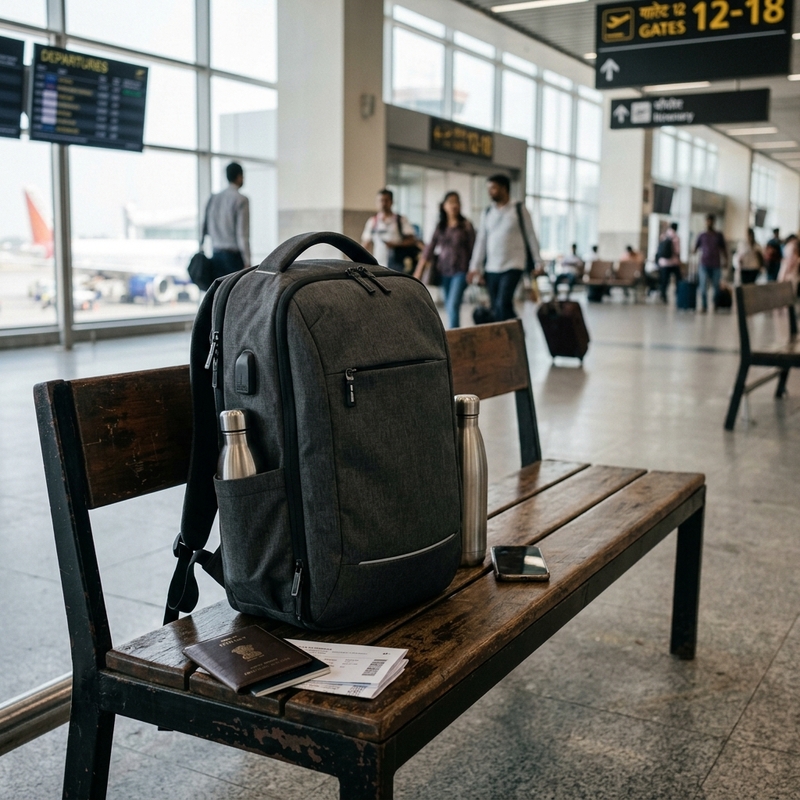
The best anti-theft backpack for Indian travel is not the one with the flashiest design or the longest feature list. It is the one that quietly does its job: protects your laptop, wallet, documents, passport, chargers and daily essentials while still being comfortable enough to carry through railway stations, airports, metros, buses and crowded streets.
For most Indian travellers, a good anti-theft backpack should have hidden or rear-facing zippers, lockable zipper pulls, a padded laptop compartment, a few useful hidden pockets, water-resistant fabric and comfortable shoulder support.
Sounds simple, right?
But once you start shopping, every backpack online seems to say the same things: “secure”, “premium”, “smart”, “travel-friendly”, “anti-theft”. Some look stylish but have exposed zippers. Some protect your laptop well but barely fit a lunchbox. Some are good for airports but annoying for daily office travel.
So instead of trusting every “top 10 backpacks” list, it is better to ask one practical question:
What should a good anti-theft backpack actually do for Indian travel?
This guide is for office commuters, students, digital workers, train travellers, airport users and anyone who regularly moves through crowded public places. No fake ratings, no imaginary discounts, no pushing one brand. Just a simple buying checklist that makes sense in real life.
Who Should Buy an Anti-Theft Backpack?
#An anti-theft backpack is useful if you regularly carry things you really cannot afford to lose.
Think laptop, tablet, office documents, passport, wallet, ID cards, power bank, chargers, college essentials or travel papers.
You should consider one if you are:
#A daily public transport commuterIf you travel by metro, bus, local train, shared cab or crowded office routes, hidden zippers and back-panel pockets can make it harder for someone to open your bag from behind.
A train travellerIndian railway stations, platforms, waiting rooms and overnight journeys can get extremely crowded. A backpack with lockable zippers and hidden pockets is more practical than a regular open-zip bag.
An airport travellerIf you fly often for office work or family trips, look for laptop padding, a trolley sleeve, organised compartments and lockable zippers. These small things make airport movement much easier.
A student or digital workerIf your backpack carries a laptop, tablet, notebooks, cables and personal items every day, you need something secure but also comfortable. A bag that is safe but painful to carry will end up sitting at home.
A two-wheeler commuterIf you ride through traffic with electronics in your bag, water-resistant fabric, stable straps and proper laptop padding matter just as much as hidden zippers.
Who May Not Need an Anti-Theft Backpack?
#Anti-theft bags are useful, but they are not for everyone.
You may skip one if:
#You only carry basic daily itemsIf your bag usually has just a water bottle, umbrella, lunchbox and one notebook, a heavy anti-theft laptop bag may feel unnecessary.
You need a trekking backpackMost anti-theft backpacks are not built like trekking bags. They usually do not have proper frame support, external gear loops or enough space for serious outdoor travel.
You want super quick access all the timeHidden zippers are safer, but they can also be slower to open. If you keep taking things out every few minutes, a regular backpack may feel more convenient.
You carry bulky items dailyMany anti-theft backpacks have a slim, structured shape. They look neat, but may not fit large tiffin boxes, shoes, extra clothes or heavy books comfortably.
What to Check Before Buying an Anti-Theft Backpack
#Do not judge the bag only by how it looks from the front. The important parts are usually less obvious: zipper placement, pocket design, laptop padding, back support, material quality and rain protection.
Here is what you should check carefully.
1. Zippers: Hidden, Rear-Facing or Lockable
#The zipper design is the first thing to inspect. A backpack does not become anti-theft just because it has a modern shape or a USB port.
For Indian trains, airports, stations, buses and metros, look for at least one of these:
- Rear-facing main zipper, where the opening rests against your back
- Hidden zipper track, covered by a flap or tucked into the design
- Lockable zipper pulls, where two zip sliders can be joined with a small lock
- Smooth, strong zipper movement, because cheap zippers become irritating very quickly
A lockable zipper backpack is especially useful when the bag is not fully in your control for a short time, such as during travel handling, cloakroom deposit or crowded waiting areas.
It will not make the bag theft-proof, but it does add a basic barrier against quick opening.
Avoid bags where the main zipper is fully exposed on the top or front, unless there is a proper locking or hiding system.
2. Hidden Pockets: Useful Only If They Are Well Placed
#Hidden pockets are one of the most practical features in an anti-theft backpack, especially for train and airport travel.
Good hidden pocket locations include:
- Back-panel pocket that touches your back when worn
- Shoulder strap pocket for small cash or cards
- Inner zipped pocket for wallet, passport, keys or documents
- Deep internal pocket for valuables you do not need often
These pockets are useful for:
- Metro card
- Small cash
- Passport
- Boarding pass
- ID card
- Keys
- Emergency cash
- Wallet
But do not get impressed by bags that advertise too many “secret” pockets. If the layout is confusing, you will waste time searching for your own things.
A few well-placed hidden pockets are much better than ten awkward ones.
3. Laptop Fit and Padding
#If you are buying an anti-theft laptop backpack for office, college or travel, laptop protection should be a priority.
Check these details:
- Does it fit your laptop size, such as 14-inch or 15.6-inch?
- Is the laptop sleeve padded on the back, front and bottom?
- Is there a strap to stop the laptop from moving inside?
- Does the laptop section sit slightly above the base of the bag?
- Is there enough space for charger, mouse, notebook and documents?
Bottom padding is especially important.
Many bags look padded from the outside, but the laptop compartment has weak protection at the bottom. That matters because bags are often placed on hard floors, train berths, airport seating areas, office desks and station platforms.
Also, do not assume every “laptop backpack” fits every laptop. Some slim anti-theft bags are made for thin 14-inch laptops and may feel tight with larger devices.
4. Comfort: Shoulder Straps, Back Panel and Weight
#A secure backpack is not very useful if you hate carrying it.
In India, you may have to walk across long platforms, airport terminals, metro stairs, bus stops, parking areas and office campuses. Comfort matters more than people realise.
Look for:
- Wide padded shoulder straps
- Breathable mesh back panel
- Soft but firm back padding
- Adjustable straps
- Stable structure when fully packed
- Reasonable empty weight
Anti-theft backpacks can be slightly heavier because of extra fabric layers, hidden zipper construction, padding and compartments. That is fine if the weight is balanced.
But if the empty bag already feels heavy, it may become uncomfortable once you add a laptop, charger, bottle, lunchbox, umbrella and power bank.
For Indian summers, a breathable back panel helps. It will not stop sweating completely, but it can reduce that sticky feeling during long commutes.
5. Material: Tough and Water-Resistant
#Material quality decides how long the bag will survive daily Indian use.
You do not need to chase fancy fabric names, but you should check for:
- Thick outer fabric
- Water-resistant coating
- Reinforced stitching
- Strong base material
- Durable inner lining
- Quality zipper stitching
- Better resistance against tearing or cutting
Some anti-theft backpacks use high-density fabric or slash-resistant layers. These can help reduce the risk of quick blade cuts, but they do not make the bag impossible to damage.
Treat such claims as useful features, not magic protection.
Also check the bottom of the bag. A weak base gets dirty, scratched and worn out quickly, especially when placed on station floors, bus stands, classrooms, office corners or airport waiting areas.
6. Rain Cover and Water Resistance
#For Indian travel, rain protection is important. Even if you do not travel much during the monsoon, sudden showers can happen during office commutes, train journeys and airport transfers.
There are three common levels of protection:
Basic water-resistant fabric
#Good for light drizzle and short exposure. Not enough for heavy rain.
Better coated fabric
#Offers stronger protection, but water may still enter through seams and zippers during heavy rain.
Separate rain cover
#The most practical option for Indian monsoons, especially if you carry a laptop, tablet, documents or chargers.
If the bag does not come with a rain cover, check whether it has a dedicated pocket where you can store one separately.
A wet backpack is annoying. A wet laptop backpack can become expensive.
7. Storage Layout: Think About Daily Use
#A bag can be secure and still be irritating if the storage layout is poor.
Check whether it has space for:
- Laptop
- Charger
- Phone charger
- Power bank
- Notebook
- Documents
- Water bottle
- Umbrella
- Lunchbox
- Clothes for short travel
- Medicines or small family essentials
For Indian users, the lunchbox point is important.
Many anti-theft backpacks have a slim, rigid body. They look clean, but a round or wide tiffin may not fit properly. If you carry lunch every day, check the depth of the main compartment, not just the litre capacity.
A 25-litre bag with poor shape may feel less useful than a smaller bag with better layout.
8. Trolley Sleeve for Airport Travel
#If you fly often, a trolley sleeve is a simple but very useful feature. It lets you slide the backpack over the handle of your suitcase.
This helps at:
- Airport check-in areas
- Security lines
- Boarding gates
- Long terminal walks
- Cab pickup points
If you are buying one backpack for both Indian trains and airports, a trolley sleeve is worth having.
It may look like a small feature, but you will appreciate it when your bag is heavy and your gate is far away.
9. USB Pass-Through: Nice to Have, Not Essential
#Many modern backpacks include an external USB pass-through. It lets you keep a power bank inside the bag and connect your phone from outside.
This can be handy, but do not make it your main buying reason.
A USB port does not make a backpack anti-theft. Zipper placement, laptop padding, hidden pockets, fabric quality and comfort are far more important.
If the bag has a USB feature, check that the internal cable does not disturb your laptop or reduce useful storage space.
Which Type of Anti-Theft Backpack Should You Choose?
#The best anti-theft backpack for Indian travel depends on how you actually use it. Do not compare only by price, looks or online ratings. Compare by travel style.
- Slim office anti-theft backpack: Best for office commuters, students and metro users. Strengths include clean design, hidden zippers, laptop-friendly layout and easy carrying. The trade-off is that it may not fit a lunchbox, clothes or bulky items.
- Travel-ready hybrid backpack: Best for train travellers, airport users and digital workers. Strengths include lockable zippers, more compartments and better packing space. The trade-off is that it may be slightly heavier than a basic office bag.
- High-capacity weekend backpack: Best for short trips, family travel and business travel. Strengths include more room for clothes, tech, documents and essentials. The trade-off is that it can feel bulky for daily commute.
- Hard-shell or semi-rigid backpack: Best for city commute, laptop protection and neat office use. Strengths include better shape retention and harder casual access. The trade-off is less flexible storage space.
- Lightweight anti-theft daypack: Best for students, light commuters and short city use. Strengths include easy carrying and compactness. The trade-off is limited protection and lower capacity.
If you travel by train often, prioritise lockable zippers, hidden pockets, laptop padding and durable fabric.
If you fly often, add a trolley sleeve, organised compartments and easy laptop access.
If you commute daily, comfort and weight should be just as important as security.
Step-by-Step Buying Checklist
#Use this checklist before placing an order or buying in-store.
Step 1: List What You Carry Every Day
#Put everything on a table:
- Laptop
- Charger
- Phone charger
- Power bank
- Lunchbox
- Water bottle
- Umbrella
- Notebook
- Documents
- Wallet
- Keys
- Medicine
- Clothes, if needed
Now check whether the bag can actually hold these items without becoming overstuffed.
This simple step prevents a lot of bad purchases.
Step 2: Check Laptop Size Properly
#Do not rely only on the words “laptop backpack”.
Confirm whether it fits your laptop size. A 15.6-inch laptop needs more space than a slim 14-inch model.
Also check bottom padding. This is where many bags compromise.
Step 3: Inspect Zipper Placement
#Look closely at product photos or check the bag in person.
Ask yourself:
- Is the main zipper hidden?
- Does the zipper sit against the back?
- Can the zipper pulls be locked?
- Are the zippers smooth?
- Are the zip tracks stitched well?
If the main zipper is fully exposed and easy to open from behind, it may not be ideal for crowded travel.
Step 4: Check Hidden Pocket Placement
#A hidden pocket should be useful while travelling, not just a marketing point.
Best options are:
- Back-panel hidden pocket
- Shoulder strap pocket
- Inner zipped pocket
Avoid bags where hidden pockets are too shallow, too tight or difficult to access.
Step 5: Check Comfort When Loaded
#If you are buying offline, put some weight inside and wear the bag for a few minutes.
If you are buying online, read the product details carefully. Check strap padding, back panel design and bag weight.
Honestly, a secure bag that hurts your shoulders will not be used for long.
Step 6: Check Rain Protection
#Look for water-resistant fabric and preferably a rain cover.
If there is no rain cover, decide whether you are okay buying one separately.
For laptop users, this is not a small detail. It is important.
Step 7: Choose the Right Size
#Most daily users should avoid going too large unless they genuinely need the space.
A bigger bag usually means more weight and more temptation to overpack.
For office and college, a compact or medium-sized backpack is usually easier. For short train or airport travel, a larger hybrid backpack may make more sense.
Step 8: Check Train and Airport Convenience
#For airports, look for:
- Trolley sleeve
- Easy laptop access
- Organised compartments
- Comfortable straps
For trains, look for:
- Lockable zippers
- Strong fabric
- Hidden pockets
- Practical storage
- Rain protection
The right backpack should match your main travel routine.
Step 9: Do Not Buy Only for Looks
#A backpack can look premium and still have weak zippers, poor padding or bad storage.
Style is nice, but function matters more.
Always check how the bag opens, how it carries weight and whether it fits your actual daily items.
Common Mistakes to Avoid
#Mistake 1: Believing Every “Anti-Theft” Label
#Some bags use the term very loosely.
If the zippers are exposed, pockets are easy to access and there is no locking option, the bag may not offer much extra security.
Mistake 2: Ignoring Zipper Quality
#Zippers are used every day.
If they snag, jam or feel weak, the bag becomes annoying and less secure. Smooth zipper movement matters.
Mistake 3: Buying a Bag That Is Too Slim
#Slim bags look good in photos, but they may not fit lunchboxes, umbrellas, books, clothes or travel extras.
Check depth, not just height and width.
Mistake 4: Overlooking Comfort
#Many people focus only on locks and hidden zippers.
But if the straps are thin or the back panel is stiff, the backpack will feel painful during long commutes.
Mistake 5: Treating Water Resistance as Waterproofing
#Water-resistant does not always mean safe in heavy rain.
If you carry a laptop, tablet or important papers, a rain cover is the safer choice.
Mistake 6: Choosing Complicated Built-In Locks
#Some backpacks come with built-in combination locks.
They can be useful, but if the mechanism feels delicate or confusing, simple lockable zipper pulls with your own small lock may be easier to manage.
Mistake 7: Forgetting Indian Travel Realities
#A backpack for Indian trains and airports should handle more than just a laptop.
Think about station floors, crowded queues, sudden rain, lunchboxes, documents, power banks, long walks and daily rough use.
A Practical Note on Safety
#Anti-theft features reduce risk, but they do not guarantee complete safety.
Hidden zippers, lockable pulls, slash-resistant fabric and back-panel pockets can make casual access harder. But they cannot stop every type of theft, and they cannot protect a bag that is left unattended.
Keep your backpack in sight whenever possible, especially in railway stations, buses, platforms, airport waiting areas and crowded public places.
Think of an anti-theft backpack as one layer of protection, not a complete safety solution.
Final Buying Advice
#The best anti-theft backpack for Indian travel is not always the most expensive one. It is also not always the one with the most features.
It is the one that fits your real routine.
For daily office or college use, choose a comfortable backpack with hidden zippers, laptop padding, water resistance and enough space for your regular items.
For train travel, focus on lockable zippers, strong fabric, hidden pockets and practical storage.
For airport travel, look for a trolley sleeve, organised compartments, comfortable straps and easy laptop handling.
For family or short trips, a larger hybrid backpack may work better, but make sure it does not become too bulky for everyday use.
A good anti-theft backpack should make travel calmer, not more complicated.