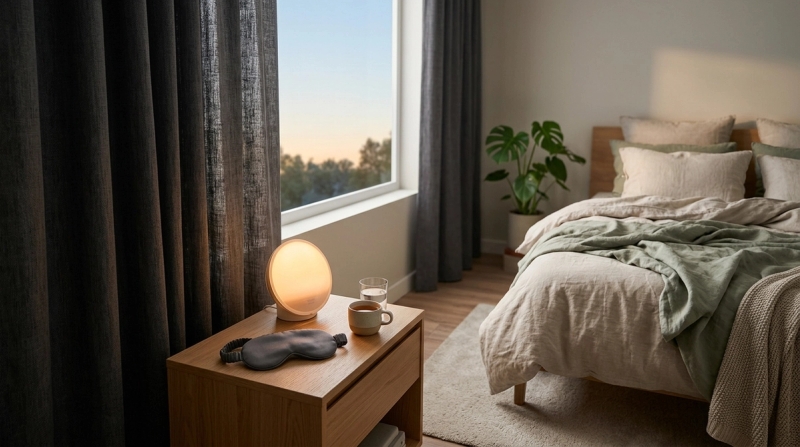
Trying to choose between a sleep mask, blackout curtains or a sunrise alarm? Buy a sleep mask if you rent, travel, share a room or need the quickest low-commitment fix. Choose blackout curtains if light through the window is the main reason you wake up. Add a sunrise alarm if dark mornings make waking up harder.
Health note: This guide is for general sleep comfort and bedroom setup. It is not medical advice for insomnia, sleep disorders, depression or chronic fatigue. If poor sleep keeps affecting your day, speak with a qualified health professional.
Short answer: which should you buy?
#- Buy a sleep mask if you need portable darkness, share a room, rent your home or sleep in different places often.
- Buy blackout curtains if your bedroom gets streetlights, early sunrise, car headlights or daytime light during shift-work sleep.
- Buy a sunrise alarm if waking up is the problem, especially in winter, early mornings or very dark rooms.
- Best combo for a bedroom: blackout curtains for the night and a sunrise alarm for waking up.
Who this is for
#This guide is for light-sensitive sleepers, renters, shift workers, students in shared rooms, parents with early-rising homes, and anyone trying to make a bedroom feel calmer without buying random gadgets.
It also helps if you liked practical AllBlogs sleep and comfort guides such as Hotel Room Sleep Checklist, Red-Eye Flight Sleep Kit, and Better Sleep: Science-Backed Bedtime Routine.
What to check first
#Before buying anything, ask one simple question: Is your problem falling asleep, staying asleep, or waking up?
- If light bothers you while falling asleep: start with a sleep mask.
- If outside light wakes you early: choose blackout curtains.
- If you wake up groggy because the room stays too dark: consider a sunrise alarm.
- If your schedule changes often: choose portable tools first.
- If you own your space and sleep there nightly: invest in the room setup.
Comparison: sleep mask vs blackout curtains vs sunrise alarm
#Sleep mask
#- Main job: Blocks light at your eyes.
- Best for: Renters, travel, shared rooms and daytime naps.
- Setup effort: Very low.
- Portable: Yes.
- Main downside: Can feel uncomfortable or slip during sleep.
- Buy first if: You need a quick, low-commitment light-blocking fix.
Blackout curtains
#- Main job: Blocks light at the window.
- Best for: Bedrooms, shift work, streetlights and early sunrise.
- Setup effort: Medium.
- Portable: No.
- Main downside: Needs measuring, hanging and edge coverage.
- Buy first if: Your window is clearly the problem.
Sunrise alarm
#- Main job: Adds gradual wake-up light.
- Best for: Dark mornings, groggy wakeups and phone-free alarms.
- Setup effort: Low.
- Portable: Usually no.
- Main downside: May wake a partner or roommate.
- Buy first if: Waking up is harder than falling asleep.
Option 1: Sleep mask
#A sleep mask is the easiest first purchase because it does not require drilling, measuring or changing the room. It works wherever your face goes.
Best for
#- Renters who cannot install curtain rods
- People sharing bedrooms or hostel rooms
- Daytime naps
- Flights, trains and hotel rooms
- Anyone testing whether light is really the problem
Avoid if
#- You dislike fabric on your face
- Masks make your skin or eyes feel irritated
- You sleep very hot
- You toss and turn enough that masks slip off
What to check before buying
#Choose a mask with an adjustable strap, soft breathable fabric and enough space around the eyes. A contoured shape is usually more comfortable than a flat strip of fabric because it reduces pressure on the eyelids and eyelashes.
Option 2: Blackout curtains
#Blackout curtains are the stronger home fix when light enters through the window. They are especially useful if you deal with streetlights, sunrise, traffic lights or bright buildings opposite your room.
Best for
#- Night-shift or rotating-shift workers
- Bedrooms with strong outside light
- Light sleepers who wake early
- People who want a full-room solution instead of wearing something
- Homes where curtains can stay up all year
Avoid if
#- You move often
- Your rental does not allow drilling
- Your window shape is unusual
- You only need darkness occasionally
What to check before buying
#Measure wider and taller than the window frame so light does not leak around the edges. Check the curtain fabric, lining, rod style and whether the sides sit close to the wall. A curtain that blocks the center but leaves glowing edges can still feel annoying.
Option 3: Sunrise alarm
#A sunrise alarm does not block light. It solves the opposite problem: waking up in a room that feels too dark or too abrupt. The light gradually brightens before the alarm sound, which can make mornings feel less harsh for some people.
Best for
#- Dark winter mornings
- Early wakeups before natural daylight
- People who dislike loud phone alarms
- Bedrooms with blackout curtains
- Anyone trying to keep the phone away from the bed
Avoid if
#- You share a bed with someone on a different schedule
- You are very sensitive to any light at night
- You need a silent alarm
- You prefer keeping electronics out of the bedroom
What to check before buying
#Look for simple controls, adjustable brightness, backup alarm sound and a display that can dim fully. If your goal is less phone use at night, avoid models that require an app for every basic setting.
Step-by-step buying checklist
#- Identify the real problem: falling asleep, staying asleep or waking up.
- Check your room: window light, LED lights, hallway light, partner habits and morning brightness.
- Try the lowest-effort fix first: a mask is useful even if you later buy curtains.
- Measure before buying curtains: include extra width and height for edge coverage.
- Think about your partner or roommate: a sunrise alarm can affect more than one person.
- Avoid fake precision: you do not need exact sleep scores to choose a basic light-control tool.
- Keep return policies in mind: comfort products are personal, so fit matters.
Best combinations
#For renters
#Start with a contoured sleep mask. Add temporary blackout film or tension-rod curtains only if your rental allows it.
For shift workers
#Blackout curtains should usually come first. A sleep mask can help with small leaks or daytime naps away from home.
For shared bedrooms
#Use a sleep mask first because it affects only you. A sunrise alarm may be unfair if another person wakes later.
For dark winter mornings
#Use blackout curtains only if night light bothers you. Add a sunrise alarm if the hardest part is waking up before natural daylight.
For frequent travelers
#A sleep mask wins. Curtains and sunrise alarms are mostly home tools, while a mask fits into any small bag.
Mistakes to avoid
#- Buying blackout curtains without measuring the window edges
- Choosing a flat mask that presses hard on the eyelids
- Buying a sunrise alarm when the real issue is late caffeine or screen use
- Assuming one product fixes every sleep problem
- Using very bright alarm displays that add more light at night
- Ignoring your partner’s schedule before adding wake-up lights
Final takeaway
#If you want the simplest answer: sleep mask for flexibility, blackout curtains for a dedicated bedroom, sunrise alarm for easier mornings. Start with the product that matches your actual problem instead of buying the most expensive gadget first.