The day my shampoo exploded in my bag, I became a solid-toiletry person
#I didn’t become a “carry-on only” traveller because I am some super organised minimalist type. Not at all. I became one because one bottle of coconut shampoo opened inside my backpack on a flight from Bengaluru to Kochi, and my kurta, charger pouch, and one packet of masala peanuts all started smelling like a salon. Funny now. Not funny at 11 pm outside the airport when you’re wiping foam with hotel tissues and pretending everything is fine.
Since then, solid toiletries have become my small travel obsession. Shampoo bars, soap bars, toothpaste tablets, deo sticks, sunscreen sticks, tiny balm tins… all that. And honestly, for Indian travellers especially, it makes so much sense. We do quick weekend trips, family trips with too many bags, budget flights where every kilo feels personal, and sometimes international flights where the security staff look at your pouch like you are smuggling liquid gold. Solid toiletries don’t solve every packing problem, but they solve a lot of annoying ones.
Also, let me say this clearly at the start: not every toiletry needs to be solid. Some liquid things are better, some skin products don’t behave nicely in bar form, and if you have acne treatment or medicated shampoo prescribed by a doctor, please don’t ditch it because some travel blogger said bars are cute. But for normal trips, especially carry-on travel, solids are honestly a game changer.
Why solid toiletries are so useful for carry-on travel
#The biggest reason is airport security. On most international routes, liquids, aerosols, gels, creams and pastes in cabin baggage need to be in small containers, usually 100 ml or less each, and packed in a transparent resealable bag of about 1 litre. India domestic flights can feel more relaxed sometimes, but don’t depend on that, because rules can change by airport, route, airline, and the mood of the security line, haan. If you are flying internationally or transiting through places like Dubai, Singapore, Doha, Bangkok, London, etc, the liquid rule becomes very real.
Solid toiletries usually don’t go into that liquids bag. A shampoo bar is not a liquid. A soap bar is not a gel. Toothpaste tablets are not paste. A solid deodorant stick is usually easier than a roll-on. This means your tiny liquids pouch can be saved for things that genuinely must stay liquid, like contact lens solution, medication, perfume, face serum, or that one moisturiser your skin refuses to live without.
There’s another benefit which people don’t talk about enough: solid toiletries survive Indian travel better. Trains, buses, autos, hill roads, bags getting thrown into tempo travellers, family members sitting on your backpack, you know the scene. Bottles leak. Caps crack. Even the “travel-size” ones sometimes open. A bar just sits there quietly, unless you pack it wet like a fool. Which I have done. More than once.
- Less leakage drama in your bag, especially during flights and long bus rides
- More space in the 1-litre liquids pouch for actually important stuff
- Usually lighter than carrying full-size bottles for short trips
- Good for hostels, homestays, treks, beach trips, and random overnight stays
- Less plastic waste, though only if you actually use the bar fully and don’t keep buying fancy ones for no reason
What counts as solid toiletries, and what still counts as liquid
#This is where people get confused. Solid soap is obviously solid. Shampoo bars and conditioner bars are also solid. But some products look “solid-ish” and still may be treated like liquids, gels, or creams depending on the airport. For example, a creamy balm in a tin may pass easily, but a thick hair wax or gel might be questioned. Toothpaste in a tube is counted as paste. Roll-on deodorant is liquid-ish. Aerosol sprays count as aerosols. Cream sunscreen is liquid or cream, even if the tube is small.
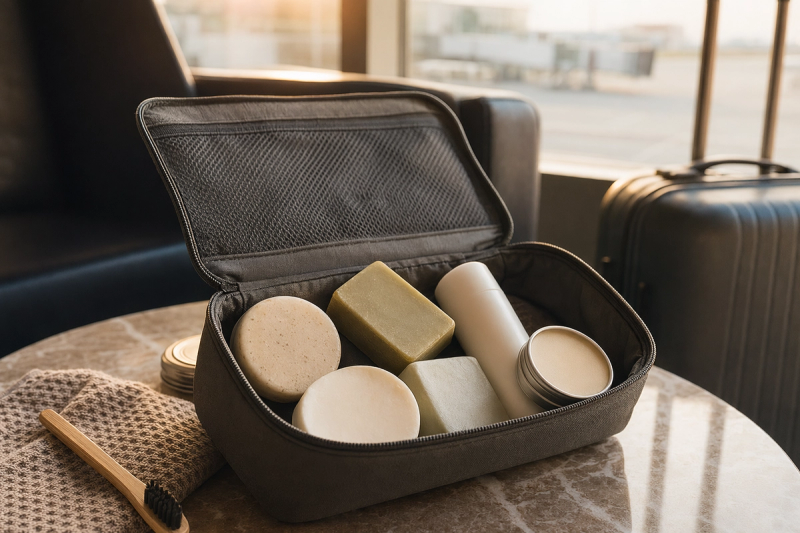
A normal solid deodorant stick is usually fine outside the liquids bag, though I still keep all toiletries together because I don’t like opening three pouches at security. Lip balm, solid perfume, soap, shampoo bars, shaving soap, toothpaste tablets, laundry soap sheets, and solid face cleanser bars are usually the easy ones. If you’re carrying something expensive or medical, keep the original label. Security staff are not there to decode your unlabeled white block wrapped in paper, and honestly, I don’t blame them.
One thing I learnt the hard way in Kuala Lumpur transit: “carry-on friendly” doesn’t mean “security-proof everywhere.” If an item looks suspicious, oversized, unlabeled, or too creamy, they can still ask. So I pack solids neatly, not like some sad hostel bathroom collection. Small tins, dry pouches, labels if possible. It sounds extra, but it saves those awkward moments where you are explaining conditioner bar to a tired security officer.
My basic solid toiletry kit for Indian and international trips
#For a 3 to 7 day trip, I don’t pack a full bathroom anymore. I pack like I’m going to actually carry my own bag, because I am. My usual kit is one shampoo bar, half a soap bar or a mini body wash bar, a small face cleanser bar, toothpaste tablets, deo stick, lip balm, tiny moisturiser, sunscreen, comb, razor if needed, menstrual products, and a microfiber or thin Turkish towel depending on the trip. If it’s a hotel trip, I skip towel. If it’s hostel or trek, towel comes with me.
Actually, the towel thing matters more than people think. Solid bars need to dry. If you keep a wet shampoo bar in a closed plastic dabba, it becomes mushy and sad, like overcooked upma. I usually pat it on a towel and leave it open for 10 minutes while I pack other stuff. If you’re also trying to make a compact shower kit, the comparison in Microfiber vs Turkish Towel for Travel: Which Is Better? is useful, because the wrong towel can take half your bag and never dry in monsoon.
- Shampoo bar: one small bar can last many washes, but choose based on your hair type. Hard water in many Indian cities can make some bars feel waxy.
- Conditioner bar: optional, but helpful if your hair becomes jhaadu after beach trips or hill-station dry weather.
- Soap or body bar: I cut a normal bar into two pieces. No need to carry a full brick for a weekend.
- Toothpaste tablets: amazing for flights, but try them at home first. Some taste like chalk pretending to be mint.
- Deodorant stick: better than spray for carry-on. Also kinder to people sitting next to you in a hostel dorm.
- Solid cleanser or cleansing balm: good if you wear sunscreen daily, but don’t overcomplicate it.
The sunscreen part, because Indians ignore it and then suffer
#I used to think sunscreen was only for Goa beach days. Very wrong. Ladakh sun roasted me. Hampi sun humbled me. Even walking around Jaipur in winter gave me that tight, burnt feeling on my face. Solid sunscreen sticks are convenient for travel because they don’t spill and they are easy to reapply on the nose, cheeks, neck, and hands. But I don’t fully replace normal sunscreen with a stick unless the trip is short. Sticks can miss patches if you are lazy, and most of us are lazy when sweating in 38 degrees.
For strong sun, I still carry a small 50 ml tube of sunscreen in my liquids pouch and use a stick for reapplication. Hats, sunglasses, cotton scarves, and UPF clothing help a lot too, especially if you don’t want to burn through sunscreen every two days. If you’re trying to reduce how much sunscreen you carry without being careless, read UPF Clothing vs Sunscreen for Travel. It explains the balance nicely, because no, a shampoo bar lifestyle does not mean the sun will suddenly respect your skin.
For Indian seasons, my sunscreen packing changes. Summer trips to Rajasthan, Gujarat, Hampi, coastal Karnataka, Tamil Nadu temples, or even city walks in Delhi need proper sun planning. In the mountains, the air feels cool but UV exposure can be harsh, especially at altitude. Monsoon is cloudy but still not a free pass. Winter is easier, but if you are outdoors all day, still use it. Trust me, “I don’t tan much” is not a skincare strategy.
Airport rules in real life: what I actually do before security
#My airport routine is boring but it works. Before leaving home, I separate liquids and solids. Liquids go in one transparent pouch. Solids go in a separate toiletry pouch. I keep both near the top of my backpack because nobody wants to dig through underwear at security. For international travel, I assume the 100 ml rule will apply even if one airport ignored it last time. Transit airports can be stricter than your departure airport, and that’s where people get caught.
If I’m carrying a water bottle, I empty it before security and refill after. This saves money and also keeps my liquid packing clean. Airport water refill points are common in many airports now, though the taste and location can vary wildly. If you want to make this habit smoother, this Airport Water Bottle Refill Guide for Travelers is a good companion read, because paying ₹120 for water at the gate still hurts my middle-class soul.
For flights within India, I’ve seen people carry larger toiletries in cabin bags without trouble, especially on domestic routes. But I wouldn’t build a packing plan around “my cousin did it once.” If you’re flying onward internationally, pack for the strictest airport on your route. Also remember that airline cabin baggage weight limits are a seperate headache. Many Indian budget airlines are serious about 7 kg cabin limits. A few solid bars may not sound like much, but full-size “just in case” items add up fast.
Best solid toiletries for different kinds of trips
#Not every trip needs the same kit. A two-night Mumbai work trip, a Spiti road trip, a Goa hostel week, and a temple town family trip all have different bathroom situations. This is where packing becomes personal. I’ve stayed in ₹600 hostel dorms where the shower shelf was basically one rusty corner, and I’ve stayed in ₹4,000 midrange hotels where the provided shampoo made my hair feel like rope. Price doesn’t always predict toiletry quality, honestly.
For budget travel in India, hostel dorm beds in popular places like Rishikesh, Jaipur, Goa, McLeodganj, and Kochi can often sit roughly around ₹500 to ₹1,200 per night depending on season and location. Basic guesthouses may be around ₹1,200 to ₹2,500, and midrange hotels can go ₹3,000 to ₹7,000 or more in touristy areas. These ranges move a lot during long weekends, festivals, cricket matches, New Year in Goa, and hill-station peak season. Why am I telling you this in a toiletry guide? Because cheaper stays often provide little or no toiletries, while midrange places provide them but not always good ones. Carry your basics.
Weekend city break
#For a weekend in Delhi, Mumbai, Bengaluru, Chennai, Pune, Kolkata, Ahmedabad or Hyderabad, I keep it super light: toothpaste tablets, deo stick, face cleanser, sunscreen, lip balm, tiny moisturiser, and maybe a shampoo bar if I know I’ll wash hair. If staying with friends or family, I ask first. Indian homes always have soap and toothpaste somewhere, but using someone else’s face wash is where friendships are tested.
Beach trips
#For Goa, Gokarna, Varkala, Pondicherry, Andaman, Udupi side, I carry shampoo bar, conditioner bar, soap, sunscreen tube plus stick, aloe gel if I have space, and laundry soap sheets. Salt water makes clothes smell quickly. Also sand enters everything. Use a tin or pouch that closes properly, otherwise your soap becomes a beach fossil.
Treks and mountain trips
#For Himachal, Uttarakhand, Kashmir, Sikkim, Ladakh, or Northeast routes, I go minimal. Soap, toothpaste tablets, sunscreen, lip balm, moisturiser, hand sanitiser, and maybe dry shampoo powder if showers are uncertain. In cold places, solid shampoo is useless if you’re not going to wash hair anyway. Don’t pack fantasy toiletries for the person you wish you were. Pack for the tired person you become after a 7-hour shared taxi.
Season-wise packing: India makes toiletries behave weirdly
#In summer, bars can get soft if kept in a hot car or near a window. In North India peak summer, even my deo stick once became slightly melty inside a bus bag. Keep toiletries away from direct heat. In monsoon, drying is the main problem. Soap bars become mushy, towels smell damp, and everything feels like it has absorbed air from a wet bathroom. Use a draining soap case or wrap bars in a quick-dry cloth after they are not dripping. Don’t seal wet bars immediately unless you enjoy mystery fungus anxiety.
Winter is nicer for solid toiletries, especially in dry places like Rajasthan or Ladakh, but your skin may need more moisturiser. Here I make space in the liquids pouch for a good cream because solid lotion bars don’t always work for me. Some people love them. I find many of them sit on skin like ghee. Maybe I haven’t found the right one. For most Indian travel, October to March is comfortable for sightseeing in many plains and heritage cities, while summer works for high-altitude mountain trips. Monsoon is beautiful in the Western Ghats and Northeast, but pack for dampness like your life depends on it.
How to store shampoo bars and soap without making a mess
#Storage is the make-or-break thing. A good shampoo bar can last ages if it dries properly, and finish in five days if you keep it wet in a closed box. I learnt this in a hostel in Fort Kochi where the bathroom had no shelf, only one nail and hope. Now I carry a small soap case with drainage holes, or a tin with a bit of loofah slice at the bottom. Some people use cork cases. Some use old mint tins. Whatever works, bas hawa lagni chahiye.
At night, I open the case and let the bar dry if the room is private. In dorms, I don’t leave toiletries in shared bathrooms because things disappear. Not always stolen in a dramatic way, sometimes someone just thinks it’s common soap. I wrap the bar in a dry handkerchief only after it’s not wet. If I am leaving early morning, I pat it dry, put it in the case, and unpack it at the next stay. Small effort, but it saves the bar.
- Don’t store shampoo bar and soap together unless you enjoy mystery fragrance combinations
- Cut large bars into travel-size pieces before the trip
- Use a soap case with holes, not a fully sealed plastic box for wet bars
- Label bars if they look similar, because face cleanser and laundry soap are not fun to confuse
- Carry one tiny zip pouch for emergency wet packing, but don’t keep bars in it for days
What I don’t recommend buying blindly
#Solid toiletries are trendy now, and Instagram will convince you that you need twelve bars in pastel colours. You don’t. Try products at home before travel. Especially shampoo bars. Some work beautifully, some leave residue, some smell amazing but do nothing, and some are too harsh for frequent washing. If your scalp is sensitive, test properly. Don’t experiment on day one of a wedding trip where you need your hair to behave.
Toothpaste tablets are another personal thing. I like them for flights and short trips, but for long travel I still carry a tiny toothpaste tube sometimes. Mouthfeel matters. Same with solid perfumes. Nice idea, but in Indian heat, many vanish in one hour. Natural deodorants can also fail badly in humid cities. I say this with love: test your deo on a normal sweaty day in Mumbai local-type conditions before taking it to Thailand or Chennai in May.
Also, avoid carrying huge solid bars “because it’s not liquid.” Carry-on has weight and space limits too. A full-size shampoo bar, conditioner bar, soap bar, face bar, laundry bar, lotion bar, shaving bar, and massage bar will weigh more than one smart toiletry kit. Minimalism can become its own overpacking. Very Indian behaviour, actually. We remove one suitcase and then fill the cabin bag with backup items “just in case.”
A practical packing list I actually use
#Here’s my honest list for a one-week carry-on trip. I adjust depending on hotel quality, weather, and whether I’m travelling solo or with family. Family trips are different because someone will always forget toothpaste and then your carefully measured tablets vanish in two mornings. If travelling with parents, I carry normal toothpaste too because they will not entertain my “chew this tablet” innovation.
- Shampoo bar, cut into a smaller piece, packed in a draining case
- Small conditioner bar if beach, hard water, or long hair situation
- Half soap bar or mini body bar
- Toothpaste tablets for short trips, small paste tube for longer trips
- Solid deodorant stick, tested before travel
- Face cleanser bar or small liquid cleanser, depending on skin mood
- Sunscreen tube under 100 ml plus sunscreen stick for reapplying
- Lip balm, moisturiser, comb, safety pins, small nail cutter in checked bag if required
- Hand sanitiser, because Indian travel bathrooms are full of plot twists
- Laundry soap sheets or a small laundry bar for socks, innerwear, and emergency chai spills
Small hygiene and safety things nobody tells you
#Solid toiletries touch surfaces more often than liquids, so hygiene matters. Don’t rub your shampoo bar directly on dirty bathroom shelves. Don’t share face bars with random people. If a bar falls on a hostel bathroom floor, I personally wash the top layer properly or shave a bit off with a clean knife if available. Sounds dramatic, but hostel bathrooms have seen things. Things we don’t need to discuss over chai.
If you have allergies, eczema, fungal scalp issues, acne medication, or any skin condition, be careful with handmade products. “Natural” doesn’t automatically mean safe. Essential oils can irritate skin. Strong fragrance can trigger headaches. If you need medicated shampoo, carry it in a 100 ml bottle for flights or check the airline rules for medical liquids when relevant. Keep prescriptions for important medication. Travel hacks should not mess with health.
For international trips, also think about customs and quarantine rules, though normal toiletries are usually fine. Don’t carry loose powders in unmarked packets because it looks weird. Keep things in packaging if possible. And please don’t pack blades casually in cabin baggage. Cartridge razors are usually accepted in many places, but loose blades and safety razor blades can be restricted in cabin bags. When in doubt, check your airline and airport guidance before leaving, not while standing barefoot at security.
Where to buy solid toiletries in India, without going broke
#You can find solid toiletries online easily now, but I still like buying one or two from local stores when travelling. In places like Goa, Auroville side, Rishikesh, Dharamshala, Fort Kochi, and some markets in Bengaluru or Mumbai, there are small shops selling handmade soaps and shampoo bars. Some are genuinely good. Some are just pretty and overpriced. Smell is not performance, remember that.
Price-wise, shampoo bars in India can be anywhere from around ₹150 for basic ones to ₹700 or more for boutique brands. Soap bars can be ₹50 to ₹400 depending on ingredients and branding. Toothpaste tablets are still a bit niche and can feel expensive compared to normal toothpaste. My rule: buy one, test at home for at least a week, then travel with it. Don’t buy an untested bar the night before a trip to Manali and expect miracles.
If you’re on a tight budget, don’t feel pressured to buy fancy sustainable products. A regular soap bar cut into pieces is already a solid toiletry. A small toothpaste tube under 100 ml is still allowed in liquids. A normal deo stick works. Travel packing should make life easier, not become another shopping project. The most sustainable item is often the one you already own and will actually finish.
My final carry-on rule: reduce liquids, don’t worship solids
#After many flights, trains, damp bathrooms, and one legendary shampoo explosion, my approach is simple: replace the easy liquids with solids, keep the important liquids, and don’t make packing a personality contest. Solid toiletries are brilliant for carry-on travel because they save liquid-bag space, reduce leaks, and make short trips smoother. But they are tools, not religion. If your skin loves one liquid moisturiser, carry it. If toothpaste tablets make you gag, don’t suffer for aesthetics.
For me, the sweet spot is around 70 percent solid and 30 percent liquid. Shampoo bar, soap, toothpaste tablets sometimes, deo stick, laundry sheets, and lip balm are easy wins. Sunscreen, moisturiser, contact lens solution, and medical items stay liquid when needed. That balance has worked from Indian weekend trips to longer international routes, and my bag smells less like accidental coconut disaster now, which is a big improvement.
Pack toiletries for the trip you are actually taking, not for the perfect traveller you saw online. Your carry-on should feel lighter, your bathroom routine should feel simpler, and your clothes should not recieve a surprise shampoo bath.
So yeah, if you’re trying carry-on only for the first time, start small. Swap one or two things. Test them at home. Dry your bars properly. Keep liquids pouch clean. And don’t panic if you still carry a tube of something. We are travellers, not airport-security robots. If you liked this kind of practical, slightly lived-in travel packing chat, you’ll probably enjoy browsing more guides on AllBlogs.in too, I keep finding useful stuff there before my own trips.