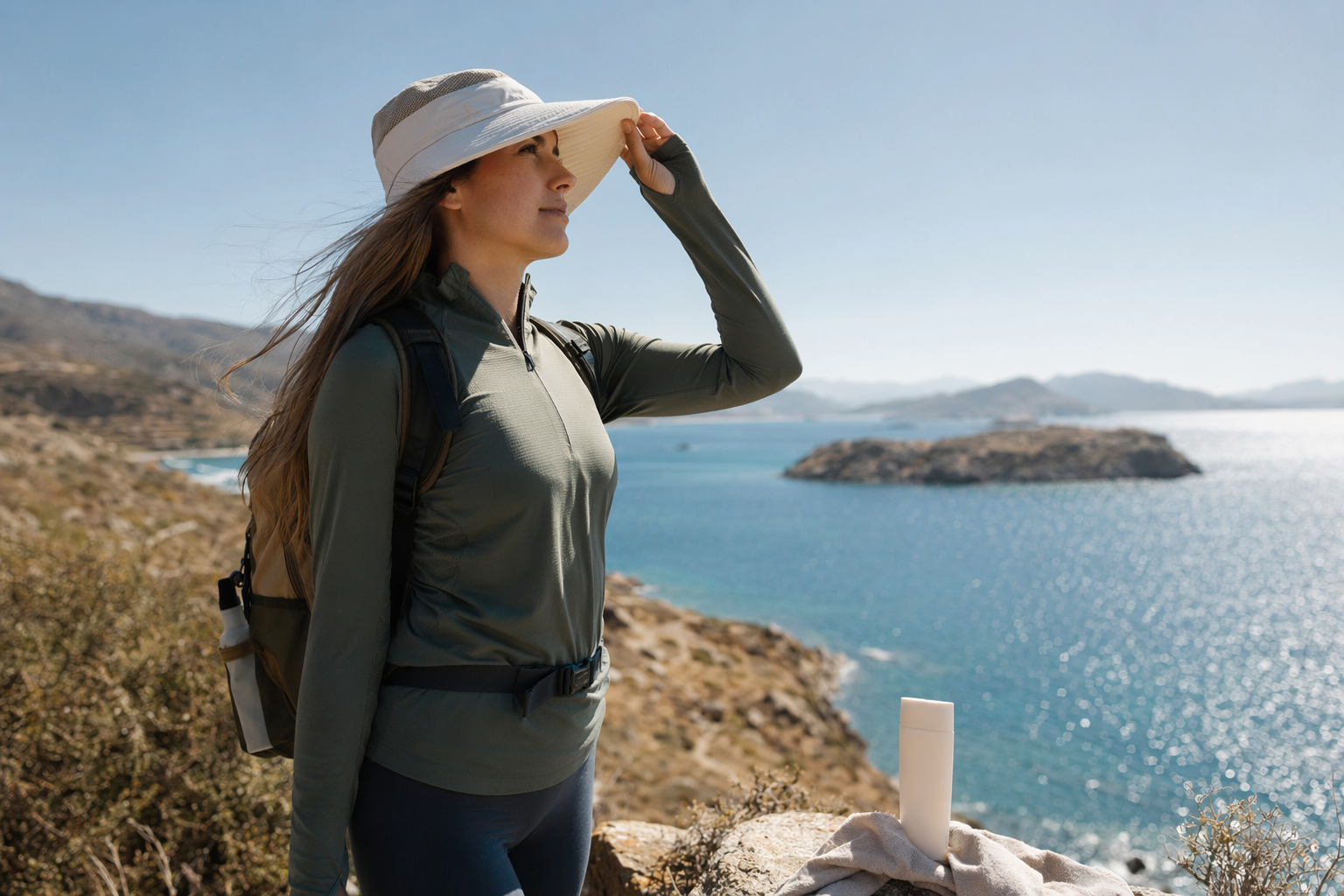
The honest answer: for travel, you usually want both
#UPF clothing vs sunscreen sounds like a tidy little either-or question, but travel is messy. You’re walking longer than planned, sweating through the nice shirt, standing in an airport taxi line at noon, then somehow sitting on a boat with one shoulder roasting because you forgot the angle of the sun is a thing. So, no, UPF clothing and sunscreen are not really enemies. They’re more like two slightly different tools that cover each other’s weak spots.
Dermatology groups such as the American Academy of Dermatology commonly recommend a layered approach to sun protection: shade, protective clothing, wide-brimmed hats, sunglasses, and broad-spectrum sunscreen with SPF 30 or higher on exposed skin. The CDC gives similar public health advice, especially for reducing sunburn and long-term UV exposure. That matters because ultraviolet radiation is linked with sunburn, skin aging, eye damage, and skin cancers. Not to scare anyone into panic packing, but to make the decision feel less like beauty shopping and more like basic travel health planning.
The short version is this: UPF clothing can be brilliant for travel because it does not need reapplying, does not count toward your liquids bag, and protects large areas consistently when worn correctly. Sunscreen is still needed for the places clothing does not cover, like face, ears, neck, hands, feet, scalp part lines, and all those weird little gaps around straps and collars. If you are going somewhere sunny, high-altitude, tropical, snowy, beachy, or just outdoorsy, a combination may help more than relying on either one alone.
What UPF clothing actually means, without the marketing fog
#UPF stands for Ultraviolet Protection Factor. It tells you how much UV radiation can pass through a fabric and reach the skin. A UPF 50 garment allows about 1/50th of UV rays through, which is often described as blocking around 98% of UV radiation. The Skin Cancer Foundation and other sun-safety organizations use that kind of explanation because it is simple enough to be useful, even if real-world protection still depends on fit, stretch, wetness, wear, and whether you actually keep the garment on.
Regular clothing can also protect you, but not always as much as people assume. Dense weaves, darker colors, synthetic fibers like polyester or nylon, and looser fits often provide more UV protection than thin, pale, loosely woven fabrics. A gauzy white cotton shirt may feel beachy and wholesome, but if you can see light through it, UV may be getting through too. That does not mean every travel outfit needs to look like expedition gear. It just means fabric choice matters, especially if you burn easily or you’ll be outside for hours.
Good UPF travel pieces are usually boring in the best way: lightweight long-sleeve shirts, airy button-ups, hiking hoodies, swim rash guards, sun gloves for long driving days, and wide-brim hats. Some are sporty, some look surprisingly normal now. The wellness trend here is practical, not glamorous. More travelers are building sun-smart wardrobes that work for cities, beaches, hikes, and temple visits without requiring six outfit changes. If you’re trying to pack light, a sun shirt that doubles as a plane layer and walking-day top fits naturally into a capsule setup like this 7-Day Travel Capsule Wardrobe: Pack Light.
What sunscreen does better than clothing
#Sunscreen is flexible. That’s its big advantage. You can put it on your nose, cheeks, ears, back of neck, hands, tops of feet, and the strip of skin between your leggings and socks that somehow becomes a tiny red bracelet after one afternoon. UPF clothing cannot protect skin it does not cover. Sunscreen can.
In the U.S., the FDA explains SPF mostly in relation to UVB protection, the rays that are a major cause of sunburn, while “broad-spectrum” labeling means the product also helps protect against UVA, which contributes to skin aging and can play a role in skin cancer risk. Dermatology organizations commonly suggest broad-spectrum SPF 30 or higher for daily outdoor exposure, plus reapplication about every two hours and after swimming, sweating, or toweling off. That reapplication part is where many travelers, very understandably, fall apart.
Most people do not apply enough sunscreen. The common adult guideline is about one ounce, roughly a shot-glass amount, for the exposed areas of the body when wearing swimwear. For the face and neck, many dermatologists talk about the “two finger” amount as a rough everyday measure, though product texture and face size vary. Sunscreen also gets rubbed off by backpacks, seatbelts, towels, masks, snorkeling gear, sweat, and hands. So sunscreen is powerful, but it asks for attention. On vacation. When attention is already being spent on train platforms, snacks, maps, and “wait, where’s the passport?”
The travel math: which one is easier when you are tired, hot, and distracted?
#This is where UPF clothing quietly wins a lot of travelers over. A long-sleeve UPF shirt gives steady coverage as long as it is on your body and not stretched thin or damaged. No airport liquid limit. No greasy hands. No white cast. No wondering whether the back of your shoulders got missed. For long sightseeing days, boat trips, desert tours, safari drives, snow sports, or theme parks, that simplicity can be a big deal.
Sunscreen, though, is easier to adapt. You might not want to wear long sleeves to dinner, or maybe your UPF shirt is wet from swimming, or maybe you are in a place where modest clothing is expected but it’s also humid and you need breathable options. Sunscreen lets you cover exposed spots without changing your outfit. It also helps when UV exposure sneaks up in ordinary travel moments: outdoor cafés, ferry decks, walking tours, open-air markets, convertible rides, and airport transfers where nobody planned to be outside for 45 minutes.
A useful way to think about it: use clothing for the big real estate and sunscreen for the edges. Torso, shoulders, arms, and thighs are easier to cover with UPF garments. Face, ears, neck, hands, lower legs, and feet usually need sunscreen unless they’re covered too. Add a hat and sunglasses and suddenly the whole system works better, with less pressure on any single product to be perfect.
A simple comparison, because shopping tabs get chaotic
#| Travel need | UPF clothing may be better when | Sunscreen may be better when |
|---|---|---|
| Long outdoor days | You want consistent coverage without reapplying fabric-covered areas | You need to protect face, hands, feet, and gaps |
| Carry-on only | No liquid limits and no spills in your bag | Small tubes or sticks fit easily, but amounts can run out fast |
| Swimming or snorkeling | Rash guards and swim leggings reduce sunscreen needed on covered skin | Water-resistant sunscreen is still needed on exposed areas |
| Hot humid weather | Loose UPF fabrics can reduce direct sun on skin, though some feel warm | Lightweight sunscreen may feel less covered up, but sweat affects wear |
| Sensitive or reactive skin | Less product on large areas may reduce irritation risk for some people | Mineral formulas may suit some sensitive skin, but patch testing can help |
| Kids and family travel | Clothing can reduce repeated full-body applications | Sunscreen remains important for exposed skin, and pediatric advice matters |
How to build a sun-smart travel outfit without feeling wrapped in plastic
#The best sun-protective outfit is the one you’ll actually wear. That sounds obvious, but it gets ignored a lot. A UPF hoodie that feels suffocating in humidity will end up shoved in a tote bag by lunch. A floppy hat that flies off every three minutes becomes a souvenir for the ocean. So comfort is not shallow here. It is part of adherence, basically.
Look for breathable, quick-drying fabrics, vents, relaxed cuts, and pieces that work with your actual itinerary. For a beach trip, a UPF rash guard may be the hero item, especially if you’ll swim, snorkel, paddleboard, or sit under bright reflected light. For city travel, a lightweight long-sleeve button-up, linen-blend overshirt, or UPF travel shirt can cover shoulders and arms while still looking normal enough for lunch. For hiking, a hooded sun shirt can protect the back of the neck, and some people like thumbholes for hand coverage, though sunscreen is still often needed.
Hats deserve more respect than they get. A wide-brim hat usually protects more than a baseball cap because it shades the ears, sides of face, and neck. Sunglasses should ideally block UVA and UVB, since UV exposure can affect the eyes over time. And if you are bald, have thinning hair, wear braids or a part line, or have a scalp that burns easily, hats and sunscreen powders or scalp-friendly formulas may be worth considering. Not as a medical treatment, just as practical prevention.
Where sunscreen still needs a proper routine
#For sunscreen, the boring details are the health details. Choose broad-spectrum SPF 30 or higher for outdoor travel, and water-resistant if you’ll sweat or swim. Apply before you are already burning, and use enough. Reapply about every two hours outdoors, and sooner after swimming, heavy sweating, or towel drying. This is the advice you’ll see repeated by groups like the American Academy of Dermatology, the FDA, and many public health agencies because under-application and missed reapplication are common reasons sunscreen does not perform as expected.
Sticks are handy for the face, ears, lips, and kids who won’t stand still, but they can be under-applied if you do one delicate swipe and call it done. Sprays are convenient, but they need to be rubbed in for even coverage, and it’s generally better not to inhale them. Lotions and creams are easier to measure, though less elegant in a tiny day bag. Lip balm with SPF is another overlooked thing, because lips can burn too.
If sunscreen stings, pills make you sun-sensitive, or you have a history of skin cancer, melasma, lupus, eczema, rosacea, allergies, or other skin conditions, it is reasonable to ask a dermatologist or qualified clinician what type of sun protection is appropriate for you. Some medications, including certain antibiotics, acne treatments, diuretics, and anti-inflammatory medicines, can increase photosensitivity for some people. Do not stop or change medication because of a travel article, obviously. Just ask ahead if you are unsure.
Hot weather is not just about UV, unfortunately
#Sun protection and heat safety overlap, but they are not the same thing. UPF clothing may protect skin from UV and sometimes help you feel less blasted by direct sun, but too many heavy layers in hot weather can trap heat. Sunscreen helps prevent sunburn on exposed skin, but it does not prevent dehydration, heat exhaustion, or heat stroke. A shaded break, breathable clothing, fluids, salty foods or electrolytes when appropriate, and pacing your day all matter.
For sightseeing in hot places, it can help to plan the exposed stuff earlier or later and keep indoor museums, cafés, markets, or naps for the harshest middle hours. This is not always possible, because tours love starting at weird times and kids love melting down exactly when the UV index is rude. Still, a rough plan helps. If you’re already thinking about sun shirts and sunscreen, it’s worth pairing that with the basics in Travel Day Hydration Mistakes: Water, Coffee, Electrolytes, since heat stress can sneak up fast when travel days are long.
Seek urgent medical help for signs of serious heat illness such as confusion, fainting, very high body temperature, severe weakness, or symptoms that feel alarming. For sunburn, medical advice is especially important if there is extensive blistering, fever, chills, dizziness, dehydration signs, severe pain, eye involvement, infection signs, or symptoms in a baby or medically vulnerable person. General wellness tips are not a substitute for care when something is severe, persistent, worsening, or unusual.
Beach, city, mountain, snow: the location changes the plan
#At the beach, UPF swimwear can reduce the amount of sunscreen needed on large areas, which is useful because sunscreen washes, rubs, and sweats off. A rash guard plus swim shorts or leggings can be especially practical for snorkeling, surfing lessons, kayaking, or chasing children around shallow water. Sunscreen still belongs on the face, ears, neck, hands, and exposed legs or feet. Reflection from water and sand can increase exposure, and shade from an umbrella can still allow scattered UV to reach skin.
In cities, people often underestimate sun because it does not feel like a “sun day.” But long walking routes, rooftop bars, bus tours, outdoor queues, and café seating add up. A breathable overshirt, hat, sunglasses, and face sunscreen can be enough for many low-key days. In mountains or snow, UV exposure can be stronger due to altitude and reflection from snow. Skiers and hikers often need sunscreen under the chin, around goggles, on lips, and on any exposed skin. Cold air can trick you because you do not feel the burn coming.
Near the equator, in summer, at high altitude, and during high UV index days, be more cautious. Cloudy skies are not a free pass either. UV can still reach the skin through clouds, and UVA can pass through some glass, which is relevant for long car, bus, or window-seat days. If you have a very fair skin tone, burn easily, have many moles, have a personal or family history of skin cancer, or are immunosuppressed, individualized advice from a clinician may be especially valuable before intense sun travel.
Sensitive skin, darker skin tones, and the “do I really need this?” question
#People with darker skin tones have more natural melanin, which can offer some UV protection, but it does not eliminate risk. Sunburn, hyperpigmentation, photoaging, and skin cancers can still occur, and skin cancer may be diagnosed later in people of color because changes are sometimes missed or dismissed. So the advice is not about fear or vanity. It’s about respecting that every skin tone benefits from sensible UV protection, even if the exact routine varies.
For sensitive skin, UPF clothing can reduce how much sunscreen has to touch the body, which may be helpful for some people. For exposed areas, fragrance-free mineral sunscreens with zinc oxide or titanium dioxide are often suggested for sensitive skin, though they can leave a cast and not everyone likes the feel. Chemical sunscreens can be elegant and transparent, but some people find them irritating around the eyes. Patch testing a new sunscreen before a big trip is boring but smart. Do it before you’re standing in a hotel bathroom with a red, stinging face and dinner reservations in 20 minutes.
For babies under 6 months, many pediatric and dermatology sources recommend keeping them out of direct sun as much as possible, using shade and protective clothing, and asking a pediatrician about sunscreen if needed on small exposed areas. Children’s skin can be more vulnerable to sunburn, and childhood sunburns are one reason sun safety gets emphasized so much. For older adults or anyone with limited mobility, clothing-based protection may also be easier than repeated application, but comfort and overheating risk still matter.
Packing checklist, but not the perfect influencer kind
#- One lightweight long-sleeve UPF shirt or breathable overshirt for walking days, ferry rides, and surprise sun
- A UPF rash guard if swimming, snorkeling, paddling, or doing beach days longer than “just one hour”
- Broad-spectrum SPF 30 or higher sunscreen, ideally enough for the whole trip, not one tiny optimistic tube
- Lip balm with SPF, sunglasses with UVA and UVB protection, and a hat that will actually stay on your head
- A small sunscreen stick for ears, nose, hands, and reapplication when pulling out a full lotion bottle feels annoying
Also think about sweat and friction, because hot-weather travel is not delicate. Sunscreen, sand, seams, backpacks, and long walks can make skin unhappy even when you are doing the “right” things. If thigh rub, waistband irritation, or underarm chafing tends to happen on warm trips, the packing decision may overlap with sun protection more than you’d expect. This guide on Anti-Chafing Shorts vs Balm vs Powder: What Should You Buy? fits right into that same practical, prevent-the-small-misery category.
Common mistakes that make sun protection less effective
#The first mistake is thinking UPF means invincible. A shirt only protects what it covers. If it rides up, gaps at the neckline, gets stretched tight, or is removed because it feels too hot, protection drops. Some fabrics may also lose performance over time with wear, laundering, chlorine, saltwater, or fabric breakdown, depending on how the UPF protection is built into the garment. Follow care instructions when you can, even if hotel sinks and mystery soap are not exactly laboratory conditions.
The second mistake is treating sunscreen like a morning blessing that lasts all day. It does not. Reapplication matters, and so does quantity. Another mistake is skipping ears, neck, hands, hairline, tops of feet, and the backs of knees. Travel sunburns love awkward locations. People also forget that insect repellent, makeup, moisturizer, sweat, and masks can affect the sunscreen layer. If using both sunscreen and insect repellent, many public health sources suggest applying sunscreen first, letting it dry, then applying repellent. Combination sunscreen-repellent products are often not ideal because sunscreen usually needs more frequent reapplication than repellent.
And then there’s the “base tan” myth. A tan is a sign that skin has responded to UV exposure. It is not reliable protection. Indoor tanning is also not a safe pre-vacation strategy. Major health organizations, including the WHO and dermatology associations, warn against tanning beds because UV exposure from them can increase skin cancer risk. If you want color, sunless tanner is generally considered a lower-UV option, but it usually does not provide meaningful sun protection unless it is also labeled with SPF, and even then it needs normal sunscreen rules.
So which should you choose?
#If you are packing for a sunny trip and want the most realistic answer, choose UPF clothing for coverage you do not want to think about, and sunscreen for the exposed parts you cannot cover. UPF clothing is especially helpful for long outdoor stretches, swimming, children who hate reapplication, carry-on packing, and people who want to reduce sunscreen use on large areas. Sunscreen is essential for flexibility, face and hand protection, dressier outfits, and all the tiny exposed spots clothing misses.
For many travelers, a good routine looks like this: wear a UPF or tightly woven top during the highest-exposure parts of the day, add a hat and sunglasses, apply broad-spectrum SPF 30 or higher to exposed skin, reapply on schedule, and take shade breaks when possible. Adjust based on your skin, destination, medications, health conditions, and comfort. If you have medical concerns, unusual skin changes, severe sun sensitivity, a history of skin cancer, or symptoms after sun exposure that worry you, a qualified healthcare professional is the right person to guide you.
The best sun protection plan is not the most perfect one on paper. It is the one you can repeat when you are sweaty, distracted, hungry, and still trying to enjoy the trip.
Travel should not feel like a dermatology exam every morning. But a little planning can prevent a lot of avoidable discomfort, and it may support long-term skin and eye health too. Pack the shirt. Bring enough sunscreen. Wear the hat even if it looks a bit dramatic. Future-you, walking back to the hotel not lobster-red and miserable, will probably be grateful. For more practical wellness and travel stuff without making it too precious, you can always browse AllBlogs.in.