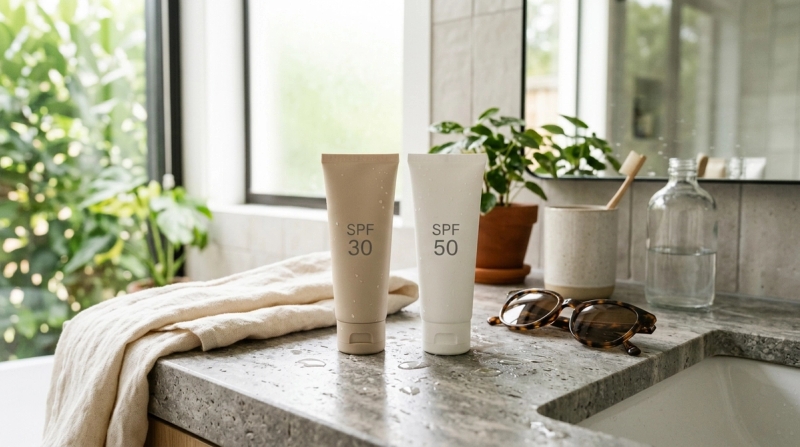
If your day is mostly indoors, with a short commute or a few quick errands, SPF 30 is usually enough. But if you walk a lot, ride a two-wheeler, sweat easily, wait outdoors, or spend more time in the sun, SPF 50 is the smarter choice.
Here’s the simple difference: SPF 30 blocks around 97% of UVB rays, while SPF 50 blocks around 98%. So no, SPF 50 is not “almost double” the protection of SPF 30. The number sounds much bigger, but the actual UVB protection difference is small.
What matters just as much, especially in humid weather, is whether the sunscreen feels good on your skin, stays put when you sweat, and is easy enough to reapply.
Because honestly, sunscreen should not feel like a complicated science project. But in hot, sticky, unpredictable weather, it often does. One bottle says SPF 30. Another says SPF 50. Some are gel-based, some are matte, some claim to be water-resistant, and some feel so greasy that you want to wash your face five minutes after applying them.
So let’s keep it practical. The SPF 30 vs SPF 50 sunscreen decision is not about blindly choosing the bigger number. It is about your actual routine.
How much sun do you get? How much do you sweat? Are you mostly indoors? Do you ride a bike? Will you actually use this sunscreen every morning without hating it?
That is what really decides the right sunscreen for you.
What SPF Actually Means
#SPF stands for Sun Protection Factor. It tells you how well a sunscreen protects your skin from UVB rays, which are the rays mainly responsible for sunburn and surface-level sun damage.
In simple terms:
- SPF 30 sunscreen blocks about 97% of UVB rays.
- SPF 50 sunscreen blocks about 98% of UVB rays.
So yes, SPF 50 gives slightly more protection, but the gap is not huge.
However, real life is not the same as a lab test. In a lab, sunscreen is applied in the correct amount and tested under controlled conditions. In real life, most of us apply less than we should. Then we sweat, wipe our face, travel in traffic, sit near windows, get caught in light rain, or spend time outdoors without realizing how much sun we are getting.
In those situations, SPF 50 gives you a little extra buffer.
But here’s the important part: a sunscreen you enjoy wearing will always beat a higher-SPF sunscreen that feels sticky and stays unused in your drawer.
SPF 30 vs SPF 50 Sunscreen: Quick Comparison
#When SPF 30 Sunscreen Is Enough
#SPF 30 is not “weak.” For many people, it is a perfectly good everyday sunscreen.
Choose SPF 30 sunscreen if:
- Your routine is mostly indoors: You travel by cab, car, metro, bus, or train, and then spend most of the day inside an office, classroom, or home.
- Your sun exposure is short: You step out for tea, lunch, a short walk, or quick errands, but you are not standing in direct sunlight for long.
- You prefer lighter textures: SPF 30 formulas are often easier to make lightweight, which is a big plus in humid weather.
- You are consistent with reapplication: If you reapply when needed, SPF 30 can work well for daily use.
For many office-goers and college students, a broad spectrum SPF 30 sunscreen is practical, comfortable, and enough for regular indoor-heavy routines.
When SPF 50 Sunscreen Makes More Sense
#SPF 50 is a better choice when your sunscreen has to handle more sun, more sweat, and more outdoor exposure.
Choose SPF 50 sunscreen if:
- You walk or ride a two-wheeler: If your commute includes 30 to 60 minutes under the sun, SPF 50 is usually a safer daily pick.
- You sweat a lot: Humidity, helmets, crowded buses, local trains, and sticky weather can wear down your sunscreen faster.
- You spend time outdoors: Field work, college fests, sports, markets, travel days, and long shopping trips all need better sun protection.
- You tan or pigment easily: If your skin gets tanned, dull, or uneven quickly, SPF 50 can help more when used properly.
- You know you apply too little: Most people do. SPF 50 gives a slightly better margin when application is not perfect.
For humid Indian weather, especially if you commute daily or sweat a lot, SPF 50 is often the more practical option.
But again, texture matters. If an SPF 50 sunscreen feels heavy, greasy, or uncomfortable, you probably will not use enough of it. In that case, a comfortable SPF 30 used properly is still better.
What to Look for in Sunscreen for Humid Weather
#In humid weather, the SPF number is only one part of the decision. If the sunscreen feels oily, sticky, or suffocating, you will avoid it. And once you stop using it, the SPF number becomes useless.
Here is what to check before buying sunscreen for hot and humid weather.
1. Choose Broad Spectrum Protection
#SPF mainly tells you about UVB protection. But your skin also needs protection from UVA rays, which are linked to tanning, pigmentation, and early signs of aging.
That is why you should look for a broad spectrum sunscreen.
If the label mentions PA+++ or PA++++, that is also useful. It usually indicates UVA protection.
2. Pick Water-Resistant Sunscreen If You Sweat
#A water-resistant sunscreen is helpful for summers, monsoon commutes, gym days, outdoor errands, and sweaty travel.
This does not mean the sunscreen will stay perfectly forever. It simply means it is less likely to disappear the moment you start sweating.
You still need to reapply it, especially after heavy sweating, rain, or wiping your face.
3. Choose a Texture You Can Actually Wear
#Texture can make or break your sunscreen habit.
If you have oily or combination skin, look for words like:
- Gel sunscreen
- Aqua gel
- Matte finish
- Dry touch
- Non-greasy
- Lightweight
- Silicone-based
- Oil-free
If your skin is dry, you may prefer a lotion or cream sunscreen. But in humid weather, avoid anything that feels too thick or sticky.
The best sunscreen is not just the one with the best label. It is the one you can apply generously without feeling uncomfortable.
4. See How It Feels After 10 Minutes
#Some sunscreens feel fine when you first apply them, then become greasy after a few minutes. Others pill, sting, or make your face look shiny.
If possible, test how the sunscreen settles after 10 minutes.
For daily use, comfort is not a small detail. It decides whether you will apply enough sunscreen every morning or skip it because it feels annoying.
5. Buy for Your Routine, Not Just Your Skin Type
#Your lifestyle matters as much as your skin type.
Someone who sits indoors all day does not need the same sunscreen as someone who walks across campus, rides a scooter, works outdoors, or spends time in traffic.
Buy sunscreen for your real day, not the perfect routine you wish you had.
How Much Sunscreen Should You Apply?
#One of the biggest sunscreen mistakes is applying too little.
A tiny pea-sized amount is not enough for your face and neck. Sunscreen needs to form an even layer on your skin to give the protection mentioned on the bottle.
Use the Two-Finger Rule
#For your face, neck, and ears, apply sunscreen along the length of your index and middle fingers. This is commonly known as the two-finger rule.
Make sure you cover:
- Face
- Neck
- Ears
- Hairline
- Back of the hands
- Any other exposed area
If you apply too little, you will not get the full SPF protection written on the product.
How Often Should You Reapply Sunscreen?
#Neither SPF 30 nor SPF 50 lasts perfectly all day, especially in humid weather.
Reapply sunscreen:
- Every 2 to 3 hours if you are outdoors
- After heavy sweating
- After wiping your face with a towel or tissue
- After getting wet in rain or water
- Before stepping out again after spending hours indoors
If you are indoors most of the day and not sitting beside a sunny window, one proper morning application may be enough for many people.
But if your day involves outdoor travel, sweating, rain, or wiping your face again and again, reapplication matters a lot.
For easier reapplication, you can keep a sunscreen stick, spray, or compact sunscreen in your bag. If your face is sweaty, gently blot first, then reapply. Avoid rubbing too much because it can get patchy and messy.
Common Sunscreen Mistakes to Avoid
#1. Using Makeup SPF as Your Only Sunscreen
#Foundation, BB cream, or compact powder with SPF is usually not enough on its own.
To get the SPF written on makeup, you would need to apply a thick, even layer. Most people do not apply makeup that way.
Use proper sunscreen first. Makeup with SPF can be an extra layer, not your main protection.
2. Skipping Sunscreen on Cloudy or Rainy Days
#Clouds and rain do not fully block UV rays. Even when the sky looks dull, UV exposure can still happen.
If you are stepping out during monsoon or on a cloudy day, sunscreen still matters.
3. Forgetting Your Neck, Ears, and Hands
#Many people apply sunscreen only on the face. But your neck, ears, and hands also get daily sun exposure, especially while walking, driving, or riding a two-wheeler.
These areas tan and age too, so do not ignore them.
4. Buying a Sunscreen You Hate
#A fancy sunscreen is useless if you never want to wear it.
If it feels greasy, burns your eyes, pills under makeup, or makes you look too shiny, you will probably avoid it. Choose something comfortable enough for daily use.
5. Thinking SPF 50 Means No Reapplication
#SPF 50 gives slightly more UVB protection than SPF 30, but it does not last all day.
Sweat, rain, oil, friction, and wiping your face all reduce the sunscreen layer. Reapplication is still needed.
Simple Buying Guide
#Still confused? Use this quick rule.
Buy SPF 30 if:
#- Your sun exposure is short.
- You spend most of the day indoors.
- You want a lighter daily sunscreen.
- You are on a tighter budget.
- You are willing to reapply when needed.
Buy SPF 50 if:
#- You walk, ride a two-wheeler, or wait outdoors during your commute.
- You sweat a lot.
- You live in hot, humid, or monsoon-heavy weather.
- You spend longer hours outdoors.
- You want a little extra buffer against sweat and under-application.
For most humid-weather commuters:
#A broad spectrum, water-resistant SPF 50 gel or matte sunscreen is usually the safer everyday choice.
But if SPF 50 feels too heavy and makes you avoid sunscreen altogether, choose a comfortable SPF 30 and use it properly.
Consistency matters more than chasing the highest number.
Related AllBlogs Reading
#If you want to build a clearer sunscreen routine, also read these existing AllBlogs guides:
- SPF vs PA Rating: How to Read Sunscreen Labels Before You Buy
- How Much Sunscreen to Use: Face, Neck, and Body Guide
- Water-Resistant Sunscreen vs Regular Sunscreen: Sweat and Swim Guide
- Gel Sunscreen vs Cream Sunscreen: What Should Oily Skin Use in Humid Weather?
Final Verdict: SPF 30 vs SPF 50 Sunscreen
#The SPF 30 vs SPF 50 sunscreen choice is not about being perfect. It is about choosing what fits your day.
For short indoor routines, SPF 30 is enough.
For humid weather, long commutes, sweating, two-wheeler rides, monsoon travel, and outdoor time, SPF 50 is the better choice.
Whatever you buy, make sure it is:
- Broad spectrum
- Comfortable on your skin
- Suitable for humid weather
- Easy to reapply
- Something you will actually use every day
That is what makes sunscreen work in real life.
Safety Note
#This article is for general education and practical buying guidance only. Skincare results vary from person to person. If you get breakouts, rashes, burning, swelling, or any severe skin reaction after using sunscreen, stop using the product and consult a certified dermatologist.