Before you wash a wool sweater, read its care label. That label decides whether the garment can be hand washed, machine washed on a wool cycle, or needs professional cleaning. The safest general routine is gentle handling, a stable water temperature, and flat drying—but it is not a replacement for the instruction sewn into that sweater.
This matters because “wool” describes a fiber, not one identical garment. A sturdy machine-washable merino knit, a loose hand-knit, a cashmere blend, and a sweater with leather trim can all need different care. The label and construction come before internet advice.
Start with a three-way decision
#Find the care label before doing anything else. Then put the sweater in one of these groups.
| Label instruction | Best approach | Do not assume |
|---|---|---|
| Dry clean only | Use a professional cleaner or ask the maker for care guidance | That a delicate home cycle is an acceptable substitute |
| Hand wash | Wash gently by hand using the stated temperature | That a washing machine's delicate setting is equivalent |
| Machine washable | Use the stated temperature and the machine's wool cycle | That tumble drying is allowed unless the label says so |
If the label is faded or missing, stop before experimenting with a valuable sweater. Search for the maker's care information if you know the style, or choose a professional cleaner. A cautious choice is cheaper than trying to reverse felting or a stretched neckline.
Do you need to wash it today?
#Wool does not need a full wash after every brief wear. If the sweater is clean and has no spill, stain, or strong odour, air it out on a wide hanger or flat drying rack away from direct heat. Let it rest completely dry before returning it to a drawer.
This is not a rule to ignore hygiene. A sweater worn directly against skin, used during a sweaty commute, or marked by food or makeup needs attention sooner. The point is simply to separate a real cleaning need from a reflex laundry load. Less unnecessary washing means less rubbing, less wet weight, and fewer chances to change the knit's shape.
What you need for a hand-washable sweater
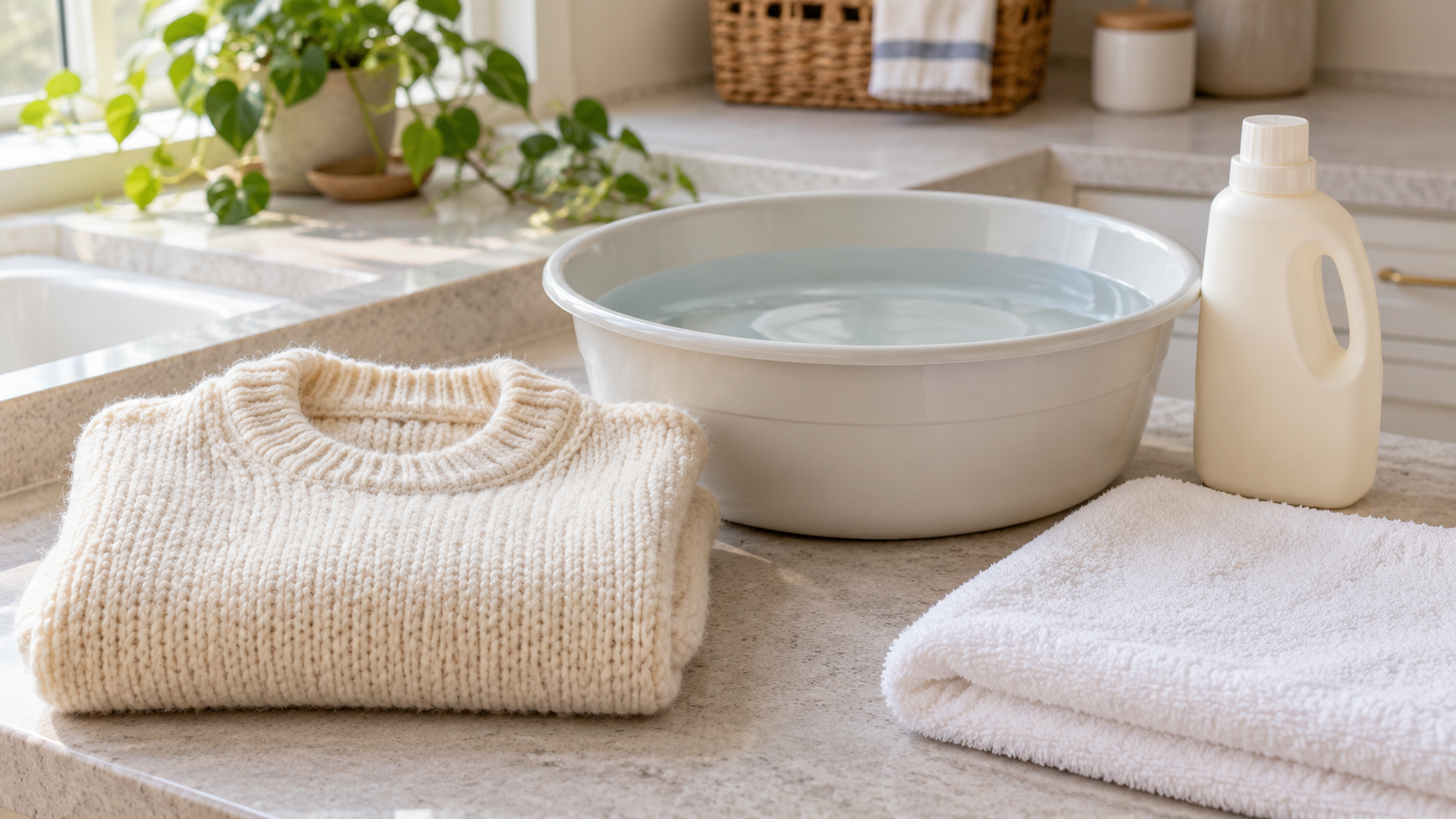
#Keep the setup simple:
- A clean basin, sink, or tub with enough room for the sweater to move without being packed tight.
- Cool or lukewarm water, unless the label gives a different instruction.
- A detergent intended for wool or delicates, used according to its directions.
- Two clean absorbent towels or a flat drying rack.
Avoid treating a wool sweater like a cotton T-shirt. Strong stain removers, bleach, a stiff brush, and a long aggressive soak can all create a new problem. If a garment has a special finish, embellishment, lining, leather trim, or a label that names a specific restriction, the restriction wins.
How to hand wash wool without rough handling
#Prepare the water first
#Fill the basin before adding the sweater. Mix in the correct amount of wool detergent so it disperses in the water rather than sitting directly on one part of the knit. Use the label's temperature instruction. When no exact temperature is printed, keep the water comfortably cool to lukewarm rather than hot.
Turn the sweater inside out. This is a practical way to reduce rubbing on the visible outer surface, especially around areas that pill easily. Empty the pockets and close zips or fasteners if the garment has them.
Submerge and move it gently
#Lower the sweater into the water and press it down slowly. Let the water travel through the knit. Instead of scrubbing, knead, twist, or rub, gently press the water through the fabric a few times. Focus on the whole garment, not one frantic spot.
For a small mark, treat only as far as the label and detergent instructions allow. Rubbing a stain hard can roughen fibers and leave that patch looking different from the rest of the sweater. If the mark is oily, old, or on a delicate blend, professional advice is often a better next step than stronger chemistry.
Rinse without temperature shocks
#Drain the wash water and refill with clean water at a similar temperature. Support the sweater with both hands as you move it. Press the rinse water through it until detergent is gone. Repeat only as needed.
The goal is gentle, even handling. Big changes in water temperature and lots of friction are the combination to avoid. Do not wring the sweater like a towel; a soaked knit is heavy and twisting it can pull the body, sleeves, and neckline out of shape.
Can you machine wash a wool sweater?
#Yes, but only when the label says it is machine washable. A wool cycle is designed for that job, but it cannot make every wool garment machine safe. “Delicate” is not a universal permission slip, and a regular cycle is not a sensible test.
For a machine-washable sweater, turn it inside out and put it in a mesh laundry bag if the knit is fine or likely to catch. Wash it with similarly light, gentle items rather than towels, jeans, or clothes with hooks and zips. Select the label's temperature and the wool cycle. Use a wool-appropriate detergent and avoid overloading the machine.
When the cycle finishes, take the sweater out promptly. Do not leave it crushed and damp in the drum while you do something else. Check the care label again before using a dryer: many machine-washable wool items still need to dry flat.
Drying is where shape is saved or lost
#Drying a sweater on a narrow hanger can stretch the shoulders because the wet garment is heavy. High heat can also be risky when the label does not permit it. Flat drying gives the knit support while it returns to its usual shape.
First, lift the wet sweater from underneath with both hands. Place it flat on a clean towel. Starting at the bottom, roll the towel and sweater together into a loose log, then press down gently along the roll. Unroll it. This removes excess water without twisting the knit.
Move the sweater to a second dry towel or a flat drying rack. Smooth it into the shape it had before washing: align the side seams, ease the sleeves straight, and check that the cuffs, hem, and neckline are not curled or pulled. Let it dry away from a radiator, direct sun, or hot air source unless its label specifically permits that method.
Drying time changes with the sweater's thickness, room humidity, and airflow. Do not pack it away while the center still feels damp. If the towel beneath it becomes soaked, switch to a dry one. Turning the sweater once it is no longer fragile and wet can help both sides dry evenly, but move it with support.
A simple worked example
#Imagine you have a lightweight wool crewneck worn over a T-shirt for two calm office days. It has no stain, and the label says hand wash cold and dry flat. Air it out first. If it smells fresh, you may not need to wash it yet.
If it does need washing, use cool water and wool detergent, press it gently in the basin, rinse at a similar temperature, and roll it in a towel to remove water. Then lay it flat and reshape the crewneck and sleeves. The key decisions are based on the label, not on how expensive the sweater looks or whether another wool item survived a machine cycle.
Now change one detail: the label says dry clean only. The routine changes completely. Do not hand wash it just because the fiber content says wool. The label may reflect the full garment—its dye, lining, trim, construction, or finish—not only the fiber named on the tag.
Stains, pilling, and storage are separate jobs
#A stain does not always call for washing the entire sweater. Start by blotting a fresh spill with a clean cloth; do not grind it in. Check the label before any spot treatment, and test only where the garment instructions allow. For a difficult stain, a cleaner can assess the whole garment and its care limitations.
Pilling is not dirt. It is small tangles of loose fiber created by friction, often at the underarms, cuffs, bag-contact areas, and sides. Let the sweater dry completely first. Then use a tool suited to the knit and work lightly. Existing Allblogs guidance on fabric shavers, lint rollers, and sweater combs is useful for choosing a tool; do not use a shaving tool on a wet sweater.
Store clean, fully dry wool folded rather than hanging for long periods. Folding helps a knit keep its shoulder shape. A breathable drawer or storage box is more useful than sealing something away while damp. Before a seasonal change, inspect the sweater for crumbs, makeup, or a hidden stain, since storage makes those easier to forget.
Common mistakes to avoid
#- Washing a dry-clean-only sweater at home because it is “only wool.”
- Using hot water, then rinsing in very cold water.
- Scrubbing a mark until the knit looks fuzzy or thin.
- Wringing or twisting water from the body and sleeves.
- Hanging a heavy wet sweater from the shoulders.
- Using a dryer without an explicit label instruction.
- Storing a sweater before it is completely dry.
The safest wool-care habit is not memorising one universal trick. It is reading the garment label, choosing the gentlest allowed method, and supporting the sweater while it is wet. That is how you clean a favorite knit without turning a small laundry job into a permanent fit problem.