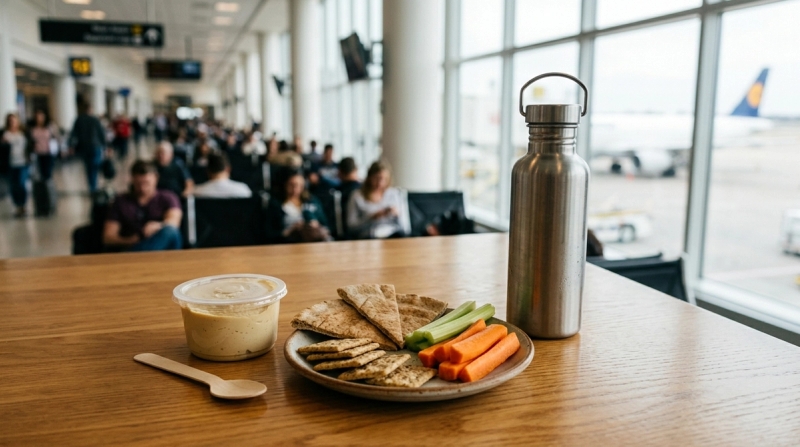
Hummus sounds like the perfect airport snack until you actually start thinking through the logistics.
It’s filling. It’s easy to eat with crackers, pita, or veggies. It feels a lot more like “real food” than a sad bag of chips from the newsstand. And if you’re trying to avoid a heavy airport meal before boarding, a little hummus cup can be just right.
But hummus is also a little annoying to travel with.
It counts as a spread or paste at security. It needs to stay cold. And if you pick the extra-garlic version, the person in 18B may quietly resent you for the next three hours.
So what’s the move? Should you buy hummus after security, pack it from home, or forget the whole thing?
Here’s the realistic answer.
Quick Answer: Buy, Pack, or Skip?
#Buy hummus after security if you want the easiest option.For most travelers, this is the best choice. You don’t have to worry about the TSA 3.4 oz/100 ml rule, and the hummus has likely stayed refrigerated until shortly before you bought it.
Pack hummus only if it’s 3.4 oz/100 ml or smaller, fits in your liquids bag, and you’ll eat it soon.A small sealed single-serve cup can work for a short travel day. But it still counts toward your carry-on liquids allowance, and it still needs to be eaten within a safe time window.
Skip hummus if it’s going to sit unrefrigerated for hours.If you take it out of the fridge before leaving home, ride to the airport, wait around, board, take off, and then eat it mid-flight, it may have been warm for too long.
The short version: buy it after security for most trips, pack it only when the timing is short and simple, and skip it if you can’t keep it cold.
Why Hummus Works as an Airport Snack
#Hummus makes sense before a flight. It’s savory, satisfying, and easy to pair with things that travel well, like crackers, pita, or cut vegetables.
It also feels a little more balanced than candy, chips, or a pastry eaten over your suitcase at the gate.
The problem is that hummus behaves differently once you leave your kitchen.
At home, it goes from the fridge to your plate. Easy. At the airport, it might go from the fridge to your bag, into a car or train, through security, into the gate area, onto the plane, and then sit there until the seatbelt sign turns off.
That’s where the two big issues show up:
- Security rules: Hummus is treated like a spread or paste, not a solid snack.
- Food safety: Hummus is perishable and should not sit at room temperature for too long.
Once you understand those two things, the decision gets much easier.
Can You Bring Hummus on a Plane?
#Yes, you can bring hummus on a plane. You just have to be careful about how you bring it.
If you bring hummus through airport security in your carry-on, it has to follow the rules for liquids, gels, creams, pastes, and spreads. Even though hummus is clearly food, TSA does not treat it the same way as crackers, bread, or carrot sticks.
Think of hummus more like:
- Peanut butter
- Yogurt
- Salsa
- Guacamole
- Dip
- Soft cheese spread
In other words, if you can scoop it, smear it, or dip something into it, assume the 3.4 oz/100 ml rule applies.
The TSA 3.4 oz/100 ml Rule for Hummus
#In the U.S., hummus packed in a carry-on must be in a container that is 3.4 oz/100 ml or smaller. It also needs to fit inside your quart-sized liquids bag.
The basic TSA rule is:
- Each liquid, gel, cream, paste, or spread must be in a container of 3.4 oz/100 ml or less
- Those containers must fit in one clear quart-sized bag
- Each passenger gets one quart-sized bag
So, a 2 oz single-serve hummus cup may be fine if it fits in your liquids bag. A larger tub of hummus probably will not make it through security in your carry-on, even if there’s only a little bit left inside.
That last part surprises people. Security usually looks at the size of the container, not just the amount of food left in it.
Also, TSA rules apply in the United States. Other countries may have different screening rules, and even in the U.S., the TSA officer at the checkpoint makes the final decision.
Is Hummus a Liquid or a Solid at Airport Security?
#In normal life, hummus feels like food. At airport security, it falls into the spread, paste, or dip category.
A simple way to think about it:
- Crackers: solid
- Pita: solid
- Carrot sticks: solid
- Hummus: spread or paste
If it can be scooped, smeared, mashed, or spread, treat it like a liquid or paste for carry-on screening.
This also applies to similar foods, including:
- Guacamole
- Salsa
- Creamy dips
- Soft cheese spreads
- Some nut butters
- Yogurt-style snacks
If you’re unsure, play it safe and assume the 3.4 oz/100 ml rule applies.
The Food Safety Issue: Hummus Needs to Stay Cold
#Security is only half the problem. Food safety matters just as much.
Hummus is a refrigerated perishable food. Once it leaves the fridge, the clock starts ticking.
Standard food safety guidance says perishable foods should not sit at room temperature for more than 2 hours. If it’s very hot, around 90°F or higher, that window drops to about 1 hour.
That does not mean hummus instantly becomes dangerous the moment it hits two hours. But after that point, it is no longer considered safely held by standard food safety guidance, and the risk starts going up.
And honestly, a plane is one of the worst possible places to gamble with your stomach.
Airport Time Adds Up Fast
#It’s easy to underestimate how long your food has actually been out.
A normal travel day might look like this:
- You take hummus out of the fridge before leaving home
- You drive, take a train, or get a rideshare to the airport
- You check in or drop a bag
- You go through security
- You wait at the gate
- You board the plane
- You sit through boarding and taxi
- You wait for the seatbelt sign to turn off
- You finally eat
Even if everything goes smoothly, that can easily be more than two hours.
Add a flight delay, a long security line, a hot car, or a slow boarding process, and that hummus has been hanging out unrefrigerated for longer than you probably intended.
That’s why packing hummus from home only makes sense when the timeline is short or you have a reliable way to keep it cold.
Can You Use an Ice Pack?
#Yes, you can use an ice pack or gel pack, but there’s one important security detail.
Frozen liquid items are generally allowed through TSA screening if they are frozen solid when you present them at the checkpoint. If the ice pack is partially melted, slushy, or has liquid at the bottom, it may need to follow the 3.4 oz/100 ml rule.
So yes, a frozen gel pack can help keep hummus cold. But it needs to stay fully frozen until you get through security. On a hot day, or after a long commute to the airport, that may not happen.
For a short domestic travel day, a small hummus cup in an insulated lunch bag with a frozen solid ice pack can be reasonable. For a longer travel day, buying hummus after security is usually much simpler.
Buy Hummus If...
#Buying hummus after security is usually the easiest choice.
Buy it at the airport if:
- You don’t want to deal with the TSA liquids bag
- Your travel day is long
- You’re not sure when you’ll eat
- You want the hummus to stay cold as long as possible
- Your carry-on space is limited
- You don’t want to risk having it tossed at security
Once you’re past security, the 3.4 oz/100 ml carry-on screening rule is usually no longer the same issue for food purchased in the secure area. In most cases, you can buy a refrigerated hummus snack pack near your gate and bring it onto the plane.
There can be exceptions with international connections, secondary screening, or different airport rules, so keep that in mind.
The food safety side is usually better, too. Hummus cups sold from refrigerated airport cases have typically stayed cold until you buy them. That gives you a much better starting point than hummus that has been sitting in your tote bag since breakfast.
Just remember: the 2-hour rule still applies after you buy it. If you grab a hummus cup in the terminal and then save it for later that night at your hotel, that’s not a great plan.
Pack Hummus If...
#Packing hummus can work, but only in the right situation.
Pack hummus if:
- The container is 3.4 oz/100 ml or smaller
- It fits inside your quart-sized liquids bag
- You’ll eat it within the 2-hour food safety window
- Your trip to the airport is short
- Your gate wait is short
- The container is sealed or very leak-resistant
- You’re pairing it with solid foods like crackers, pita, or vegetables
A small single-serve hummus cup is the best option. A big tub from home is not carry-on friendly, and honestly, it’s more trouble than it’s worth.
Also think about your liquids bag. If it’s already full of toothpaste, sunscreen, moisturizer, hand sanitizer, and other travel basics, a hummus cup may not be worth the space.
Skip Hummus If...
#Sometimes the smartest move is to skip it.
Skip hummus if:
- You have a long flight
- You’ll be away from refrigeration for more than two hours
- You don’t have a reliable way to keep it cold
- The container is larger than 3.4 oz/100 ml and you’re going through security
- The hummus is extra garlicky or strongly scented
- You’re traveling internationally with fresh vegetables
- You want to save it for later in the day
For long-haul flights, shelf-stable snacks are usually easier. Crackers, pretzels, plain pita, trail mix, roasted chickpeas, protein bars, and packaged snacks are much less fussy than a refrigerated dip.
Best Things to Eat With Hummus Before a Flight
#If you do buy or pack hummus, choose dippers that are tidy, solid, and easy to manage in a small airplane seat.
Crackers
#Crackers are one of the best hummus pairings for travel. They’re solid, easy to pack, and don’t need refrigeration.
Good choices include:
- Sturdy crackers
- Pretzel crisps
- Seed crackers
- Plain water crackers
- Whole grain crackers
Avoid crackers that shatter into crumbs the second you touch them. Nobody wants a lap full of cracker dust before takeoff.
A resealable pouch or small hard-sided container helps a lot.
Pita
#Pita is another good option. It’s filling, easy to eat, and obviously made for hummus.
For travel, cut or tear it into pieces before you leave. Trying to rip pita over your lap in a cramped airplane seat is weirdly messy and not worth it.
Keep it sealed until you’re ready to eat. Airplane cabins are dry, and bread can get stale quickly.
Vegetable Sticks
#Vegetables are fresh, crunchy, and great with hummus.
Good options include:
- Carrot sticks
- Celery sticks
- Bell pepper strips
- Cucumber sticks
For domestic travel, cut vegetables are generally treated as solid food at security. International travel can be more complicated. Fresh produce may be restricted when entering another country, and some places are very strict about agricultural rules.
If you bring vegetables on an international flight, plan to eat them before landing or dispose of them properly if required.
Also, pack vegetables dry. Wet veggie sticks can make the whole snack bag soggy, which is just depressing.
What to Avoid Before Long Flights
#Hummus can be a good flight snack, but not every version is a good idea.
Avoid Large Tubs of Hummus
#A full-size tub of hummus is not practical before security. It’s probably over the 3.4 oz/100 ml limit, and it won’t fit neatly in your liquids bag.
If you want a bigger portion, buy it after security or choose a different snack.
Avoid Hummus That’s Been Warm Too Long
#If you don’t know how long the hummus has been out of the fridge, don’t eat it.
This includes hummus that sat:
- In your bag during a long commute
- At the gate for hours
- On the plane while you slept
- In a car after landing
- In a hotel room before check-in
When in doubt, toss it. Annoying, yes. But much better than feeling awful mid-flight.
Avoid Strong Garlic or Onion Flavors
#A little garlic is normal in hummus. But extra-garlic, onion-heavy, or super pungent hummus can be a lot in a closed airplane cabin.
Planes are shared spaces. If a food smells strong on the ground, it may feel even stronger when your seatmate is inches away.
For flights, mild hummus is usually the kinder choice.
Avoid Messy Pairings
#Some foods seem like good dippers until you try to eat them from a tiny tray table.
Avoid:
- Flaky crackers
- Brittle chips
- Crumbly bread
- Overfilled containers
- Leaky homemade portions
- Anything that requires a pile of napkins
A good airport snack should be easy to open, easy to eat, and easy to clean up.
Avoid Saving Hummus for Later
#If you buy hummus in the terminal and then decide not to eat it, don’t just keep it for hours.
Once hummus has been unrefrigerated for more than two hours, it should be thrown away. That’s one of the big differences between hummus and shelf-stable snacks.
Crackers can wait. Hummus really can’t.
Packing Tips If You Bring Hummus From Home
#If you still want to pack hummus, keep it simple.
Use this checklist:
- Choose a container that is 3.4 oz/100 ml or smaller
- Put it in your quart-sized liquids bag before security
- Keep it cold until you leave home
- Eat it within two hours of taking it out of the fridge
- Pack crackers, pita, or vegetables separately
- Use a leak-resistant container
- Bring napkins or wipes
- Don’t pack more than you’ll actually eat
Commercially sealed single-serve cups are usually easier than spooning hummus from a big tub into a tiny container.
If you do portion it yourself, make sure the lid is truly secure. Cabin pressure, bag movement, and being shoved under the seat can all cause weak containers to leak. Hummus all over your backpack is not the travel memory you’re looking for.
Best Strategy for Most Travelers
#For most people, the easiest strategy is:
Pack the solid dippers, buy the hummus after security.
Bring crackers, pita, or maybe veggie sticks from home. Then, once you’re through security, buy a refrigerated hummus cup near your gate and eat it soon.
This gives you the best of both worlds. You don’t waste liquids-bag space on hummus, and you don’t have to worry as much about it sitting warm for half the day.
It also gives you flexibility. If the airport has hummus, great. If not, you still have crackers or pita and can pick up something else.
Final Verdict
#Airport hummus cups can be a great snack before a flight, but timing matters.
Buy hummus after security if you want the easiest and safest option.Pack hummus only if the cup is 3.4 oz/100 ml or smaller, fits in your liquids bag, and will be eaten within the 2-hour food safety window.Skip hummus before long flights, long waits, hot travel days, or anytime you can’t keep it cold.
Hummus is a good airport snack when you handle it right. Just remember what it is: a refrigerated spread with security rules, not a shelf-stable snack you can forget about until later.