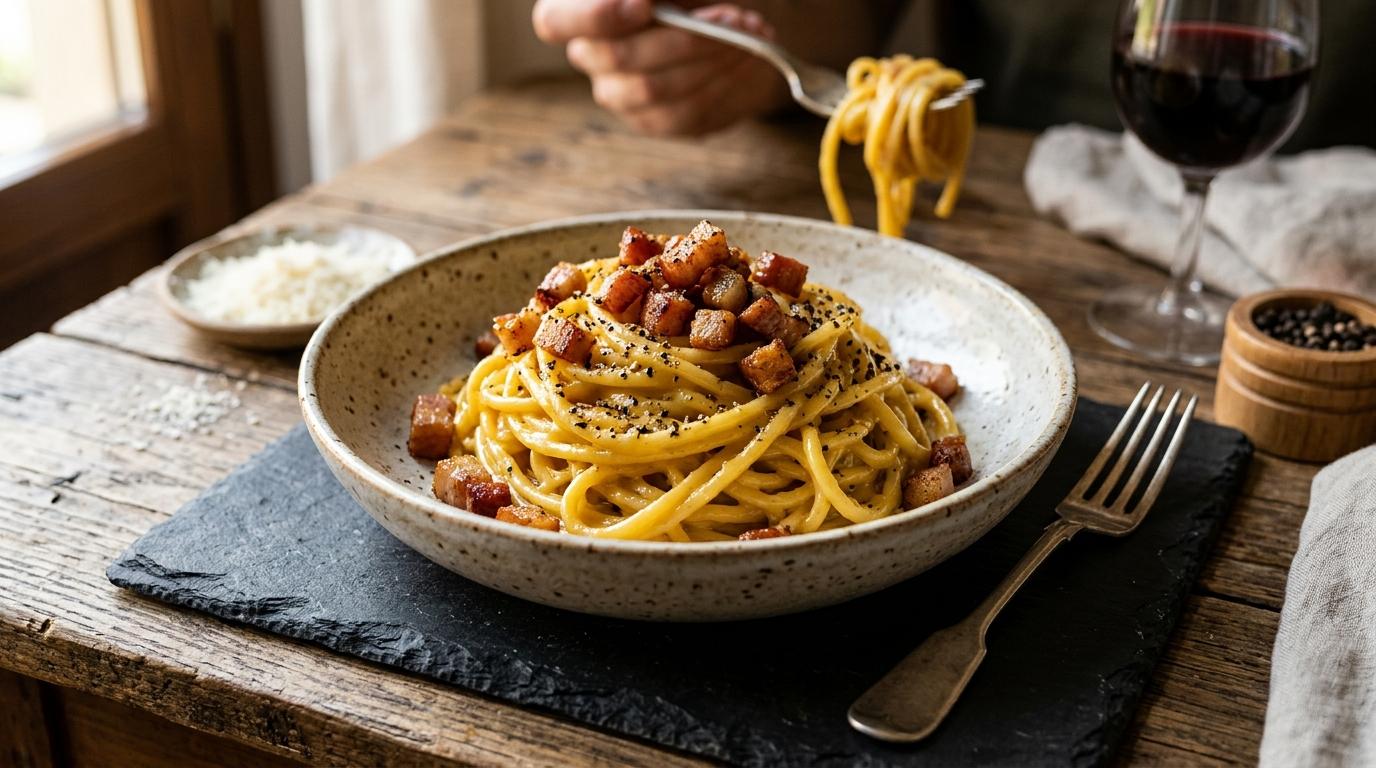
Authentic Roman carbonara needs only five ingredients: cured pork jowl (guanciale), fresh egg yolks, aged Pecorino Romano cheese, coarse black pepper, and pasta. There is no heavy cream, no garlic, no butter, no peas, and no onions.
The creamy sauce that coats the pasta does not come from dairy cream. It comes from mixing hot starchy pasta water and rendered pork fat with whisked egg yolks and grated cheese off the stove.
When you get it right, it is one of the most satisfying bowls of pasta you can make. When you get it wrong, the eggs scramble into curds or separate into grease.
The whole secret is simple: control the heat and keep the pan off the burner when the eggs go in.
The 5 Essential Ingredients of Classic Carbonara
#In Rome, sticking to these five ingredients is standard. Each one gives the dish its balance of fat, salt, and texture.
1. Guanciale (Cured Pork Jowl)
#Guanciale is cured pork cheek seasoned with salt, black pepper, and herbs, then aged for a few months. It is mostly firm fat with ribbons of lean meat. When you cook it slowly over medium-low heat, it releases clear, savory fat while the outside turns crisp and golden. That rendered fat coats the pasta and carries the whole sauce—you do not need any olive oil or butter.
2. Egg Yolks (The Golden Ratio)
#The eggs give the sauce its rich body. While some home cooks use whole eggs, traditional Roman kitchens use mostly yolks: one whole egg plus three or four yolks for four servings. The yolks bind the pork fat and pasta water together without thinning the sauce. Using mostly yolks also gives the pasta a deep yellow color and a smooth, custard-like coat.
3. Pecorino Romano Cheese
#Pecorino Romano is a hard, aged sheep's milk cheese from around Rome. It is sharp, salty, and bold, which cuts right through the rich pork fat and eggs. Authentic carbonara uses 100% Pecorino Romano. If that sharpness feels too strong for your palate, you can mix 70% Pecorino Romano with 30% Parmigiano-Reggiano for a milder, slightly sweet finish.
4. Coarsely Cracked Black Pepper
#Black pepper is not just a topping here; it is a main flavor. Crack whole peppercorns coarsely in a mortar or with the bottom of a heavy skillet. Toasting the cracked pepper in the warm pork fat brings out its aroma and gives each bite a clean, peppery bite. Fine pre-ground pepper from a shaker tastes dusty and lacks punch.
5. Pasta (Spaghetti or Rigatoni)
#Spaghetti and rigatoni are the two classic choices. Bronze-cut spaghetti has a rough, chalky texture that grabs the sauce, while short ridged rigatoni catches the crispy bits of pork inside its tubes. Both work great.
Why Cream Is Never Needed
#The biggest mistake cooks make is pouring in heavy whipping cream.
Many commercial kitchens add cream because it acts as a safety cushion. Dairy cream stops eggs from curdling even if someone overheats the pan.
But adding cream changes the whole dish for the worse:
- It washes out the sharp, salty flavor of Pecorino Romano into a bland white sauce.
- It leaves a heavy, greasy film on your tongue instead of letting the savory pork shine.
- It covers up the natural, glossy texture that egg yolks and pasta water create on their own.
Once you know when to pull the pan off the heat, egg yolks and pasta water give you a sauce that is silkier and lighter than anything made with cream.
Why Eggs Scramble and How to Stop It
#Eggs start setting and turning into solid curds between 65°C and 70°C (149°F–158°F).
If your pan is sitting directly on a hot stove burner, the bottom of the pan is easily over 120°C (248°F). The second raw eggs touch that metal, they scramble into an omelet.
To keep the sauce smooth and glossy, follow two basic rules:
- Take the skillet off the flame: Never pour eggs into a pan sitting on a live burner. Pull the pan completely off the heat, add the hot cooked pasta, and toss it for 30 seconds. That cools the metal down to around 60°C. Then fold in the egg and cheese mixture. The heat from the pasta cooks the eggs gently without scrambling them.
- Use starchy pasta water: As pasta boils, it releases starch into the water. Adding a few spoonfuls of that cloudy water into the pork fat and eggs helps the fat and water blend smoothly. It keeps the sauce velvety instead of greasy, just like our foolproof no-clump emulsion technique for classic Roman cacio e pepe.
Recipe Overview & Timings
#- Prep Time: 10 minutes
- Cook Time: 15 minutes
- Total Time: 25 minutes
- Servings: 4 generous portions
- Cuisine: Italian (Roman)
- Course: Main Course
Ingredients
#- Pasta: 400g (14 oz) bronze-cut spaghetti, spaghettoni, or rigatoni
- Guanciale: 200g (7 oz), skin trimmed off, cut into 1/4-inch thick by 1-inch long pieces
- Eggs: 4 large egg yolks plus 1 large whole egg, at room temperature
- Cheese: 100g (3.5 oz) Pecorino Romano DOP, finely grated
- Black Pepper: 2 teaspoons whole black peppercorns, coarsely cracked
- Salt: 1 tablespoon coarse sea salt (for boiling the pasta water only)
How to Make It Step by Step
#Follow these steps in order to get a glossy, restaurant-style carbonara at home.
Step 1: Mix the Egg and Cheese Paste
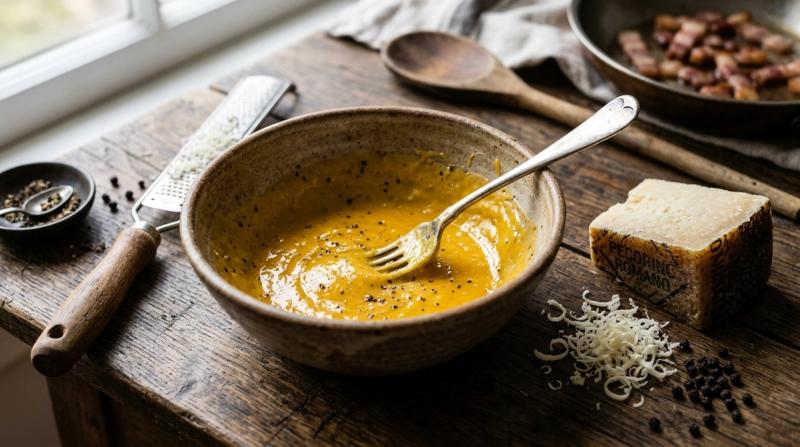
#In a medium mixing bowl, whisk together the 4 egg yolks and 1 whole egg. Add 80 grams of the grated Pecorino Romano (save the remaining 20 grams for serving) and 1 teaspoon of cracked black pepper. Whisk for about a minute until it forms a thick, golden paste. Keep the bowl near the stove so the eggs stay at room temperature.
Step 2: Boil the Pasta (Use Less Salt)
#Bring a large pot with 4 liters of water to a rolling boil. Add only 1 tablespoon of coarse salt—about half of what you would normally use. Guanciale and Pecorino Romano are already salty, so heavy salt in the water will make the finished dish too salty. Drop the pasta into the pot and cook until it is 2 minutes shy of al dente.
Step 3: Crisp the Guanciale on Low Heat
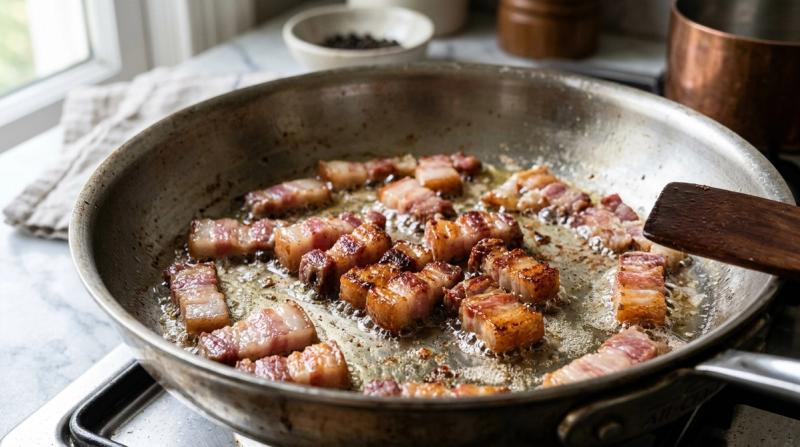
#Set a large skillet over medium-low heat. Add the sliced guanciale to the dry pan. Do not add oil or butter; the pork will render plenty of its own fat. Cook slowly for 8 to 10 minutes, stirring now and then. The fat will melt into a clear, bubbling pool while the pork turns crisp on the outside and tender in the middle.
Use a slotted spoon to transfer half of the crispy pork to a small plate for topping later. Turn off the heat under the skillet.
Step 4: Toast the Black Pepper in the Warm Fat
#Add the remaining 1 teaspoon of cracked black pepper directly into the warm skillet with the pork fat. The leftover heat will toast the pepper for 30 seconds, bringing out its aroma without burning it.
Step 5: Toss the Pasta with Starchy Water
#When the pasta is 2 minutes shy of al dente, use tongs to lift it directly from the boiling pot into the skillet with the pork fat and pepper. Turn the heat under the skillet to medium for just 60 seconds. Add 1/2 cup of hot pasta water. Toss and stir the pasta for about a minute until a thin, cloudy glaze coats the noodles.
Step 6: Take the Skillet Off the Heat and Add the Eggs
#Move the skillet completely off the stove and place it on a cool counter or heat-proof mat. Toss the pasta for 30 seconds so steam escapes and the pan cools slightly below 65°C.
Pour the egg and cheese paste over the pasta. Toss the noodles with tongs in one hand while stirring with a spoon or spatula in the other. As the pasta, warm fat, and eggs mix together, they will turn into a thick, glossy sauce that coats every strand.
If the sauce feels too thick, splash in 2 to 3 tablespoons of hot pasta water and keep tossing. The starch will loosen the sauce into a smooth, creamy glaze.
Step 7: Plate and Serve Hot
#Divide the hot pasta into warm bowls. Top each bowl with the reserved crispy guanciale, the remaining grated Pecorino Romano, and a light pinch of cracked black pepper. Serve it right away while it is hot and creamy.
Guanciale vs Pancetta vs Bacon: Easy Substitutions
#If you cannot find authentic Italian guanciale, you can use other cured pork cuts. Here is how they compare:
| Cured Meat | Cut of Pork | How It Is Cured | Smoke Profile | Result in Pasta |
|---|---|---|---|---|
| Guanciale | Pork Jowl / Cheek | Salt, pepper, herbs; aged 2–3 months | Unsmoked | Crisp outside, melting fat; traditional Roman taste |
| Pancetta | Pork Belly | Salt and spices; slab or rolled | Unsmoked | More lean meat, slightly less liquid fat; closest substitute |
| Bacon | Pork Belly | Brined or dry-cured; smoked | Heavy wood smoke | Smoke covers up the cheese and egg flavor; use only if needed |
| Smoked Pancetta | Pork Belly | Lightly smoked Italian pancetta | Light smoke | Good backup option if plain pancetta is not available |
If you buy unsmoked pancetta, ask the butcher for a single 1/2-inch thick slice so you can cut it into thick strips. Thin pre-sliced sandwich cuts crisp up too fast and do not release enough fat for the sauce.
How to Reheat Leftover Carbonara Without Scrambling
#Carbonara is best eaten in the first few minutes after tossing. Once it cools, the eggs set and the fat firms up.
If you have leftovers, do not microwave them on high power. A microwave heats the eggs past 80°C in seconds, turning the creamy sauce into rubbery bits floating in oil.
Use one of these two gentle reheating methods instead:
- The Steam Bowl Method: Put your cold leftover pasta in a heat-proof glass or metal bowl set over a small pot of simmering water. Add 2 tablespoons of water or warm milk. Stir gently with a fork as the steam warms the bowl. The indirect heat will melt the cheese and fat back into a smooth sauce without curdling the eggs.
- The Low-Heat Skillet Method: Put a nonstick skillet on the lowest burner setting. Add 2 tablespoons of water and your leftover pasta. Cover with a lid for 2 minutes to let trapped steam loosen the noodles. Take off the lid, toss gently for 30 seconds until warm, and plate immediately.