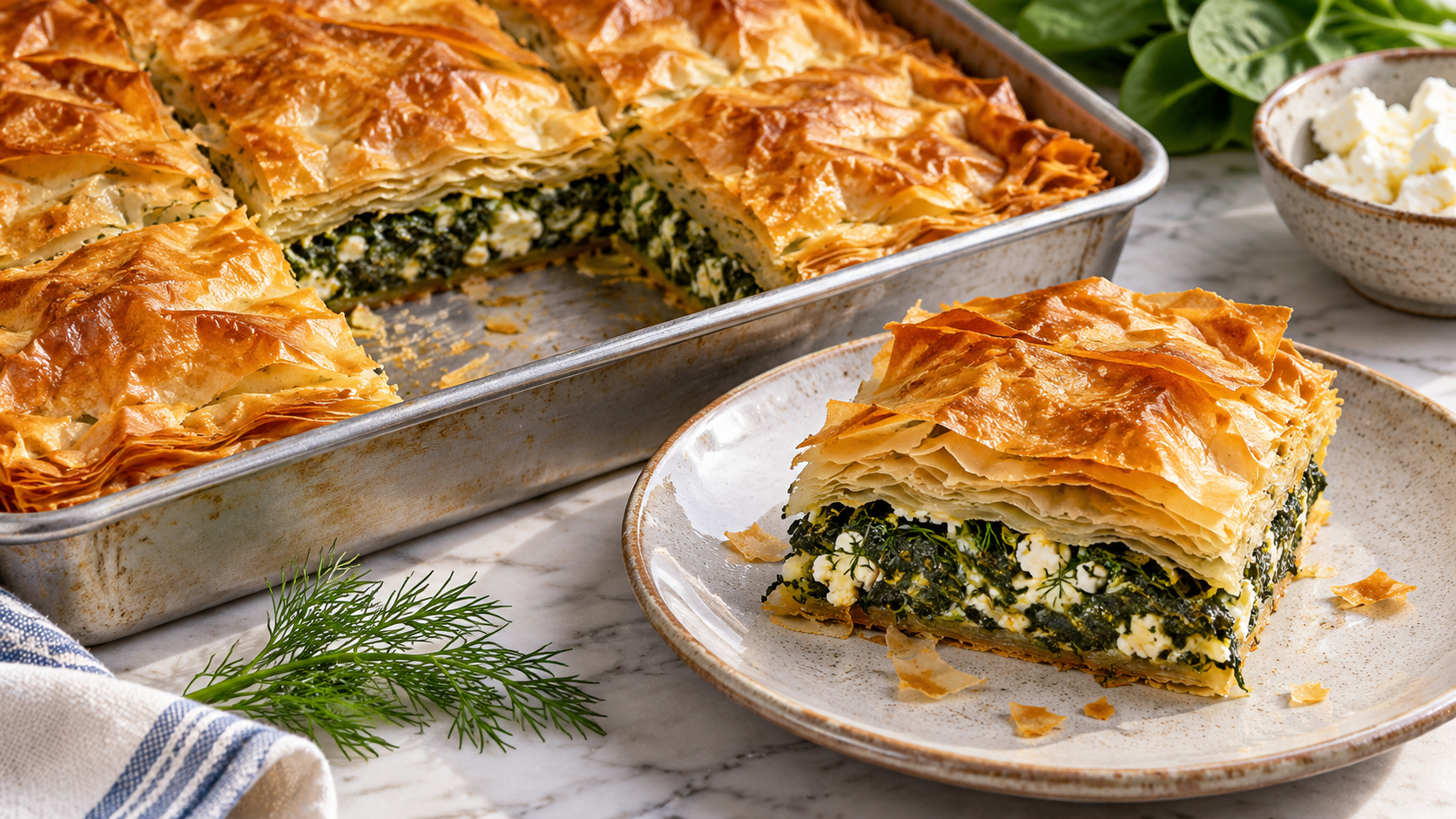
For spanakopita, I’d squeeze the spinach before I even open the filo. You can patch a torn sheet with another piece. Once a wet filling is under the pastry, you’ve got a much harder problem. The little pile of spinach left after squeezing is what you want for a crisp Greek spinach and feta pie.
Say there’s a bag of chopped spinach in the freezer and a packet of filo you bought for something else. I’d move both to the fridge ahead of time, then make sure there’s enough room on the counter for the tray and the unrolled sheets. That’s the beginning of dinner here. There’s no need to roll out your own pastry to make a pie worth slicing.
Start with the water in the spinach
#The card uses frozen chopped spinach because it makes the shopping and prep simple. The tray size and basic combination of spinach, feta, eggs, herbs and olive oil draw on Suzy Karadsheh’s recipe. What I’d pay closest attention to is the spinach before it touches the bowl. It should be fully thawed so you can squeeze water out of the middle as well as the outside.
Work in handfuls over a sieve. If a handful feels too cold and you can still feel ice in the centre, let it finish thawing in the refrigerator. Once it’s ready, close your hand around a small portion and squeeze. You’ll get more out of it than if you push down on the whole pile at once. A clean kitchen towel can help with the last bit. Twist it over the sink rather than over a dry counter where you’ll be laying out pastry.
Then break up the compressed spinach with your fingers or a fork. If you leave it in tight clumps, you’ll get a bite of plain spinach here and a bite of almost pure feta there. When you rub a bit between your fingers, it should separate without leaving a pool underneath. Keep the spinach cold while you finish the rest of the prep.
Fresh spinach is also an option. Wilt it in batches, drain it, and squeeze once it’s cool enough to handle. Start with more than the bowl looks like it can hold. Those raw leaves lose a lot of volume. If I were at the shop and choosing solely for this pie, I’d take the frozen bag for a repeatable starting amount. If I already had a pile of fresh greens at home, I’d use those and judge the amount after wilting.
Keep the filling spreadable
#I’d crumble feta by hand so some pieces stay recognisable. You can use a fork if the block is firm. Drain it if it came in brine, and taste a little separately before adding any salt. The feta does a fair amount of the seasoning. The herbs still need room to come through.
Chop the parsley finely and use dill in the filling. If using fresh dill, dry it after rinsing. I’d keep the stems that are soft enough to chop and put the tougher ones aside. The onion should be fine enough to distribute through the pie. If you choose to soften it first for a milder flavour, let it cool before adding it. A hot heap of onions is an awkward thing to put into a mixture that’s about to sit on paper-thin pastry.
The egg helps bind the filling as the pie bakes. I’d mix it through once the spinach is broken up, then fold in the feta without crushing it into a smooth paste. Avoid tasting the mixture once the raw egg has gone in. If you want to check the salt, do it with a bit of feta and spinach before that stage.
Look at the bowl when you’re done. The filling should hold together when you pick up a spoonful and still be easy to spread. If you can see liquid collecting at the bottom before the eggs go in, drain it then. After that, I’d avoid trying to fix the bowl with an arbitrary handful of flour. It changes the filling and won’t pull the extra water back out of the pastry once you assemble it.
Give the filo a place to lie flat
#Thaw the packet according to its directions and keep it closed until the filling and tray are ready. A sheet can be cold and still flexible. If the folded layers feel stiff enough to snap, give the package the time it needs in the fridge. Some brands have small rolls, some have wide ones, and they can take different amounts of time to thaw.
Before unrolling the stack, brush the dish with olive oil and have the brush, extra oil and filling within reach. Set a slightly damp clean towel over the sheets you’re waiting to use. I’d wring the towel out well. Water dripping onto filo makes it stick together. It only needs enough cover to keep the exposed surface from drying and cracking while you work.
If you’ve picked up puff pastry by mistake, save it for a spinach pie written for puff. Here, the layers come from the individual sheets you stack and brush. That’s also why one small tear is easy to fix.
Don’t worry about one tear. Lay the sheet in, brush it lightly and cover the hole with an overlap from the next sheet. I’d save the best intact pieces for the visible top and use the more awkward scraps to line a corner. You can fix a surprising amount without stopping to open a second packet.
Make the bottom layers do their share
#Try one sheet over the tray before you start brushing. If it’s long, let the extra hang over the rim. If it’s short, move the next sheet towards the other end and overlap the two. I’d check each corner with a fingertip before spooning in the spinach. The last thing you want to discover with a full tray is that the corner under your first square has nothing but oil under it.
Brush lightly as you go. A sheen is enough. If there’s oil pooling in a low spot after two layers, move it around with the brush before adding more. There will be less guesswork if you pour some oil into a small bowl and refill it as needed instead of trying to pour from a bottle over the whole tray.
Put more of the pastry below the filling than above it, as the source tray method does. Spread the filling gently, working from the centre outward. Watch the corners. A mound in the middle takes longer to heat, and bald corners give you a square that’s mostly pastry. If you want, use the back of a spoon to even it out before the first top sheet goes on.
I’d loosely fold in the overhang and tuck the top layers around it, then brush the surface. Where the folds get especially thick, ease them out so there isn’t a pile of damp pastry trapped against the rim. An uneven edge is fine. It’ll still look like a pie once the colour comes up.
Lightly score the top where you’d like to cut portions. Stop well before the filling. I’d make the marks while the sheets are still flexible. Once they’re crisp, it’s much easier to follow an existing line than to press a knife through the entire unmarked top and flatten half of it.
Check the centre and the base
#The top should turn golden, and the edges should feel crisp. A raised fold near the rim can colour earlier than the broad centre. Use the oven setting in the card and give the whole tray time to finish. If the top starts getting too dark, loosely protect it with foil while the centre and lower layers catch up.
Check the temperature in the middle with a clean food thermometer. The U.S. food safety chart lists 165°F (74°C) for casseroles, including meatless ones. Colour gives you a separate clue about pastry texture. If you can lift an edge gently with a spatula, look for some colour on the lower layers. Avoid lifting the middle of the pie while the filling is still setting.
Let it stand briefly before you cut. If you go through it immediately, the first piece can be hard to lift cleanly. Follow the scored lines and slide a flat spatula underneath. An edge piece comes away more easily than a square boxed in on all four sides, so I’d take that one first and use the space to get under the next piece.
If the bottom is soft, look at where it happened
#If it’s soft across the whole tray, I’d check the spinach prep and the bake first. Water left in the filling reaches a lot of the pastry at once. And a pie with a browned top can still need time underneath. On the next bake, weigh or measure your filling consistently, get the oven ready, and look at the base near the edge before calling it done.
If only one patch is wet, check whether the filling was spread evenly or a seam lined up through the lower layers. A thin corner may still be crisp while the centre is struggling. That difference is useful. Move the seams in the next tray and spread the filling out without pushing down hard.
If the sheets themselves shatter before assembly, have a look at how long they were exposed. Take out one or two at a time and re-cover the stack. Patching is fine for this pie. A sheet that’s glued wet to the next one is another matter. Replace a dripping towel with a well-wrung one and keep the oil brush away from the unused sheets.
When there’s only one tray
#If I were taking the pie somewhere, I’d check that the tray fits in the bag before loading it. A rigid container is useful once the pieces cool enough to handle. Stacking warm pieces tightly is a good way to steam the pastry you just spent an hour baking. For a meal at home, use a flat plate and give the squares some space. If the rest of dinner is running late, serve the pie warm and keep the portioning simple. It can sit briefly while you dress the salad, within safe serving limits. It doesn’t need to land on the table the moment you take it out.
Think about lunch before you make another pie
#For dinner, I’d cut it in larger squares and serve it with a sharp salad. For a table with several things to try, smaller pieces are easier to pick up once they’ve had a little time to settle. The filling already has feta and herbs. A side with acidity and crunch will do more here than another rich sauce.
If I planned to serve it tomorrow, I’d prep the greens and feta separately and keep them refrigerated. The next day I can add the egg and open the filo when the oven is warming. That leaves very little to do in front of guests and keeps the assembled pastry from sitting against a wet filling overnight.
Refrigerate cooked portions promptly and keep the fridge at 40°F (4°C) or colder. The U.S. guidance is within two hours, or within one hour above 90°F (32°C). Reheat leftovers to 165°F (74°C). An oven or toaster oven can help the outside crisp up on a suitable tray. If I’m packing a cold portion, I’d keep it chilled until lunch.
There’s an easy way to see whether the next tray needs changing. Take a corner piece, then take one from the middle. If both have layers you can lift with a fork, you’ve got the practical part down. Then the next choice can be about how much dill you want, or who gets the corners.