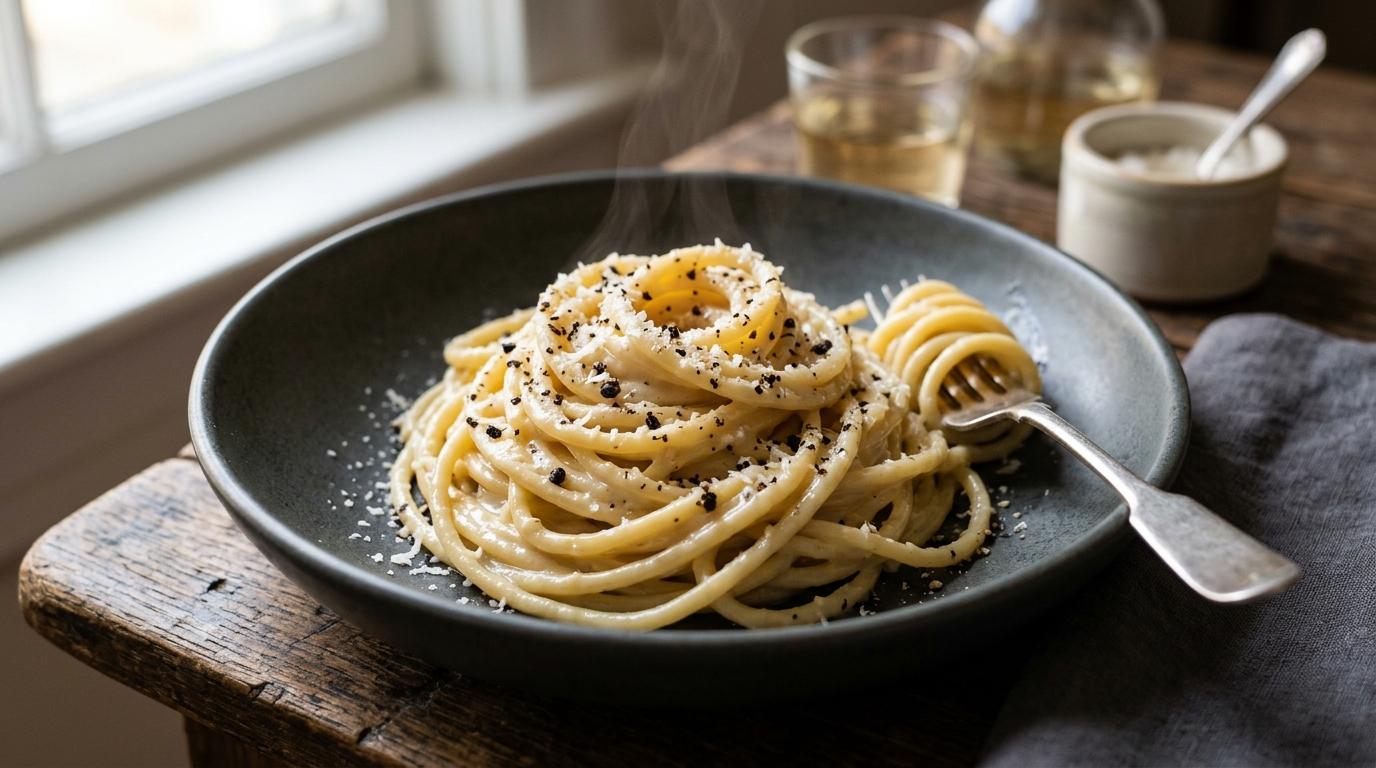
Cacio e pepe sounds like the simplest recipe in the world. The name literally translates from Roman dialect to "cheese and pepper." There are only three ingredients: dry pasta, aged Pecorino Romano cheese, and black peppercorns. 
There is no butter, no heavy cream, no olive oil, and no garlic.
Yet if you ask ten experienced home cooks how their first attempt at cacio e pepe went, at least eight of them will tell you it was an utter disaster. 
Instead of a velvety, glossy cheese cream coating every single strand of pasta, they ended up with a pool of watery pepper broth at the bottom of the bowl and a tough, gummy ball of melted cheese stuck like chewing gum to their tongs or the bottom of the pan.
The reason cacio e pepe fails so often is that it is not really a recipe. It is an exercise in physical chemistry. 
Once you understand what happens to cheese proteins when they hit hot water, you can make this Roman masterpiece consistently without a drop of cream and with zero clumping.
The Roman Holy Trinity: Why 3 Ingredients Terrorize Home Cooks
#In traditional Roman cooking, there are four classic pasta dishes that build upon one another: Gricia, Carbonara, Amatriciana, and Cacio e Pepe. 
While the other three use rendered pork fat from cured pork jowl (guanciale) to help lubricate and stabilize the sauce, cacio e pepe has no meat fat to lean on. The entire sauce must be created out of nothing more than the water you cooked the pasta in and the hard, aged sheep's milk cheese you grate over it.
This process is called mechanical emulsification. An emulsion is a stable mixture of two liquids that normally do not want to combine: in this case, the free fats inside the cheese and the hot water from the pasta pot.
If you simply grate cheese over hot noodles in a pan, the fat separates from the water, the proteins bind tightly together, and the sauce breaks instantly. To make it work, you need two things: the right temperature and a powerful stabilizing emulsifier.
The Science of the Clump: Protein Coagulation at 65°C
#The culprit behind the rubbery cheese clump is a specific family of milk proteins called caseins.
Pecorino Romano is a hard, aged sheep's milk cheese aged for at least eight to twelve months. During aging, moisture evaporates, leaving behind concentrated milk fats and tightly bundled casein protein chains held together by calcium phosphate bonds.
When you heat Pecorino Romano, the milk fat melts around 32°C to 35°C (90°F to 95°F), turning the cheese soft and pliable. 
However, if the temperature continues to rise above 65°C (149°F), the casein proteins denature. They uncoil, shed their water, and aggressively bond with one another. Because water and fat repel each other, the contracting proteins squeeze out all the melted butterfat into an oily sheen and fuse into an insoluble, rubbery ball.
Once cheese proteins coagulate above 65°C, there is no culinary technique on earth that can melt them back into a smooth sauce. 
The core secret to cacio e pepe is never letting your cheese experience temperatures above 65°C.
Starch Is Your Shield: The Shallow Water Boiling Hack
#If heat makes cheese clump, how do Roman trattorias get away with pouring hot pasta water into cheese? 
The answer is starch.
Starch consists of two types of carbohydrate molecules: amylose and amylopectin. When dry semolina pasta cooks in boiling water, surface starch granules absorb water, swell, and burst, leaching suspended starch molecules into the liquid.
In an emulsion, starch molecules act as physical microscopic spacers. They get in between the casein protein chains, preventing them from colliding and linking together into rubber. At the same time, the starch thickens the water, increasing its viscosity so it can trap tiny droplets of melted cheese fat in a silky suspension.
The Big Mistake: Too Much Water
#Most people follow the traditional rule of boiling pasta in a giant stockpot filled with 5 or 6 liters of rapidly rolling water. 
For ordinary pasta with tomato sauce, that is fine. But for cacio e pepe, boiling in a massive pot of water is a critical mistake because it dilutes the starch. Your pasta water ends up thin, clear, and watery.
Instead, cook your pasta in a wide, shallow skillet or a small saucepan with just enough water to submerge the noodles—roughly 1.5 liters (6 cups) of water for 340 grams (12 oz) of pasta.
As the pasta boils in this shallow pool, the water turns cloudy, opaque, and milky white. That concentrated starch liquid is liquid gold. It has roughly triple the starch density of stockpot water, providing the heavy-duty emulsifying power needed to hold the cheese together.
The Pepper Technique: Dry Toasting Whole Peppercorns
#Black pepper in cacio e pepe is not a casual garnish shaken from a bottle at the table. It is a cooked vegetable element that builds the foundation of the sauce.
Pre-ground black pepper from a shaker has already lost its volatile aromatic essential oils; all that remains is harsh, one-dimensional heat. 
For authentic cacio e pepe, use whole black peppercorns, ideally Tellicherry peppercorns, which are left on the vine longer to ripen and have a complex, fruity, woodsy aroma.
How to Toast the Pepper
#Do not grind the peppercorns in a fine pepper mill. Place whole peppercorns on a cutting board and crush them coarsely with the heavy bottom of a cast iron skillet or in a mortar and pestle. You want irregular, cracked chunks that provide textural pops of heat.
Heat a wide dry skillet over medium heat without any oil or butter. Add the cracked peppercorns. 
Toast them dry for 1 to 2 minutes, constantly shaking the pan. As the heat penetrates the peppercorn shells, volatile aromatic compounds like piperine and pinene bloom, filling your kitchen with a toasty, floral fragrance.
The moment the pepper smells intensely fragrant and begins to release faint wisps of smoke, carefully pour in half a cup of water. 
The water will immediately boil violently, deglazing the pan and extracting the toasty peppery oils into a cloudy, aromatic broth. Turn off the heat and set the skillet aside. That pepper broth is the liquid base of your sauce.
The Two-Bowl Method: Creating the Cheese Paste
#If you dump dry grated cheese directly into a skillet with hot pasta, you will fail almost every time because you cannot stir fast enough to prevent hot spots from exceeding 65°C.
The foolproof professional technique is the two-bowl paste method:
- Microplane Your Cheese: Do not use pre-shredded cheese from a tub, which is coated in potato starch or cellulose to prevent sticking and will never melt. Do not use the large holes of a box grater. Use a microplane or the fine powder holes of a grater. You want the Pecorino to look like light, fluffy snow so it hydrates instantly.
- Make the Paste Off-Heat: Place 1 cup of the grated Pecorino into a separate heat-proof mixing bowl.
- Temper With Warm Water: Ladle about 1/3 cup of warm pasta water into the bowl with the cheese. Do not use water straight out of a rolling boil; let the water sit in your ladle for 20 seconds so its temperature drops around 60°C.
- Whisk into a Paste: Vigorously whisk the cheese and warm water with a fork. Within twenty seconds, the cheese will absorb the water and transform into a thick, completely smooth paste with the consistency of pancake batter or hummus.
Because this paste has already integrated water and starch below the coagulation temperature, it is buffered and resilient. It can be tossed with warm noodles without seizing into a clump.
Step-by-Step Execution: Marrying Pasta and Cream
#Once your pasta is boiling, your pepper broth is steeped, and your cheese paste is whisked, the final assembly takes less than two minutes.
- Under-cook the Pasta: Pull your pasta out of the boiling water roughly 2 minutes before the package says al dente. The noodles should still have a firm white core.
- Finish in the Pepper Skillet: Use tongs to transfer the dripping wet pasta directly into the skillet with the pepper broth over medium-high heat. Add another 1/2 cup of starchy pasta water. Toss and stir the pasta in the simmering broth for 90 seconds. As the pasta finishes cooking, it releases more surface starch directly into the skillet broth.
- The Cool-Down Pause (Critical Step): Remove the skillet completely from the heat burner. Set it on a cool counter or trivet and let it sit for 30 to 45 seconds. Lift the noodles with your tongs a few times to let excess steam escape. You want the pan to drop slightly in temperature so it does not scorch the cheese.
- Add the Paste and Emulsify: Pour your prepared cheese paste over the warm pasta.
- Agitate Aggressively: Using your tongs in one hand and shaking the skillet with the other, toss and twirl the pasta rapidly and continuously. The mechanical motion combined with the starch slurry will cause the cheese paste and peppery broth to marry into a glossy, creamy sauce that coats every strand like liquid silk.
- Adjust Consistency: If the sauce looks a little too thick or sticky, splash in 1 tablespoon of warm pasta water. If it looks too watery, sprinkle in a tablespoon of dry grated cheese and keep tossing; the residual heat will melt it smoothly.
Pasta Selection: Tonnarelli vs Spaghetti vs Rigatoni
#The shape and production method of your pasta directly affects whether your cacio e pepe sauce clings or slides off into a watery puddle:
| Pasta Type | Surface Texture | Starch Release | Sauce Grip | Roman Authenticity |
|---|---|---|---|---|
| Fresh Tonnarelli (Chitarra) | Rough, square, porous | High | Exceptional | Traditional Roman standard |
| Bronze-Die Spaghetti | Chalky, rough, matte | High | Excellent | Modern Italian trattoria standard |
| Bronze-Die Rigatoni | Ridged, hollow cylinder | Moderate to High | Great (Sauce enters tube) | Popular Roman alternative |
| Teflon-Die Boxed Spaghetti | Smooth, slick, yellow | Low | Poor (Sauce slides off) | Avoid for cacio e pepe |
Always look for the words "trafilata al bronzo" (bronze-die extruded) on the pasta package. 
Standard supermarket pasta extruded through smooth Teflon dies comes out shiny and slick; cheese emulsion slides right off smooth noodles. Bronze dies leave microscopic grooves, pits, and a chalky white flour coating on the noodle exterior that grabs onto the cheese sauce like Velcro.
Common Mistakes and Emergency Fixes
#Even with the best intentions, things can go sideways if pan temperatures spike. Here is how to diagnose and recover:
- Problem: The sauce broke and there is an oily film floating on water.
- Cause: The pan was slightly too hot, or there was not enough starch in the water to hold the emulsion.
- Emergency Fix: Pull the pan completely off the heat, add 2 tablespoons of cold pasta water (which immediately drops the temperature), and whisk vigorously with a fork. The cold liquid helps the fat re-emulsify.
- Problem: The cheese turned into a solid, rubbery ball on the bottom of the pan.
- Cause: The pan was over 65°C when the cheese was added, denaturing the casein proteins.
- Emergency Fix: Once proteins curdle, you cannot fix that specific clump in the pan. Use tongs to lift out the clumped cheese ball and discard it. Let the pan cool for a full minute, take another 1/2 cup of freshly grated Pecorino mixed with warm water in a bowl into a fresh paste, and toss it into the cooled pasta off-heat.
- Problem: The pasta tastes overwhelmingly salty.
- Cause: Adding too much salt to the boiling water. Pecorino Romano is one of the saltiest cheeses in the world.
- Prevention: Use only 1 teaspoon of salt in your pasta water rather than the heavy palmful you would use for a marinara sauce. The cheese provides 90% of the seasoning.
Frequently Asked Questions
#Why does the cheese clump together into a ball in cacio e pepe?
#Cheese clumps due to protein denaturation. Aged sheep's milk cheese like Pecorino Romano is packed with casein proteins. When exposed to temperatures above 65°C (149°F) in the presence of boiling water, the protein molecules violently contract, squeeze out their internal fats, and bond together into a dense, rubbery mass. To prevent this, the cheese must be tempered with warm water into a paste first and tossed with the pasta off the heat where temperatures are buffered below 65°C.
Do authentic Roman recipes use butter or olive oil in cacio e pepe?
#No. In traditional Roman trattorias, using butter, olive oil, or heavy cream in cacio e pepe is considered culinary heresy. The signature glossy creaminess comes entirely from a mechanical emulsion of suspended wheat starches from pasta cooking water and melted milk fats from the finely grated Pecorino Romano cheese.
Can you make cacio e pepe with Parmigiano-Reggiano instead of Pecorino Romano?
#Yes, but it changes the character of the dish. Pecorino Romano is an aged sheep's milk cheese that is sharp, salty, and pungent. Parmigiano-Reggiano is a cow's milk cheese that is nuttier, sweeter, and less salty. Many modern chefs use a 50/50 blend of Pecorino Romano and Parmigiano-Reggiano, which softens the sharpness of the sheep's cheese while melting slightly more smoothly.
What is the best pasta shape for cacio e pepe?
#The traditional Roman choice is fresh egg-and-semolina tonnarelli (also known as spaghetti alla chitarra), which has square, rough edges that grip the cheese sauce. For dry boxed pasta, choose bronze-die extruded spaghetti, bucatini, or rigatoni. Bronze-cut pasta has a chalky, rough exterior that releases massive amounts of surface starch into the cooking water and clings to the sauce far better than smooth, Teflon-extruded noodles.