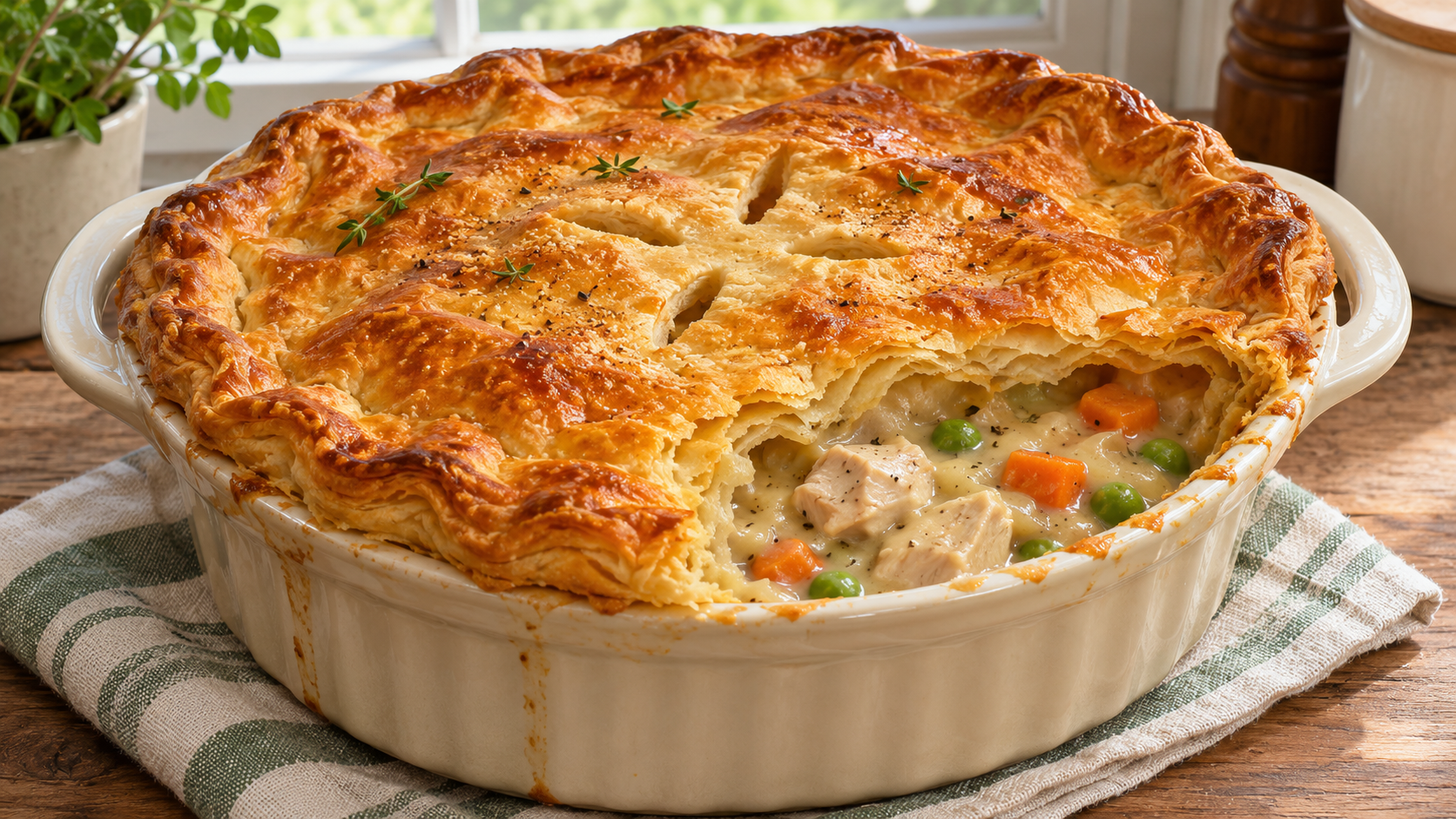
If dinner starts with cooked chicken in the fridge, I’d make one chicken pot pie with a puff pastry lid. Get the gravy thick enough to coat a spoon before it goes into the dish, and keep the pastry cold until the oven is ready. Those two checks do most of the work.
Picture a Sunday dinner you’ve already cooked once. There’s enough chicken left for another meal, but it’s a mixture of breast, thigh and awkward little pieces from around the bones. That’s a good starting point here. Pull off the meat, dice a carrot, and put a sheet of puff pastry in the fridge to thaw according to the packet. The job is suddenly a lot smaller.
Decide what kind of pie you want to serve
#The recipe card makes a pie you scoop at the table. There’s a lid and a generous layer of filling underneath. You can get some pastry and gravy into the same serving even when the first slice comes out looking like a scoop instead of a wedge.
I’d choose this format for an ordinary dinner. If you want a pie that lifts out in neat slices, look for a double-crust recipe written for that job. It’ll account for the bottom pastry and the amount of liquid the shell needs to hold. Putting another sheet of puff pastry underneath this filling changes the bake, and the dish in this recipe was chosen for a lid.
A single large dish is enough for most dinners. If you want individual pies, use oven-safe ramekins, allow room above the filling, and check them separately. Smaller dishes give more pastry per serving, which sounds nice until you realise you’ve cut six little lids and now need six places for them on the baking sheet. For me, that’s a weekend decision.
Use the chicken you have, then check its seasoning
#I would use cooked thigh and breast together if both were available. Keep the pieces close enough in size that you get chicken in most spoonfuls. A few rough edges are fine. Long shreds can pull an entire piece of pastry along when you serve the pie, so cut across any particularly long strands.
Rotisserie chicken fits this version. Take off the skin and check for little pieces of bone before it goes into the gravy. Taste the chicken by itself if it’s safe to eat and properly stored. A heavily seasoned bird can bring quite a bit of salt with it. I’d start with low-sodium stock and hold back the added salt until the chicken and peas have gone in.
If you're starting from raw chicken, cook it separately first and use a thermometer to confirm it reaches 165°F (74°C). Then cut it up for the filling. This method uses the oven to bake the pastry and heat a cooked filling. Starting with raw pieces changes how much water enters the gravy and how long the centre takes to heat.
Leftover turkey can go through the same sequence. If your turkey is already dry, cut it into small pieces so it gets well coated. It has already had its time in the oven. Folding it into the finished gravy is enough before you move on to assembly.
Make the gravy before the chicken goes in
#Here’s where I’d slow down. Soften the onion, carrot and celery in butter. Take a piece of carrot out and press it with the side of a knife. It should be starting to give. A big, hard cube can stay surprisingly firm even when the gravy around it bubbles. Cutting the vegetables small at the start keeps that problem manageable.
Stir flour into the butter and vegetables. It’ll look thick and a little clumsy at first. Keep it moving until you’ve worked in the dry flour and it no longer smells raw. The first splash of stock may turn it into a paste. Keep stirring and add a little more. Once the mixture loosens, the remaining stock and milk are easier to work in smoothly.
Let the whole pan come to a gentle simmer before deciding the gravy needs help. Dip in a spoon and look at the back. The sauce should give it an even coat that stays there long enough for you to see it. A spoon dragged across the pan should leave a brief trail. The sauce still needs to flow around the vegetables when you tip it into the dish.
If it moves like soup, give it more time at a simmer and stir along the base. If it’s holding stiff ridges, add stock a spoonful at a time. Add the chicken and peas when the sauce looks close, let everything come back up to heat, and make the final adjustment then. Frozen peas can go straight in, but a pan that has cooled down needs a moment before you can judge it again.
This is when I’d taste a spoonful with some chicken in it. The gravy on its own may seem mildly seasoned while the next bite, with rotisserie meat, already has enough salt. A little thyme and black pepper finish the filling without taking it away from the chicken.
If the flavour feels weak even though the salt is right, check the stock you used. A little reduced unsalted stock can bring more chicken flavour without the salt of an extra stock cube. On a weeknight I’d keep it simpler and use a stock I already like, then give the gravy enough time to thicken. More seasoning won’t fix a sauce that’s still watery.
Cut the lid before you need it
#While the pastry is still cool, check it against the rim of the dish. An unrolled sheet that only just covers the hole will be annoying to work with once the filling is in. Leave enough pastry to meet the rim without pulling it tight. Use a sharp knife so you get a clean edge.
A sheet can feel ready at one end and still be frozen at the fold. If you see a crack starting, put it back in the fridge and give it more time. If it’s soft and sticking to the paper, let it firm up again. I’d rather put it back for a while than try to drag a floppy lid across a pan of gravy.
I’d use a rimmed baking sheet under the dish to catch drips. Leave room at the top so you can carry it without gravy sloshing over the rim. If the dish is already full, bake the extra filling in a second oven-safe dish or chill it promptly for another meal.
Cut a couple of short vents once the lid is on. Brush the surface with egg wash, keeping it away from the cut edges where you can. Have the oven up to temperature first. You’ve already done the work of keeping the pastry cold and getting the filling ready. This is a good place to go straight to the oven.
Give the filling a head start on a busy night
#There are two sensible ways I’d split the job. If I’m cooking the whole pie that evening, I’ll finish the gravy, give the filling a few minutes off the heat while I clear space, then add the cold lid and bake. The filling inside should already be warm. I wouldn’t leave it on the counter waiting for the pastry to thaw.
If dinner is tomorrow, I’d refrigerate the cooked filling promptly in shallow containers. Keep the thawed pastry separately in the fridge according to the packet. The next evening, reheat the filling on the stove until it reaches 165°F (74°C), stirring and checking several spots. If the chilled gravy has tightened too much, a little stock can make it easy to spoon again. Transfer it to the baking dish and add the cold pastry just before it goes into the oven.
Some pot pie recipes are built around a chilled filling. I’d follow their full oven and dish instructions if going that route. Heating the filling first is the route in this recipe, because it keeps the centre from lagging too far behind the lid. This matters even more if your dish is fairly deep.
Keep track of how long your cooked chicken has already been in the fridge. I wouldn’t treat putting it into a pie as a way to get another full storage period. If I was already close to the end of the safe storage window, I’d choose a freshly cooked batch for a pie that needs to last beyond dinner.
Check under the colour before you serve
#A golden top is a good start. I’d also check for visible layers along the rim and a top that looks dry and well risen. If the edge has browned but the centre is pale and soft, give it time. A dark rim can be loosely shielded with foil if it needs protecting while the rest bakes.
Use a thermometer through a vent to check the middle of the filling, keeping the tip away from the base of the dish. Look for 165°F (74°C) in the centre. If it’s below that, keep baking and check again. Bubbling by the side tells you the edge is hot. The middle can still be cooler.
Let it settle briefly before cutting. Pick a serving spoon that can get under the chicken as well as through the pastry. I’d crack the lid into portions first, then lift a piece of pastry with each scoop. It’s a small thing, but it means the last person gets a piece of crust too.
What I’d change if the first serving looks wrong
#If the gravy pools like broth, look back at the pan on the stove. Did you judge its thickness before it simmered? Did a big handful of frozen vegetables go in just before you took it off the heat? Those are two things you can change without touching the pastry. For the pie already on the table, use a shallow bowl and give guests a spoon for the gravy.
If the sauce came out too tight, it may have reduced further in the oven than you expected. For leftovers, a splash of warm stock stirred into the filling after removing the lid can help. Next time, stop the stovetop reduction while the sauce still moves freely around the vegetables.
When the pastry looks flat and greasy, I’d check whether it softened on the counter and whether the oven was ready. If only one corner has a wet patch, see if the pastry drooped into the filling there. Trim and support the lid at the rim next time. The underside will always be softer than the surface because it’s over a moist filling, but you should still get defined layers above it.
Keep the next portion simple
#I’d serve the pie with something that can wait while the lid finishes. A green salad works. So do green beans dressed at the last minute. If you’re serving a hungry group, put the bowl and serving spoon on the table before you start cutting so nobody has to carry a hot dish twice.
For leftovers, portion the pie into shallow containers and chill promptly. The U.S. food safety guidance is to refrigerate perishables within two hours, or within one hour above 90°F (32°C), and to hold them at 40°F (4°C) or colder. Reheat leftovers to 165°F (74°C). An oven can bring back some crunch. If using the microwave, expect a softer lid and check the centre for cold spots.
If I knew there would be more filling than we’d eat, I’d save some before adding pastry to the whole lot. A portion of properly chilled gravy and chicken gives you another choice later. You can bake it in a small dish with its own piece of puff, and that dinner gets a crisp top of its own.