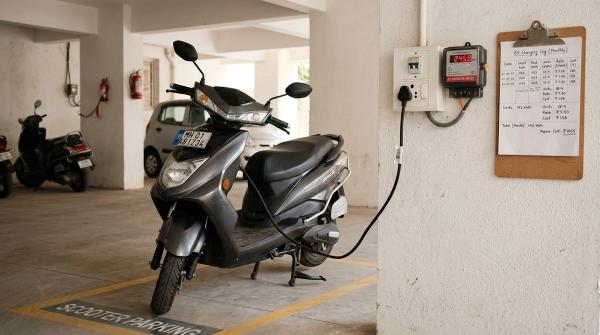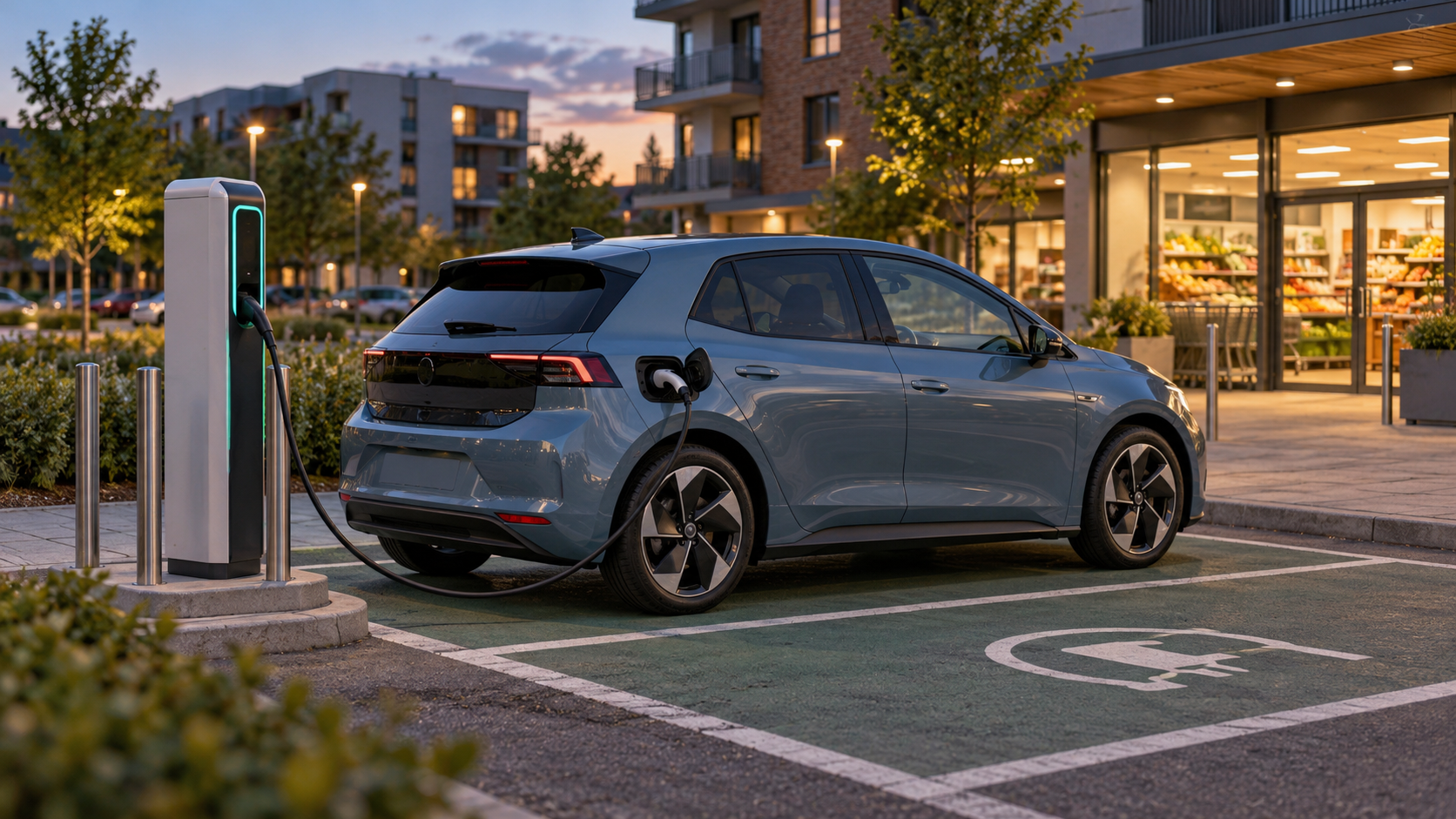
Yes, you can own an electric car without home charging. It works best when charging fits places you already visit, the available sessions replace the energy you use, and you have a practical backup when your usual charger is unavailable.
The useful question is whether that routine works for your actual week. A charger five minutes away might be ideal, or it might sit behind a gate that closes before you get home. A workplace charger can cover most of your needs, but only if you can use it often enough.
Before choosing a car, work through distance, energy, access, time and cost together. This guide is for battery electric cars. Connector standards, parking rules, payment methods and prices vary by country and operator, so check those locally.
Choose places where the car already waits
#Start with your existing calendar: work, a regular class, shopping, a station car park or an overnight parking area. Charging is easier to sustain when the car can gain energy during time you would spend there anyway.
Energy Saving Trust describes public on-street, destination and workplace charging as alternatives to a private home chargepoint. The US Department of Energy also identifies workplace and public destination charging as useful parts of charging access. Neither means that every nearby installation is available to you.
You will see two charging terms. AC means alternating current; the car's onboard charger converts it for the battery. DC means direct current; a DC charger supplies it without that onboard AC conversion. Public AC usually suits longer parking, while compatible DC fast charging suits shorter stops. The actual speed still depends on both the car and the equipment.
Think of each possible location as an arrangement you need to verify:
| Charging option | Where it can fit | What could limit the routine |
|---|---|---|
| Workplace charging | A long, regular parking period | Attendance days, sharing rules, registration and time limits |
| Public AC near home | Overnight or several hours while nearby | Parking restrictions, walking route and an occupied bay |
| Destination AC charging | A class, gym visit or shopping stop | A short visit may add less energy than expected |
| DC fast charging | A planned shorter stop or backup | Queue, price and the car's actual charging curve |
A slower point at a place you visit for three hours may be more useful than a faster one that requires a separate journey. Equally, a convenient shop is not enough if your normal visit lasts only twenty minutes.
Write down two plausible regular locations and a backup. This is a planning exercise, not a rule that everyone needs exactly three sites. One dependable workplace arrangement may do most of the work. The backup protects the days when it cannot.
Turn an ordinary week into an energy budget
#List the whole week's driving, including return journeys. Add school runs, errands, visiting friends and the extra distance needed to reach charging locations. A commute-only estimate can miss a substantial part of the week.
Then use the car's expected energy consumption for comparable driving conditions. Consumption is often shown as kWh per 100 km or miles per kWh. A kilowatt-hour, or kWh, measures energy. Kilowatts, or kW, measure power: how quickly energy is being delivered.
The basic calculation is:
Weekly driving energy = weekly distance × consumption per 100 km ÷ 100.
Here is an illustrative example, with invented numbers rather than a particular car's specifications:
- Five return commutes of 36 km: 180 km.
- Weekend and other driving: 60 km.
- Total weekly driving: 240 km, roughly 149 miles.
- Assumed driving consumption: 18 kWh per 100 km.
- Weekly driving energy: 240 × 18 ÷ 100 = 43.2 kWh.
If you work in miles per kWh, divide weekly miles by that efficiency figure instead. Keep the units consistent throughout the worksheet.
The 43.2 kWh estimate describes driving energy. It is not automatically the energy a public charger will bill. Charging losses, battery conditioning and energy used while parked can affect the overall requirement. Use actual trip records and charging receipts once available, and check whether any published consumption figure already includes charging losses before adding another allowance.
For a prospective purchase, repeat the calculation using a less favourable consumption assumption. Cold weather and cabin heating can reduce EV range, as DOE and EPA guidance explains. Your own route, speed, weather and vehicle matter more than a universal percentage.
Check the battery window, not just the advertised range
#A large weekly energy requirement does not mean you need to replace it all in one session. What matters is how much energy you can comfortably use between realistic charging opportunities.
Continue the hypothetical example with a car that has 60 kWh of usable battery capacity. Usable capacity is the portion available for driving; it can differ from the battery's advertised gross capacity.
Suppose the driver chooses to plan between 80% and 25%. These are example planning points, not a recommended charging range for every battery. Follow the specific vehicle's daily and trip charging guidance.
The example window contains:
60 × (0.80 − 0.25) = 33 kWh.
At the assumed 18 kWh per 100 km, that represents about 183 km. A 240 km week therefore needs a charging opportunity during the week if the driver wants to remain within that window. A full battery on Monday does not establish that the same routine can repeat indefinitely.
The lower planning point also needs context. It should leave enough energy to reach your backup, handle a diversion and complete essential driving. Someone with several nearby alternatives has a different problem from someone whose fallback is far away. A battery percentage alone cannot tell you whether the reserve is adequate.
Estimate what each visit can actually add
#Do not multiply a charger's biggest advertised number by the time you plan to stay and treat the result as a promise.
The vehicle's AC charging limit can constrain an AC session. DC charging power can change with battery temperature, starting charge and the vehicle's charging curve; charging commonly slows at higher charge levels. Station conditions and available power can matter too.
For a rough planning calculation, use a plausible average power into the battery, then verify it during a real session:
Energy added = average power into the battery × charging hours.
If the car averages an assumed 6 kW into the battery for three hours, it gains about 18 kWh, provided there is sufficient battery headroom. Two such visits add 36 kWh. That is 7.2 kWh short of the example's 43.2 kWh weekly driving requirement, even before any other energy needs.
This is a useful result. Two comfortable-looking charging visits can still leave a routine gradually running down the battery.
A short shopping stop makes the same point. At an assumed 6 kW average, a half-hour visit adds about 3 kWh. Five visits add 15 kWh, leaving 28.2 kWh of that week's driving energy to find elsewhere. A charger outside your supermarket is helpful; it does not automatically cover your ownership needs.
Keep the energy boundaries clear. Power shown by the charger may describe energy delivered at the charger rather than energy stored in the battery. If that is the figure you use, account for the difference instead of silently treating the two as identical.
Put the sessions on the calendar
#For the example driver, two three-hour AC opportunities plus an additional session capable of adding 12 kWh could offer up to 48 kWh into the battery. That is 4.8 kWh more than the calculated driving use. Available charging time is useful flexibility; you do not have to accept all that energy every week.
Now check the order of journeys and sessions. Starting Monday at 80% in this example, three 36 km commuting days use about 19.4 kWh, leaving roughly 48%. Adding 18 kWh on Wednesday brings the car to about 78%, so that session fits below the example upper planning point.
Here is how the week could run, assuming only the driving use already calculated:
| Point in the week | Driving energy since previous row | Energy added | Battery energy afterwards |
|---|---|---|---|
| Monday start | None | None | 48 kWh, or 80% |
| Wednesday after three commutes and charging | 19.44 kWh | 18 kWh | 46.56 kWh, or 77.6% |
| Friday after two commutes and charging | 12.96 kWh | 12 kWh | 45.6 kWh, or 76% |
| Sunday after 60 km and charging | 10.8 kWh | 13.2 kWh | 48 kWh, or 80% |
The Sunday session stops short of the available 18 kWh because the example car is back at its planning limit. Extra energy use would change these figures and might use some of that spare opportunity. Verify the time and headroom again with actual consumption. Weekly totals alone can hide a low-battery Thursday or a session that cannot add its intended energy because the battery is already nearly full.
Test the week when one session fails
#Remove your most important session from the calendar. Perhaps the office bays are occupied, you work from home unexpectedly, or the usual site is unavailable.
What happens next?
Write down the alternative location, the distance to reach it, when you would go and how much energy you need to add. Check the car's estimated arrival charge before setting off. Do not build a routine that depends on arriving nearly empty at one untested location.
For the example, losing an 18 kWh session creates a meaningful gap. Another half-hour supermarket visit adding 3 kWh will not replace it. The driver needs a longer compatible session, a different charging opportunity or a change to that week's travel.
Also test a week with a longer journey, a public holiday or a different work pattern. Workplace charging becomes less useful during leave unless you have permission and a reason to return. A backup that requires an expensive journey every weekend may be technically possible while being a poor fit for your life.
If the plan fails, use that information before buying. You might need a different vehicle, more dependable charging access or another transport arrangement. A bigger battery can increase flexibility between sessions, but it does not remove the need to replenish the energy used over time.
Count the whole charging bill
#Public-only charging costs should come from the places you expect to use. A home electricity tariff is not a substitute for their prices.
Check whether each location bills by energy, time or session, and whether parking is charged separately. Look for a subscription, minimum charge, idle fee, time-of-day rate or payment hold. Some conditions vary by site and membership. Electrify America's published guidance, for example, tells drivers to check current station pricing and idle fees at the charger or in its app; those are operator-specific terms.
Use the energy on a charging bill when estimating that bill. If a hypothetical week requires 48 billed kWh, and the assumed price is 0.50 currency units per kWh, the energy cost is 24 currency units. Add an assumed 6 in parking charges and the total becomes 30. Over 240 km, that is 0.125 currency units per km.
These are illustrative amounts, not a local tariff or a claim that 48 billed kWh stores 48 kWh in the battery. Replace them with actual prices and measured use. Add any subscription and extra charging journeys separately.
A membership also needs arithmetic. If an invented plan costs 8 currency units a month and saves 0.10 per billed kWh, it breaks even at 80 kWh per month on that network. Charging elsewhere does not help recover that fee. Use the same billing period and include applicable charges when comparing actual plans.
Compare petrol or other transport costs over the same distance using realistic consumption and local prices. This charging worksheet covers running energy and associated visits; it does not establish total ownership cost after purchase price, insurance, maintenance and depreciation.
Verify access and the actual charging experience
#A map pin is a lead to investigate. Before relying on it, check the details that could change your routine:
- Can you enter at your intended hour, including weekends and holidays?
- Is it public, customer-only, resident-only or restricted to registered employees?
- Does the exact car support the connector and charging method?
- Is a cable or approved adapter required, and who provides it?
- How do payment, registration and any reservation system work?
- Are charging and ordinary parking time limits different?
- Can you park correctly and reach the port without obstructing another bay or walkway?
At work, ask the facilities team how charging is shared and what happens when demand exceeds the available bays. DOE workplace guidance covers registration, scheduling, time limits and pricing because access depends on more than equipment being installed.
Visit at the time you expect to use the site. A quiet Sunday morning tells you little about Tuesday evening availability. Recent status information can help, but your plan still needs an alternative.
When using a charger, follow the vehicle and operator instructions and confirm that energy transfer has actually started before walking away. A connected cable or accepted payment does not always mean the car is charging. Check the vehicle's charging status and any alerts, then return before the site's charging or parking limit expires.
If equipment appears damaged or shows a fault, use the operator's support process or another suitable point. Do not open equipment, force connectors or improvise an electrical workaround to rescue the schedule.
Choose the car around the routine
#Once you understand your charging opportunities, compare vehicles against them. Ask about usable capacity, expected consumption in your conditions, AC charging capability and DC charging performance across a useful charge range.
The maximum DC figure is only one part of the answer. You need to know what the car can add during the kind of stop you will actually make. Similarly, paying for higher AC capability has limited value if your regular locations cannot provide it.
Check the manual for daily charging limits and any battery preparation features. Tesla's Model 3 manual, for example, directs owners to the vehicle or app for recommended daily and trip limits. That illustrates why a fixed percentage should not be copied across every model, battery and market.
A longer-range car may let you choose a more convenient charging day. Weigh that flexibility against its price and your real need. Buying battery capacity to avoid checking unreliable access can leave the underlying problem unsolved.
Try the routine before committing
#Spend a week recording your journeys and visiting the likely charging locations at realistic hours. Check the walk home, lighting, accessibility and whether returning to move the car fits your responsibilities.
If a suitable test drive or rental permits charging, try a normal session with the relevant car. Follow the provider's terms. Record arrival charge, charging time, energy added or billed, total cost and any unexpected wait. Treat one successful visit as evidence about that visit, not proof of permanent availability.
Then complete the failure-week exercise. Include the person who will do the charging trips if the car is shared. A plan can look convenient on paper while putting every extra journey on one household member.
You are ready to make a useful decision when the ordinary week balances, the order of sessions works, a missed session has a reachable answer, and the real bill and extra time are acceptable. If one of those remains uncertain, resolve it before committing. Reliable charging access is part of choosing the car.