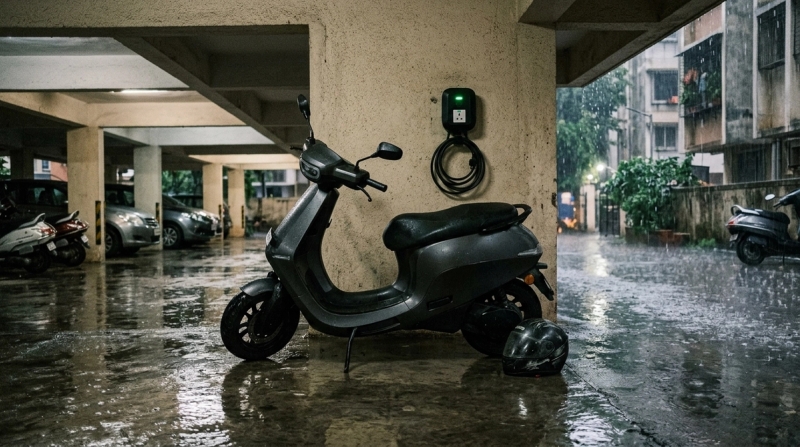
The Indian monsoon does not go easy on two-wheelers.
One minute you are leaving home in a light drizzle. The next, the road is covered in muddy water, potholes have disappeared, buses are spraying water from both sides, and your shoes are already wet. Somewhere in the middle of all this, one thought comes up:
Is it actually safe to ride an electric scooter in rain?
The honest answer is: yes, usually. But not blindly.
Most modern electric scooters sold in India are designed to handle normal rain, wet roads, and splashes. They are not delicate gadgets that will stop working at the first drop of water.
But they are also not boats.
An IP rating, even IP67, does not mean you can ride through flooded underpasses, deep water, or unknown puddles without risk. Rain-ready is not the same as flood-proof.
This guide is a practical monsoon checklist for Indian electric scooter riders. We’ll talk about riding in rain, charging safely, parking, IP ratings, post-ride care, warranty cautions, and when it’s better to stop riding and call the service centre.
Quick Answer: Can You Ride an Electric Scooter in Rain?
#Yes, you can ride an electric scooter in rain if your scooter is built for wet-weather use and you follow the owner’s manual.
Most electric scooters today come with sealed electrical parts and some level of water resistance. Normal rain, road spray, and wet roads are usually fine.
But water resistance has limits.
Avoid riding through:
- Deep standing water
- Flooded underpasses
- Waterlogged roads
- Unknown puddles
- Muddy water where you cannot see the road
- Any water level that may reach the battery, motor, controller, or charging port
A simple rule works best: if you cannot see the road under the water, don’t ride through it.
Charging needs even more caution. Electric scooter charging in rain should only be done in a dry, covered place, with a dry plug, dry socket, and dry charging port. Some brands, including Ola, advise owners not to start or stop charging outdoors while it is raining, because moisture may enter when the charging port is open.
And above everything else, follow your own scooter’s manual. IP ratings, charging rules, service instructions, and warranty terms can differ from one model to another.
Why Monsoon Riding Needs Extra Care
#Riding an EV scooter in Indian rain is not automatically unsafe. The real problem is the full monsoon package: slippery roads, hidden potholes, poor visibility, waterlogging, bad parking spots, and risky charging setups.
During monsoon, your scooter has to deal with:
- Rainwater on the display, switches, seat, and floorboard
- Splash from buses, cars, and trucks
- Slippery mud, oil patches, wet leaves, and road paint
- Hidden potholes and broken drain covers
- Damp basement parking
- Wet sockets and extension boards
- People trying DIY fixes after water exposure
A petrol scooter has its own rainy-season issues. An electric scooter has different ones. The battery, motor, controller, charger, display, wiring, and charging port all need to stay within the limits set by the manufacturer.
So this is not about being scared of rain. It is about building better monsoon habits.
What an IP Rating Really Means
#You may have seen brands mention an IP67 scooter, especially when talking about the battery or motor.
IP ratings are useful. But they are also easy to misunderstand.
“IP” means Ingress Protection. It comes from the IEC 60529 standard by the International Electrotechnical Commission. The rating tells you how well an enclosure is protected against dust and water under specific test conditions.
In an IP67 rating:
- 6 means dust-tight
- 7 means protected against temporary immersion in water up to 1 metre for 30 minutes, under controlled conditions
That sounds reassuring, and it is a good sign. But it does not mean the whole scooter is flood-proof.
The battery may have one rating. The motor may have another. The display, switches, connectors, charger, and charging port may have different levels of protection.
Also, a lab test is very different from a flooded Indian road. Clean, still water in controlled conditions is not the same as muddy water, potholes, moving traffic, water pressure, stones, drain water, and repeated monsoon exposure.
So treat IP ratings as protection, not permission.
An IP67 rating should make you more confident in normal rain. It should not make you ride into a flooded underpass.
Pre-Ride Checklist for Monsoon
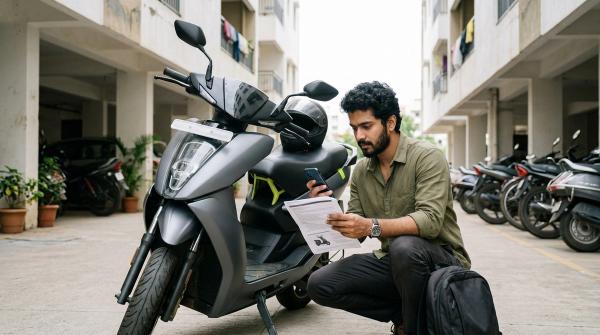
#Before you ride in rain, take one minute to check the scooter. It is a small habit, but it can prevent a much bigger problem later.
1. Check the charging port cover
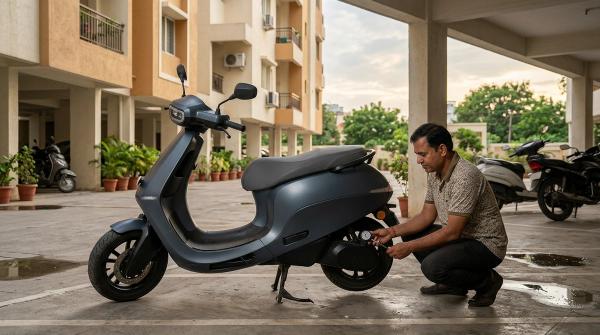
#Make sure the charging flap, rubber cap, or plastic cover is properly closed.
This is one of the most important checks before riding an electric scooter in rain. If the cover is loose, cracked, missing, or not sealing properly, don’t ignore it. Get it checked.
2. Look for exposed or damaged wiring
#Do a quick visual check around:
- Rear wheel or hub motor area
- Floorboard underside
- Swingarm area
- Charging port area
- Visible connectors
If you see cut insulation, loose wires, broken clips, or hanging cables, avoid riding in rain and contact an authorised service centre.
3. Check the tyres
#Wet roads can be slippery even when there is no flooding. Bad tyres make everything worse.
Look for:
- Worn tread
- Uneven tyre wear
- Cracks
- Low air pressure
- Nails, glass, or stones stuck in the tyre
Don’t depend only on ride modes, regenerative braking, or braking tech. Your tyres are still your first safety system.
4. Test both brakes gently
#Before entering traffic, roll slowly and test the front and rear brakes.
If braking feels weak, noisy, uneven, or jerky, ride carefully and get it checked. Rain can change braking feel, especially if the scooter was parked in a damp place.
5. Check lights, horn, and indicators
#Visibility drops quickly in rain. Make sure your headlamp, tail-lamp, brake light, indicators and horn work.
Don’t assume other drivers can see you. In heavy rain, you have to make yourself obvious.
6. Check the display for warnings
#If the dashboard shows a battery, motor, charging, insulation, or system warning, don’t start a long rain ride.
Check the manual or call the service centre first.
Riding Checklist: How to Ride an Electric Scooter in Rain
#Monsoon riding is mostly about staying smooth.
Smooth throttle. Smooth braking. Smooth turns. No sudden hero moves.
1. Avoid waterlogged roads
#This is the biggest rule.
If you cannot judge the depth, don’t enter. If you cannot see the road surface, avoid it. Water can hide potholes, stones, open drains, broken road edges, and speed breakers.
Don’t ride through deep water just to prove your scooter can handle it. Maybe the battery is sealed well, but another component may not be designed for that kind of exposure.
2. Slow down before puddles
#Even shallow water can unsettle the scooter if you hit it fast.
Slow down before the water patch, not after entering it. Fast splashes can push water into areas where it should not go. Sudden resistance from water can also affect your balance.
3. Use gentle throttle
#Electric scooters deliver power quickly. On wet roads, sudden acceleration can cause wheelspin or loss of grip.
If your scooter has Eco, Normal, or a calmer ride mode, use it in heavy rain. Avoid aggressive starts on painted lines, metal covers, wet slopes, tiles, and muddy patches.
4. Brake earlier than usual
#Keep more distance from the vehicle in front. Brake gradually.
Wet tyres need more space to stop. If your scooter has regenerative braking, remember that braking feel may be slightly different in rain. Be gentle with every input.
5. Avoid sharp leaning
#Corners, flyover ramps, apartment driveways, parking slopes, and tiled surfaces can become very slippery when wet.
Take turns slowly and keep the scooter more upright than usual.
6. Be careful on road paint and metal surfaces
#White lane markings, zebra crossings, manhole covers, metal plates, and drainage grates can become extremely slippery in rain.
Cross them straight and slow. Don’t brake hard or accelerate hard on them.
7. Do not ride through flooded underpasses
#Flooded underpasses are unpredictable. Water levels can rise quickly, and you don’t know what is under the surface.
If cars and bikes are turning back, you should too. Saving ten minutes is not worth risking damage to your battery, motor, controller, or wiring.
Charging Checklist: Electric Scooter Charging in Rain
#Charging is where you should be strict. No shortcuts here.
Your scooter may handle rain while riding, but charging involves electricity, connectors, sockets, cables, and exposed contact points. A wet plug or damp charging port is not something to gamble with.
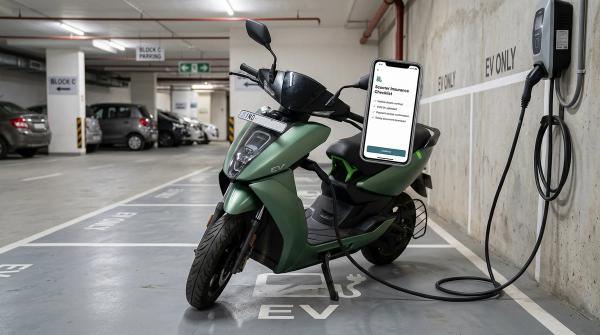
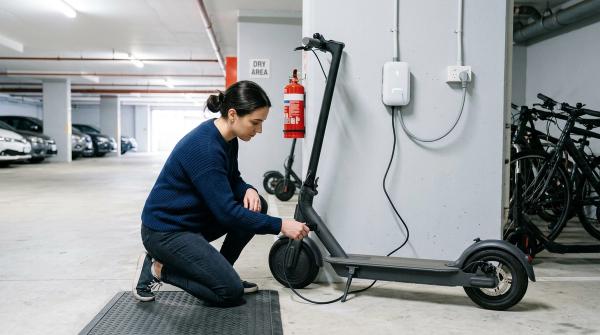
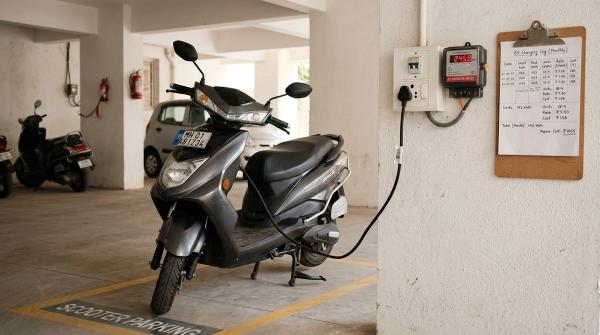
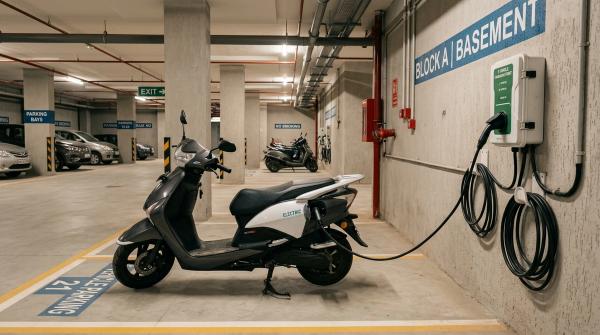
1. Charge only in a dry, covered area
#Use a garage, covered parking area, or protected charging point.
Avoid spots where rain can blow directly onto the plug, socket, charger, cable, or scooter charging port. Also, don’t keep the charger on a wet floor.
2. Do not plug in immediately after a rain ride
#If you have just ridden through rain, park the scooter in a dry place first.
Let water drain off. Wipe the outside of the charging port area gently. Do not push cloth, tissue, cotton buds, wires, or tools into the port.
Charge only when the charging port, plug, and surrounding area are dry.
3. Keep the charging port and plug dry
#Before connecting the charger, check the scooter charging port, charging plug, charger body, cable, wall socket and any approved extension board.
If anything is wet, do not charge. Wait until it is dry, or contact support if you are unsure.
4. Follow brand-specific instructions
#Brand guidance matters. Don’t assume all scooters have the same charging rules.
- Ola advises avoiding starting or stopping charging while it is raining outdoors, because moisture may enter when the port is exposed.
- TVS recommends using the manufacturer charger, keeping the scooter clean and dry, and following the service schedule.
- Brands like Ather, Bajaj, VIDA, TVS, and others may have their own usage, warranty, and charging instructions.
The safest rule is simple: if your manual says not to charge in a certain condition, don’t charge.
5. Use the original charger
#Use the charger supplied or approved by the manufacturer.
Avoid damaged chargers, loose adapters, makeshift wiring, and unknown third-party chargers. Apart from safety risks, non-approved charging accessories can also create warranty problems.
6. Avoid wet extension boards
#Many apartment riders depend on shared sockets or extension boards. During monsoon, this needs extra care.
Do not use extension boards lying on the floor, sockets exposed to rain spray, loose plugs, burnt sockets, cracked switchboards or damp wall points.
If your apartment charging area is not protected, raise it with your society, landlord, or facility team. Don’t create a risky jugaad setup.
7. Stop if you see a warning
#If the charger shows an error, the scooter dashboard shows a fault, or charging behaves oddly, stop charging and contact the authorised service centre.
Do not open the charger. Do not open the charging port assembly. Do not try battery or charger repair at home.
Parking Checklist During Monsoon
#Where you park your scooter matters almost as much as how you ride it.
1. Prefer covered parking
#Park under a roof whenever possible. This protects the scooter from long rain exposure, dripping water, and repeated wet-dry cycles.
If you live in an apartment, avoid parking where water flows across the floor during heavy rain.
2. Avoid low-lying basement corners
#Basement parking can flood or collect seepage during monsoon.
Try not to park in the lowest corner of the basement, near open drains, or where you can see water marks on the walls or floor.
If your building often gets waterlogged, move the scooter before heavy rain if possible.
3. Keep the charging area away from standing water
#Do not charge in a spot where water collects around the tyres or stand.
Even if the scooter looks fine, the socket, charger, and cable should not be exposed to wet flooring or water spray.
4. Use the centre stand if practical
#If your scooter has a centre stand and the ground is stable, use it. It can keep the scooter steady and help avoid leaning into puddles or seepage.
But don’t force the centre stand on slippery tiles or uneven ground if it makes the scooter unstable.
5. Don’t cover a wet scooter tightly
#A cover can help in open parking, but don’t trap moisture under a tight cover right after a rain ride.
Let the scooter dry in a ventilated place first. If you use a cover, make sure it is clean and not already damp inside.
Post-Ride Checklist After Rain
#Once you reach home or office, don’t just park and walk away. Take two minutes.
1. Wipe visible water
#Use a soft cloth to wipe the seat, display, switches, handlebar area, charging flap area, floorboard and rear body panels.
Do not use a pressure washer to clean off rainwater or mud.
2. Check the charging port area
#Do not open the charging port unnecessarily in rain.
Once you are in a dry place, check the outer flap area. If you see water or mud near the port, let it dry before charging.
3. Watch for warning lights or strange behaviour
#After a rain ride, pay attention to dashboard warnings, sudden power loss, flickering display, lamp problems, unusual motor sound, burning smell, charging errors or the scooter not powering on.
Any of these are good reasons to stop using the scooter and contact the service centre.
4. Let the scooter dry before charging
#After a rain ride, don’t plug in immediately unless the scooter, charging port, plug, and socket are dry and the manual allows it.
5. Do not open sealed parts
#Do not open the battery pack, motor, controller, charger, connectors, or display unit.
These are not home-repair parts. Opening sealed parts can be unsafe and may affect warranty coverage.
Monsoon EV Maintenance: What to Do Before and During the Season
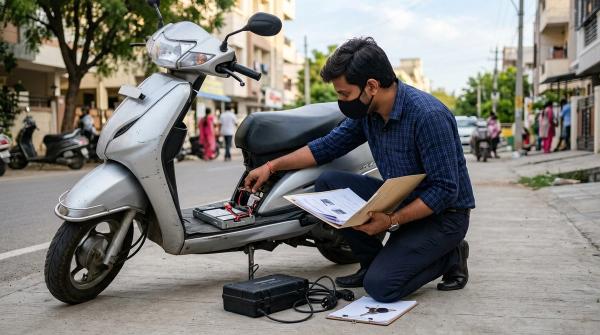
#Good monsoon EV maintenance is mostly preventive. You don’t need to become a mechanic. In fact, you shouldn’t.
Before monsoon
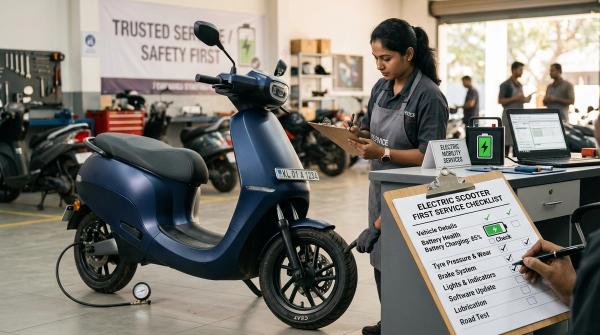
#Book a service check if your scooter is due for one, or if the manual recommends a periodic inspection.
Ask the authorised service centre to check:
- Charging port flap or seal
- Visible wiring and connectors
- Brake condition
- Tyres
- Lights and indicators
- Software or dashboard warnings
- Any previous water-related fault codes, if applicable
Follow the manufacturer’s service schedule. TVS, for example, advises owners to use the manufacturer charger, keep the scooter clean and dry, and follow the service schedule.
During monsoon
#Keep the scooter clean and dry as much as practical.
This does not mean wiping every raindrop in panic. It simply means you should not let mud, grime, and standing water sit around sensitive areas for days.
Avoid harsh cleaning. Don’t pressure wash near the dashboard, charging port, wheel hub area, floorboard seams, or electrical connectors.
After heavy rain exposure
#If the scooter was parked in a flooded area, went through deep water, or behaved strangely after rain, don’t keep riding like nothing happened.
Get it inspected by an authorised service centre.
Battery and Warranty Cautions
#The battery is one of the most expensive and sensitive parts of an electric scooter. Treat it with respect, especially during monsoon.
Do not attempt DIY battery repair
#Do not open the battery casing. Do not try to dry it with a hairdryer. Do not place the scooter or battery near heat. Do not use rice, silica packets, sunlight, or random home tricks as a repair.
If water may have reached a sealed electrical component, the right next step is inspection by trained technicians.
Do not repair the charger yourself
#A charger that got wet, smells burnt, shows errors, or has damaged wiring should not be used.
Do not open it. Do not tape the cable and continue using it. Contact the authorised service channel.
Water damage warranty terms vary
#Warranty rules differ between brands and models. Ather, Ola, Bajaj, VIDA, TVS, and other manufacturers may have different terms for battery, charger, motor, controller, and water damage.
Read your owner’s manual and warranty booklet. Many warranties exclude misuse, tampering, flooding, unauthorised repairs, or deep water exposure.
Important point: don’t assume IP67 means every water-related issue is covered.
Keep service records
#Keep invoices, service history, and official communication from the brand or service centre.
If a warranty question comes up later, records help.
Service-Centre Red Flags: When to Stop Riding
#Don’t wait for a small issue to become a big one.
Contact an authorised service centre if you notice any of these after rain exposure:
- Scooter does not start
- Scooter shuts down while riding
- Dashboard warning appears
- Display flickers, blanks out, or shows moisture inside
- Headlamp, tail-lamp, or indicators behave strangely
- Charging does not start
- Charging stops again and again
- Charger shows an error
- Charging port looks wet, damaged, burnt, or corroded
- Cable insulation is cut or swollen
- You smell burning or see smoke
- Motor response feels jerky or weak
- Unusual sound from the motor or wheel area
- Scooter was parked in standing water
- Scooter entered deep water, even briefly
Most importantly, if the scooter stops during or after water exposure, do not keep trying to restart it.
Move it to a safe, dry place if you can do so without risk, then call roadside assistance or service support.
What Not to Do in Monsoon
#These mistakes are common, so here is the simple no-nonsense list.
Do not:
- Ride through flooded roads to test the scooter
- Assume an IP67 scooter is fully waterproof
- Charge with a wet plug, wet socket, or wet charging port
- Start or stop charging outdoors in rain where your brand advises against it
- Use a pressure washer around electrical areas
- Use a damaged charger
- Use unknown third-party chargers
- Open the battery, controller, motor, charger, or display
- Ignore dashboard warnings after rain
- Skip scheduled service and then expect all water-related issues to be covered
- Trust social media DIY fixes over the owner’s manual
Monsoon safety is not about being afraid of your scooter. It is about respecting its design limits.
Final Word
#Riding an electric scooter in rain is normal for many Indian commuters. You don’t need to park your EV every time the sky turns grey.
But you do need better monsoon habits.
Avoid flooded roads. Keep the charging port dry. Charge only in protected areas. Use the original charger. Follow the service schedule. Don’t open sealed electrical parts. And if something feels wrong after rain exposure, let the authorised service centre handle it.
Your scooter may be rain-ready. It is not a boat.
Disclaimer: This guide is based on general monsoon safety principles, IEC IP rating concepts, and manufacturer-style precautions. Specifications, IP ratings, charging rules, service requirements, and warranty terms vary by model and brand. Always follow your scooter’s official owner’s manual and warranty terms for final guidance.