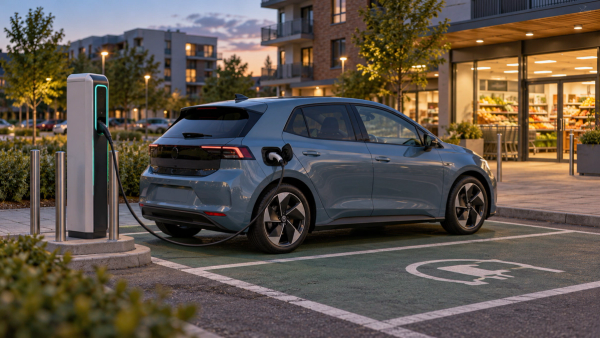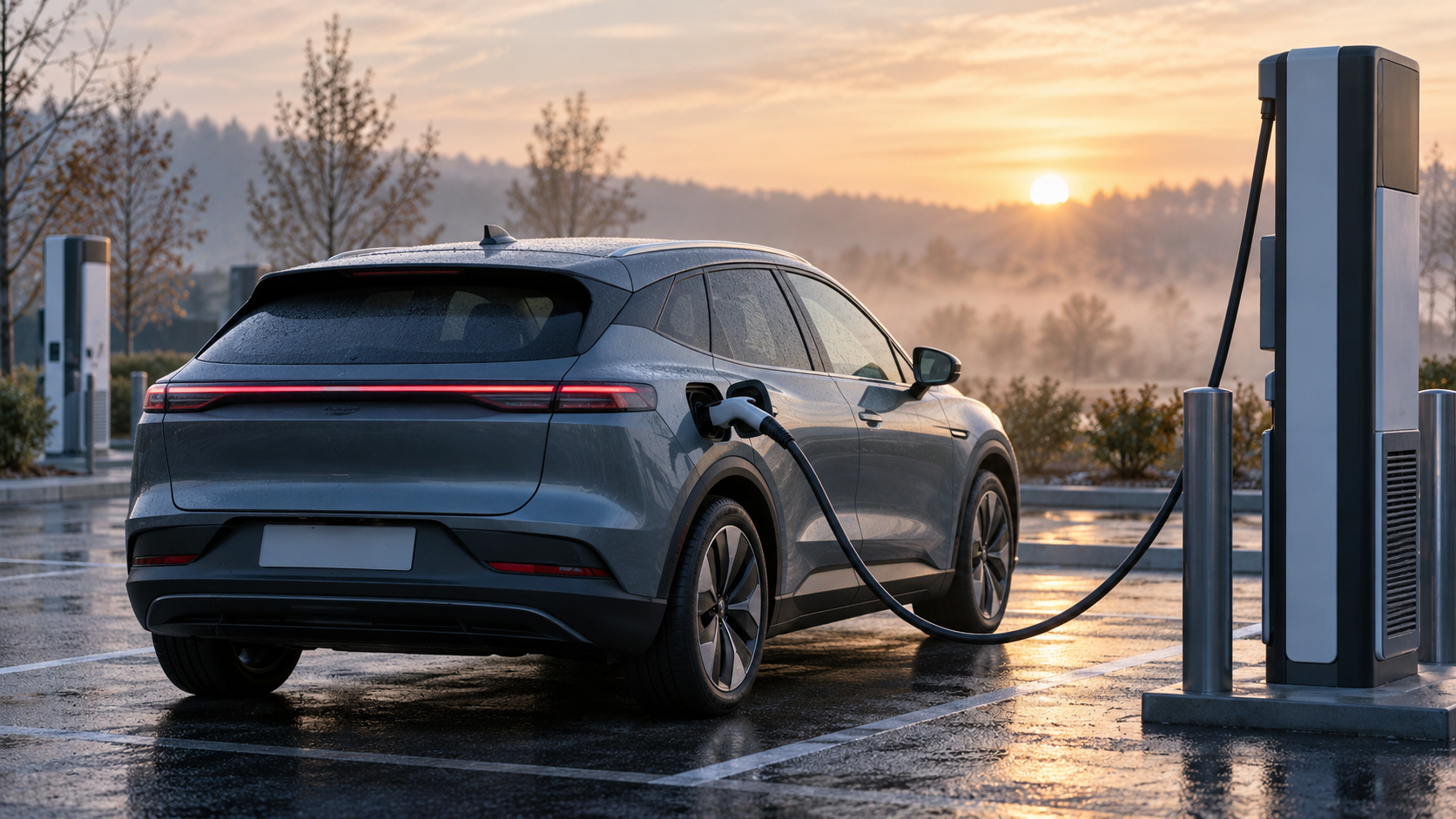
If a DC fast charging stop is coming up, battery preconditioning can help your electric car arrive ready to accept power. The car warms or cools its traction battery when needed, often after you choose a fast charger in its built-in navigation. It is useful when battery temperature would otherwise slow charging. It cannot make a car exceed its own charging limit, fix a weak charger, or guarantee the time shown in an advert.
The important first check is your specific vehicle. Some cars start conditioning automatically on a planned charging route, some offer a manual control, and some do not have the feature. Even within one brand, the model year, software, market and equipment can change what is available. Use your owner's manual and the vehicle's current charging screen as the final instructions.
What battery preconditioning changes
#A battery does not accept charge at one fixed speed in every condition. Its temperature affects how much charging power the car will request and safely accept. If the pack is too cold or too hot, the vehicle's battery management system may limit the charging rate. Battery preconditioning uses the car's thermal system to move the pack toward a suitable temperature before the charging session begins.
Think of it as preparing the battery for the next stop, rather than asking the charger for more power. Hyundai's current owner guidance describes conditioning for a pack that is too hot or too cold, and BMW describes the same goal before high-power DC charging. A car may heat the pack in cold weather or cool it when conditions call for that. The car makes those decisions from its own sensors and software. Drivers should not try to heat, cool or alter the pack themselves.
The benefit is usually clearest at a compatible DC fast charger, where temperature can be a major limit on how much power the car accepts at the start of a stop. AC charging at home or a destination normally has a different purpose and power level. Some vehicles also use preconditioning before departure for comfort or range management, but that is not automatically the same control as preparing for a DC stop.
Battery conditioning and cabin preheating are different
#The word preconditioning can describe more than one feature. Cabin preheating makes the inside comfortable and may clear windows before you leave. Battery preconditioning for fast charging targets the high-voltage pack. Kia explicitly separates battery preparation from warming the interior. Your car may coordinate the two, but pressing a climate button does not prove that its battery has been prepared for a fast charger.
There is another useful distinction: departure preparation while plugged in and en-route preparation while driving. When a compatible car is plugged in, some of the energy for heating or cooling can come from the charging supply. On the road, conditioning draws energy from the vehicle. Hyundai warns that this can reduce the remaining driving distance, and its system may avoid operating when charge is low. A small loss of displayed range during conditioning is therefore not automatically a fault, but it should be part of your arrival plan.
The car's screen, app and manual should tell you which function you have switched on. Look for wording such as battery conditioning, battery optimization or preparation for fast charging. Do not assume that a warm cabin, a fan noise or a particular icon means the battery is at an ideal charging temperature; indicators differ by vehicle.
When it is worth using
#Preconditioning deserves attention when three things line up: you are heading to a DC fast charging stop, the vehicle supports the feature, and the battery temperature may limit charging. A cold morning after outdoor parking is an obvious example. A hot day or a pack that has been working hard can also call for thermal management. Hyundai's manual discusses both temperature extremes. The car may decide that no extra conditioning is needed when the pack is already suitable.
For a longer journey, route planning is often the simplest approach. Select an actual fast charging station in the car's own navigation early enough for the vehicle to react. Tesla's Model Y guidance recommends a substantial drive to the selected charger to give its system time to prepare in cold conditions. Volkswagen describes automatic preparation when a supported model has an active route to a DC station; it also offers a manual option on many newer models. Hyundai and Kia manuals likewise describe navigation-linked conditioning on equipped vehicles.
These examples show a pattern, not a universal button sequence. A location entered into a phone's map may guide you without telling the vehicle's battery system what is coming. A manually entered street address may also be treated differently from a charging-station destination. Check what your car recognizes, and look for its conditioning status rather than assuming every navigation route will trigger it.
If the stop is close, the vehicle may have less time to adjust temperature. Some models allow manual or remote activation. Others do not. Follow the method and timing in the exact owner's manual, and do not keep switching modes in hope of forcing a faster result. The car may suppress conditioning because the pack is already suitable, the battery is too low, or the feature is unavailable in that configuration.
Find the right instruction for your car
#Before a journey that depends on fast charging, look up the charging or EV settings chapter for your exact model year and market. Find out whether battery conditioning is fitted, whether it works automatically with built-in navigation, and whether a manual or remote command exists. Check how the car confirms that it is active. The words used by different brands are similar enough to be confusing, while the actual triggers can be quite different.
Also check whether the planned station is recognized as a DC charger by the vehicle. Some route planners distinguish a charging destination from an ordinary address. If the station is missing from the car's map, a phone map can still help you reach it, but it may not activate the car's route-based preparation. Use any supported manual option only if the manufacturer documents it for your vehicle.
Do not copy a temperature threshold or countdown from another owner's video. Pack temperature, weather, software and the time remaining to a stop can affect the car's choice. A control that is absent on your screen may simply not apply to your configuration. The manual and in-car status are better evidence than a generic online checklist.
A simple plan for your next fast charging stop
#Start with the charger and the car, not a promised peak number. Confirm that the site is a compatible DC fast charger, is accessible at your intended time and has a backup option. Connector and operator support vary by region and vehicle. A charger with a high advertised output cannot make a car accept more than its own system permits.
Then check the vehicle's manual for its fast-charge preparation method. If navigation-linked conditioning is supported, choose the actual charging location in the vehicle's system before you are almost there. If a manual control is available, use only the documented procedure. If neither exists, you can still charge: expect the car to manage its battery once connected, possibly at a slower initial rate.
Before leaving, look at your estimated charge on arrival and the distance to an alternative site. Conditioning uses energy when the car is not plugged in. A faster session is not worth planning an arrival with no practical reserve. Let the car's trip planner and your own route conditions guide the decision. If the car declines to condition at a low charge level, respect that behavior rather than trying an unsupported workaround.
At the station, park correctly, use the supported connector and follow the charger and vehicle instructions. Confirm that the session actually begins. Watch the car's status, the energy you need for the next leg and any site time limits. A displayed charging rate is an observation at that moment, not a promise that the rate will stay there until full.
After one or two comparable sessions, note the conditions that matter: outside temperature, arrival charge, whether battery conditioning was shown, which charger you used and how much energy was added over what time. That record is more useful than comparing a single number on the screen with a brochure maximum.
What preconditioning cannot fix
#The charger, the car and the battery's current state all matter. Tesla's charging guidance lists state of charge, pack temperature, ambient conditions, vehicle configuration and station use as influences on charging rate. Charging also commonly slows as a battery fills. That means a fully prepared battery at a high charge level can still charge more slowly than you expected.
Here is a practical example. Imagine a driver arriving at a compatible DC station with a battery that has been conditioned. If the car is already nearly full, its charging system may reduce power as the session continues. Moving to a charger with a bigger number on its sign does not necessarily change that. The useful question is how much energy the car adds during the portion of the stop you actually need, not whether it briefly reaches a peak figure.
Now change the example: the driver arrives after a short cold-weather journey without a recognized charger destination. Initial power may be lower while the vehicle warms the pack. This does not by itself prove a charger fault or battery damage. If the same car repeatedly charges far below its usual rate under similar battery levels and temperatures, check the car's alerts and the operator's station status, then ask the manufacturer or charging operator for support. Do not diagnose pack health from one session.
Station power can be limited or shared, and a session can fail for ordinary equipment or payment reasons. Conditioning does not solve those problems. Nor does it change connector compatibility, subscription terms or local parking rules. Keep these separate when deciding whether a stop is reliable.
How to interpret a slow session without guessing
#First check whether energy transfer started at all. A connected cable and an accepted payment are not always enough. The car and charger should show an active session. If the equipment reports a fault, follow the operator's instructions or use a suitable alternative; do not force a connector, open equipment or improvise a repair.
If charging is active but slower than expected, look at the battery's charge level. A high state of charge is a common reason for tapering. Next consider whether the pack may be very cold or hot and whether the vehicle showed conditioning before arrival. Then compare the station's available output with the car's capabilities and any messages about reduced power. A manufacturer's quoted peak is usually a best-case point on a charging curve, not a rate held for the whole visit.
Only compare sessions that are reasonably alike. A stop at 15% charge on a cool day is not a fair match for a stop at 75% on a very hot day. Weather, route length, vehicle software, battery age and station behavior can all differ. Keep your notes factual: the start and end battery percentages, elapsed time, energy added and any warnings. Avoid guessing at internal battery temperature if your car does not show it.
For a recurring issue, use the vehicle's service channel and the charger's support channel with those observations. Ask whether the car has relevant software updates or model-specific operating guidance. There is no safe owner-level shortcut that replaces the vehicle's thermal controls.
The decision that matters for everyday driving
#If most of your charging happens during long parking sessions on AC, you may rarely need to think about fast-charge preconditioning. If you depend on short DC stops, especially in difficult weather, learn how your exact car prepares for them. That knowledge can make a route more predictable without turning every stop into a battery experiment.
Use the vehicle's recognized charger route when supported, leave a sensible arrival reserve, and judge the whole session by useful energy added and time spent. If the car says conditioning is unnecessary or unavailable, accept that signal and follow its manual. The goal is a dependable stop, not chasing the charger's highest number.