You know that slightly annoying feeling when your electric scooter used to come back home with 30–35% battery left, and now the same ride ends at 10–12%?
The first thought is usually: “Bas, battery kharab ho gayi kya?”
Maybe. But in many cases, the battery is not the villain.
An electric scooter range drop can happen because of very normal things: low tyre pressure, Sport mode, extra load, a new route with more flyovers, heavy traffic, rain, heat, brake drag, or simple battery ageing. The important thing is to check the easy stuff first before assuming you need an expensive battery replacement.
Quick answer
#An electric scooter range drop is usually caused by one or more of these:
- Low scooter tyre pressure
- Fast riding or aggressive acceleration
- Higher ride mode like Sport, Warp or Hyper
- Pillion rider or extra luggage
- Flyovers, slopes or hilly roads
- Stop-start city traffic
- Hot weather, rain or waterlogged roads
- Brake drag or wheel resistance
- Charging issues
- Software or battery calibration
- Ageing battery and reduced EV scooter battery health
If the range has reduced slowly over months or years, it may be normal ageing or changed usage. But if the range drops suddenly within a few days, the scooter shuts down while charge is still showing, or charging has become strange, it is better to visit an authorised service centre.
First, are you comparing with the claimed range?
#Many range worries start because of the brochure number.
The range shown in ads is usually tested in controlled conditions. Daily Indian roads are not controlled at all. Your scooter has to deal with signals, potholes, speed breakers, bad patches, traffic, flyovers, sudden braking, hot weather, rain, pillion riders and bags.
So yes, real-world EV2W range is often lower than the official claimed range.
There are two different situations here.
Case 1: Your scooter never gave the claimed range
#If your scooter is new and it never matched the company’s claimed range from day one, that alone does not mean the battery is faulty.
For example, a scooter with a claimed range of 100 km may not give 100 km in regular city riding. If you ride fast, use Sport mode, carry a pillion, or deal with daily traffic, the real range will naturally be lower.
Case 2: Your scooter used to give better range, but now it does not
#This is the one worth checking properly.
If your scooter earlier gave good range on your usual route, and now the same ride is using much more battery again and again, something has changed. It could be the scooter. It could also be your route, riding style, tyre pressure, weather, load, brakes, software, or EV scooter battery health.
That is where this checklist helps.
Before doing anything, ask: what changed?
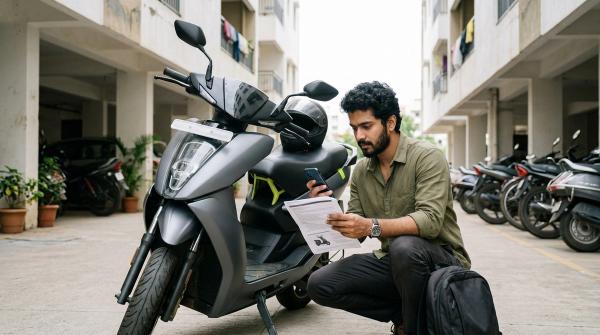
#Spend two minutes thinking like a mechanic. Not in a complicated way, just basic common sense.
Ask yourself:
- Did I recently start using Sport, Warp, Hyper, or another high ride mode?
- Has my office, college or daily route changed?
- Am I climbing more flyovers now?
- Am I carrying a pillion more often?
- Am I carrying heavier bags or luggage?
- Has the weather become very hot, rainy or unusually cold?
- Did the range drop after servicing, repair, tyre change or software update?
- Are the tyres looking slightly low?
- Is the scooter harder to push by hand?
- Does the battery percentage fall suddenly after a certain point?
- Does the scooter slow down or cut power even when charge is still showing?
Most of the time, one of these questions gives you the first clue.
10 simple checks before visiting service
#These checks are safe for most owners because you are not opening the battery, charger, controller, wiring or body panels.
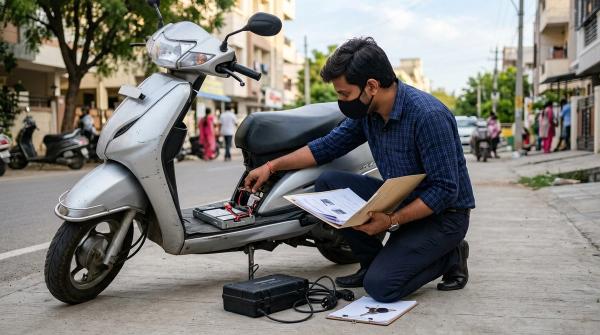
Do not open sealed parts. Do not touch electrical components. If you notice burning smell, smoke, swelling, water damage, exposed wires, unusual heat or loose parts, stop using the scooter and contact service.
1. Check scooter tyre pressure
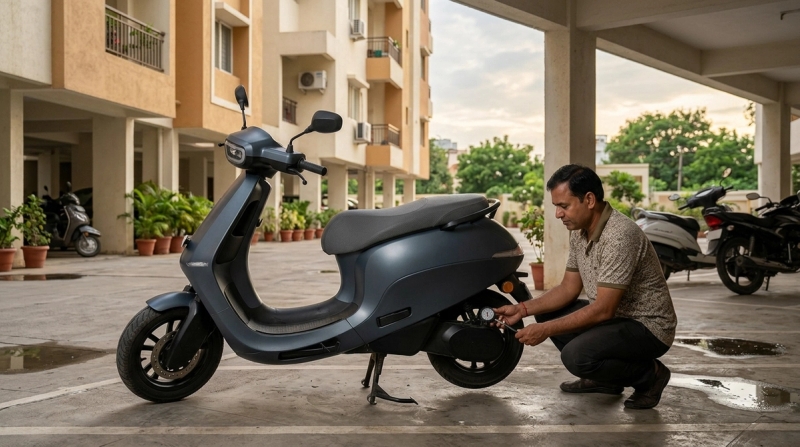
#Low scooter tyre pressure is one of the most common reasons for poor electric scooter range. It is also one of the easiest things to miss.
When tyre pressure is low, the scooter has to work harder. The motor uses more energy to maintain the same speed. You may not feel a huge difference while riding, but the battery will drain faster.
What to do:
- Check tyre pressure when the tyres are cool.
- Use the PSI recommended by your scooter manufacturer.
- Check both front and rear tyres.
- Recheck every week if you ride daily.
- Check more often if you carry a pillion or ride on rough roads.
Even a small drop in tyre pressure can affect range, especially on daily commutes.
2. Look at your ride mode
#Most electric scooters have modes like Eco, Normal, City, Sport, Warp, Hyper or similar names.
Higher modes give better pickup and higher speed. They also use more battery. If you moved from Eco to Sport and the range dropped, your scooter may simply be behaving exactly as designed.
What to do:
- Use Eco or the lowest comfortable mode for regular commuting.
- Use Sport or higher modes only when needed.
- Compare range on the same route and same mode for a few days.
- Do not compare an Eco ride with a Sport ride and expect the same result.
Your ride mode changes the scooter’s performance. It also changes how quickly the battery percentage drops.
3. Compare riding style, not just distance
#Two rides of 20 km are not always equal.
A calm 20 km ride at steady speed will usually use less battery than a fast 20 km ride with hard acceleration, sudden braking and repeated top-speed runs.
Electric motors are efficient, but aggressive throttle still consumes power.
What to do:
- Avoid full-throttle starts if you want better range.
- Keep your speed steady where traffic allows.
- Do not keep chasing top speed.
- Brake early instead of braking at the last second.
- Ride smoothly.
Smooth riding helps range. It is also safer and less stressful.
4. Check weight and payload
#Electric scooters are easy to ride, so it is easy to forget that weight matters.
A solo rider is one thing. A rider plus pillion, laptop bag, school bag, groceries and a full under-seat boot is another. Every extra kilo matters when the scooter starts from a signal or climbs a flyover.
What to do:
- Compare solo range and pillion range separately.
- Avoid carrying heavy items you do not need.
- Do not exceed the load limit mentioned by the manufacturer.
- Expect lower range when riding with family members or luggage.
If range drops mainly when you carry extra load, the battery may not be the problem.
5. Notice stop-start traffic
#City traffic is tough on range.
In traffic, your scooter keeps starting from zero, slowing down, and starting again. Regenerative braking can recover some energy, but it cannot recover everything used to move the scooter.
What to do:
- Keep a little gap so you can roll smoothly.
- Do not accelerate hard just to stop at the next red signal.
- Try a route with fewer stop-go sections if possible.
- Do not judge range from one terrible traffic day.
Mumbai, Bengaluru, Delhi NCR, Pune, Hyderabad, Chennai and Kolkata can make the same scooter feel very different from one week to another.
6. Count flyovers, slopes and ramps
#Climbing needs energy. There is no shortcut here.
If your route has many flyovers, basement parking ramps, hilly roads or steep colony lanes, range will reduce compared to a flat route. Many riders do not realise how much this matters.
What to do:
- Compare range on the same route, not just the same distance.
- Expect lower range if your commute has more climbs.
- Use gentle throttle on inclines when traffic allows.
- Do not assume battery damage just because a new route gives less range.
Same kilometres, different effort. That is the simplest way to understand it.
7. Check for brake drag
#Many EV owners look only at the battery and forget basic mechanical issues.
If a brake is slightly stuck, the motor has to fight that friction all the time. This can reduce range and also make the brake area hotter than usual.
Safe checks:
- Put the scooter on the centre stand, if your model has one.
- Spin the wheels by hand.
- Listen for scraping or rubbing sounds.
- See if the wheel stops too quickly.
- Do not adjust brakes yourself unless your owner’s manual clearly says you can.
If the wheel feels tight or there is constant rubbing, visit service. Brake drag affects both range and safety.
8. Think about weather
#Weather affects batteries, tyres and road resistance.
In Indian summers, scooters parked outside can become very hot. In monsoon, wet roads, slush, mud and waterlogged patches can make the scooter use more energy. A weather-related range drop is common, but electrical issues after water exposure should not be ignored.
What to do:
- Park in shade whenever possible.
- Avoid leaving the scooter in harsh direct sun for long hours.
- Expect lower range in heavy rain or waterlogged areas.
- Avoid flooded roads unless your manufacturer clearly says it is safe.
- If the scooter behaves strangely after water exposure, contact service.
Rainy-day range drop does not always mean battery failure. But water-related faults need attention.
9. Watch charging behaviour
#This is not only about range. Charging behaviour can tell you a lot about what is happening.
Watch for these signs:
- The scooter stops charging earlier than before.
- It shows 100% but drops quickly after a few kilometres.
- The charger becomes unusually hot.
- Charging takes much longer or much shorter than usual.
- The scooter does not charge beyond a certain percentage.
- Battery percentage jumps up or down suddenly.
What to do:
- Use the charger supplied or approved by the manufacturer.
- Plug into a safe, properly earthed socket.
- Avoid damaged extension boards.
- Avoid loose plugs and jugaad wiring.
- Do not open the charger or battery pack.
- If charging becomes irregular, contact service.
Sometimes the scooter is not charging fully, and it only looks like the range has dropped. The actual issue could be the charger, socket, calibration or battery management system.
10. Consider EV scooter battery health and age
#All batteries age. Electric scooter batteries also lose some usable capacity over time.
Usually, this happens gradually. A slow range reduction over years is very different from a sudden range collapse in one week.
Signs that EV scooter battery health may need checking:
- Range has reduced slowly but clearly over time.
- Battery percentage falls faster than before on the same route.
- The scooter feels weak at lower charge levels.
- The scooter shuts down or limits power earlier than expected.
- Charging and displayed range no longer feel consistent.
- A full charge does not last like it used to, even after tyre and mode checks.
Do not open the battery at home. Let an authorised technician run proper diagnostics.
A simple daily commute example
#Imagine this.
You have a 15 km office ride. You start at 100%. The rear tyre is slightly low. You are carrying a laptop bag and a heavy backpack. You choose Sport mode because traffic feels fast today. Your route has two flyovers. Then you get stuck in 20 minutes of stop-start traffic. It is also hot outside.
By the time you reach office, the battery percentage looks worse than expected.
That does not automatically mean the battery is bad. Many small things have added up:
- Low tyre pressure
- Higher ride mode
- Extra load
- Flyovers
- Stop-start traffic
- Heat
This is why one bad commute should not create panic. Track the range over a few similar rides before deciding.
India-specific notes: monsoon, heat, hills and apartment charging
#Monsoon riding
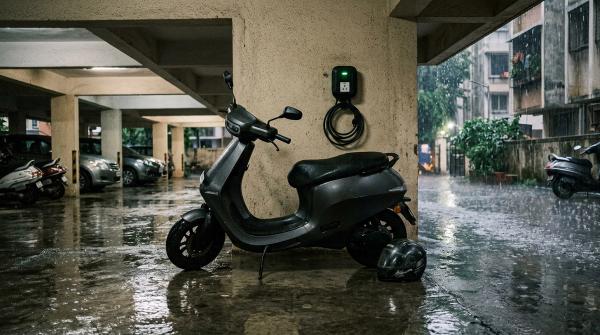
#Wet roads can reduce range because tyres push through water, mud and slush. Waterlogged roads also hide potholes, stones and debris. If your range drops mainly on rainy days, the road surface itself may be the reason.
But be careful with flooded patches. If the scooter behaves strangely after riding through water, do not keep using it and hoping it will become fine on its own. Contact service.
Summer heat
#High heat is tough on batteries, tyres and riders. In many Indian cities, scooters parked outside sit in harsh sunlight for hours. Range can feel less predictable in these conditions.
Simple habits help:
- Park in shade where possible.
- Let the scooter cool a little if it has been standing in strong sun.
- Avoid aggressive riding when the scooter is already hot.
- Do not charge in unsafe, hot or poorly ventilated places.
Flyovers and hilly areas
#A route with multiple flyovers can use more battery than a flat route of the same distance. If you live in a hilly area or regularly climb steep parking ramps, keep that in mind while estimating range.
The distance may be the same, but the work done by the scooter is not.
Apartment charging
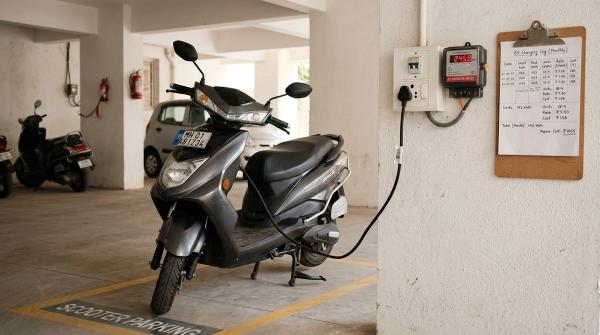
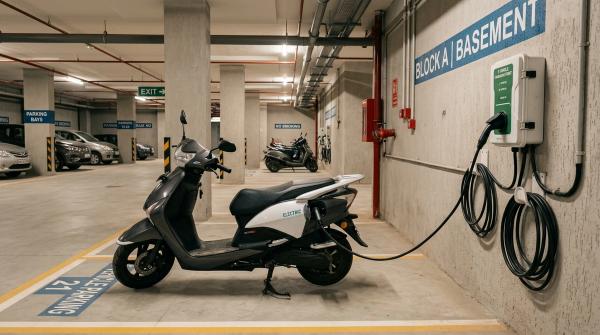
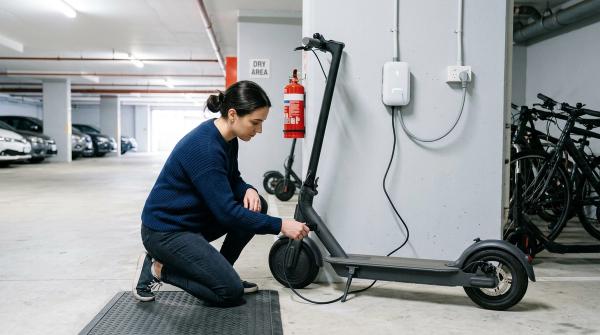
#For apartment users, charging becomes part of daily routine. But loose sockets, poor earthing, shared extension boards and temporary wiring can create problems.
Use the manufacturer-recommended charger and a safe socket. If charging is inconsistent again and again, get it checked. Do not ignore it as “normal”.
How to track electric scooter range properly
#One ride can mislead you. A few rides will show the pattern.
Use a simple note like this:
After a week, things become clearer.
Maybe range drops only in Sport mode. Maybe it happens only with a pillion. Maybe rainy days are the issue. Or maybe the range is poor every day, even after correcting tyre pressure and riding gently. That last case deserves a service visit.
Related AllBlogs reading
#If you are building an everyday EV ownership routine, also read AllBlogs guides on electric scooter charging cost in India, battery warranty checks, riding an electric scooter in rain, first service preparation and EV insurance add-ons.
What not to do
#When range drops, avoid shortcuts that can make things worse.
Do not:
- Open the battery pack.
- Use an unapproved charger.
- Ignore unusual heat, smell, smoke or electrical behaviour.
- Keep riding through deep water to “test” the scooter.
- Assume every range drop means battery replacement.
- Assume every range drop is normal.
- Keep charging again and again if the charger or socket feels unsafe.
The safe approach is simple: check the basics, track the pattern, and visit service if the symptoms are sudden, serious or repeatable.
Final takeaway
#An electric scooter range drop is not always battery failure. In daily use, electric scooter range changes because of tyre pressure, speed, ride mode, load, flyovers, traffic, weather, brake drag, charging behaviour and battery age.
Start with the simple checks. Fill tyres to the recommended pressure. Ride the same route in Eco mode. Remove extra load if possible. Watch the scooter over a few normal commutes.
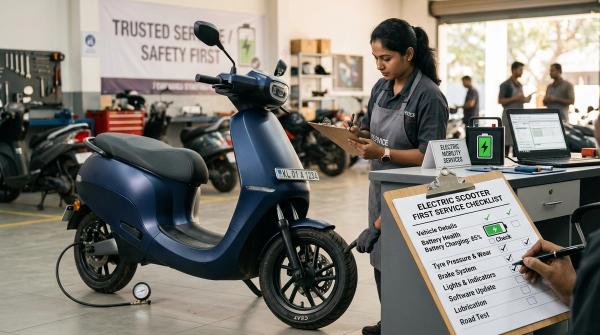
If range improves, you probably found the reason. If it does not improve, or if the drop is sudden, the scooter cuts power, or charging becomes irregular, visit an authorised service centre.
That is the safest way to protect your scooter, your battery and your daily commute.