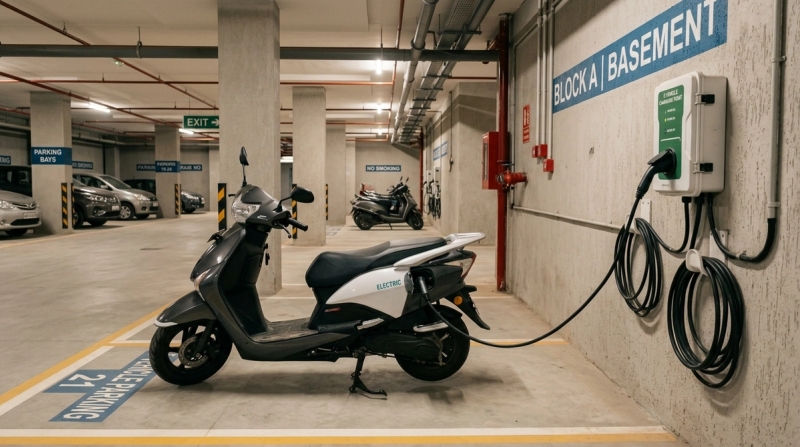
Charging an electric scooter at home sounds simple enough.
You park the scooter, plug it in, go upstairs, have dinner, sleep, and wake up to a full battery. That is one of the biggest joys of owning an EV scooter.
But if you live in an Indian apartment, you already know there is usually a little more drama involved.
Maybe your parking slot is in the basement. Maybe the nearest socket is a common society socket. Maybe someone has casually told you, “Just use an extension board from your balcony, everyone does it.” Maybe the RWA is asking who will pay for the electricity. Or maybe the charging point is in a damp corner where you’re not fully sure if it is safe.
And then there is the charger itself. It may look harmless, almost like a laptop charger, but it is still handling electricity for hours at a time. Add heat, moisture, old wiring, loose sockets, monsoon rain, and apartment parking rules, and it becomes something worth taking seriously.
This guide is for everyday electric scooter owners. Not electricians. Not DIY experts.
No wiring tutorials. No jugaad fixes. No risky shortcuts.
Just a clear, practical electric scooter home charging safety checklist you can actually follow.
The goal is simple: charge your scooter safely, avoid damage, follow apartment rules, and not create a fire risk for yourself or your neighbours.
Quick answer: how to charge an electric scooter safely at home
#For safe EV scooter charging at home, stick to these basics:
- Use only the charger supplied or approved by your scooter manufacturer.
- Plug it into a proper grounded wall socket that matches the charger requirement.
- Avoid extension boards, multi-plug adapters, loose sockets, and damaged plugs.
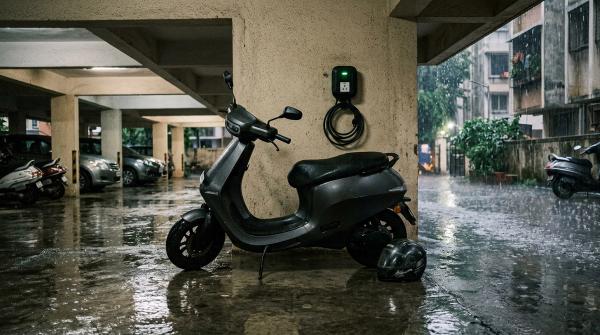
- Do not charge in rain, wet parking areas, or near standing water.
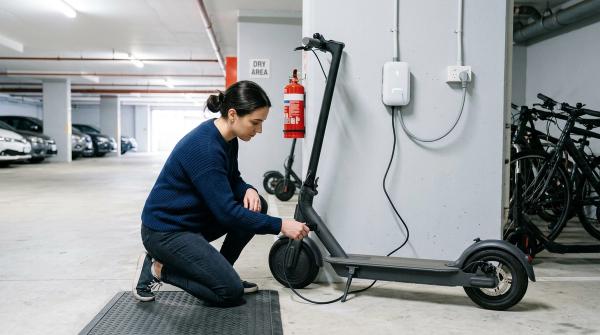
- Do not charge in staircases, corridors, lift lobbies, doorways, or escape routes.
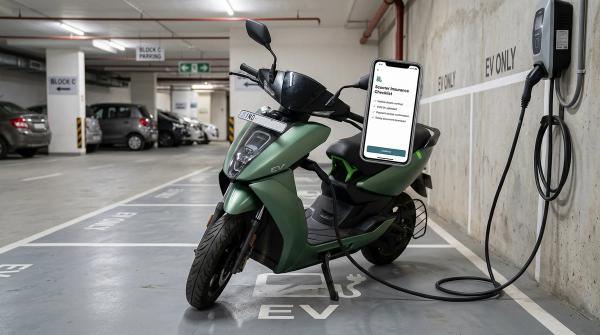
- In apartments, take RWA or society permission before using any parking-area socket.
- If you need a charging point in your parking slot, get it installed only by a qualified electrician, and only after society approval.
- Keep the charger uncovered and in a ventilated place while charging.
- Unplug after charging, as advised in your scooter manual.
- Stop charging immediately if you smell burning, hear crackling, see melting, or notice unusual heat.
A good thumb rule is this:
If the setup looks temporary, overloaded, wet, loose, hidden, or “adjusted somehow”, don’t charge there.
Why electric scooter home charging safety matters
#Most electric scooter charging problems do not start with something dramatic.
They usually start with something small.
A loose socket.A cheap extension board.A plug that gets a little hot every day.A charger kept under a seat cover.A damp basement corner.A common socket used without permission.A cable stretched across a walking path.
And because the scooter still charges, people ignore the warning signs.
That is where the risk begins.
An electric scooter charger runs for hours. Many people charge at night. In apartments, the socket may be old, dusty, shared, exposed to moisture, or not designed for regular long charging sessions.
Fire-safety guidance from consumer and public-safety agencies repeats the same basic points: use the correct charger, avoid damaged equipment, do not block escape routes, keep charging areas safe, and unplug after charging is done.
Your scooter manual should always be the first source of truth. But the larger idea is simple:
Keep your charging setup dry, visible, approved, properly rated, and boring.
Boring is good when electricity is involved.
Apartment EV charging: what Indian riders should sort out first
#If you live in an independent house, home charging is usually easier. You may already have a safe socket near your parking area. Even then, the socket and wiring should be proper.
In an apartment, apartment EV charging needs a little more planning.
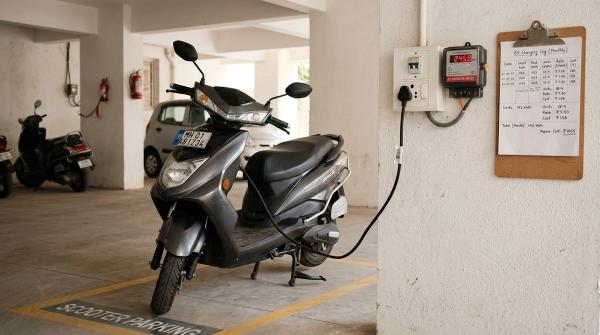
Your scooter may be parked in:
- Basement parking
- Stilt parking
- Open parking
- Podium parking
- A shared garage
- A rented parking slot
The electricity may come from your own meter, a common meter, or a society-managed system. So plugging into the nearest available socket and hoping nobody notices is not a great idea.
It may work for one night. It may even work for a week. But later it can create safety issues, billing disputes, and arguments with the society.
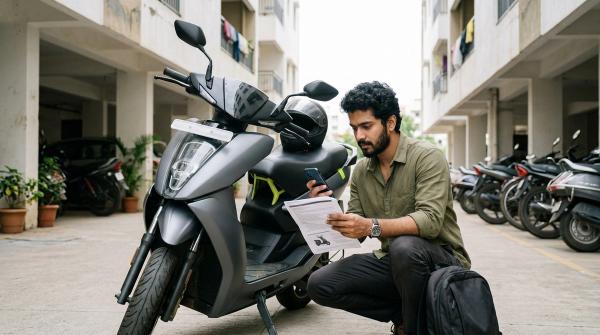
1. Speak to the RWA or society office first
#Before you start charging in a shared parking area, speak to the RWA, apartment association, or facility manager.
Ask them clearly:
- Is personal EV charging allowed in my parking slot?
- Should the power come from my own meter?
- Is a sub-meter or separate billing setup required?
- Where can the charging point be placed?
- Who is allowed to inspect or install the point?
- How should the cable be routed?
- Are there any basement charging restrictions?
- Is charging allowed during heavy rain or water seepage?
- Do I need written approval?
Yes, this can feel like extra work. But it is much better than getting into a fight later because someone objected to your charging cable, electricity usage, or socket placement.
A proper approval also makes your setup safer and more accountable.
2. Do not use common sockets without approval
#Many apartment basements have sockets for cleaners, security staff, maintenance work, pumps, lights, or temporary tools.
Those sockets are not automatically available for personal scooter charging.
Using a common socket without permission can create two problems.
First, there is the billing issue. Someone has to pay for that electricity.
Second, and more importantly, that socket may not be safe for long charging. It may be old, loose, already loaded, or connected to a circuit that was never meant for EV scooter charging.
If your society already has an EV charging process, follow it.
If it does not, request written permission and ask for a safe, approved method. RWAs may move slowly, that is true. But a shortcut can become a bigger headache later.
3. Never drop a wire from your balcony
#This is one of the most common unsafe apartment charging ideas.
A long cable from your flat window or balcony down to the scooter may look convenient, but it is risky.
A hanging cable can be damaged by:
- Rain
- Wind
- Sharp balcony edges
- Vehicles
- People walking past
- Pets
- Children
- Someone pulling it by mistake
It can also become a trip hazard or pass through areas where other people can touch it.
The worst part is that after a few days, temporary arrangements start feeling normal. People stop checking the cable properly. That is when problems happen.
If your parking slot needs a charging point, get it planned through the society and installed by a qualified electrician.
Do not treat electrical work as a weekend DIY project.
The socket: what to check before plugging in
#The charging socket is one of the most important parts of your home charging setup.
Even a good charger cannot fully protect you from a loose, burnt, cracked, overloaded, or poorly installed socket.
Before you plug in your scooter, take a few seconds to check the socket.
1. Match the socket to the manufacturer’s charger requirement
#Check your scooter manual and charger label.
Some portable electric scooter chargers may work with a normal grounded household socket. Others may need a higher-rated socket depending on the charger design and power draw.
Do not guess only by looking at the plug shape.
If your manual mentions a specific socket rating, earthing requirement, or installation instruction, follow it.
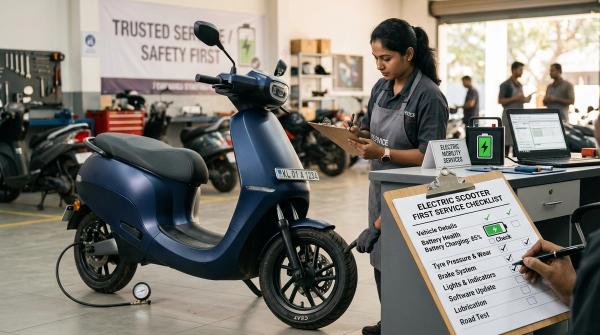
If you are not sure, ask the scooter service centre or a qualified electrician.
Do not:
- Force the plug into a socket
- Bend the pins
- File the plug
- Use a converter just because it fits
- Modify the charger or socket
If it does not fit properly, there is a reason.
2. Use a grounded socket
#A proper three-pin grounded socket is important for electric scooter charger safety.
Avoid:
- Two-pin adapters
- Loose converters
- Old switchboards
- Jugaad connections
- Sockets where the plug keeps wobbling
- Boards with visible burn marks
A safe socket should hold the plug firmly. It should not spark, crackle, smell, or heat up abnormally.
If you have to adjust the plug angle to make charging start, stop using that socket.
That is not a minor inconvenience. That is a warning sign.
3. Avoid old or shared high-load sockets
#Do not plug your scooter into a socket that is already being used for other heavy appliances.
Also avoid sockets that look old, damaged, or poorly maintained.
Watch for:
- Brown or black marks around the socket
- Melted or discoloured plastic
- A plug that becomes hot quickly
- Buzzing or crackling sounds
- Burning smell
- A loose or broken switch
- Repeated MCB tripping
- Dust buildup
- Signs of moisture or water seepage
If you notice any of these, do not use that socket for charging.
Inform the society electrician or call a qualified electrician, depending on who maintains the point.
Extension boards: why they are usually a bad idea
#This is where many scooter owners get tempted.
The charger cable is short. The socket is far away. An extension board is lying at home. Problem solved, right?
Not really.
For electric scooters, an extension board is usually the wrong answer.
Most household extension boards are meant for temporary use with small appliances. An EV scooter charger may run continuously for hours. A weak board, thin cable, loose contact, cheap plug, or overloaded multi-plug setup can overheat.
Avoid using:
- Extension boards
- Multi-plug adapters
- Daisy-chained extension boards
- Old cable reels
- Cheap spike guards
- Loose three-pin converters
- One board shared with other appliances
Even if an extension board says “heavy duty”, check your scooter manual first. Many manufacturers advise against extension cords or non-approved adapters.
If the charger cannot reach the socket safely, the solution is not a longer extension board.
The safer solution is a properly placed charging point, approved by your society and installed by a qualified person.
Charger safety: use the correct charger every time
#Your scooter charger is not just a cable.
It is part of the charging system designed for your scooter and battery.
For electric scooter charger safety, follow these rules:
- Use only the charger supplied or approved by the manufacturer.
- Do not use an unknown third-party charger just because the connector fits.
- Do not use a damaged charger cable, plug, or charging brick.
- Do not wrap the charger tightly while it is still warm.
- Do not cover the charger with cloth, bags, helmets, cardboard, or seat covers.
- Keep the charger away from water, puddles, and damp floors.
- Follow the plug-in and unplug sequence given in your owner’s manual.
A charger may become mildly warm during normal use. That can be okay.
But it should not become painfully hot. It should not smell burnt. It should not make crackling sounds. It should not cause the socket or plug to heat up.
If something feels wrong, stop.
Do not try “one more time just to check”.
Step-by-step safety checklist for daily charging
#Use this checklist when charging at home. After a few days, it will become a habit.
Before you plug in
#- Read the scooter manual and follow the manufacturer’s charging instructions.
- Use only the manufacturer-supplied or manufacturer-approved charger.
- Check that the scooter, charger, plug, and socket are dry.
- Do not charge in rain, near waterlogging, or on a wet floor.
- Inspect the charger cable for cuts, cracks, fraying, or exposed wires.
- Inspect the plug and socket for burn marks, melting, looseness, or dust buildup.
- Make sure the socket is grounded and suitable for the charger requirement.
- Remove extension boards, multi-plug adapters, and temporary connectors.
- Keep the charger in an open, ventilated place.
- Keep the scooter away from blocked exits, staircases, narrow corridors, and doorways.
- In an apartment, confirm that the charging point is approved for your use.
While charging
#- Keep the charger brick uncovered.
- Do not place the charger on a seat, cloth, cardboard, or plastic bag.
- Do not let the cable lie in standing water.
- Do not let the cable cross a walking path or vehicle path.
- Do not stretch the cable tightly.
- Avoid charging where children, pets, or passersby may pull the cable.
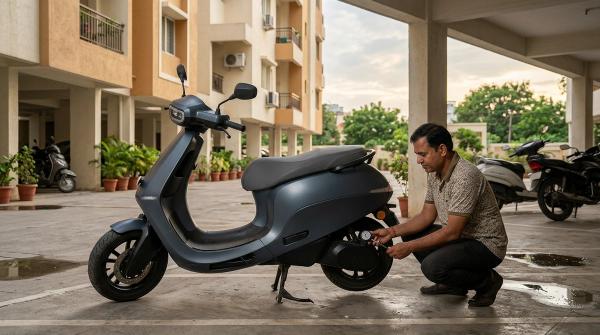
- Check once after a few minutes for unusual heat, smell, or sound.
- If the MCB trips repeatedly, stop charging and get the setup checked.
- Do not ignore warning lights or error messages from the scooter.
After charging
#- Switch off and unplug as advised in the scooter manual.
- Do not leave the charger connected for days after charging is complete.
- Let the charger cool before storing it.
- Store the charger in a dry place.
- Report socket damage or heating before using it again.
This may look like a long list, but in real life it takes less than a minute.
A quick glance can prevent a lot of trouble.
Rain and wet parking areas: be extra careful
#Indian EV owners have to deal with monsoon rain, damp basements, open parking, water seepage, and sometimes proper waterlogging.
This is where charging discipline matters even more.
Do not charge if:
- The scooter charging port is wet
- The plug or socket is wet
- The charger brick has been exposed to rain
- The floor has standing water
- Water is dripping near the charging point
- The cable has to pass through a wet area
- Your hands are wet while handling the charger or plug
If you rode through heavy rain, let the scooter dry as recommended by the manufacturer before charging.
Do not use a hair dryer, heater, blower, or any DIY drying method on the charging port. You may damage parts or push moisture deeper inside.
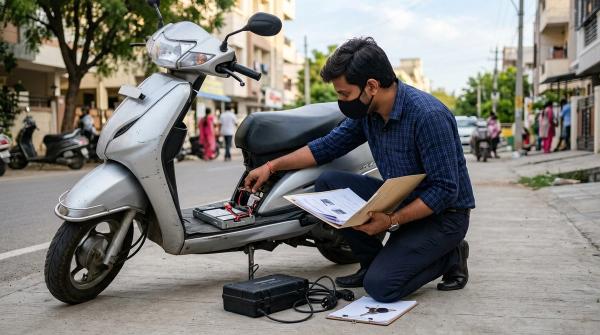
If you see water inside the port, corrosion, cracks, or damage around it, contact the service centre.
When in doubt, wait and get it checked.
Where not to charge your scooter
#Some places are unsafe even if a socket is available.
Avoid charging in:
- Staircases
- Building corridors
- Doorways
- Lift lobbies
- Emergency exits
- Narrow passages
- Cluttered store rooms
- Wet open areas
- Areas near flammable materials
- Spots where the cable crosses a walking path
- Spots where the cable crosses a driving path
Fire safety agencies repeatedly warn against charging micromobility devices in escape routes.
The reason is simple. If something goes wrong, people must be able to leave quickly. A scooter, charger, or cable should never block that path.
Also, avoid hidden corners where nobody can see the charging setup. If there is heat, smoke, sparks, or cable damage, someone should be able to notice it early.
A visible, open, dry charging spot is always safer.
When to stop charging and call service
#Stop charging immediately if anything feels wrong.
Do not wait for it to “settle”. Do not assume it is normal because it happened yesterday too.
Call the scooter service centre, roadside assistance, the society electrician, or a qualified electrician, depending on the issue, if you notice any of these signs.
1. Burning smell
#Any smell of melting plastic, burning insulation, or smoke is serious.
Stop charging at once.
2. Crackling, buzzing, or hissing sounds
#Sounds from the socket, plug, charger, or scooter during charging should not be ignored.
Charging should be quiet and uneventful.
3. Unusual heat
#Mild warmth may be normal.
Too hot to touch comfortably is not normal.
If the charger, plug, socket, or cable is getting very hot, stop using it.
4. Sparks or black marks
#Do not continue using a socket or charger that sparks or shows black marks.
Get it checked before charging again.
5. Swelling, warping, or leakage
#If the battery area, floorboard, or removable battery casing looks swollen, bent, cracked, or leaking, do not charge.
Contact service immediately.
6. Repeated MCB tripping
#One trip can happen for many reasons.
Repeated tripping means something needs inspection. It could be the socket, circuit, charger, or load.
7. Damaged cable or exposed wire
#Do not tape it and continue.
That is not a repair. Replace or service it through the proper channel.
8. Error message on the scooter or charger
#Follow the manual. If the warning continues, contact the service centre.
If there is smoke, visible fire, or immediate danger, move away and follow your building’s emergency process. Do not try to repair the charger, socket, battery, or wiring yourself.
A simple apartment charging conversation with your RWA
#If your society does not yet have clear EV charging rules, keep the discussion practical.
Try not to turn it into a massive WhatsApp group debate if you can avoid it.
You can ask the RWA or facility manager:
- Can I install or use an approved charging point for my scooter in my allotted parking?
- Should the supply come from my personal meter or a society-approved metering setup?
- Who is allowed to inspect or install the point?
- Are there rules for cable routing and socket placement?
- Are there timing, safety, or parking-area restrictions?
- What should I do if the socket trips or heats up?
- Is charging allowed in basement parking during heavy rain or water seepage?
- Is written approval required?
Keep written approval if possible.
It helps avoid confusion later, especially when guards, facility managers, tenants, owners, or committee members change.
Common unsafe shortcuts to avoid
#Every first-time EV scooter buyer should probably get this list during delivery.
Do not:
- Use a long extension board from your flat
- Drop a wire from your balcony
- Plug into a random basement socket
- Use a two-pin adapter
- Share one socket with multiple appliances
- Charge in a corridor or staircase
- Charge while the socket or scooter is wet
- Cover the charger to “protect it from dust”
- Ignore repeated heating or tripping
- Use a damaged charger after taping it
- Buy an unverified charger because it is cheaper
- Modify the plug, socket, cable, or charger
- Ask a local handyman to create a temporary connection without society approval
Safe charging is not about being scared of EVs.
It is just about respecting electricity.
Final word
#Home charging is one of the best parts of owning an electric scooter.
When done properly, it becomes boring in the best possible way.
Park. Plug in. Let it charge. Unplug. Ride.
But when done casually, it can create risks that are completely avoidable.
Use the correct charger. Use the right socket. Keep everything dry. Keep exits clear. Follow apartment rules. And if something smells, sounds, or feels wrong, stop charging and call service.
That is the safest way to make electric scooter ownership feel easy, practical, and stress-free.