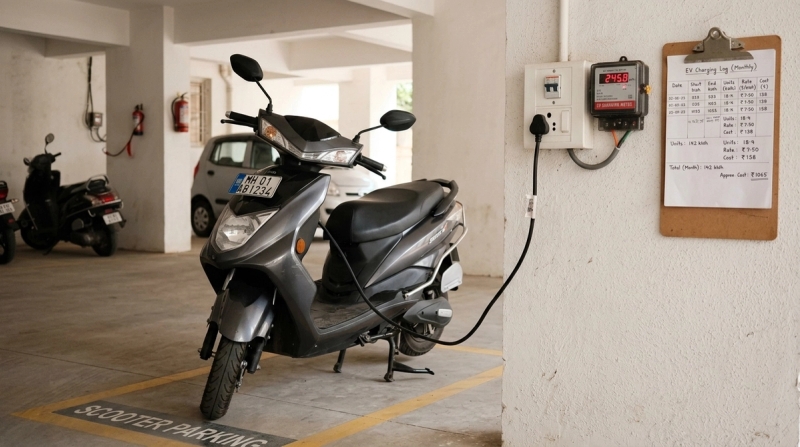
If you’re thinking of buying an electric scooter, there’s one question that almost always comes up first:
“How much will it add to my electricity bill?”
It’s a very practical question. With petrol, the cost is obvious because you pay at the pump. With an electric scooter, the expense quietly shows up in your home electricity bill, so it can feel a little unclear in the beginning.
The good news is that calculating the electric scooter charging cost in India is not complicated. You don’t need advanced maths or a technical background. If you know your scooter’s battery size, your electricity tariff, and the real-world range you get, you can estimate the cost quite easily.
Your final cost will depend on a few things:
- Battery size
- Electricity rate in your city or state
- Your home billing slab
- Real-world range, not just claimed range
- How much you ride every month
- Whether you charge at home, in an apartment, or at a public charger
- Society or RWA billing rules, if you live in an apartment
Let’s break it down in a simple, practical way.
The Quick Formula
#The simplest way to calculate cost per km is:
Cost per km = battery kWh × electricity tariff ÷ usable range
For example:
- Battery size: 3 kWh
- Electricity tariff: ₹7 per unit
- Real-world usable range: 90 km
Calculation:
3 × ₹7 ÷ 90 = ₹0.23 per km
So, before charging losses, one full charge costs:
3 × ₹7 = ₹21
But in real life, charging is not 100% efficient. Some electricity is lost as heat in the charger, wiring, and battery management system. So it’s better to add a small buffer of around 10%.
That means a 3 kWh battery may draw roughly:
3 × 1.1 = 3.3 units
So the more realistic full-charge cost is:
3.3 × ₹7 = ₹23.10
In this example, your actual cost comes to around ₹0.26 per km.
What Is a “Unit” in Your Electricity Bill?
#Your electricity bill is charged in units.
In India:
1 unit = 1 kWh
So if your electric scooter has a 3 kWh battery, it needs about 3 units for a full charge before charging losses. With a 10% charging-loss buffer, it may draw about 3.3 units from the wall.
This is why EV scooter units per charge are fairly easy to estimate once you know the battery capacity.
These are estimates, not fixed values. The actual units used can change slightly based on the charger, battery condition, temperature, wiring quality, and how deeply discharged the battery was before charging.
Why Charging Cost Is Not the Same for Everyone
#You may hear someone say, “My scooter costs only ₹20 to charge,” while another person says, “Mine costs ₹35.”
Both can be right.
There is no single fixed charging cost across India because electricity tariffs vary widely.
Your cost can change because of:
1. Your city and state
#Electricity rates are different across India. A unit of electricity may cost less in one state and more in another.
2. Your billing slab
#Many domestic electricity bills work on slabs. For example, the first few units may be charged at a lower rate, and higher consumption may move you into a higher slab.
If your home already uses a lot of electricity, scooter charging may push some units into a more expensive slab.
3. Your meter type
#Charging from your home meter may be billed differently from charging through:
- A society meter
- A common-area meter
- A separate EV meter
- A commercial or shared connection
4. Apartment society rules
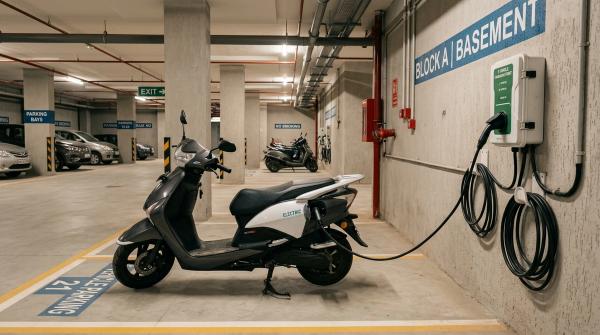
#Some apartment societies or RWAs charge EV users separately, especially if the charging point is in the basement or common parking area.
5. Updated tariff orders
#Electricity tariffs change from time to time. Always check your latest electricity bill or your electricity distribution company’s tariff page.
The best way to calculate your own electric scooter charging cost in India is to use your actual electricity rate, not someone else’s estimate.
How to Calculate Cost Per Full Charge
#Basic formula:
Cost per full charge = battery kWh × electricity tariff per unit
More realistic formula:
Cost per full charge = battery kWh × 1.1 × electricity tariff per unit
Here, 1.1 adds a 10% buffer for charging losses.
Example 1: 2.5 kWh Battery
#Assumptions:
- Battery size: 2.5 kWh
- Electricity tariff: ₹6 per unit
- Charging-loss buffer: 10%
Step 1: Calculate units drawn from the wall:
2.5 × 1.1 = 2.75 units
Step 2: Calculate charging cost:
2.75 × ₹6 = ₹16.50
So one full charge costs around ₹16.50.
If your tariff is ₹8 per unit, the same scooter will cost:
2.75 × ₹8 = ₹22
Same scooter. Different tariff. Different charging cost.
Example 2: 3.5 kWh Battery
#Assumptions:
- Battery size: 3.5 kWh
- Electricity tariff: ₹7 per unit
- Charging-loss buffer: 10%
Step 1: Units drawn from the wall:
3.5 × 1.1 = 3.85 units
Step 2: Full-charge cost:
3.85 × ₹7 = ₹26.95
So you can round it to about ₹27 per full charge.
How to Calculate Electric Scooter Charging Cost Per Month
#Your electric scooter charging cost per month depends mainly on how much you ride.
A person riding 15 km a day will spend much less than someone riding 50 km a day, even if both own the same scooter.
Use this formula:
Monthly charging cost = monthly km × cost per km
You can also calculate it through units:
Monthly units = monthly km ÷ usable range per full charge × units per full charge
Then:
Monthly cost = monthly units × electricity tariff
Let’s look at two practical examples.
Example A: Short Daily Commute
#Assumptions:
- Daily riding: 20 km
- Monthly riding: 600 km
- Battery size: 3 kWh
- Units per full charge with buffer: 3.3 units
- Real-world usable range: 90 km
- Electricity tariff: ₹7 per unit
Step 1: Cost per full charge
3.3 × ₹7 = ₹23.10
Step 2: Cost per km
₹23.10 ÷ 90 = ₹0.26 per km
Step 3: Monthly charging cost
600 × ₹0.26 = ₹156
So in this case, the scooter may add around ₹150 to ₹160 per month to the electricity bill.
That’s a realistic number for someone with a short daily commute, assuming the range and tariff are close to the values used above.
Example B: Heavier Daily Use
#Assumptions:
- Daily riding: 50 km
- Monthly riding: 1,500 km
- Battery size: 4 kWh
- Units per full charge with buffer: 4.4 units
- Real-world usable range: 110 km
- Electricity tariff: ₹8 per unit
Step 1: Cost per full charge
4.4 × ₹8 = ₹35.20
Step 2: Cost per km
₹35.20 ÷ 110 = ₹0.32 per km
Step 3: Monthly charging cost
1,500 × ₹0.32 = ₹480
So for heavier daily use, the monthly charging cost may be around ₹480.
Again, this is only an example. Your actual cost may be lower or higher depending on your scooter, tariff, and riding pattern.
What Affects Your Real-World Cost Per Km?
#The formula gives you a good estimate, but day-to-day riding can change the result.
Your cost per km may increase if:
- You ride fast most of the time
- You often use sport or high-power mode
- You carry a pillion regularly
- You ride with heavy bags or delivery loads
- Your route has many flyovers or slopes
- You are stuck in stop-go traffic every day
- Your tyre pressure is low
- Your usable range is much lower than the claimed range
- Your apartment society charges a higher electricity rate
- You charge mostly at public chargers with higher pricing
Your cost per km may be lower if:
- You ride smoothly
- You use eco or normal mode
- Your route is flat and predictable
- Your home electricity tariff is low
- Your scooter delivers good real-world range
- You avoid unnecessary hard acceleration and braking
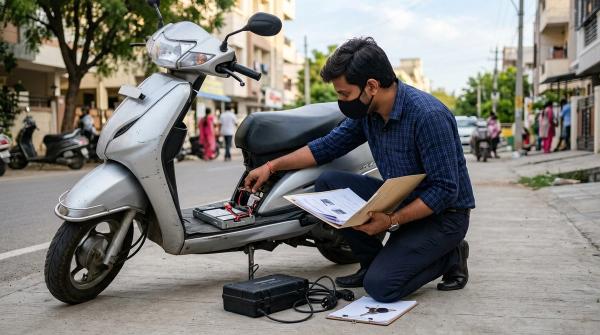
A good habit is to track your first few weeks of ownership. Note:
- Odometer reading
- How often you charge
- Battery percentage before and after charging
- Units consumed, if you have a separate meter or suitable smart plug
If you use a smart plug or meter, make sure it is rated for the charger load and is safe for continuous use.
Can NITI Aayog’s e-AMRIT Portal Help?
#Yes. NITI Aayog’s e-AMRIT portal has useful tools and calculators for EV charging and ownership cost estimates.
You can use it as a reference while comparing scooters or checking approximate running costs.
However, your actual electricity bill will still depend on your:
- Local electricity tariff
- Home billing slab
- Meter type
- Apartment or society billing rules
- Real-world riding range
- Monthly usage
So treat online calculators as helpful guides, not exact bill predictions.
Home Charging Electric Two-Wheeler Checklist
#A home charging electric two-wheeler setup should be safe and properly checked. It may feel as simple as plugging in a phone, but it draws more power and charges for several hours.
Before you make daily charging a routine, go through these checks.
1. Read the Charger Label
#Look at the charger supplied by the scooter manufacturer.
Check:
- Input voltage, usually around 220V to 240V AC
- Current rating in amps
- Recommended socket type
- Manufacturer instructions
- Any warning labels
Do not assume a socket is safe just because the plug fits.
2. Use the Recommended Socket
#Many electric scooters need a properly earthed, higher-rated socket. Depending on the charger, this may be a 15A socket.
Check your owner’s manual. If you are not sure, ask:
- The scooter brand’s service team
- A qualified electrician
- A manufacturer-approved installer
Avoid cheap adapters, loose plugs, and temporary “jugaad” arrangements. They may work for a few days, but they are risky for regular charging.
3. Check Earthing
#Proper earthing is important for safe EV charging.
Get the charging point checked if:
- Your building has old wiring
- Lights flicker often
- You feel small shocks from appliances
- MCBs trip frequently
- The socket feels loose
- The plug heats up during use
A basic inspection by a qualified electrician can prevent bigger problems later.
4. Avoid Ordinary Extension Boards
#Do not charge your scooter using normal household extension boards, multi-plugs, loose adapters, or thin extension reels.
EV charging draws current continuously for hours. A weak extension board can heat up, melt, or become a fire risk.
If your parking space is far from a socket, do not create a long DIY extension setup. Speak to your society, electrician, or brand-approved installer for a proper fixed charging point.
5. Do Not Share the Line With Heavy Appliances
#Avoid charging from a line that also powers heavy appliances such as:
- Geysers
- Room heaters
- Air conditioners
- Heavy kitchen appliances
If the MCB trips repeatedly, don’t keep resetting it and continuing as usual. That is a warning sign. Get the circuit checked.
6. Keep the Charger Ventilated
#It is normal for the charger to become warm while charging.
Place it on a dry, stable surface with enough airflow around it. Do not cover it with:
- Cloth
- Plastic
- Bags
- Helmet
- Rain cover
- Newspaper
Heat needs to escape properly.
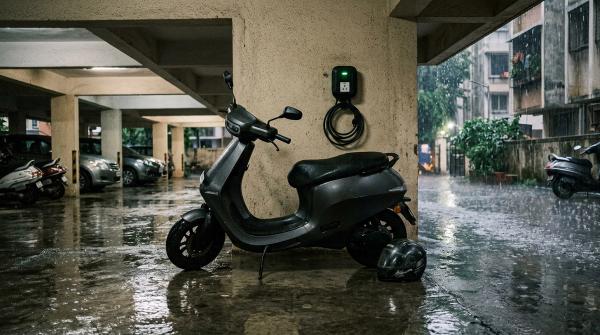
7. Keep the Charging Area Dry
#This is especially important during the monsoon.
Do not charge if:
- The socket is wet
- The charger is wet
- The scooter charging port is wet
- Water has entered the parking area
- The cable is lying in standing water
Wait until everything is dry. If you think water has entered the charger or charging port, contact the service centre before using it again.
Apartment Charging Checklist for Indian Residents
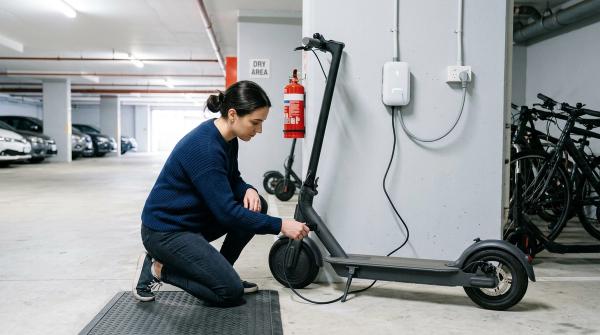
#If you live in an apartment, charging is not just about plugging in the scooter. You also need society approval, proper billing, and safe installation.
Before installing or regularly using a charging point, check the following.
1. Society or RWA Permission
#Ask your society or RWA whether EV charging is allowed in your parking area and what process you need to follow.
Some societies may ask for:
- Written application
- Electrician inspection
- Load approval
- Separate meter
- Billing agreement
- Fixed charging point installation
It is better to clear this before installation instead of dealing with objections later.
2. Metering and Billing
#Ask how the electricity will be billed.
Common options include:
- Charging through your home meter
- Charging through a separate EV meter
- Charging through a common-area meter
- Society-managed billing
Also ask which tariff applies. Domestic tariff and common-area tariff may not be the same, and this can affect your monthly cost.
3. Cable Routing
#Charging cables should not create a tripping hazard or block common areas.
Avoid routing cables through:
- Lift lobbies
- Staircases
- Wet areas
- Public walkways
- Driveways
- Common corridors
Also avoid hanging charging cables from balconies or windows. It is unsafe and many societies do not allow it.
4. Load Capacity
#The building’s electrical system should be able to handle the extra charging load.
This becomes especially important when many residents start buying EVs. One scooter may not be a big load, but multiple scooters charging every night can affect the building’s electrical planning.
The Ministry of Power issued EV Charging Infrastructure Guidelines in 2024, and EV charging safety is also covered under Central Electricity Authority safety rules. For apartments, it is always better to follow proper electrical checks instead of informal wiring.
Safety Red Flags: Stop Charging Immediately
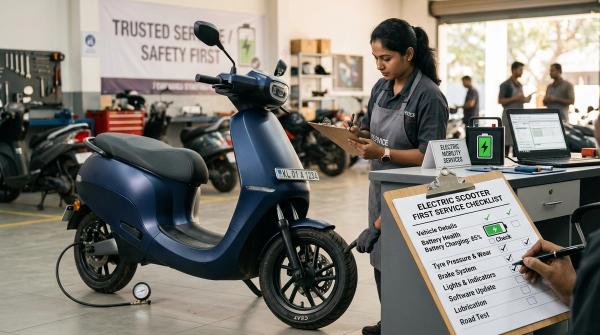
#Stop charging and contact the manufacturer’s service centre if you notice:
- Sparks while plugging or unplugging
- Burning smell from the socket, charger, cable, or scooter
- Charger or plug becoming unusually hot
- Smoke
- Melting marks on the socket or plug
- Repeated MCB tripping
- Cracked charger casing
- Damaged charging cable
- Water in the socket, charger, cable, or charging port
A little warmth during charging can be normal. But excessive heat, smoke, sparks, burning smell, or water exposure are not normal.
Do not:
- Open the charger
- Modify the plug
- Repair the battery yourself
- Bypass safety parts
- Use damaged cables
- Try DIY wiring
Use the manufacturer’s charger and authorised service support.
When Does Public Charging Matter?
#For most electric scooter owners, home charging is the main charging method. It is convenient, predictable, and usually cheaper.
Public charging matters when:
- Your daily travel is longer than your scooter’s comfortable range
- You cannot charge at home or in your apartment
- You need a top-up during the day
- Your workplace has charging
- You ride on unfamiliar routes
- You use the scooter for delivery or high-mileage work
Public charging may cost differently from home charging. The price may include:
- Per-unit electricity charges
- Time-based fees
- Parking charges
- App or network fees
- Minimum session charges
Always check the charging app or station tariff before plugging in.
For regular use, compare these separately:
- Home charging cost per km
- Public charging cost per km
Do not assume both will be the same.
Simple Monthly Cost Worksheet
#Use this worksheet before buying a scooter or after your first week of ownership.
Fill in your numbers:
- Battery size: ___ kWh
- Charging-loss buffer: ___ %
- Units per full charge: ___ units
- Electricity tariff: ₹___ per unit
- Cost per full charge: ₹___
- Real-world usable range: ___ km
- Cost per km: ₹___
- Monthly riding: ___ km
- Estimated monthly charging cost: ₹___
Formula recap:
Units per full charge = battery kWh × charging-loss multiplier
If you are using a 10% buffer:
Units per full charge = battery kWh × 1.1
Then:
Cost per full charge = units per full charge × tariff
And:
Cost per km = cost per full charge ÷ usable range
Finally:
Monthly cost = cost per km × monthly km