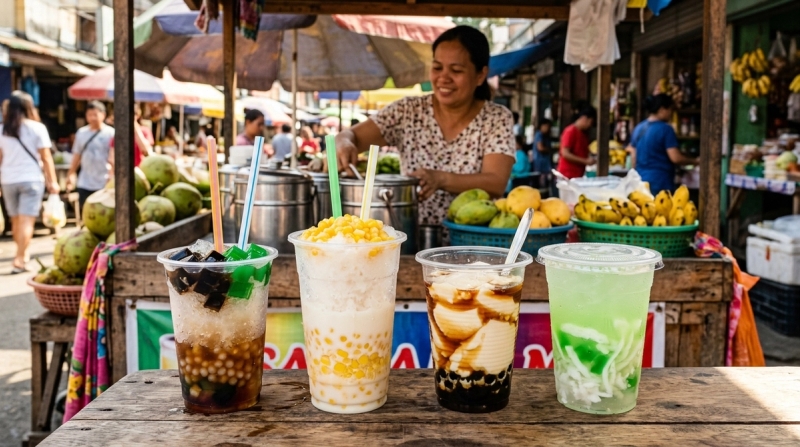
The Philippines can be brutally hot, especially around noon when the sun feels like it is sitting right above your head. Walk through a market in Manila, Cebu, Iloilo, Davao, or almost any town on a busy afternoon, and you will quickly understand why cold drinks are not just a treat here. Sometimes they feel like survival.
That is where samalamig comes in.
Samalamig, also called palamig, refers to the sweet, cooling drinks you will see at roadside stalls, school canteens, markets, eateries, and neighborhood corners. Some are icy and syrupy. Some are milky and rich. Some have chewy pearls, jelly cubes, coconut strips, corn, or shaved ice. A few are so thick and loaded with ingredients that you are not quite sure whether you should drink them or eat them.
Honestly, that is part of their charm.
This guide is for travelers who want to try Filipino dessert drinks and street refreshments beyond the usual soda or bottled water. We will cover classics like sago’t gulaman, mais con yelo, taho, buko pandan, and buko juice, plus simple hygiene tips for choosing street stalls and easy options if you avoid alcohol.
Quick Answer Summary
#Short on time? Here is the simple version.
- Samalamig or palamig means refreshing Filipino drinks, usually sweet, cold, and served with ice.
- Sago’t gulaman is a classic street drink made with chewy sago pearls, jelly cubes, brown sugar syrup, water, and ice.
- Mais con yelo is a sweet corn and shaved ice dessert with milk and sugar.
- Taho is usually served warm in the morning and made with silken tofu, brown sugar syrup, and small sago pearls.
- Buko juice is young coconut water, often served chilled with soft coconut meat.
- Buko pandan is a creamy coconut and pandan dessert drink with young coconut, green jelly, and milk.
- Alcohol-free Filipino drinks are easy to find. Try sago’t gulaman, calamansi juice, buko juice, taho, mais con yelo, fruit shakes, or other palamig.
- For hygiene, pay attention to the ice, dairy storage, covered containers, clean serving tools, vendor turnover, and how money is handled.
What Is Samalamig?
#Samalamig is a broad term for cooling Filipino refreshments. You may also hear people say palamig, from the word lamig, which means cold. In everyday use, both usually refer to sweet iced drinks sold in casual places: street stalls, markets, school canteens, small eateries, bus stops, and neighborhood sari-sari store areas.
Most samalamig are simple but satisfying. A typical drink might have:
- Water or milk
- Sugar syrup
- Ice
- Tapioca pearls, jelly, fruit, coconut, or other add-ins
They are made for hot weather, but they are also part of daily food culture. Many Filipinos enjoy them with merienda, the light snack between meals, or alongside salty street food and fried snacks.
For travelers, samalamig is fun because it shows how much Filipino desserts love texture. These drinks are rarely just liquid. They might be chewy, slippery, icy, creamy, soft, or all of those things at once.
If your first sip comes with a mouthful of sago pearls or jelly cubes, do not be surprised. That is the point.
Sago’t Gulaman: The Classic Street Drink
#If you only try one drink from this guide, make it sago’t gulaman.
You will often see it in large clear containers at street stalls, usually beside other brightly colored drinks. It is usually dark amber or brown because of the sugar syrup. The name tells you the main ingredients:
- Sago: chewy tapioca pearls
- Gulaman: jelly cubes, often made with agar
- Arnibal or sweet syrup: usually brown sugar syrup
- Cold water and ice
The flavor is sweet, caramel-like, and refreshing. The texture is the real star. The sago pearls are chewy, the gulaman is soft and bouncy, and the cold syrupy drink hits especially well when the heat starts getting uncomfortable.
Sago’t gulaman is a great first Filipino street drink because it is easy to recognize, widely available, and very local without being too challenging.
What does sago’t gulaman taste like?
#Expect brown sugar sweetness with light molasses notes. It is usually sweeter than iced tea or lemonade, but the ice helps balance it out.
If you do not love very sweet drinks, you can ask for more ice or less syrup. Just keep in mind that many stalls mix the drink ahead of time, so customization may not always be possible.
When should you order it?
#Sago’t gulaman is perfect with salty or fried food. Try it with grilled skewers, fried snacks, pancit, barbecue, or anything spicy and savory.
It is also one of the easiest non-alcoholic Filipino drinks to find when you are walking through markets, transport terminals, food courts, or busy street food areas.
Mais con Yelo: Sweet Corn, Milk, and Shaved Ice
#Mais con yelo literally means corn with ice. If you did not grow up eating corn in desserts, the idea may sound a little unusual at first. But once you try it, it makes sense.
A typical serving includes:
- Sweet corn kernels
- Shaved or crushed ice
- Sugar
- Evaporated milk
- Condensed milk, depending on the version
It is cold, creamy, sweet, and just a little savory from the corn. The corn adds texture and small bursts of sweetness, while the milk and ice turn it into something between a drink and a dessert.
You usually drink some of the melted milk and ice, then use a spoon for the corn at the bottom. It is simple, filling, and very satisfying on a hot afternoon.
How is mais con yelo different from halo-halo?
#Halo-halo is usually more elaborate. It can include beans, jellies, fruit, shaved ice, milk, ube, leche flan, ice cream, and other toppings.
Mais con yelo is much simpler. It focuses on corn, milk, sugar, and ice.
If halo-halo feels like too much for your first try, mais con yelo is a gentler place to start.
A similar option: saba con yelo
#You may also see saba con yelo, which uses sweetened saba banana instead of corn. Saba is a type of cooking banana commonly used in Filipino snacks and desserts.
Like mais con yelo, saba con yelo is part drink, part dessert. It is best eaten slowly as the ice melts into the milk and syrup.
Taho: Warm, Soft, and Usually a Morning Treat
#Taho is not cold like most samalamig, but it absolutely belongs in any guide to Filipino street drinks and dessert-style snacks.
It is usually sold in the morning by a vendor called a magtataho. In many neighborhoods, people recognize the long call of “tahooo” echoing down the street. Traditionally, the vendor carries metal containers filled with warm silken tofu, syrup, and small sago pearls.
A cup of taho usually has:
- Warm silken tofu
- Arnibal, a brown sugar syrup
- Small sago pearls
The texture is soft and comforting. The tofu is delicate, the syrup is sweet, and the tiny pearls add a little chew. It is often served in a cup and eaten with a spoon, though some people sip it too.
What does taho taste like?
#Taho is mild, sweet, and cozy. The tofu itself has a gentle flavor, so the brown sugar syrup carries most of the sweetness.
It is not refreshing in the icy way that sago’t gulaman or calamansi juice is, but it has its own appeal. It feels like a warm breakfast snack, especially when bought fresh from a morning vendor.
When should you look for taho?
#Morning is the classic time to find taho. If you are staying in a residential neighborhood, listen for the vendor’s call early in the day.
You may also find taho in malls, food courts, cafés, or specialty stalls, sometimes with modern flavors like strawberry, ube, or matcha. But the traditional street version is still the one most people associate with childhood and everyday mornings.
Buko Juice and Buko Pandan: Coconut-Based Coolers
#Coconut is everywhere in Filipino drinks and desserts. When people say buko, they usually mean young coconut, which has soft meat and sweet, refreshing water.
Two popular coconut-based options are buko juice and buko pandan.
Buko Juice
#Buko juice is young coconut water, often served chilled and sometimes lightly sweetened. It may also include soft strips of young coconut meat.
Compared with creamy dessert drinks, buko juice is lighter and more refreshing. It is a good choice when you want something cooling but not too heavy.
If you are careful about street ice, ask if it can be served without added ice, especially when the coconut is freshly opened.
Buko Pandan
#Buko pandan is richer, creamier, and sweeter. It commonly includes:
- Young coconut strips
- Pandan-flavored green jelly
- Evaporated milk
- Condensed milk
- Sometimes cream or other sweet add-ins
Pandan has a fragrant, slightly nutty, vanilla-like aroma that pairs beautifully with coconut. Depending on where you order it, buko pandan may be served as a drink, a chilled dessert, or something in between.
Because it usually contains milk, be more careful when buying it from outdoor stalls in hot weather. Look for chilled storage, covered containers, and a stall with steady customers.
Other Filipino Dessert Drinks to Know
#Once you understand the basics, other Filipino drinks become easier to figure out. Here are a few more worth trying.
Calamansi Juice
#Calamansi is a small Filipino citrus fruit with a bright, sharp flavor. Calamansi juice is usually made with calamansi, water, sugar, and ice.
It is tangy, refreshing, and lighter than milk-based drinks. If sago’t gulaman or buko pandan feels too sweet, calamansi juice may be more your style.
Think of it as a Filipino citrus cooler: simple, zesty, and very good in hot weather.
Ice Candy
#Ice candy is a frozen treat made by pouring flavored liquid into narrow plastic tubes and freezing it.
Common flavors include:
- Mango
- Buko
- Chocolate
- Avocado
- Melon
- Ube
It is not really a drink, but it belongs in the same world of cooling Filipino street snacks. You bite or tear one end of the plastic and push the frozen mixture up as it melts.
It can be a little messy, especially if you are walking while eating it, but that is part of the experience.
Fruit Shakes
#Fruit shakes are common in food courts, beach towns, casual eateries, and roadside stalls. They are usually blended with fruit, ice, sugar, and sometimes milk.
Popular flavors include:
- Mango
- Banana
- Buko
- Watermelon
- Avocado
- Melon
Mango shake is especially popular with travelers. Just remember that fruit shakes often rely on ice, so choose places where the setup looks clean and the ingredients are handled well.
Street Stall Hygiene Tips for Travelers
#Street drinks are one of the joys of food travel, but in a hot country, it helps to be a little observant. You do not need to be afraid of everything. Just use common sense, especially with ice, dairy, water, and serving tools.
Here are practical things to check before ordering samalamig or other Filipino dessert drinks.
1. Look at the ice
#Ice is one of the biggest things to watch.
Many vendors use tube ice, the kind with a hole in the middle. This is commonly commercially produced and is often a better sign than ice chipped from a large block in questionable conditions.
Be more cautious if you see ice:
- Dragged across surfaces
- Handled directly with bare hands
- Stored uncovered
- Chipped from a dirty-looking block
- Sitting in a container exposed to dust or flies
If you have a sensitive stomach, or if you have only just arrived in the Philippines, you may want to start with established eateries, mall kiosks, food courts, or stalls that clearly handle ice cleanly.
For some drinks, you can ask for less ice or no ice, though not every drink works well that way.
2. Be careful with dairy in the heat
#Drinks like mais con yelo, buko pandan, and many creamy palamig use evaporated milk, condensed milk, or cream. They are delicious, but dairy needs careful handling in hot weather.
Look for:
- Drinks kept cold
- Covered containers
- Milk added fresh
- Clean ladles and scoops
- Cups stored properly
- A stall with steady customers
If a creamy drink has been sitting in the sun, skip it. There will always be another drink to try.
3. Check if containers are covered
#Large drink containers should ideally have lids. Covered containers help protect drinks from dust, insects, smoke, and street debris.
Also notice how the vendor serves the drink. A cleaner setup usually uses ladles, scoops, tongs, or gloves rather than bare hands touching ice, toppings, cup rims, or straws.
4. Choose busy stalls when possible
#A busy stall is often a good sign because the drinks and ingredients move quickly. High turnover means the product is less likely to sit around for hours.
Of course, busy does not automatically mean safe, but it is a useful clue. A quiet stall with uncovered jugs sitting in full heat deserves more caution.
5. Watch how money is handled
#At small stalls, the same person often handles both payment and serving. That is normal. Still, pay attention to whether they touch the inside of cups, straws, ice, or toppings after handling cash.
Small details matter with drinks because they are served cold and are not cooked again before you consume them.
6. Pick simpler options when unsure
#If a stall looks questionable, choose something safer or skip it.
For example, a freshly opened coconut without added ice may feel more comfortable than a creamy mixed drink from an uncovered container. Taho is served warm, which some travelers may prefer, though you should still check the cups and serving tools.
Food travel should be fun, not reckless. A little judgment goes a long way.
What to Order If You Avoid Alcohol
#The Philippines is a very easy place for non-drinkers because so many everyday beverages are naturally alcohol-free.
If you want Filipino drinks without alcohol, you will have plenty of choices.
If you want the classic street drink
#Order sago’t gulaman.
It is sweet, cold, chewy, and easy to find almost anywhere there are street drinks.
If you want something creamy and filling
#Order mais con yelo or buko pandan.
These are better when you want dessert, not just a drink.
If you want something light and refreshing
#Order calamansi juice or buko juice.
These are good choices when you want something cooling without the heaviness of milk.
If it is morning
#Look for taho.
It is warm, soft, sweet, and strongly tied to local morning routines.
If you are at a market or food court
#Look for fruit shakes, buko juice, sago’t gulaman, calamansi juice, or other palamig.
These drinks pair well with savory snacks and give you a local alternative to beer, soda, or plain bottled drinks.
For travelers who do not drink alcohol, Filipino beverage culture can feel surprisingly generous. You are not stuck with water or soft drinks. You can still join the food scene through colorful, sweet, local drinks with real personality.
Taste Guide: Which Drink Should You Try First?
#If you are staring at a menu or a row of drink containers and have no idea where to start, use this quick guide.
- Sweet and chewy: Sago’t gulaman
- Creamy and icy: Mais con yelo
- Warm and soft: Taho
- Light and coconut-forward: Buko juice
- Creamy and coconut-forward: Buko pandan
- Tangy and refreshing: Calamansi juice
- Frozen and nostalgic: Ice candy
- Fruity and familiar: Mango shake or fruit shake
If you are unsure, start with sago’t gulaman or calamansi juice. They are easy to understand, easy to find, and good introductions to Filipino refreshments.
Simple Ordering Tips
#Ordering at a samalamig stall is usually casual. Many drinks are displayed in clear containers, so if you are unsure about pronunciation, pointing is perfectly fine.
A few tips:
- Say the drink name clearly, like “sago’t gulaman” or “mais con yelo.”
- If you are cautious about ice, ask if they can serve it with less ice or no ice.
- For creamy drinks, check whether they are kept cold before ordering.
- If there are several options, ask which one is popular.
- Keep small bills or coins ready.
- Avoid placing money near open ingredients, cups, or ice.
- Drink it while it is still cold, especially if it contains milk.
You do not need to overthink it. Look at the stall, choose what matches your mood, and enjoy the drink before the ice melts.
What is the difference between samalamig and palamig?
#They are often used interchangeably. Both refer to cooling refreshments, usually sweet iced drinks. Usage can vary by region or person, but travelers can think of them as part of the same drink family.
Is sago’t gulaman the same as bubble tea?
#No. Both may have chewy pearls, but they are different drinks.
Sago’t gulaman is a Filipino street refreshment made with sago pearls, gulaman jelly, brown sugar syrup, water, and ice.
Bubble tea is usually tea-based and is more commonly associated with milk tea shops.
Are Filipino dessert drinks alcoholic?
#Most common samalamig and Filipino dessert drinks are alcohol-free.
Typical non-alcoholic choices include:
- Sago’t gulaman
- Mais con yelo
- Taho
- Buko juice
- Buko pandan
- Calamansi juice
- Ice candy
- Fruit shakes
Are these drinks vegan?
#Some are more likely to be vegan than others.
Usually plant-based options include:
- Sago’t gulaman
- Calamansi juice
- Plain buko juice
- Taho, depending on the syrup and toppings
Drinks that commonly contain dairy include:
- Mais con yelo
- Buko pandan
- Many fruit shakes
- Creamy palamig
If you need to be strict, ask about milk, condensed milk, evaporated milk, and cream.
Is street ice safe in the Philippines?
#It depends on the source and handling.
Many travelers feel more comfortable with stalls that use clean-looking commercial tube ice or with established eateries and food courts. Be cautious with chipped block ice, uncovered ice, or ice handled directly by hand.
If you have a sensitive stomach, start with cleaner-looking places and avoid ice when you are unsure.
What is the best Filipino drink for hot weather?
#Sago’t gulaman is a classic choice because it is cold, sweet, and widely available.
If you want something lighter, try calamansi juice. If you want something natural and coconut-based, go for buko juice, especially if it is freshly opened and chilled.
What should I avoid if I have a sensitive stomach?
#Be cautious with:
- Dairy-based drinks sitting in the heat
- Uncovered containers
- Questionable ice
- Stalls with poor handling
- Cups or straws touched with unclean hands
- Drinks that look like they have been sitting too long
Choose busy vendors, cleaner setups, established eateries, or simpler drinks without added ice if you are unsure.
Final Sip
#Filipino samalamig is practical, playful, and deeply connected to the country’s heat. These drinks cool you down, but they also introduce you to the textures and flavors that show up again and again in Filipino sweets: chewy sago, soft gulaman, shaved ice, coconut, pandan, milk, corn, and brown sugar syrup.
Start with sago’t gulaman if you want the classic street drink. Try mais con yelo when you want something creamy and cold. Look for taho in the morning. Choose buko juice or calamansi juice when you want something lighter.
And, as with all street food, use your eyes before your appetite. Check the ice, containers, dairy, cups, and the way the stall handles money and serving tools.
With a little care, Filipino dessert drinks can be one of the easiest and most enjoyable ways to taste everyday life in the Philippines.