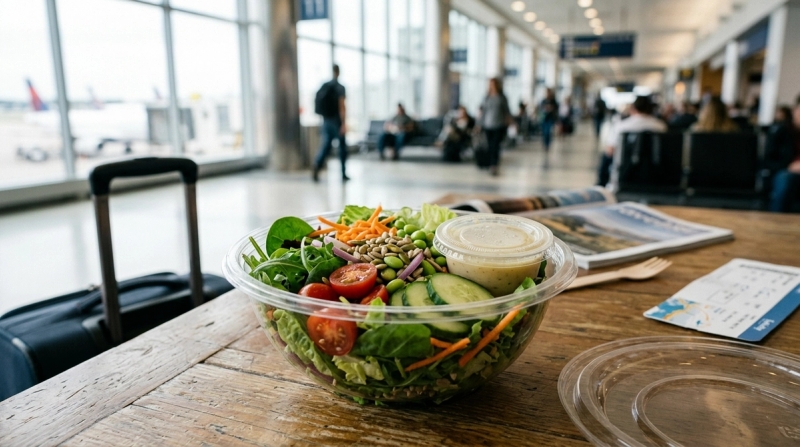
A salad sounds like the responsible airport choice.
It feels lighter than a burger, fresher than a wrapped sandwich, and easy enough to eat while you’re sitting at the gate pretending not to stare at the boarding screen.
But an airport salad before a flight is not always the easy, safe, stomach-friendly win it looks like.
The issue usually isn’t salad itself. It’s everything around it: cold storage, how long it has been sitting out, who handled it, whether the dressing counts as a liquid at security, and whether your stomach is about to deal with raw broccoli at 35,000 feet.
So, should you buy one, pack one, or just skip it?
Here’s the practical guide.
Quick answer: should you eat an airport salad before flying?
#Yes, if it passes the common-sense test.
An airport salad can be a good pre-flight meal if it looks fresh, feels properly cold, and you’re going to eat it soon after buying it. It’s less appealing if the container feels only slightly cool, the greens look sad and watery, or it has chicken, eggs, tuna, cheese, seafood, or creamy dressing already mixed in.
For a short flight, a fresh salad before boarding may be completely fine.
For a long-haul flight, a delay-heavy travel day, or a sensitive stomach, you may be better off choosing something hot, cooked, or shelf-stable.
Buy-pack-skip decision table
#Use this when you’re standing in the terminal trying to make a quick call.
When buying an airport salad makes sense
#Buying a salad at the airport makes sense when the food looks cold, fresh, and recently prepared.
A busy vendor is usually a better sign than a lonely cooler full of salads that look like they’ve been waiting since breakfast. You want turnover. Food that moves quickly is less likely to sit around all day.
Made-to-order salads are often a better bet than pre-packed ones because you can actually see what’s going into your meal. You can check the greens, the toppings, the prep area, and how the staff handles everything.
That doesn’t make it risk-free, but it gives you more information than a sealed plastic bowl sitting in a mystery fridge.
Grab-and-go salads can also be fine if the cooler is clearly cold, the packaging is sealed, and the salad looks crisp and fresh. Just don’t buy it too early. A cold salad is not something you want to carry around the terminal for three hours like a souvenir.
If you buy one, eat it soon.
Cold-case and food-safety checks before you buy
#Cold ready-to-eat foods need proper temperature control. Standard food-safety guidance says cold perishable food should be kept at 40°F or below, and perishable food should not sit at room temperature for more than two hours.
You probably won’t have a thermometer in your backpack. So use what you do have: your eyes, your hands, and your gut feeling.
1. Make sure the case actually feels cold
#The salad container should feel cold, not just “not warm.”
If the cooler door is hanging open, the case is overstuffed, or the salads at the front feel barely cool, skip it.
A weak cold case is not where you want to gamble on chopped greens, eggs, chicken, tuna, cheese, seafood, or creamy dressing.
2. Look for wilted greens or pooled liquid
#Avoid salads with:
- Slimy leaves
- Brown edges
- Water or brownish liquid at the bottom
- Foggy or leaking packaging
- Crushed, tired-looking ingredients
- Dressing already mixed into soft greens
A little moisture in packaged produce can be normal. But limp leaves and a puddle at the bottom are not reassuring.
3. Be extra cautious with high-risk add-ins
#A simple greens-and-vegetables salad is one thing.
A salad with cooked chicken, deli meat, tuna, eggs, cheese, creamy dressing, or seafood needs more careful refrigeration and handling.
Those ingredients are not automatically unsafe. Plenty of them are perfectly fine when kept cold. But they leave less room for error if the salad has been sitting too long or stored too warm.
4. Watch how the food is handled
#If you’re ordering a made-to-order salad, take a quick look at the station.
Are the ingredients being kept cold? Are the utensils separate and clean-looking? Are staff using gloves or tools properly? Does the prep area look calm and tidy, or does it look like a lettuce tornado just passed through?
If it feels messy, choose something else. You have enough airport stress already.
For a more detailed pre-meal check, you can also use this Food Court Hygiene Checklist.
5. Don’t stretch the two-hour window
#If you buy a cold salad, don’t carry it through a delay, board with it, forget about it, and then eat it halfway through the flight.
The two-hour room-temperature guideline is a limit, not a target. In a warm terminal, crowded boarding area, or stuffed carry-on bag, it’s smarter to eat sooner rather than later.
When packing your own salad is the better move
#Packing your own salad can be a great option if you care about freshness, cost, or exactly what’s in your food. It also saves you from trying to judge an airport cold case while your gate changes for the third time.
But homemade doesn’t automatically mean safer.
A packed salad is only the better choice if you can keep it clean, cold, and simple.
Good travel salad ingredients include sturdy foods that don’t collapse immediately, such as:
- Washed greens that hold up well
- Cooked grains, if kept cold before eating
- Firm vegetables
- Whole cherry tomatoes instead of chopped juicy tomatoes
- Nuts or seeds packed separately
- Dressing packed separately
Try not to build a salad that’s already wet, creamy, and delicate before you even leave home. The wetter it is, the faster it turns soggy and strange. It also becomes more important to keep it cold.
For more packing ideas, see Packed Salads While Traveling.
TSA and liquid dressing rules
#For U.S. airport security, lettuce usually isn’t the problem.
The dressing is.
TSA’s liquids, aerosols, and gels rules apply to liquids, gels, creams, and pastes in carry-on bags. Salad dressing can count. So can creamy dips, hummus, yogurt-based sauces, and similar items.
For carry-on screening in the United States:
- Dressing should be in a container of 3.4 ounces (100 milliliters) or less.
- It should fit inside your quart-sized liquids bag.
- Full-size dressing bottles should not go through security in a carry-on.
- If you’re unsure, pack dressing in a small separate container.
Solid salad ingredients are generally allowed through TSA checkpoints. It’s the sauces, dressings, and creamy add-ons that tend to surprise people.
If you’re flying internationally, check the rules for your departure airport and any connection airports. Liquid limits are common in many places, but details and enforcement can vary.
If your salad includes spreads or sandwich-style fillings on the side, this guide may also help: Airport Sandwich Security Rules.
The easiest way to pack dressing
#Use a small leakproof container that holds 3.4 ounces or less.
Put it in your liquids bag for screening. After security, keep it with your salad and add it only when you’re ready to eat.
This keeps the greens from turning soggy and makes the whole thing much easier to manage.
If you’re using a sealed grocery-store salad kit, check the dressing packet size before assuming it can go through security. If the packet is over the limit, or if it’s not clearly small enough, it could be an issue.
A simple packed salad strategy
#If you want a salad that travels well, think in layers.
Put sturdy ingredients at the bottom, delicate greens on top, and keep the dressing separate. Pack crunchy toppings separately too, unless soft croutons are somehow your thing.
A practical airport salad before a flight might include:
- Sturdy greens or a grain base
- Cooked vegetables or firm raw vegetables
- A small portion of protein, kept cold until eating
- Nuts, seeds, or crackers in a separate pouch
- Dressing in a 3.4-ounce-or-smaller container
Eat it before boarding if you can. It’s usually easier and cleaner than trying to balance a salad on a tray table while your seatmate needs to climb over you.
Comfort tips for bloating and long flights
#Even a perfectly safe salad can still be a bad idea for your stomach.
Cabin pressure changes can make gas in your digestive system expand. Raw vegetables are also high in fiber, and some ferment more in the gut. Put those together and you may end up with bloating, cramps, or just a very uncomfortable flight.
If you’re prone to bloating, be careful with big portions of:
- Broccoli
- Cauliflower
- Cabbage
- Kale
- Onions
- Beans
- Lentils
- Large amounts of raw greens
You don’t have to avoid vegetables completely. Just keep the portion reasonable and choose gentler ingredients before a long flight.
Make salad more flight-friendly
#If you still want salad before boarding:
- Choose a smaller portion.
- Go easy on beans, onions, cabbage, and cruciferous vegetables.
- Avoid very creamy dressings if they bother your stomach.
- Eat slowly instead of rushing at the gate.
- Drink water, but don’t overdo carbonated drinks if they make you gassy.
- Eat the salad earlier rather than right as boarding starts.
For a short domestic flight, a small fresh salad may be perfectly fine.
For a long international flight, a giant raw salad right before boarding may not be your best move.
When you should skip the salad
#Sometimes the smartest salad decision is not eating the salad.
Skip it if:
- The cold case does not feel cold.
- The package is leaking, swollen, damaged, or wet inside.
- The greens look slimy, wilted, or browned.
- There is pooled liquid at the bottom.
- The salad contains chicken, tuna, eggs, cheese, seafood, or creamy dressing and does not seem well chilled.
- You won’t eat it within a reasonable time.
- Your flight is long and you’re prone to bloating.
- You already feel nauseated, stressed, or unsettled.
A salad that looks “healthy” is not automatically the best travel food. Before a flight, safe and comfortable matters more than virtuous-looking.
Safer alternatives when salad is risky
#If the airport salad does not pass your cold-case check, choose something with fewer food-safety and digestion concerns.
Warm grain bowl
#A warm rice, quinoa, or grain bowl with cooked vegetables and a simple protein can be easier on the stomach than a big raw salad.
Since it’s served hot, it also avoids some of the uncertainty of cold-case storage.
Hot oatmeal
#For early departures, hot oatmeal can be a gentle choice. It’s warm, simple, and filling without feeling too heavy.
If mornings are your main travel struggle, see Early Morning Flight Breakfast.
Banana or orange
#Fruit with a peel is one of the easiest airport foods.
Bananas and oranges come with their own natural protection, make very little mess, and don’t need refrigeration.
Toast, bagel, or plain bread-based snack
#A simple bread-based snack may not be exciting, but it can be easy on the stomach before a long flight.
This is especially true if travel makes you nervous or nauseated.
Packaged dry snacks
#Nuts, crackers, granola bars, and similar sealed snacks are good backups because they don’t depend on cold storage.
They’re also easy to save for a delay. For budget-friendly ideas, see Cheap Airport Food.
Hot soup, if practical
#Hot soup can be comforting, but it’s not always convenient near boarding.
It may also be treated as a liquid if you try to bring it through security. If you want soup, buy it after security and eat it before boarding.
Best airport salad choices before a flight
#If you decide to buy or pack a salad, keep it simple.
Better choices tend to be:
- Freshly assembled salads
- Salads with dressing on the side
- Smaller portions
- Cooked vegetables instead of all raw vegetables
- Simple greens without too many wet toppings
- Ingredients that look cold, fresh, and recently prepared
Be more cautious with:
- Creamy dressings already mixed in
- Seafood salads
- Tuna or egg salad toppings
- Large portions of beans or cabbage
- Warm-feeling grab-and-go containers
- Salads bought far ahead of boarding
The point is not to be afraid of salad. It’s to choose the version that actually fits your travel day.
Final decision: buy, pack, or skip?
#Buy the airport salad if it’s cold, fresh, clean-looking, and you’re going to eat it soon.
Pack your own if you want more control and can keep it cold, with dressing packed according to TSA liquid rules.
Skip the salad if the cold case looks questionable, your flight is long, your stomach is sensitive, or you’d have to carry it around for hours.
A good pre-flight meal should not create a food-safety worry or a bloating problem halfway through the trip.
Sometimes that meal is a salad. Sometimes it’s oatmeal, a banana, a warm grain bowl, or a packet of nuts from your bag.
Choose the option that keeps you comfortable, steady, and ready to travel.