Organize baby clothes around what fits now, what comes next, what needs washing and what has been outgrown. Keep the ready-to-wear clothes in the easiest drawer or closet section. Give the other groups separate, clearly marked places so they stop drifting back into daily use.
You can do this with a drawer, a shelf and containers you already own. The useful result is simple: whoever dresses your baby can find a clean outfit that fits, and whoever puts laundry away knows where it belongs.
The tricky part is that several things change at once. Clothes arrive as gifts, sizes differ between garments, and a favourite sleeper can leave the rotation while it is still in the wash. A workable system needs to handle that movement, rather than just look tidy after one big sort.
Start with four destinations
#Before buying dividers, gather the clothes from drawers, gift bags, the laundry area and your outing bag. Sort while your baby is safely cared for elsewhere. If a full sort is too much, start with everyday bodysuits and sleepers; special outfits can wait.
Use these four destinations. They are groups, not a requirement to buy four bins.
| Destination | What belongs here | Where it can go |
|---|---|---|
| Ready to wear | Clean, dry clothes that fit now and suit current use | The easiest drawer, basket or closet section |
| Next size | Clothes to check as the current fit changes | One marked shelf or container |
| Laundry | Used items and pieces waiting to be washed or dried | Your normal laundry system, separate from clean clothes |
| Outgrown | Clothes removed from daily use | A temporary collection point before storing or passing on |
Keep a small separate decision pile for things you cannot classify yet: a gift with return tags, a garment with a missing size label, or something needing a repair. Give that pile a next action. Otherwise it becomes another version of the original clutter.
Check the garment's condition as you sort. A broken fastening or an unreadable care instruction needs attention before the item joins the ready-to-wear group. Organisation does not make a damaged garment suitable to use.
Sort by fit first, then by the printed size
#Printed sizes help you find the next group to inspect. They do not tell you exactly when your baby will wear each piece.
Some labels use a month range, some use a single month, and others use height. Manufacturer charts may also include weight. Carter's, for example, provides height and weight guidance in separate tables for different garment types. Use the chart for the actual brand and category rather than treating every month label as equivalent.
Keep two pieces of information: the original label and the garment's place in your current wardrobe. A bodysuit marked 0–3 months might join the ready-to-wear drawer while another with the same label remains in the next-size group. You do not need to rename either item or remove its label.
When dressing your baby, check that the garment fastens comfortably without pulling tightly, that openings are comfortable and that a footed sleeper has room for the feet. If fit is unclear, compare with a piece that currently works and check the manufacturer's guidance. Sleepwear and specialised garments may have particular fit instructions; a storage category does not override them.
For unlabeled hand-me-downs, compare them with a known garment and mark the storage group as approximate. Do not create a confident size record from appearance alone.
Within the future-size storage, keep original sizes together. Within the daily drawer, actual usability matters more. This distinction prevents a very tidy collection of labels from hiding the clothes your baby can wear today.
Choose a drawer layout you can see
#Start with garment type inside the ready-to-wear area: bodysuits, sleepers, trousers, layers and small accessories. You can combine categories when there are only a few pieces. A separate compartment for every item type usually creates more work than it saves.
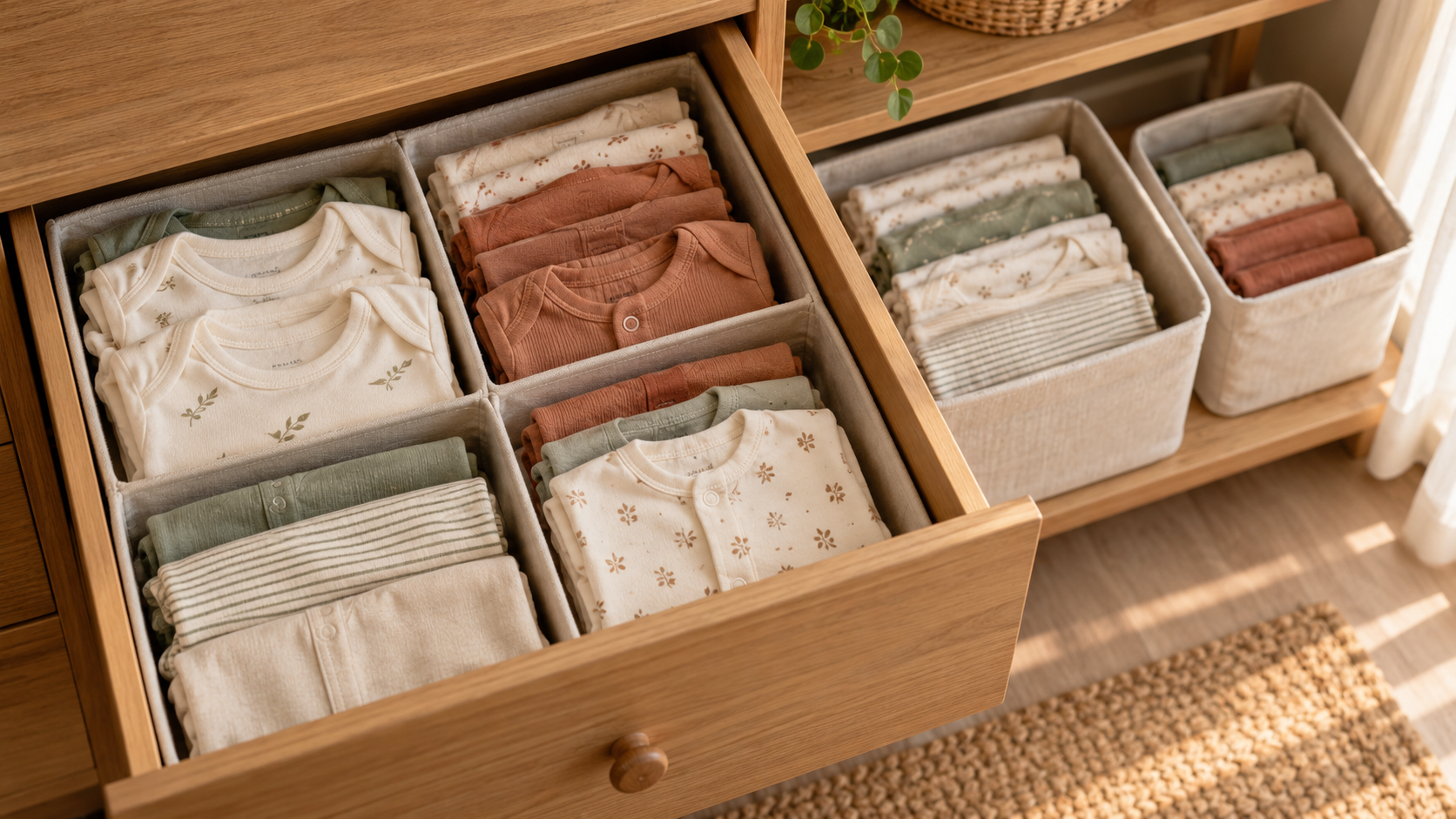
Fold clothes so you can see each piece without removing a tall stack. One option is to fold a bodysuit into a small rectangle and place similar pieces upright in a shallow divider. Another is a short flat stack with only a few garments. Try both with your actual drawer; the better method is the one you can maintain after washing.
Do not pack the drawer so tightly that removing one sleeper brings the whole row out. Leave enough space to return an item without refolding its neighbours. If a fabric organizer collapses whenever it is partly empty, a simple separated section may be easier.
Keep socks and other small accessories together, rather than spreading them across several drawers. Use plain category labels if another caregiver is likely to put clothes away. Colour coding can help, but words remain useful when two people interpret colours differently.
If you prefer hanging clothes, divide the rail into current use and future sizes. Hang the pieces that are awkward to fold, while everyday soft garments can stay in drawers. Measure the rail and shelf space before buying organizers. A divider that fits an empty drawer may be inconvenient once the drawer is filled.
Work out the wardrobe from your laundry cycle
#The useful number of everyday outfits depends on how often you change clothes and how long it takes to wash, dry and return them. Counting everything you own is less helpful than counting clothes that will be ready before the drawer runs out.
Use this planning calculation:
Usable everyday sets = expected sets per day × days until laundry is ready again + a spare allowance.
This is a household planning tool, not a medical recommendation or a fixed baby-shopping list. A set might be a sleeper, or a bodysuit and trousers; use the combination you normally dress your baby in.
For a hypothetical example, assume two everyday sets are used each day. If washing and drying mean clean clothes return every three days, six sets cover that interval. Adding two spare sets gives eight. If drying takes one extra day, the same assumptions suggest ten. The extra need comes from the longer turnaround, not from the baby's age label.
Your numbers may be very different. Track what actually reaches the laundry over a few ordinary days and include spare clothes already assigned to an outing bag or another caregiver's home. Those pieces cannot also count as available in your main drawer.
Before buying more, check whether the problem is quantity or flow. A basket of washed but unreturned outfits can make the wardrobe feel smaller than it is. Conversely, a drawer full of future sizes will not solve a shortage of current-fit clothes.
Give laundry and new arrivals a clear route
#Make the return route consistent: used clothes go to laundry; washed clothes finish drying; clean, dry pieces return to the appropriate group. Check the garment's care label for washing and drying directions. A single rule such as “everything on the hottest cycle” can be unsuitable for some fabrics, trims or fastenings.
Keep pieces awaiting stain treatment or repair apart from wearable clothes. An outfit is not ready just because it has left the hamper. You do not need a complicated treatment station; a designated place and an obvious next action are enough.
When folding clean laundry, make one quick decision about each item: still in use, next size, or outgrown. This catches the garments that were missing during a size change. It also stops too-small clothes from repeatedly returning to the drawer.
Give new gifts the same route. Check size, season, care instructions and any return conditions before removing tags or washing. Wash according to the label before placing clothes in your ready-to-wear group. Keep unprepared future pieces clearly separate from items already prepared for use.
If several people do laundry, agree on what the groups mean. “Clean” should not be confused with “fits now,” and “next size” should not become a place for every item nobody knows what to do with.
Adapt the same system to your space
#One drawer in a shared bedroom
#Use the drawer for current everyday clothes. Keep the next-size group on one existing shelf and place the temporary outgrown collection somewhere adults can manage it without blocking access. A full nursery wardrobe is optional.
Avoid scattering future clothes through several rooms unless you keep a simple location note. If one-size-up sleepers are in a bedroom cupboard and larger gifts are elsewhere, record both. Otherwise you may buy replacements for clothes you already have.
A closet with plenty of space
#More space can make it easier to forget future garments. Label each group with its original size range and broad contents. Put nearer future sizes where you can inspect them without emptying the whole closet. Keep special outfits separate so they do not crowd everyday decisions.
A home with slow drying
#Allow for the complete wash-and-dry turnaround in your clothing calculation. Keep wet or partly dry laundry out of clean drawers and long-term storage. If clothes repeatedly return smelling damp, address drying and the storage environment before buying additional containers.
The same approach works in a wet winter, a humid climate or any home with limited drying space. There is no need to tie the system to one country or season.
Make the setup easy for another caregiver
#A system that only one person understands leaves that person responsible for every outfit search. Keep labels plain and locations predictable.
Show another caregiver where the ready-to-wear clothes are, which items are waiting for preparation and where outgrown clothes go. Ask them to find an outfit and put a clean one away while the baby is safely cared for. If they need a long explanation, simplify the layout.
A short note might say: “Everyday clothes in this drawer. Next size on the shelf. Too-small pieces in the collection basket.” Add a specific exception only when it changes a real decision, such as a garment waiting for repair.
For clothes that travel between homes, use a basic list of what was sent and what returned. Keep each home's spare supply in the wardrobe count. Use a suitable garment label if identification is needed, following its attachment instructions. A long inventory of every sock is usually unnecessary unless items are repeatedly getting lost.
Change sizes in stages
#You do not have to replace the whole drawer on a particular date. Different garment types may leave the rotation at different times.
When several frequently used pieces stop fitting, inspect the next-size group. Check the actual garments, their care instructions and their suitability for the current weather. Prepare what you need, then move those pieces into everyday use.
Remove outgrown clothes as you notice them. Keep the temporary collection available until the laundry and outing bags have been checked. Otherwise the last small sleeper can reappear after its storage group has already been put away.
Review bulky seasonal clothes separately. A larger coat stored for a future season still needs a fresh fit check when that season arrives. There is no guarantee that a month label and the weather will line up as planned.
If only one category is running short, replace that gap. Several usable trousers do not help when all the sleepers have been outgrown. A simple count by garment type is more useful here than an overall wardrobe total.
Store outgrown clothes with a clear purpose
#Decide whether each group is for another child, a named recipient, donation, resale or keepsakes. Separate sentimental pieces from practical hand-me-downs so a keepsake does not disappear into a large mixed collection.
Clean items according to their care instructions and let them dry completely before storage. The Canadian Conservation Institute also stresses complete drying before storing textiles. Its specialist cleaning methods are for collection objects; everyday baby clothes should follow their own labels.
Choose a clean, dry storage place and a container suited to the room. A lid or bag cannot fix a damp cupboard. Avoid making an airtight package from anything that is still damp, and inspect stored items when the environment or season changes. If dampness, pests or visible mould are present, keep affected items apart and resolve the problem before returning clothes to use.
Label stored groups with the original size, garment types and season where relevant. “0–3 months: bodysuits and lightweight sleepers” tells you more than “baby clothes.” Add a brief contents list when several containers look alike.
For an irreplaceable older garment or delicate ceremonial outfit, seek suitable textile-care advice before attempting aggressive cleaning. Ordinary daily clothes and fragile heirlooms do not need the same treatment.
Check a donation recipient's current acceptance requirements before sending items. For passing on or resale, describe sizes and condition honestly. Clothes that need a decision should not quietly become someone else's mystery bag.
A worked example for one drawer and one shelf
#Imagine a family using the eight-set planning example above. They have one drawer for the current wardrobe and one shelf for larger clothes. This is an illustrative layout, not a required shopping quantity.
The drawer has three areas: bodysuits, sleepers, and trousers with light layers. Small accessories share a divider. The family keeps its chosen everyday sets here and records that separate spare clothes are in the outing bag.
On the shelf, one group holds clothes to check next. A second holds later gifts, with original labels and season noted. Laundry follows the household's normal route, while a separate temporary collection receives outgrown items.
During the next wash return, two sleepers no longer fit. They go to the outgrown collection. The caregiver checks and prepares replacement sleepers from the next-size group; the bodysuits stay where they are because they still work.
If the drawer remains short after clean laundry returns, the family has a specific gap to fill. If it looks full again, more clothes may not be necessary. That small distinction keeps an organisation task from becoming an automatic shopping trip.
Keep storage separate from baby safety decisions
#Secure dressers and other furniture according to the manufacturer's instructions. CPSC's Anchor It campaign recommends furniture anchoring to help prevent tip-overs. Drawer dividers, neat stacks and a child's current lack of mobility do not replace that step.
Keep plastic storage bags, packaging, small clips and loose label-making supplies out of children's reach. Do not use the cot as a place to sort or store clothes. Keep tied garments and bibs out of the sleep space.
If clothing storage is beside an elevated changing surface, gather what you need before starting a change. Never leave your baby there to fetch an outfit or check a storage box. A well-organized drawer helps preparation; it does not replace supervision.
For an ordinary reset, check what fits, return fully dry laundry, inspect the next-size group and move outgrown pieces to their next destination. If one part keeps getting messy, change that part of the layout. The useful system is the one everyone can keep using on an ordinary busy day.