
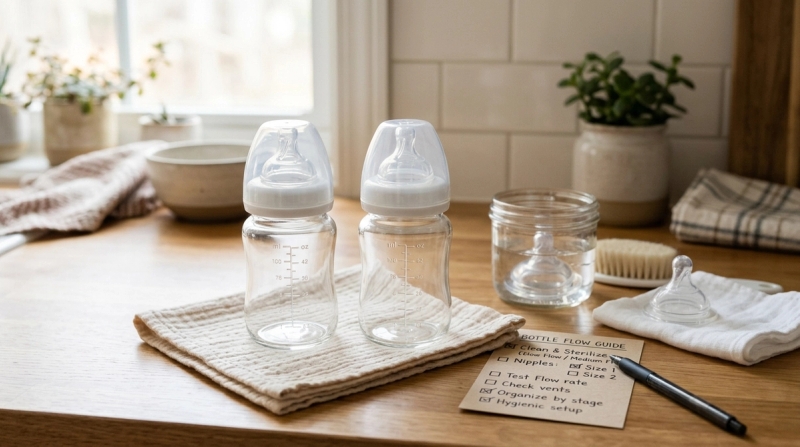
Baby bottle nipple flow means how quickly milk or formula comes out of the bottle nipple when your baby feeds. It sounds like a small detail, but it can make a big difference to how comfortable feeding feels.
If the flow is too fast, your baby may gulp, cough, leak milk, pull away, or look like they are struggling to keep up. If the flow is too slow, they may suck very hard, get irritated, fall asleep before finishing, or take a very long time to feed.
The goal is not to move up nipple sizes quickly. The goal is to find the bottle nipple size that helps your baby feed calmly, breathe comfortably, and finish without too much effort.
Safety note: This article is for general information only. It is not a diagnosis or treatment plan, and it does not replace advice from your pediatrician, lactation consultant, or feeding specialist. Please get help quickly if your baby has choking, breathing trouble, poor weight gain, signs of dehydration, feeding distress, or was born premature.
What baby bottle nipple flow actually means
#Bottle nipple flow rate is the speed at which milk comes through the nipple, also called a baby bottle teat.
During a feed, your baby is doing three things at once:
- Sucking
- Swallowing
- Breathing
When the flow matches your baby’s ability, feeding usually looks steady and relaxed. When the flow is too fast or too slow, your baby may start showing signs of stress.
Most bottle brands use labels such as:
- Preemie or ultra-slow flow
- Newborn or Level 1
- Slow flow nipple
- Medium flow
- Fast flow nipple
- Variable flow or Y-cut nipple
These labels are helpful, but they are not perfect. A Level 1 nipple from one brand may not be the same as a Level 1 nipple from another brand. Even nipples that look very similar can feel different once your baby starts sucking.
So, instead of choosing only by the age printed on the packet, watch your baby during the feed. Their face, breathing, latch, comfort, and effort will often tell you more than the label.
Quick comparison: too slow, too fast, or just right?
#One difficult bottle does not always mean the nipple is wrong. Babies have sleepy feeds, fussy feeds, and distracted feeds too.
But if you keep seeing the same pattern again and again, this table can help you decide what may be going on.
Signs the nipple flow is too slow
#A slow flow nipple is often a sensible place to start, especially for newborns. But sometimes “slow” is too slow for a particular baby.
The issue is not the name of the nipple. The issue is how much effort your baby has to use to get milk.
Here are common signs that the flow may be too slow.
1. Feeds often take a long time
#If your baby regularly takes more than about 30 minutes to finish a bottle, the nipple may be too restrictive.
Of course, some babies are naturally slower feeders. But if long feeds come with hard sucking, frustration, or tiredness, it is worth checking the nipple flow.
2. Baby sucks very hard
#You may notice strong cheek movement, intense sucking, or a baby who looks like they are working really hard for every swallow.
They may stay latched, but their body or face may look tense instead of relaxed.
3. Baby gets frustrated during the feed
#Some babies start the bottle calmly, then become upset partway through. They may cry, fuss, pull at the bottle, push it away, or keep unlatching.
This can happen when they are hungry and trying hard, but the milk is not coming fast enough for them.
4. Baby falls asleep before taking enough
#Babies do fall asleep during feeds for many reasons, especially when they are very young. But if your baby often falls asleep before taking enough milk, and the feed also seems long or tiring, the nipple may be making them work too hard.
Do not assume sleepiness is only about nipple flow, though. If your baby is unusually sleepy, not feeding well, or not having enough wet diapers, speak with your doctor.
5. The nipple collapses
#If the nipple flattens or caves in while your baby is sucking, it may mean your baby is sucking hard against a flow that is too slow.
It can also happen if the bottle vent or anti-colic part is blocked. First, wash and check all venting parts carefully. If everything is clean and fitted correctly but the nipple still collapses, the nipple size or bottle setup may need changing.
Signs the nipple flow is too fast
#When the nipple flow is too fast, your baby may look like they are trying to manage milk that is arriving before they are ready for it.
Feeding may feel rushed, messy, noisy, or stressful.
Watch for these signs.
1. Gulping, coughing, or sputtering
#Some swallowing sounds are normal. But repeated loud gulping, coughing, choking-like moments, or sputtering can mean the milk is coming faster than your baby can comfortably handle.
2. Milk spills from the mouth
#A little milk around the lips is common sometimes. But if milk often leaks from the corners of the mouth, runs down the chin, or soaks the bib, the flow may be too fast.
Your baby may not be able to swallow quickly enough, so the extra milk escapes.
3. Baby keeps pulling away
#Your baby may unlatch, turn their head, arch their back, push the bottle away, or cry during the feed.
This may be their way of saying, “Wait, I need a break.”
4. Baby looks tense or panicked
#A baby who is comfortable usually looks settled. A baby who is struggling with a fast flow may have wide eyes, stiff hands, flared nostrils, a tight body, or sudden fussiness.
If you notice choking, breathing trouble, color changes, or repeated distress during feeds, contact your pediatrician or a feeding specialist.
5. The bottle empties very quickly
#A fast bottle is not always a successful bottle.
If your baby finishes quickly but gulps throughout, spills a lot, seems uncomfortable, or cries after feeding, the flow may be too fast.
Choosing the right bottle nipple size
#The best bottle nipple size is the one your baby can manage comfortably.
Age ranges on packaging are only starting points. They are not strict rules, and they do not fit every baby.
A simple way to think about it:
- For newborns, start with the slowest practical option unless your doctor or feeding professional has advised something else.
- Stay with the current nipple if your baby feeds calmly, breathes comfortably, and is growing well.
- Try a slower nipple if your baby is gulping, coughing, spilling a lot, or pulling away.
- Consider moving up only if feeds are regularly too long, tiring, or frustrating, and the nipple and vent are clean, undamaged, and fitted correctly.
If your baby was premature, has feeding difficulties, breathing concerns, poor weight gain, or ongoing distress during feeds, do not keep changing nipples on your own. Ask your pediatrician, lactation consultant, or infant feeding specialist for guidance.
Do nipple shape and texture matter?
#Yes. Flow is important, but it is not the only thing that affects feeding.
The shape, softness, and fit of the nipple can also change how your baby latches and how well they control the milk.
Shape
#A nipple with a rounded shape and a gentle slope from tip to base may help some babies get a deeper latch.
If your baby only sucks on the very tip of the nipple, the feed may become less efficient or more tiring.
Texture
#The nipple should be flexible enough for your baby to compress, but not so soft that it collapses easily.
Replace the nipple if it looks or feels:
- Sticky
- Cracked
- Cloudy
- Stretched
- Torn
- Thinner than before
- Damaged around the milk hole
Fit with the bottle
#Use nipples made for your bottle brand and collar whenever possible. Mixing brands can cause leaking, poor venting, or a flow that does not work as expected.
This is especially important when buying replacements from local shops or online, where two parts may look almost the same but may not actually fit properly.
Practical care tips for Indian homes and humid weather
#In many homes, bottle care happens in busy kitchens, shared drying spaces, hot weather, monsoon dampness, and with more than one caregiver helping.
That is normal. The key is to keep the routine simple, clean, and consistent.
Do not enlarge the nipple hole
#A common home suggestion is to make a slow flow nipple faster using a hot needle, pin, blade, or scissors.
Please avoid this.
Cutting or piercing the nipple can make the flow unpredictable. Milk may come out too fast, the edges may become rough, and the nipple may weaken or tear.
If your baby truly needs a faster flow, buy the next suitable nipple size from the same brand.
Dry nipples fully during monsoon
#In humid weather, bottle parts can stay wet for longer. After washing and sterilizing as you normally do, let nipples air-dry completely in a clean, well-ventilated place before storing or assembling them.
Also check inside the teat, because moisture can get trapped there.
Inspect more often in hot weather
#Heat, frequent washing, sterilizing, and daily use can wear down bottle nipples faster.
Check nipples regularly for:
- Tiny tears
- Stickiness
- Thinning
- Cloudiness
- Stretching around the milk hole
- A sudden change in how fast milk comes out
If you notice damage or a change in flow, replace the nipple.
Buy exact replacements when possible
#When buying from a pharmacy, baby store, supermarket, or online marketplace, check the brand, level, and nipple type carefully.
Words like “newborn,” “slow,” and “medium” can mean different things across different brands.
Baby bottle nipple flow checklist
#Use this checklist every few weeks, or whenever bottle feeding suddenly feels harder than usual.
- Watch one full feed without rushing.
- Notice whether your baby looks calm, tense, sleepy, or frustrated.
- Listen for repeated gulping, coughing, or sputtering.
- Check if milk is leaking heavily from the mouth.
- See whether the nipple collapses during sucking.
- Check the bottle vent or anti-colic parts for blockage.
- Inspect the nipple for tears, stickiness, thinning, cloudiness, or a stretched hole.
- Confirm the nipple matches the bottle brand and collar.
- Notice whether feeds are often very long or unusually fast.
- Ask a professional if there is feeding distress, choking, breathing trouble, poor weight gain, dehydration signs, or prematurity.
Final takeaway
#The right baby bottle nipple flow is not about reaching the next level quickly. It is about helping your baby feed with less stress, less spilling, and a steady suck-swallow-breathe rhythm.
Watch your baby more than the label. Check the nipple. Keep bottle parts clean and dry. Change sizes only when the signs really point that way.
And if feeding looks distressing, or your baby has growth, breathing, or medical concerns, get professional help early.