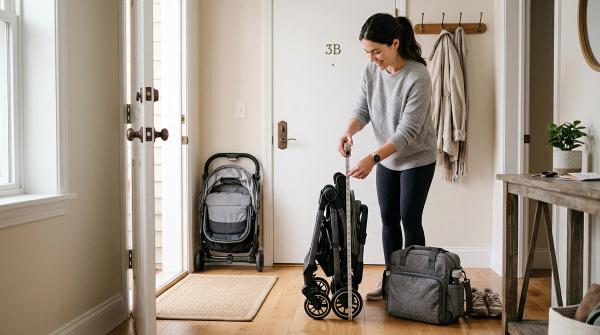
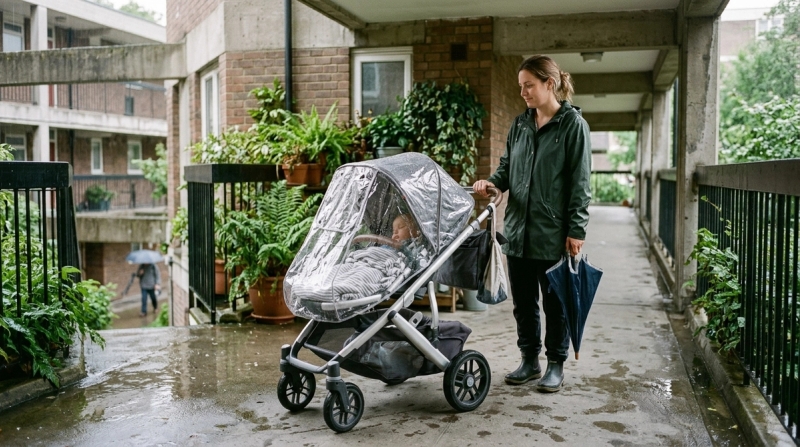
Quick answer: A stroller rain cover is safe when it fits properly, has good ventilation, and is used only when your baby actually needs protection from rain or wet weather. Keep vents or mesh panels open, never seal the stroller completely, and avoid using blankets, dupattas, plastic sheets, tablecloths, or garbage bags as makeshift covers. Once you are indoors, inside a lift, sitting in a cab, or the rain has stopped, open the cover or remove it.
When a Stroller Rain Cover Actually Helps
#A rain cover is useful when you are taking a baby stroller in rain and need short-term protection from wet weather.
It helps during:
- Sudden monsoon showers
- Windy drizzle
- Walks from the apartment gate to a cab or auto
- Quick errands on wet roads
- Moving between parking areas, lifts, lobbies, and homes
- Clinic visits on rainy days
- Family visits when the stroller may otherwise get soaked
A good cover can keep the stroller seat, canopy, footrest, harness area, and storage sections from becoming damp and uncomfortable.
But here is the part many parents forget: a rain cover is not meant to stay on for the whole outing.
It is meant for active rain, wet surroundings, or short outdoor transitions. Once you are out of the rain, pull it back or remove it.
This is especially important in humid cities, where heat and moisture can build up quickly inside a covered stroller. And it usually happens in the most ordinary moments. You rush into the lift, then the lobby, then the cab, and suddenly the cover has been zipped down for much longer than needed.
So make this a small habit: every time you step out of the rain, check the cover.
If you are in a lift, mall, clinic, restaurant, cab, or someone’s home, your baby probably does not need the rain cover closed anymore.
Safety-First Buying Checklist
#You do not need the fanciest or most expensive rain cover. But you do need one that gets the basics right.
1. Choose a Cover Made for Strollers
#A proper stroller rain cover is designed for stroller use. That makes a big difference.
It should sit over the stroller neatly without sagging into your baby’s space or getting too close to their face and body.
A good cover should stay clear of:
- Wheels
- Brakes
- Harness straps
- Buckles
- Your baby’s face
- Your baby’s legs and feet
If your stroller brand sells a compatible rain cover, start there. Brand-specific covers often fit better because they are made for that stroller’s shape.
If you are buying a universal cover, measure your stroller before ordering. Universal covers can work well, but “universal” does not always mean “perfect for every stroller.” Many parents realise this only after the cover arrives and does not sit right.
2. Check Ventilation Before Anything Else
#Good stroller airflow is non-negotiable.
Look for features like:
- Mesh side panels
- Side vents
- Zippered openings that can stay partly open
- A design that does not seal the stroller completely
- Enough space for air to move in and out
Avoid covers that create a tight plastic bubble around the stroller. Rain protection is helpful, but not at the cost of fresh air.
Some rain covers look clean and stylish in product photos, but once fully zipped, they barely allow airflow. So look carefully at the design, not just the picture.
Ask yourself: if this cover is on during humid weather, how will air enter and leave?
If the answer is not clear, choose another one.
3. Get the Fit Right
#A rain cover that is too tight may press against the canopy, seat, or your baby’s legs. A cover that is too loose may flap in the wind, block your view, or hang near the wheels.
Before buying, measure your stroller’s:
- Length
- Width
- Height
- Widest points, including the canopy and handle area
Also think about extra stroller parts such as:
- Snack tray
- Extended canopy
- Footrest
- Parent organiser
- Cup holder
- Storage basket
- Mosquito net attachment, if any
These small additions can change how the rain cover fits.
A slightly bad fit may not seem like a big issue at home. But in real monsoon weather, with wind, wet roads, and traffic around you, an ill-fitting cover becomes frustrating very quickly.
4. Make Sure You Can See Your Baby Clearly
#The front panel should be clear enough for you to check your baby at a glance.
During stroller rain outings, you should be able to quickly see:
- Is my baby’s face clear?
- Is the cover away from the mouth and nose?
- Is my baby getting too warm?
- Is my baby restless or uncomfortable?
- Is the harness still in place?
- Is the baby sitting or lying safely?
Do not depend only on sound. Rain noise, traffic, people talking, lift sounds, and crowded spaces can make it hard to hear small signs of discomfort.
Visibility matters.
If the plastic fogs up too much, has heavy creases, or blocks your view, it becomes harder to use safely.
5. Check Access to Brakes, Handles, and Harness
#A rain cover should not make the stroller harder to control.
Before using it outside, test it at home once. Put the cover on and check whether you can still:
- Hold the handle properly
- Use the brakes quickly
- Reach the harness
- Buckle and unbuckle your baby safely
- Keep the cover away from the wheels
- Push, turn, and stop without the cover slipping
- Open the cover quickly if needed
This matters even more during monsoon. Floors can be slippery, pavements may be uneven, roads may have puddles, and everyone around you may be rushing to get out of the rain.
You want both hands and the stroller controls to work smoothly.
6. Avoid Heavy, Stiff, or Poorly Attached Covers
#A very heavy rain cover can be difficult to manage, especially in wind. A stiff cover may not sit well on compact strollers. Loose strings, ties, or dangling straps can get near the wheels or brakes.
Choose something that feels stable once attached. You should not have to stop every few minutes to adjust it.
Also, if the cover has a strong plastic smell when it is new, air it out before using it around your baby. Open it fully and leave it in a ventilated place for a while.
It is a small step, but worth doing.
7. Think About Storage Before Buying
#Monsoon storage is not glamorous, but it is practical.
A good rain cover should be easy to:
- Shake off
- Wipe dry
- Hang up
- Fold after drying
- Carry in the stroller basket or diaper bag
Do not fold and store it while it is still damp.
A wet cover stuffed into a stroller basket, cupboard, car boot, diaper bag, or apartment entryway corner can start smelling bad. It may also develop mildew or stains.
Drying the cover properly is one of those boring little steps that makes the product last longer and keeps it nicer to use.
Rain Cover vs Umbrella vs Blanket or Plastic Sheet
#A blanket may feel like the soft, caring choice. Many parents do it automatically when sudden rain starts. But over a stroller, a blanket can block airflow and trap heat. If it gets wet, it becomes heavy and can sag inward.
A plastic sheet or tablecloth is also risky. It was not made for stroller use. It may cling to the stroller, cover openings, block your view, or flap around in the wind.
A stroller umbrella can work for very light drizzle. But during proper monsoon rain, especially sideways rain, it usually does not protect enough. If it is not attached securely, it can also make steering awkward.
For most rainy stroller outings, a fitted and ventilated rain cover is the safest practical option, as long as you use it only when needed.
7 Monsoon Stroller Safety Rules
#1. Keep the Vents Open
#Do not close every opening just to stop a few drops of rain.
Air needs a way to move in and out.
If the cover has zippered vents, keep them open as the design allows. If it has mesh panels, make sure the canopy, blanket, diaper bag, or your own hand is not blocking them.
A little drizzle near the edge is usually less worrying than a stroller with no airflow.
2. Check Your Baby Often
#Monsoon weather can be sticky, humid, and uncomfortable. So while you are watching the road, also keep checking your baby.
Look for signs such as:
- Sweaty neck
- Damp back
- Flushed face
- Damp clothes
- Fussing more than usual
- Fogging inside the cover
- Restlessness
- Baby looking too warm or uncomfortable
If your baby seems uncomfortable, move to shelter and open or remove the rain cover.
It sounds simple because it is simple. But in real life, when you are managing bags, rain, traffic, and timing, this small check makes a big difference.
3. Never Seal the Stroller Completely
#Do not wrap the stroller tightly in plastic. Do not tuck the rain cover so firmly that no air can pass through. Do not use tape, clips, extra cloth, or plastic to close every gap.
The goal is not to create a waterproof chamber.
The goal is to protect your baby from rain while still allowing airflow and visibility.
A stroller rain cover should feel like a shield, not a sealed container.
4. Do Not Use Blankets or Plastic Sheets as Rain Covers
#This is one of the most important monsoon stroller safety rules.
Avoid using:
- Blankets
- Dupattas as full stroller covers
- Large cloths over the entire stroller
- Plastic table covers
- Garbage bags
- Packaging plastic
- Tarpaulin-style sheets
These can block airflow, trap heat, reduce visibility, and sag into the stroller space.
If you are caught without a proper rain cover, it is usually safer to wait under shelter for a few minutes instead of creating a makeshift sealed cover in a hurry.
Not always convenient, yes. But safer.
5. Be Extra Careful When Moving Between Rain and Indoors
#Rainy-day outings with a baby are rarely one simple walk. They are usually a series of small transitions.
For example:
- Home to lift
- Lift to parking
- Parking to cab
- Cab to clinic
- Clinic to pharmacy
- Gate to family home
Every time you leave the rain, reassess the cover.
Pull it back in the lift. Open it in the cab. Remove it indoors. Put it back only when you step out into rain again.
This habit takes a few seconds, but it helps prevent the stroller from becoming hot and stuffy.
6. Handle Stroller Sleep Safely
#Rain sounds and stroller movement can make babies sleepy. If your baby falls asleep in the stroller, keep checking them.
The American Academy of Pediatrics safe sleep guidance recommends that babies sleep on a firm, flat sleep surface. So when you reach your destination and it is practical, move your baby from the stroller to a firm sleep space instead of leaving them sleeping in the stroller for a long, unobserved stretch.
This is not meant to scare you. It is just a reminder that the stroller is mainly for travel. Once you are settled somewhere, a safer sleep setup is better when possible.
7. Dry the Cover Fully Before Storing It
#After a rainy outing, remove the cover and shake off the extra water. Wipe it with a clean dry cloth, then hang or drape it somewhere with airflow.
Do not store it while damp.
Avoid leaving a wet rain cover crumpled in:
- Stroller basket
- Car boot
- Apartment entryway
- Cupboard
- Diaper bag
- Under the stroller seat
If you do not have much drying space, hang it over a chair, drying rack, bathroom rod, or a protected balcony area.
Fold it only when it is completely dry.
Quick Pre-Outing Checklist
#Before you leave home with a baby stroller in rain, quickly check:
- Is the rain cover made for stroller use?
- Does it fit the stroller properly?
- Is it away from my baby’s face and legs?
- Are the vents or mesh panels open?
- Can I see my baby clearly?
- Can I reach the brakes?
- Can I hold the stroller handle properly?
- Is the harness visible and usable?
- Is the cover away from the wheels?
- Can I open or remove it quickly?
- Will I remember to open it indoors?
- Do I have a place to dry it after coming back?
If the answer is no to any of these, fix it before stepping out.
Common Mistakes New Parents Make
#Even careful parents make these mistakes, especially when rain starts suddenly.
Leaving the Cover On Indoors
#This is probably the most common mistake.
You rush from the gate to the lift, then into the lobby, then someone starts talking to you, and the cover stays zipped down.
Try to make it automatic: once you are out of the rain, open the cover.
Covering the Stroller With a Blanket
#It looks harmless, but it can block airflow quickly. Wet blankets also become heavy and uncomfortable.
Use a blanket for warmth when needed, but not as a rain shield over the stroller.
Buying Only by Price or Looks
#A cute or cheap rain cover is not always the safest choice.
Before buying, check:
- Ventilation
- Fit
- Visibility
- Ease of opening
- Access to brakes and harness
- How securely it attaches
Looks matter less than airflow and safety.
Forgetting to Dry It
#A damp rain cover can smell bad very quickly in monsoon weather.
After every wet outing, dry it fully before folding and storing it. Future you will be grateful.
Official and Source Notes
#- The U.S. Consumer Product Safety Commission (CPSC) has safety standards for carriages and strollers, including 16 CFR Part 1227. These relate to stroller safety, but parents should still follow the stroller manufacturer’s instructions and local guidance.
- The American Academy of Pediatrics (AAP) safe sleep guidance recommends moving a baby to a firm, flat sleep surface for sleep when practical, instead of relying on a stroller for prolonged or unobserved sleep.
- Always follow your stroller manufacturer’s instructions for compatible accessories, brakes, harness use, folding, and weight limits.
Final Takeaway
#A rain cover is useful during monsoon outings, but it should never turn your stroller into a sealed plastic space.
For better stroller rain cover safety, choose a fitted cover with ventilation, keep the airflow open, watch your baby closely, remove the cover indoors, and dry it properly before storage.
Monsoon outings with a baby can feel like a lot. There are bags, wet roads, cabs, lifts, puddles, and sometimes a crying baby right in the middle of it all.
But the safety habit is simple:
Cover only when needed.Keep air moving.Keep checking your baby.