Let’s talk about the thing nobody wants to talk about until they are standing in a moving train, holding the door handle with one hand and praying with the other. Indian train toilets. If you are a foreign tourist planning your first long train journey in India, honestly, this is one of those small topics that can make or break your comfort. I’m Indian, I’ve travelled in sleeper, 3AC, 2AC, chair car, general coach by mistake also, and yes, I have seen the good, the bad, and the “bhai, let me just wait till next station hotel” type toilets.
The first thing to know is this: Indian train toilets are not always terrible, but they are not always clean either. They depend on the train, route, class, crowd, time of day, and sometimes just luck. A Vande Bharat toilet can feel almost like an airport washroom if people behave properly. A long-distance sleeper coach toilet after 18 hours of travel in peak summer can feel like a survival challenge. Both are India. Same railway system, totally different experience.
So, what kind of toilets do Indian trains actually have?
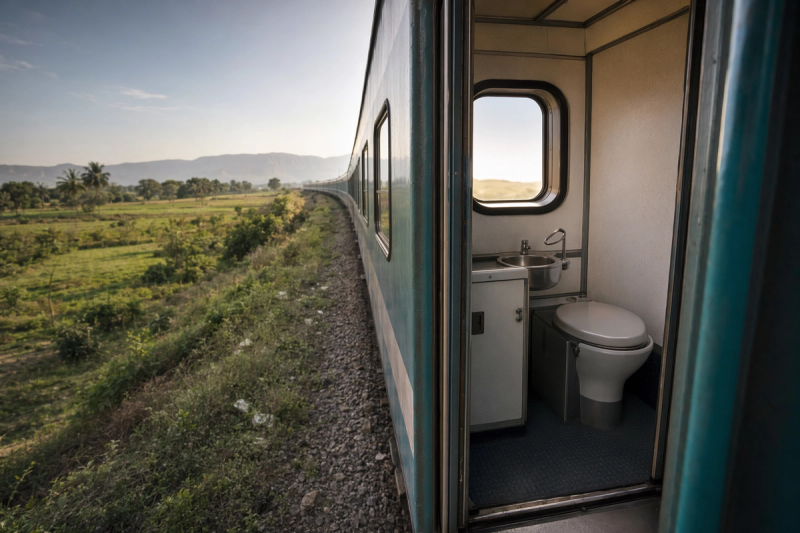
#Most long-distance Indian trains have toilets at both ends of the coach, usually four toilets per coach. In many coaches you’ll find two Indian-style squat toilets and two western-style toilets, though this can change depending on coach type and train. AC coaches usually have a mix. Sleeper class also has a mix in many trains, but sometimes the western one is occupied, broken, wet, or just not something you want to use unless you really need it. Sorry, but that’s the truth.
Newer trains and upgraded coaches are much better than what we had years back. Indian Railways has fitted bio-toilets in most broad-gauge passenger coaches, and newer premium trains like Vande Bharat, Tejas, Gatimaan, and some upgraded LHB coaches may have more modern fittings, better lighting, sensor taps, and sometimes vacuum-style flushing. But don’t imagine every train is like that. If you are taking an overnight express from Delhi to Varanasi or Mumbai to Goa or Chennai to Madurai, you may get a decent toilet, you may get a wet floor situation. It’s not dramatic, it’s just practical.
My honest experience, from someone who actually uses these trains
#I’ve done Delhi to Jaisalmer in sleeper class, Mumbai to Mangalore in 3AC, Kochi to Chennai in 2AC, and one very questionable overnight ride from Gorakhpur where I still don’t like thinking about the toilet after 5 am. The funny thing is, early in the journey everything looks okay. Fresh water, dry-ish floor, dustbin not overflowing. By morning, especially after everyone wakes up and chai starts circulating, the toilet becomes a busy public space. You learn timing. That is the real Indian train skill, not booking Tatkal.
If you are a foreign tourist, don’t panic. I’ve met backpackers from Germany, Japan, Australia, France, all doing Indian trains, and most of them managed fine after the first awkward visit. The main shock is not the toilet itself, it’s the movement of the train. You think you’re balanced, then the train takes a curve and suddenly you are doing yoga you never signed up for. Squat toilets are actually easier in a moving train for many Indians because you don’t touch the seat, but for someone not used to squatting, it can be tricky. Western toilets are familiar, but seats may be wet, and you’ll want to clean before sitting.
Best train classes if toilet comfort matters
#If toilet cleanliness is a big concern, choose your class carefully. 1AC is the most comfortable and usually least crowded, but it’s expensive and not available on all trains. 2AC is a solid choice for foreign tourists who want privacy, decent toilets, and less chaos. 3AC is the most common “comfortable but not too costly” option and I recommend it to most first-time visitors. Sleeper class is iconic and cheap, yes, but toilets get rough on long journeys, especially in summer and festival rush. Chair car and executive chair car on day trains are usually manageable because people are not living in the coach overnight.
| Train/Class | Toilet expectation | Who should choose it |
|---|---|---|
| Vande Bharat / Executive Chair Car | Generally cleaner, modern fittings, better maintenance | First-time visitors, families, short daytime routes |
| 2AC | Usually decent, less crowded than 3AC, better privacy | Foreign tourists on overnight journeys |
| 3AC | Okay to decent, depends heavily on crowd and train | Budget-conscious travellers wanting comfort |
| Sleeper Class | Very mixed, can get dirty on long routes | Experienced travellers, short rides, tight budgets |
| General / Unreserved | Avoid for toilet comfort, very crowded | Only if you really know what you’re doing |
When is the best time to use the toilet on an Indian train?
#This sounds silly but trust me, timing matters. The cleanest time is usually soon after the train starts, or after a major station where cleaning staff may come onboard. Many trains have OBHS, onboard housekeeping service, especially in AC long-distance trains. You’ll see staff sweeping, mopping, collecting garbage, sometimes cleaning toilets. If the toilet is dirty, you can ask coach staff politely, or use Rail Madad app or call 139 for complaints. Does it work every time? Not magically. But I’ve seen toilets cleaned after passengers complained, so it’s not useless.
- Best time: first 1-3 hours after departure, before everyone settles in fully.
- Also good: after a major halt like New Delhi, Mumbai Central, Ahmedabad, Bhopal, Nagpur, Vijayawada, Chennai, Howrah, Jaipur, etc.
- Worst time: early morning rush, especially 5:30 am to 8:30 am on overnight trains.
- Avoid if possible: right before arrival at big stations, because everyone suddenly remembers they need to go.
The packing list I always suggest to foreign friends
#Don’t overpack like you’re going for a Himalayan expedition, but for Indian train toilets, a small hygiene pouch is gold. Keep it in your day bag, not inside your big suitcase under the berth. You don’t want to climb down, unlock your bag, search for tissue while the train is shaking and your co-passenger is staring like “kya kar raha hai yeh?” Make one small pouch and keep it ready.
- Toilet paper or tissues: Indian trains may not provide it, especially outside premium services. Carry your own, always.
- Wet wipes: very useful, but please don’t flush them. They block toilets and create horrible mess.
- Hand sanitizer: non-negotiable. Keep a small bottle in pocket also.
- Soap paper or tiny liquid soap: because sometimes the washbasin has water but no soap.
- A small torch or phone light: some toilets have poor lighting at night, though newer coaches are better.
- Flip-flops or washable sandals: don’t go barefoot or in socks. Please. Just don’t.
- Disposable toilet seat covers or sanitizer spray: helpful for western toilets if you prefer sitting.
- Small plastic bag or zip pouch: for used tissues if dustbin is full, especially on remote routes.
Indian-style vs western-style: which one should you use?
#This is personal. Many foreign tourists prefer western toilets because they are used to them, but in Indian trains, the western toilet seat may be wet from water splashing, cleaning, or people using the health faucet in a very enthusiastic way. Indian-style squat toilets avoid contact with the seat completely, which is why many locals prefer them. But if your knees are not used to squatting, don’t try to become a hero on a fast-moving train between two stations. Use the western one, clean the seat, hold the handle, and take your time.
One thing foreigners notice is the water system. Indians commonly use water instead of toilet paper. You’ll find a mug, tap, or jet spray/health faucet depending on the coach. Sometimes the water pressure is low. Sometimes the tap works too well and attacks you like a monsoon cloud. If you use tissue, throw it in the bin, not the toilet. Even in trains with bio-toilets, tissue and wet wipes can cause blockage. And a blocked toilet in a train coach is basically everyone’s problem, not just yours.
Safety, hygiene, and those small uncomfortable details
#Safety-wise, train toilets are usually inside the coach area, near the doors. At night, especially for solo women travellers, I suggest going when the coach is not completely silent or taking a friend if you feel uncomfortable. Lock the toilet door properly. Some old locks are loose, so check it twice. Don’t keep your phone on the washbasin ledge, don’t hang your passport pouch on a random hook unless you are sure it won’t fall, and don’t leave valuables on your berth when going. Theft is not happening every second, but crowded trains are crowded trains.
For hygiene, assume the floor is wet. It may be water, it may not be only water. Sorry, but better to be mentally ready. Roll up long trousers, avoid dragging scarves or dupattas, and if you wear a jumpsuit while travelling by train in India, I admire your confidence but also, why would you do that to yourself? Loose pants with pockets, simple t-shirt, easy footwear. That’s the winning uniform.
Latest travel update type stuff you should know before booking
#Train travel in India has improved a lot, especially on popular tourist routes. More Vande Bharat trains are running now between major cities, stations are being redeveloped under big railway upgrade plans, and many premium trains have cleaner coaches than older memories people still share online. Digital booking through IRCTC is standard, foreign tourists can book online with their international number and passport details, though payment can be annoying sometimes. Apps like ConfirmTkt, ixigo, MakeMyTrip, and RailYatri are also used widely for checking train running status, platform numbers, and PNR updates.
As we move toward 2026, the trend is clear: Indian Railways is trying to make long-distance travel cleaner and more tourist-friendly, but the experience still depends on passenger behaviour. A toilet can be spotless at departure and destroyed in six hours if people misuse it. So keep expectations balanced. Choose better trains where possible, avoid waitlisted stress if you can, and don’t book the cheapest option for a 30-hour ride if you know toilet comfort matters to you.
Routes where foreign tourists often face this toilet reality
#If you are doing classic India routes like Delhi to Agra, Delhi to Jaipur, Jaipur to Jodhpur, Delhi to Varanasi, Mumbai to Goa, Kochi to Alleppey, Chennai to Madurai, or Kolkata to New Jalpaiguri for Darjeeling, you’ll probably use trains at some point. Short routes are easier. Even if the toilet is not great, you can survive 2-5 hours. Overnight routes need planning. For Delhi to Varanasi, I’d pick 2AC or 3AC over sleeper for a first-time foreign tourist. For Mumbai to Goa, 2AC/3AC is comfortable, and Konkan Railway views are stunning, btw. For Kerala routes, trains are usually manageable, but toilets can get crowded during holiday season.
Seasonal tips: summer, monsoon, winter, festival rush
#Best months for train travel in much of India are October to March. Weather is cooler, toilets don’t smell as intense, and sitting in a coach feels less sweaty. Summer, from April to June, is rough in North and Central India. AC class becomes worth the money, not just for sleep but for basic sanity. Monsoon is beautiful, especially Konkan and Kerala, but station platforms get wet, coach floors get muddy, and toilets become slippery. During Diwali, Holi, Christmas-New Year, Durga Puja, Eid holidays, and long weekends, trains are packed. Book early and mentally prepare for more crowding.
One more seasonal thing foreigners don’t always realise: winter fog in North India can delay trains badly, especially around Delhi, Agra, Varanasi, Lucknow, Amritsar, and Bihar routes. A 2-hour delay can become 8 hours. That means more toilet use, more crowding, more mess. Carry extra tissue, snacks, water, and patience. Patience is not sold on IRCTC, sadly.
Food, chai, and toilet planning, yes they are connected
#Indian train food is part of the adventure. Chai in a paper cup, samosa at a station, idli-vada in South India, poha in Madhya Pradesh, bread omelette from a pantry guy, veg thali through e-catering. Lovely stuff. But if your stomach is not used to Indian spices or station food, be careful before an overnight train. I’m not saying don’t eat, because what is travel without food? Just don’t experiment with five new spicy things right before boarding a 14-hour train.
Use IRCTC e-catering or trusted station vendors on big routes if you want safer meals. Carry bananas, biscuits, ORS sachets, nuts, and bottled water. Don’t drink random tap water from train washbasins. It is for washing hands, not drinking. Also, don’t go crazy with chai if you hate train toilets. I say this and then I still drink three chais, so yes, I’m also not perfect.
Accommodation near stations, in case your train is delayed or you need a reset
#Sometimes the smartest toilet strategy is not inside the train at all. If your train arrives at 4 am or gets delayed badly, book a room near the station or use railway retiring rooms where available. Retiring rooms and dormitories at major stations can be surprisingly useful, but availability depends on confirmed tickets and station facilities. Prices vary a lot, but dorm beds can be around ₹300-₹800, basic retiring rooms ₹700-₹1,500 or more, and private hotels near stations usually start from ₹800-₹2,500 for budget places. Mid-range hotels in cities like Delhi, Jaipur, Mumbai, Kochi, and Varanasi may be ₹2,500-₹6,000 depending on season and location.
For foreign tourists, I’d say don’t choose the absolute cheapest hotel beside a busy station unless reviews are good. Station areas are convenient but can be noisy, crowded, and a little overwhelming after a long train ride. Look for places with recent reviews mentioning clean bathroom, 24-hour check-in, and walking distance or easy cab access. A proper shower after an overnight train feels like rebirth. Not even joking.
Small etiquette things that make life better for everyone
#Indian trains are shared spaces, and toilets become messy partly because people stop caring. Don’t throw tissue on the floor. Don’t flush plastic. Don’t leave the tap running. If you splash water everywhere, wipe what you can. If the toilet is blocked, tell the attendant or raise it on Rail Madad instead of just walking away and cursing India in your travel diary. Also, avoid using the toilet when the train is standing at a station if you can, especially in older coaches or crowded halts. It’s just better manners, and many trains still display that instruction.
My simple rule: enter with low expectations, carry your own supplies, use the toilet before the morning rush, and you’ll be fine. Maybe not luxury fine, but India-train fine.
What I’d tell a foreign friend before their first Indian train ride
#I’d tell them this: don’t romanticise Indian trains too much, but don’t fear them either. They are chaotic, warm, loud, sometimes smelly, sometimes beautiful. You’ll see families sharing food, students charging phones near the door, uncles giving unsolicited route advice, kids staring out of windows, chai sellers calling “chai chai” like a soundtrack. Toilets are just one practical part of that whole experience. Prepare properly and it won’t ruin your journey.
Book 2AC or 3AC for overnight routes. Keep your hygiene pouch ready. Wear washable footwear. Use the toilet early. Don’t expect toilet paper. Don’t flush wipes. Drink enough water but don’t overdo chai before sleeping. Check train status before reaching the station. Keep your luggage chained if you’re sleeping, and keep passport and money close. If something feels wrong, speak to the TTE, coach attendant, RPF helpline, or use 139. Most people around you will help if you ask nicely, even with broken English or broken Hindi. Indians are nosy, yes, but often helpful-nosy.
Final thoughts: it’s not glamorous, but it’s manageable
#India train toilets are not the highlight of your trip, obviously. But they also don’t have to be the horror story people make them into. Pick the right train, pack smart, understand the local water-and-toilet-paper difference, and keep your sense of humour. That last one is important in India anyway. Some journeys will be smooth, some will test your balance and patience, and some will make you appreciate hotel bathrooms like never before.
For me, trains are still one of the best ways to see India. You pass small towns, fields, rivers, station tea stalls, random temples, city edges, and all those tiny scenes flights completely skip. The toilet part is real, but so is the magic. If you’re planning your first Indian rail trip, go prepared and go with an open mind. And if you want more grounded travel tips, local-style guides, and honest India travel talk, have a look at AllBlogs.in sometime.