If you’re stuck between buying a backpack rain cover vs waterproof backpack, don’t overthink it. Start with one simple question:
How much rain does your bag actually face on a normal monsoon day?
If your bag only gets wet during a short walk to the bus stop, school gate, metro station, or office entrance, a rain cover is usually enough. But if you ride a scooter, walk for long stretches, carry a laptop, or live in a city where rain comes with wind from all directions, a waterproof backpack — or at least a waterproof liner inside your bag — is a much safer choice.
Quick answer
#- Already have a good backpack? Buy a rain cover.
- Carry a laptop every day? Use a waterproof backpack or add an inner waterproof liner.
- Ride a bike or scooter in the rain? Prefer a waterproof backpack.
- Buying a school bag for monsoon? Choose water-resistant fabric plus a rain cover.
- Want the cheapest protection? Use a rain cover with an inner plastic or waterproof liner.
One thing to be clear about: a normal water-resistant bag is not the same as a waterproof bag.
Water-resistant backpacks can handle light drizzle for some time. But in proper Indian monsoon rain, water can still enter through zippers, stitching, old coating, seams, and the bottom of the bag.
The real monsoon problem
#Indian monsoon commutes are rarely neat and predictable.
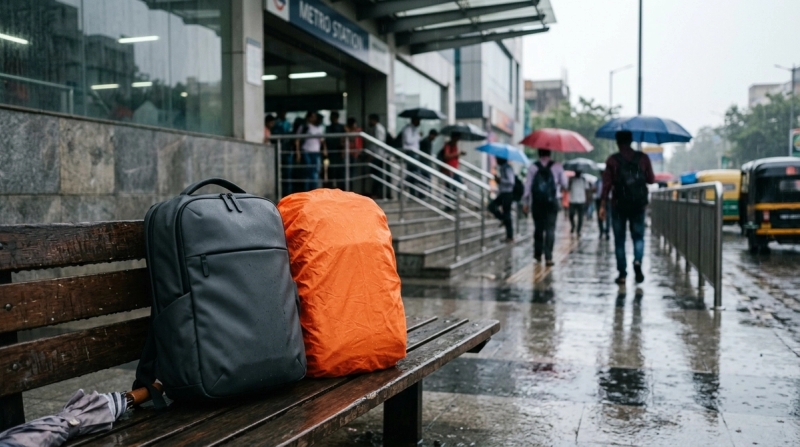
One day it’s just a light drizzle. The next day you’re stuck outside a metro station, rainwater is dripping from the roof, your umbrella is tilted sideways, and your bag is getting splashed from every angle.
Your backpack may get wet while:
- Walking to school, college, tuition, or office
- Waiting at a bus stop
- Riding pillion on a scooter
- Crossing waterlogged lanes
- Standing outside a shop, metro gate, or office building
- Keeping the bag on a wet classroom or office floor
Most daily backpacks are made for comfort, storage, and looks. They are not really built for heavy rain.
Even if the fabric looks like it is repelling water, the weak points are usually:
- Zippers
- Stitching and seams
- Bottom panel
- Laptop compartment edges
- Shoulder straps
- Back padding
- Old fabric coating that has worn out
So this is not just a “cover or no cover” decision. You’re really choosing between three levels of protection:
- A backpack rain cover
- A water-resistant backpack
- A waterproof backpack or inner waterproof liner
Backpack rain cover vs waterproof backpack: quick comparison
#- Best for short rain exposure: Backpack rain cover.
- Best for light drizzle and casual use: Water-resistant backpack.
- Best for heavy rain, laptops and two-wheeler commutes: Waterproof backpack.
- Best if you already own a bag: Rain cover.
- Best if you are buying new anyway: Waterproof or strongly water-resistant backpack with internal protection.
- Main rain-cover weakness: Back panel and straps stay exposed.
- Main water-resistant-bag weakness: It can leak in long rain.
- Main waterproof-bag tradeoff: It usually costs more and may feel stiffer.
Option 1: Backpack rain cover
#A rain cover for backpack use is a separate cover that goes over the outside of your bag. Most have elastic around the edges so they can grip the backpack properly.
Some hiking and travel backpacks already come with a rain cover hidden in a small bottom pocket. But many school, college, and office bags do not.
Why it works
#A rain cover blocks direct rain from hitting the front and sides of your backpack. This is useful because zippers and stitched seams are often the first places where water enters.
It works well if your commute is something like:
- Home to bus stop
- Bus stop to office
- Classroom to hostel
- Tuition to auto stand
- Metro station to office entrance
If you already have a comfortable backpack and don’t want to buy a new one just for monsoon, a rain cover is a practical and affordable fix.
Where it falls short
#A rain cover does not properly cover the side of the bag that touches your back. So the shoulder straps and back padding can still get wet.
Also, if rainwater runs down your raincoat or shirt, it can reach the back of the bag even when the front is covered.
Another issue is access. If you need to open your bag again and again for your wallet, ID card, charger, notebook, bottle, umbrella, or lunch box, the cover can become annoying. You may have to remove or adjust it every time.
For bike and scooter users, a loose rain cover can flap in the wind or shift out of place. It still helps, but it is not the strongest solution for long rain exposure.
Option 2: Water-resistant backpack
#Many school, college, office, and travel bags are sold as water-resistant. This usually means the fabric can handle light rain for a short time.
It does not mean the entire bag is waterproof.
A water-resistant backpack may be fine if:
- You mostly travel by car, cab, bus, or metro
- Your outdoor exposure is short
- You don’t carry expensive electronics
- You use an umbrella most of the time
- You avoid standing in heavy rain
But for a proper monsoon backpack India setup, water-resistant fabric alone is not always enough.
Water can still enter through:
- Zippers
- Stitch holes
- Seams
- Worn-out coating
- The base of the bag
- Wet floor contact
If you are buying a waterproof school bag, read the product description carefully. Many bags are only water-resistant, even if they look tough.
A genuinely waterproof bag should ideally show some visible signs of protection, such as:
- Coated material
- Sealed or welded seams
- Covered zippers
- Rubberized zipper lines
- Roll-top or flap-style closure
- Stronger bottom panel
Option 3: Waterproof backpack
#A waterproof backpack is designed for stronger rain protection than a normal daily backpack.
Good waterproof backpacks usually use coated materials and sealed or welded seams instead of regular stitching. Some also have protected zippers, flap covers, or roll-top closures to reduce water entry.
Who should consider one?
#A waterproof backpack makes more sense if you:
- Ride a scooter or bike to college or office
- Carry a laptop, tablet, camera, documents, or exam papers
- Walk long distances in the rain
- Live in a high-rainfall city
- Don’t want to handle a separate rain cover every day
- Are buying a new bag anyway
For office commuters, this is usually safer than depending only on a laptop bag rain cover, especially if the laptop compartment is close to the back panel.
Tradeoffs to expect
#A proper waterproof backpack can feel a little different from a regular bag.
Some waterproof materials are stiffer. Zippers may feel tighter. Roll-top closures can take a few extra seconds to open and close. The bag may also look more functional than stylish.
Also, don’t assume every shiny or coated-looking bag is waterproof. Construction matters more than appearance.
A glossy bag with normal stitching and exposed zippers can still leak in heavy rain.
Option 4: Waterproof liner inside the bag
#This is the backup plan many people forget, even though it is one of the most useful.
A waterproof liner sits inside your backpack and protects your things even if the outer bag gets wet.
It can be:
- A proper dry liner
- A waterproof pouch
- A laptop sleeve
- A document folder
- A strong plastic layer for books and clothes
For laptops, don’t just put the device loosely inside a plastic bag. Use a proper padded sleeve or laptop compartment along with waterproof protection.
A liner is useful when:
- You cannot replace your current bag
- Your school or college bag leaks a little
- You want extra safety for notebooks, chargers, clothes, or documents
- You are packing for hostel or travel during monsoon
- You carry electronics but don’t want to buy a waterproof backpack yet
If you’re preparing for campus life, you may also find our Indian hostel room monsoon guide and monsoon packing list useful for handling damp clothes, electronics, and daily carry items.
Who should buy a backpack rain cover?
#Buy a backpack rain cover if:
- You already own a comfortable backpack
- You want a low-cost monsoon upgrade
- Your rain exposure is usually short
- You travel mostly by bus, metro, cab, auto, or short walks
- You carry books, lunch, clothes, or general college items
- You want something small and packable for sudden showers
A rain cover is especially practical for students who use the same school, tuition, or college bag every day.
If you’re also buying rainy-season basics, check our guide on school shoes for monsoon so the rest of the commute is covered too.
Avoid only using a rain cover if:
#- You ride a two-wheeler in heavy rain
- Your bag has no internal laptop protection
- You often stand outside in downpours
- You need to open your bag every few minutes
- Your backpack is already torn, badly worn, or leaking from the bottom
Who should buy a waterproof backpack?
#Buy a waterproof backpack if:
- You carry a laptop or work device daily
- You ride a bike or scooter
- Your commute includes long walking stretches
- You live in a high-rainfall area
- You want one simple bag for the whole monsoon
- You are buying a new office or college backpack anyway
A waterproof backpack is also worth considering if you are comparing normal office bags with safety-focused bags like an anti-theft backpack. During monsoon, theft protection is useful, but rain protection becomes just as important if you carry electronics.
Avoid a waterproof backpack if:
#- You only face light drizzle
- You don’t carry electronics or important papers
- You already have a good bag and only need occasional protection
- You dislike stiffer materials or slightly heavier construction
- A rain cover plus inner liner already solves your problem
What to check before buying
#Don’t buy a bag only because the tag says “waterproof”. If possible, check the details properly before paying.
1. Seams
#Look inside the bag. If you see normal stitching and tiny needle holes, water can enter during long rain.
Better waterproof backpacks usually have sealed, taped, or welded seams.
2. Zippers
#Zippers are one of the most common weak points.
Look for:
- Rubberized zippers
- Covered zippers
- Fabric flaps over zipper lines
- Roll-top or flap closures
If the zipper is fully exposed, rain can slowly get in.
3. Bottom panel
#The bottom of the bag matters more than people think.
Students and commuters often keep bags on:
- Wet classroom floors
- Bus stops
- Scooter footboards
- Office entrances
- Railway or metro platforms
- Hostel room floors
A stronger coated bottom panel can make a big difference.
4. Rain cover size
#If you are buying a rain cover, match it to your backpack size when the bag is fully packed.
A tight cover can slip off. An oversized cover can flap, sag, or collect water.
5. Strap and back padding
#A rain cover will not fully protect the straps and back padding.
If wet straps irritate you, or your laptop compartment is close to the back panel, don’t depend on a rain cover alone.
6. Laptop compartment
#For laptop carry, check whether the compartment is padded and slightly raised from the base.
Rain protection matters, but impact protection is also important in daily commute.
7. Access style
#If you open your bag often, a rain cover can become irritating.
A waterproof backpack may be more convenient if you regularly need your office ID, wallet, charger, notebook, lunch box, or water bottle.
Step-by-step buying checklist
#Use this before buying anything.
- Map your commute
How many minutes is your bag directly exposed to rain on a normal day? - List what you carry
Books, uniform, laptop, charger, documents, lunch, medicines, and clothes all need different levels of protection. - Check your current backpack
Look for a hidden rain cover pocket. Some bags already have one, and many people never notice it. - Inspect weak points
Check the zippers, seams, base, back padding, and old fabric coating. - Decide your protection level
- Test the rain cover fit
Try it on a fully packed bag, not an empty one. - Add internal protection
Use a sleeve, pouch, liner, or separate waterproof layer for electronics and important papers. - Think about daily convenience
If the setup is too annoying, you may stop using it after the first week of monsoon.
Common mistakes to avoid
#Mistake 1: Treating water-resistant as waterproof
#Water-resistant means the bag can resist light rain for some time.
Waterproof means the bag is designed more seriously to stop water from entering.
They are not the same thing.
Mistake 2: Protecting only the outside
#A rain cover protects the outer side of the bag, but water can still come through the back panel, wet straps, or damp items kept inside.
For laptops and documents, internal protection is still smart.
Mistake 3: Buying the wrong rain cover size
#Too small, and it slips.
Too large, and it flaps, sags, or collects water.
Always check the size with your bag fully packed.
Mistake 4: Putting a wet umbrella inside the bag
#A waterproof bag can keep outside rain out, but wet things inside can still create moisture.
Keep wet umbrellas, socks, towels, and raincoats away from electronics, books, and documents.
Mistake 5: Ignoring the base of the bag
#Many bags survive rain from above but fail when placed on wet ground.
The bottom panel deserves attention, especially for school, college, and office commuters.
Final buying advice
#For most Indian students and everyday commuters, the smartest budget setup is:
A decent water-resistant backpack + a well-fitted rain cover + an inner liner for books or electronics.
For laptop-heavy office commutes, two-wheeler rides, or long exposure to rain, choose a waterproof backpack and still use internal protection for valuable items.
So in the backpack rain cover vs waterproof backpack decision, the answer is simple:
Buy a rain cover if your rain exposure is short and your budget is tight.
Buy a waterproof backpack if getting wet would seriously damage what you carry.