That first hot, sticky morning on Bada Danda
#I reached Puri with the kind of hunger that only an overnight train can create. You know that weird mix of sleepy, sweaty, excited and slightly annoyed because your backpack strap has been digging into your shoulder for 7 hours? That was me. Outside Puri station, the air already smelled like the sea, incense, diesel, wet dust, and frying something. Always frying something. I had come for Rath Yatra, yes, for the sight of Lord Jagannath, Balabhadra and Subhadra on their massive chariots rolling down Bada Danda, but honestly, food was half the reason I was there. Maybe more than half, if I’m being very honest.
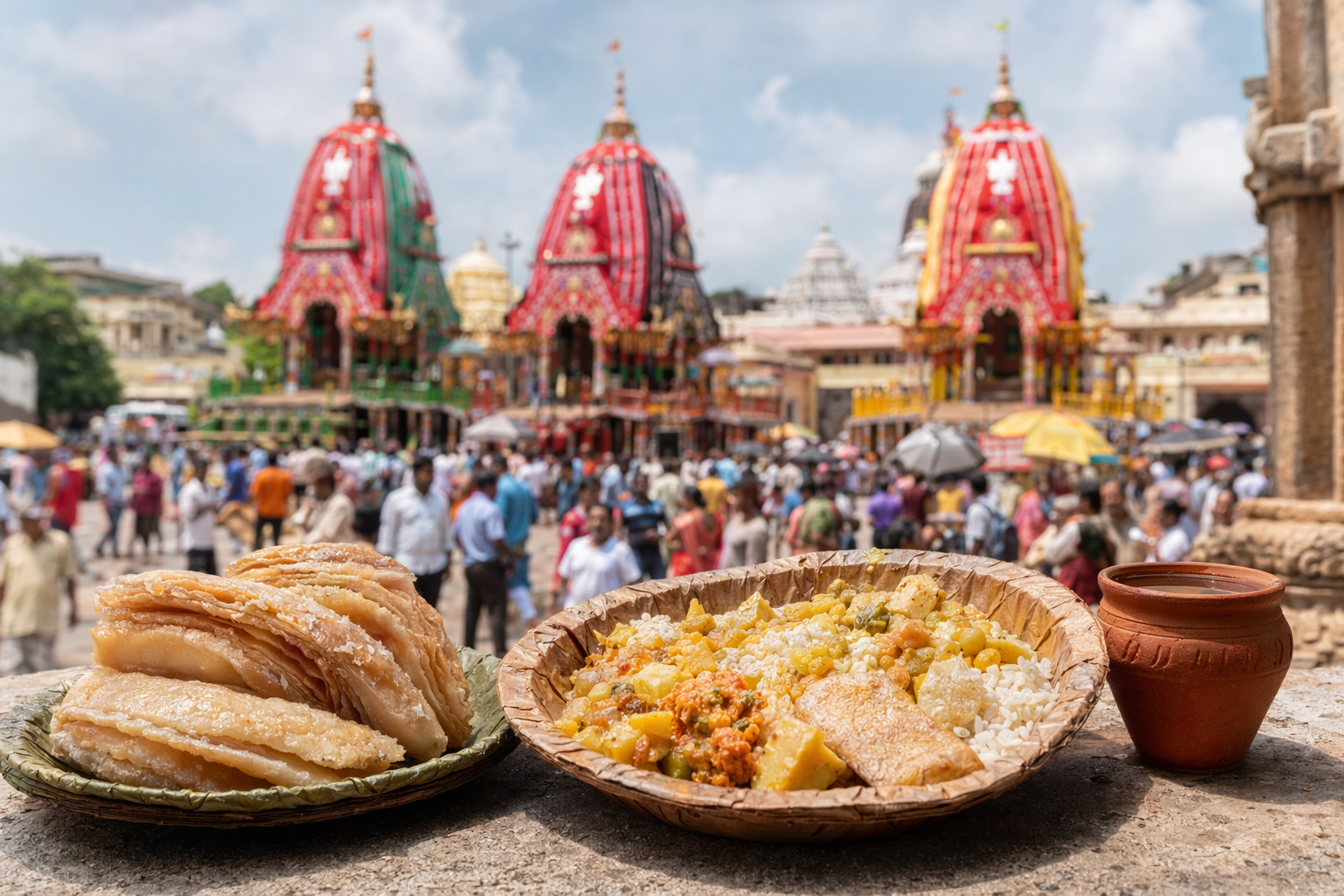
Puri during Rath Yatra is not a normal beach town. It becomes a moving, chanting, sweating, hungry universe. People arrive with bags, kids, grandparents, flowers, coconuts, plastic water bottles, umbrellas, and that look pilgrims get when they’ve travelled far and are ready to be uncomfortable for something they believe in. And somewhere inside all this devotion is food. Khaja stacked like golden folded paper. Mahaprasad eaten sitting shoulder-to-shoulder on the floor. Lemon water sellers shouting through the crowd. Tea in tiny cups. Bananas, puffed rice, curd rice in tiffins, and those emergency packets of glucose biscuits that save lives in a very unglamourous way.
Khaja: the sweet that tastes like temple bells and ghee
#If Puri had an edible souvenir that actually makes sense, it would be khaja. Not fancy chocolate, not some airport-boxed dry cake, but khaja. The first one I ate was from a shop near the Jagannath Temple area, somewhere in that maze of pilgrims, cycle rickshaws, flower sellers and sandalwood smell. It looked simple at first. Layered, pale-golden, slightly rough, like a pastry that had gone through a spiritual bootcamp. Then I bit into it and it shattered. Crisp flakes, sugar syrup, ghee, a little chew in the middle. I made that embarrassing face people make when food surprises them. Like, wait, why is this so good?
Khaja is closely associated with the food offerings around Jagannath culture, and you’ll see it everywhere in Puri, especially during festival time. Some shops sell dry khaja that travels well, some have richer syrupy pieces that are lovely but sticky as anything. I prefer the slightly drier kind because you can carry it back without turning your bag into a sugar crime scene. But if you’re eating it fresh, standing under a tarpaulin while rain threatens and a cow is trying to nose into someone’s prasad bag, go for the syrupy one. Life is short.
- Buy khaja from a busy shop where the trays are moving fast, not from a dusty pile sitting sadly in the corner.
- If you’re carrying it home, ask for the drier khaja and get it packed properly. Puri humidity has no mercy.
- Taste before buying a big box, if the shop allows. Some are beautifully flaky, some are just sweet and hard and frankly, not worth suitcase space.
Mahaprasad is not just food, and you feel that pretty quickly
#The first time I had Mahaprasad in Puri, I didn’t talk much. Which is rare for me, ask anyone who has travelled with me. I was inside the temple complex with a local friend’s family, and we went towards Anand Bazaar, the place where Mahaprasad is sold and eaten. The energy there is impossible to describe neatly. It’s crowded, yes. Chaotic, yes. But there’s also this old rhythm to it. People buying leaf plates, vendors calling out, rice being served, dal, vegetables, khatta, sweets, everything with that temple-food smell of steam, clay pots, ghee, spices, and something earthy.
Mahaprasad at the Jagannath Temple is traditionally cooked in earthen pots in the temple kitchen and offered to the deities before being distributed. People often talk about the Puri temple kitchen as one of the great living temple food traditions of India, and whether you are deeply religious or just deeply hungry, you can feel the seriousness around it. This is not restaurant food. Nobody is plating it for Instagram. There is no garnish placed with tweezers. It is rice and dal and vegetables and sweet things and sour things and it lands in front of you like a blessing, not like a menu item.
I remember sitting on the floor, knees folded badly because I am not as flexible as I pretend to be, eating with my hand from a leaf plate. The rice was softer than I expected, the dal gentle, the vegetable preparations mild but layered. There was a khatta, that sweet-sour thing Odisha does so well, that woke up my whole mouth. And there was this quiet moment where an older man beside me, a total stranger, moved his plate a bit so I had more space. No drama. Just kindness. Sometimes travel memories are not sunsets. Sometimes it’s a stranger making room while you eat temple rice.
A small note if you can’t enter the temple
#The Jagannath Temple has entry restrictions, and not every traveller is allowed inside. This is something you should know before you come, not discover awkwardly at the gate while holding a camera and looking confused. If you can’t enter, you can still experience Puri’s food culture outside the temple area, but be careful with people selling things as “official Mahaprasad” outside. Ask your hotel, a trusted local guide, or someone who actually knows the temple routines. There are genuine ways people help visitors access prasad respectfully, but there’s also plenty of tourist nonsense floating around. Puri is holy, but it is also a busy tourist economy. Both things are true.
Rath Yatra day eating: don’t be brave, be sensible
#Here’s where I sound like someone’s aunty, but I mean it. Rath Yatra day is not the day to prove your digestive courage. The crowd can be enormous, the weather is usually hot and humid because the festival falls around the monsoon season, and once you find a viewing spot, leaving it to hunt for snacks is a whole expedition. I made this mistake once. I ate spicy ghugni, two khajas, tea, and then tried to stand in the crowd for hours. Bad idea. Not disaster bad, but definitely why-did-I-do-this bad.
My rule now is simple. Eat early, eat light, carry safe water, and keep something salty and something sweet in your bag. A banana, roasted chana, plain biscuits, maybe a small packet of ORS if heat gets to you. If you’ve done other crowded yatras, the logic is similar. I wrote down similar notes while reading about mountain and monsoon pilgrimage food habits, and this practical piece on Char Dham Yatra Food in Rain: Pack, Buy, Avoid fits surprisingly well for Puri too, especially the part about rain, stomach comfort and not trusting every tempting roadside thing when your body is already stressed.
- Eat a proper breakfast before entering the thick crowd. Not too oily. Not too experimental.
- Carry a water bottle, but don’t depend only on one bottle if you’ll be out for many hours.
- Avoid cut fruit sitting in open air. I know it looks refreshing. I know watermelon calls to you. Still, no.
- Keep cash in small notes. Digital payments may work in many places, but crowds and network issues are not your friends.
Water, water, water… and then one more bottle
#Water is the least romantic part of this food guide, and probably the most important. Puri in Rath Yatra season can be brutally humid. Even when the sky is cloudy, you sweat like you are personally funding the Bay of Bengal. I used to think I drank enough water while travelling. Puri corrected me. I was standing near Grand Road one afternoon, waiting for a gap in the crowd, and suddenly realised I had a headache, dry mouth and that hollow tired feeling. Nothing dramatic, just dehydration sneaking in like a petty thief.
So, practical stuff. Buy sealed bottled water from busy shops, check the cap, and don’t be shy about drinking regularly. If your hotel has filtered water and you trust it, refill before leaving. During peak crowd hours, water sellers may be around, but reaching them is another matter. I also like carrying ORS sachets or electrolyte tablets. Not as a medical solution for everything, obviously, but for basic heat and sweat days they are useful. Coconut water is lovely when fresh, nimbu pani is tempting, but watch the water and ice situation. If your stomach is sensitive, be boring. Boring travellers enjoy the next day more.
In Puri during Rath Yatra, the best food decision you make might be the one where you don’t eat the sketchy snack and just drink clean water instead. Annoying, but true.
Breakfast before the chariot madness
#My favourite Puri breakfast is not complicated. Hot puri with aloo tarkari, maybe some bara, and tea that is too sweet but somehow exactly right. On Rath Yatra days, though, I try not to overdo the fried stuff. The problem is everything smells fantastic in the morning. Shops open early, steam comes out from giant pots, men are frying things at a speed that feels almost athletic, and you tell yourself, one more won’t hurt. It might hurt. Especially if you are then standing for four hours under a plastic rain poncho that turns you into a human dumpling.
If you’re staying near the beach, you’ll find plenty of breakfast places and hotel kitchens doing basic Indian breakfasts. Around the temple area, it gets more intense and crowded, but the food is often better if you know where to stop. I usually look for places where families are eating, not just tourists. A simple plate of idli can also be a smarter choice than oily snacks, although I say this and then immediately order kachori because I have no discipline. Travel makes hypocrites of us all.
The lanes around the temple are basically a snack map
#Walking around the Jagannath Temple area during festival days is like moving through layers of appetite. First incense, then flowers, then hot oil, then jaggery, then wet earth, then someone carrying a huge pile of khaja boxes tied with string. There are shops selling sweets, chhena poda, rabidi, rasagola, khaja, and namkeen things for people who need salt after all the sugar. Odisha sweets deserve more fame than they get, honestly. Everyone talks about the big names from bigger cities, but Puri quietly feeds you things that stay in your head for months.
Chhena poda is one of those things I always tell people to try if they’re in Odisha. It’s baked cheese, caramelised, slightly smoky if done well, and it has that dense-but-soft texture that makes you slow down. During Rath Yatra, I’m careful with dairy sweets because heat and crowds are not kind to freshness. Buy from a busy, clean-looking shop. Eat it soon. Don’t carry milk sweets around all day in your backpack like a fool. I have been that fool in another city. Never again.
Festival prasad and sweets are emotional purchases, I get it. You want to carry something back for family, neighbours, office people who suddenly become very interested in your travels. But freshness matters. The same common sense applies across Indian festivals, whether you’re carrying modak in Maharashtra or khaja from Puri. This guide on Ganesh Chaturthi Modak & Prasad Travel Safety has useful reminders about dairy sweets, packing, and not letting devotion override basic food safety. We all need that reminder sometimes.
Where I actually ate, and what I’d repeat
#I’m not going to pretend I found some secret hidden place no one knows. Puri is well travelled, especially during Rath Yatra, and most “hidden gems” are hidden only to people who didn’t ask the hotel uncle. But I did have a few meals that felt right. A small bhojanalaya not far from Grand Road where the thali came fast and hot. A sweet shop where khaja was being packed constantly, so I trusted the turnover. A beachside stall where I had tea after rain, with sand stuck to my slippers and my hair doing something tragic. Was it gourmet? No. Did it taste perfect in that moment? Completely.
One afternoon, after the big crowd energy had drained me, I went back to my lodge, washed my face, and came out again just to eat calmly. This is underrated. People try to cram pilgrimage, sightseeing, beach walk, shopping, food hunting, and spiritual awakening all into one day. Don’t. Puri rewards slow wandering. Sit with your tea. Watch the shopkeeper fold newspaper around sweets. Listen to the temple bells from a distance. Eat one khaja now and save one for later, although you probably won’t save it. I never do.
My rough food rhythm in Puri
#Morning was for simple breakfast and tea. Midday, if possible, was for Mahaprasad or a proper Odia meal. Evening was for snacks, sweets, and walking near the beach when the air finally softened a little. I also kept plain food days in between, because festival eating can get heavy. Rice, dal, curd if fresh, bananas, that kind of thing. This sounds boring but it keeps you in the game. A yatra is not a weekend buffet. Your stomach is travelling too, poor thing.
Mahaprasad etiquette, because manners matter
#I get uncomfortable when travellers treat sacred food like content. Photograph first, understand later. In Puri, Mahaprasad has deep religious meaning, and even if you are approaching it as a food traveller, you should be respectful. Ask before taking photos, especially inside or around sensitive temple spaces. Don’t waste food. Don’t bargain aggressively like you’re buying a fake handbag. Sit where people tell you to sit. Use your right hand to eat if that’s the local practice around you. Watch and learn. Honestly, most travel etiquette is just paying attention and not acting like the place exists for your entertainment.
Also, Mahaprasad tastes different when you stop trying to analyse it like a critic. The rice may be softer than restaurant rice. The dal may not punch you with spice. The vegetables may feel simple. That’s the point, or at least part of it. It is food cooked within a ritual system, not a chef’s tasting menu. I loved it more the second time because I stopped expecting restaurant drama and started noticing comfort. Warm rice, earthy pot aroma, gentle spices, that feeling of eating something shared by thousands before you. Hard to explain without sounding overly poetic, but there it is.
Monsoon mood: beautiful, messy, and slightly risky for snacks
#Rath Yatra usually lands in the June-July stretch, based on the Odia calendar, so weather is a major character in the story. Rain can come suddenly. Roads get slippery. Your sandals become questionable. Food stalls cover things with plastic sheets, steam rises from tea kettles, and everything smells ten times more dramatic. I love Puri in that weather. I also don’t fully trust food that has been sitting out through that weather.
During rain, fried snacks can be safe-ish if they are coming straight out of hot oil and being sold quickly. But chutneys, cut onions, watery pani, open salads, and anything dairy-heavy sitting outside for long make me nervous. I know locals may handle it fine. Travellers are different. Our stomachs arrive with opinions. If you’ve done Vaishno Devi or similar temple trips in the rainy season, you’ll recognise the same balance of hunger, devotion and digestion planning. I found this Vaishno Devi Yatra Food in Monsoon: Katra Guide useful in spirit, because pilgrimage food planning is weirdly universal even when the terrain is totally different.
Beach food after temple food, because Puri has two appetites
#One thing I love about Puri is how it has these two food personalities. Near the temple, food feels devotional, old, ritual-heavy. Near the beach, it becomes casual and holiday-ish. Roasted corn, tea, pakoras, seafood restaurants, hotel dining rooms, families eating ice cream even when it’s raining a little. After a day around the chariots and crowds, the beach feels like an exhale. I sat there one evening with tea and a paper plate of hot pakoras, watching kids run from waves like the waves were personally chasing them. My clothes were damp, my feet were sandy, and I had khaja crumbs in my bag. Basically happy.
Seafood in Puri can be good, but during Rath Yatra I choose carefully. Busy restaurant, fresh turnover, no suspicious smell, and I avoid anything too adventurous if I have an early crowd day next morning. There are travellers who can eat crab curry at midnight and wake up like saints. I am not them. I’ll do fish curry with rice on a calmer day, and keep the festival day food more predictable. This is age speaking, maybe. Or fear.
Packing food without packing regret
#For Rath Yatra, my bag is not glamorous. Water bottle, small towel, umbrella or light rain poncho, ORS sachets, hand sanitizer, tissues, a banana if I can manage without squashing it, roasted peanuts or chana, and a small packet of biscuits. I keep sweets separate because khaja crumbs get everywhere. If you buy khaja as prasad or gifts, pack it in a firmer box if you’re travelling by train. Soft packets get crushed under someone’s devotional luggage, and then you have khaja powder. Delicious powder, but still.
Avoid carrying too much. I know the instinct is to prepare for everything, but crowds punish heavy bags. Also, security restrictions and crowd-control rules can change during major festivals, so check local advisories from the temple administration, Odisha tourism updates, railway notices, or your hotel before heading out. Don’t rely on some random old blog comment that says “no problem bro”. Bro will not help you when a barricade is closed.
The taste I brought back
#When I think of Puri Rath Yatra now, I don’t only see the chariots, though they are unforgettable. I taste sugar flakes from khaja stuck to my fingers. I smell steamed rice from Mahaprasad. I remember the sharp relief of clean water after standing too long in humidity. I remember tea in the rain, a stranger making space, a shopkeeper tying boxes with string, and the strange peace that comes after a very crowded, very tiring, very beautiful day.
Food travel is funny like that. You go for the famous thing, the festival, the temple, the big photo moment, and then what stays with you is smaller. A bite. A sip. A warning from a local auntie not to eat that chutney. A shared plate. Puri is not always easy during Rath Yatra. It’s crowded, loud, sticky, and sometimes confusing. But if you go with patience, respect, and a sensible water plan, it feeds you in every possible way. And if you’re collecting more food-yatra stories before your next trip, have a lazy scroll through AllBlogs.in sometime. I do, usually with tea and something crunchy nearby.