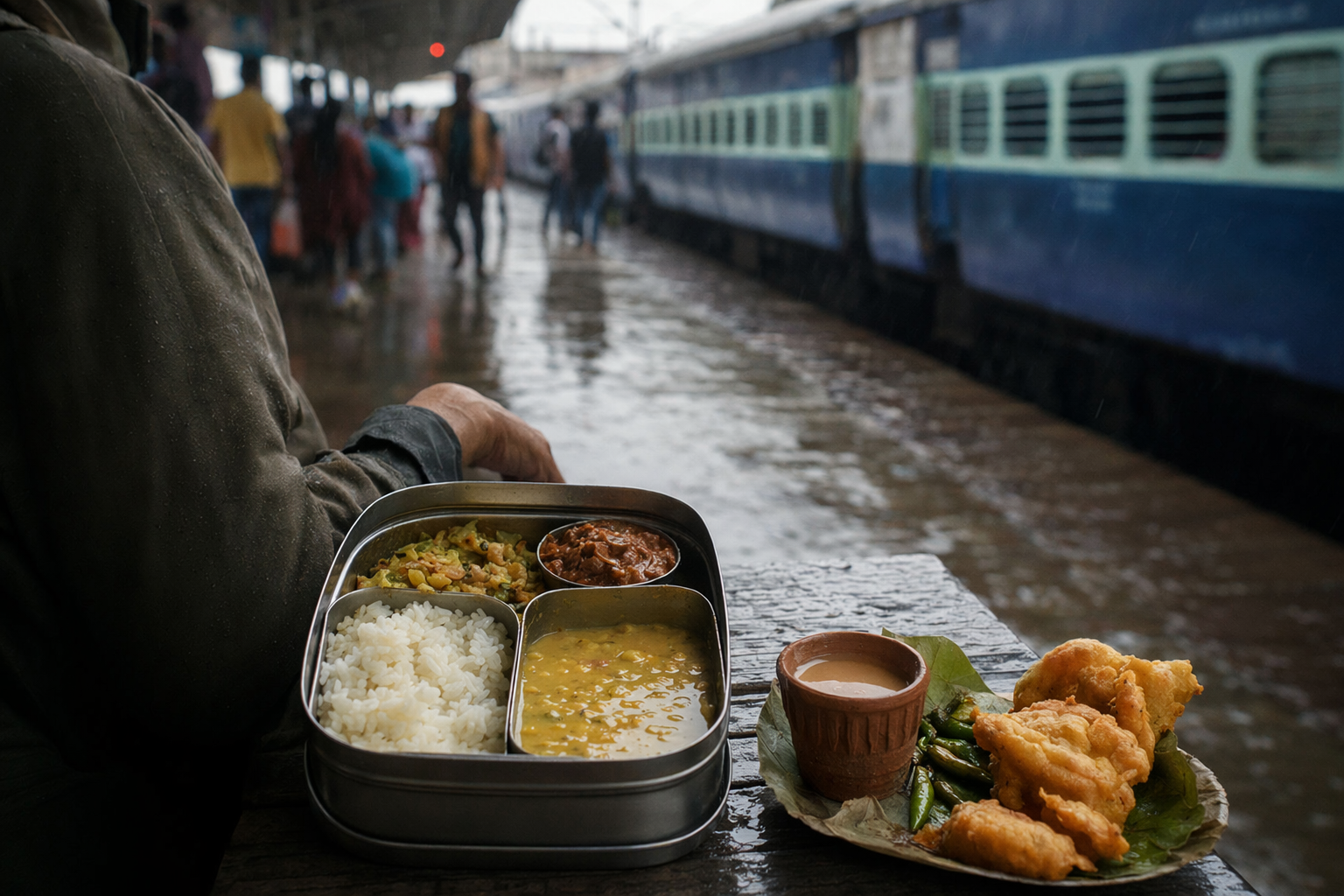
That wet-window feeling, and the first question: pantry or platform?
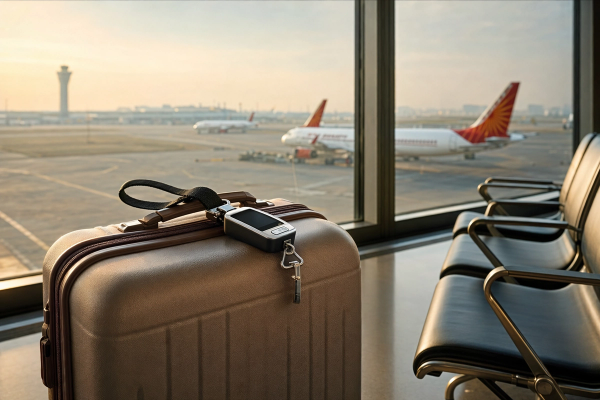
#There’s a very specific smell inside an Indian train during the monsoon. Wet backpacks, steel tiffins, damp newspapers, someone’s hair oil, chai, and that warm metallic smell that comes when the rain has been hitting the tracks for hours. I kind of love it. I also kind of hate it when the train is already three hours late and my stomach starts making those dramatic noises like it has been abandoned in a forest. That’s when the big food question arrives, not politely either: do I trust the rail pantry, or do I jump down at the next station and hunt for platform food?
I’ve asked myself this on the Konkan route with rain slapping the windows sideways, on a Delhi-bound train crawling somewhere past Itarsi, and once outside Kharagpur when the announcement kept saying “shortly” for so long that even the word shortly felt tired. Food and travel are romantic in photos, sure, but monsoon delays make them very practical. You’re not asking “what is the culinary soul of this region?” You’re asking, “will this samosa ruin me before Nagpur?” Still, weirdly, some of my most memorable meals have happened exactly in those messy, delayed, damp moments.
My first serious monsoon delay meal was a pantry thali, and I still have opinions
#Years ago, I was on an overnight train from Mumbai toward Goa in July, which is either a brilliant idea or a completely foolish one depending on how much you enjoy waterfalls appearing out of nowhere. The train slowed down near the ghats, then stopped, then moved like a sleepy buffalo. I had packed exactly one packet of banana chips because I was young and overconfident. By lunchtime, I was staring down the aisle like a wolf.
The pantry guy came through shouting “veg meal, egg meal, biryani!” and honestly I nearly hugged him. I ordered the veg thali. It arrived in one of those foil trays with rice, dal, a sabzi that was mostly potato, curd, pickle, and chapatis that had surrendered to steam. Was it the best thali of my life? No. Was it hot, filling, and delivered to my seat while rain hammered the coach roof like a drummer with anger issues? Absolutely. And that matters.
Pantry food on trains is often judged too harshly by people sitting at home, I feel. On the train, context changes everything. Hot dal when you’re stuck between stations tastes better than fancy dal in an air-conditioned restaurant where nothing has gone wrong. But, and this is a big but, pantry food also has its own problems. Quality can swing wildly. Sometimes rice is clumpy, sometimes curry is oily in that “why is it shining like paint?” way, and sometimes the food arrives lukewarm, which in monsoon weather makes me nervous.
Platform food has drama, personality, and risk... basically all the fun things
#Platform food is where the romance lives. Sorry, pantry fans. A train pulls into a station after hours of staring at rain, and suddenly the whole platform is alive: chai steam, frying oil, vendors weaving between wet passengers, people shouting into phones, kids begging for chips, aunties guarding luggage like border security. That first sip of station chai in the rain can fix your mood so fast it should be studied by scientists.
I’ve eaten vada pav at Mumbai stations when the chutney made my eyes water in the best way, poha at Ratlam that came with sev and a lemon wedge, idli from a stall in Tamil Nadu so soft it felt like the cook had emotional intelligence, and jhal muri near Howrah that tasted like mustard oil, chilli, rain, and pure impatience. Platform food gives you a quick edible postcard from wherever you are passing through. The pantry is the train’s kitchen. The platform is the country leaning into your window saying, “try this, boss.”
But monsoon changes the game. That’s the annoying part. A pakora can look golden and glorious, but if it has been sitting under a damp cloth for two hours, no thanks. Cut fruit during rain? I know it looks refreshing, but I usually avoid it. Chutneys that have been out in the open, uncovered water containers, vendors handling cash and food with the same hand... these things don’t make me feel brave, they make me feel foolish. I’m not saying don’t eat platform food. I am saying choose like someone who wants to enjoy the destination, not inspect every toilet between here and it.
So which is safer during monsoon delays?
#If you want the boring answer, it depends. If you want my train-person answer, I usually prefer hot pantry food when the train is moving slowly and station stops are unpredictable, but I prefer platform food when I can see it being cooked fresh at a busy stall. Not reheated. Not “fresh fresh, madam” with suspicious confidence. Actually fresh. Oil bubbling, idli steaming, chai boiling, dosa coming off the tawa, that kind of fresh.
Monsoon delays create two different problems. Pantry food can run out, get delayed, or arrive less hot than it should. Platform food can be rushed, exposed to moisture, or bought in panic because the train whistle went off and you grabbed the first thing in sight. I’ve done that. I once bought a bread pakora at a small station because everyone else was buying one, which is honestly not a food safety strategy. It was tasty, but halfway through I realized the inside was cold. The regret was instant.
A good rule I follow now: if it is meant to be hot, it should be hot enough that I have to wait a minute. If it is meant to be sealed, the seal better be proper. Bottled water should have an intact cap, no loose ring, no weird refill vibes. Coffee and tea are safest when I see them boiling, not when they come from a mystery flask that has been travelling since the previous government. For more practical checks, I usually point friends to Train Station Food Safety for Travelers: Eat or Avoid, because it gets into exactly those little platform decisions that sound fussy until your stomach is doing tabla at 2 a.m.
| Situation during delay | I usually choose | Why it works better |
|---|---|---|
| Train stopped between stations for ages | Rail pantry or packed food | You cannot depend on the next halt, and jumping down is not an option |
| Long halt at a big station | Fresh platform food | More turnover, more choices, easier to inspect the stall |
| Late night arrival at unknown station | Packaged snacks or pantry tea | Fewer fresh options, sleepy vendors, higher chance of stale stuff |
| Morning stop in South India | Idli, upma, filter coffee if fresh | Steamed foods and busy breakfast stalls are usually a safer bet |
| Heavy rain and waterlogged platform | Avoid exposed foods | Splashing water and open chutneys are not your friend |
The pantry car: underrated, overhated, and sometimes just plain tired
#People talk about pantry food like it is one single thing, but it really isn’t. Some trains have proper pantry cars. Some rely on onboard catering staff. Some passengers order through railway-approved e-catering services at selected stations, though in heavy delays that can get tricky because your train is not where the app hoped it would be. And then there are trains where the “meal” situation is basically a man with a basket and a level of confidence I respect but do not fully trust.
On my trip toward Kerala once, somewhere after Mangalore, the onboard tomato soup saved me. I know, tomato soup in a paper cup is not exactly culinary tourism, but hear me out. It was pouring outside, the coach AC was too cold, my socks were wet from stepping near the door, and that salty, peppery, slightly artificial soup felt like a five-star broth. Food memory is not always about quality. Sometimes it is about rescue.
Still, pantry meals can get repetitive. Rice, dal, sabzi. Rice, dal, sabzi again. Veg biryani that is really pulao wearing perfume. Egg curry if you’re lucky. Chicken curry if you’re lucky and brave. The flavours are usually broad and safe, built for mass feeding, not for seducing your tastebuds. I don’t expect a regional feast from the pantry, though once I had a surprisingly good lemon rice on a train passing through Andhra, and I still talk about it like it was a personal gift.
- What I like about pantry food: it comes to you, it is usually filling, and hot meals feel comforting when rain has ruined the timetable.
- What annoys me: timing can be random, freshness is hard to judge, and sometimes everything tastes like it came from the same giant onion-tomato base.
- What I never do anymore: accept a meal that smells sour, has swollen curd packets, or arrives barely warm and sweaty inside plastic.
Platform food is local food with a train whistle attached
#This is why I keep going back to platform food even after telling myself I’ll be sensible. India’s stations are like tiny food maps. Not perfect maps, not curated food trails, but living, noisy maps. You cross states and the snacks change before the landscape fully does. In Maharashtra, vada pav and batata vada show up like old friends. Around Gujarat, you start seeing thepla packets, dhokla, khakhra, farsan that survives delays better than most relationships. In Bengal, muri mixtures, singara, cutlets, and earthen cup chai have their own rhythm. Down south, idli-vada, lemon rice, curd rice, and filter coffee become the things you start looking for before the train even stops.
One of my favourite monsoon food stops was at a station in coastal Karnataka. I don’t even remember if it was Udupi or somewhere nearby, because the train was late and my brain was mostly rain and hunger. A vendor had banana buns, those slightly sweet, puffy things made with ripe banana and flour, and they were still warm. I bought two, burned my fingers a little, and ate them standing near the coach door while the platform smelled of wet earth and coconut oil. That was not a planned meal. It was better because it wasn’t.
Another time, near Allahabad, now Prayagraj, a delay turned into an accidental kachori breakfast. The kachoris were hot, the sabzi was spicy enough to wake up dead ancestors, and the vendor moved so fast that no one had time to ask unnecessary questions. That’s my kind of stall: busy, hot, focused. I am suspicious of quiet food stalls during delays. If nobody is buying, why am I suddenly the chosen one?
The monsoon changes taste, not just safety
#Rain makes fried food louder. I don’t know how else to explain it. A samosa on a dry April afternoon is fine. A samosa in July, with rainwater dripping from the platform roof and your train delayed by 190 minutes, becomes emotional support. Chai tastes more necessary. Pakoras feel morally correct. Even plain dal-chawal becomes a blanket.
But monsoon also dulls some foods. Bread gets sad quickly. Biscuits go soft if you open the packet and forget. Bananas bruise in your bag. Chutneys spoil faster in humid weather. Curd rice is lovely when fresh, but if it has been sitting too long in a warm coach, I get cautious. I used to pack elaborate food for trains, parathas and chutney and pickle and sweets, then I learned that heavy wet-season travel is not the time for proving your picnic skills. It is the time for smart food.
Now I carry roasted chana, peanuts, thepla if someone at home has made them, small tetra packs of juice, sealed water, maybe a dry fruit mix, and one thing that feels like joy. Usually chocolate, even though it melts and becomes a tragedy. If you’re planning a long rain-season trip, Indian Monsoon Lunchbox for Train & Bus Delays is actually useful because it thinks about spoilage, not just “what sounds yummy in a tiffin,” which is where me and many others go wrong.
The timing problem nobody talks about enough
#During normal train travel, food timing has a rhythm. Morning chai, breakfast station, lunch pantry, evening snacks, dinner before lights-out. During monsoon delays, the rhythm collapses like a wet paper bag. Breakfast becomes lunch. Lunch arrives at 4 p.m. Dinner is either too early because the pantry staff is trying to finish service, or too late because everything is chaos. And suddenly you’re eating spicy biryani at 11:45 p.m. while the family in the next berth is trying to sleep. Glamorous, no?
This is where platform food can be both blessing and trap. If your train reaches a major station at an odd hour, you may find only tea, biscuits, chips, and maybe some tired fried snacks. At dawn, though, you may get lucky. Fresh idlis at a southern junction, poha in central India, bread omelette at a busy north Indian platform, or steaming chai almost anywhere. I’ve learned not to force a heavy meal just because food is available. Sometimes skipping is better than gambling. That’s especially true before arrival, when you’re close enough to a real breakfast outside the station. The whole pack-buy-skip confusion is covered nicely in Indian Night Train Breakfast: Pack, Buy or Skip?, and I wish I’d read something like that before some of my worse decisions.
- If the train is delayed but moving, eat small and steady. Don’t wait until you are starving and irrational.
- If the next halt is a big junction, wait for fresh food rather than buying limp snacks from a random passing vendor.
- If you’re arriving in two hours, maybe just have chai and something dry. Your destination will feed you better.
My personal pantry vs platform scorecard, very unscientific but field-tested
#I don’t pretend to be a food safety expert. I’m just someone who has eaten too many train meals, made a few stupid choices, and learned to read the platform like a menu with weather warnings. When the rain is heavy and delays are long, I mentally score food on three things: heat, turnover, and control. Heat means is it freshly cooked or properly boiling. Turnover means are lots of people buying it, so it is not sitting around. Control means do I have time to choose, pay, and return without sprinting like a film hero.
Pantry wins on control. You stay in your seat, you don’t lose your slipper in platform puddles, and you don’t have to panic when the guard waves the flag. Platform wins on flavour and locality. It gives you food with place attached to it. But safety can go either way. A freshly cooked platform idli is better than a lukewarm pantry curry. A hot pantry dal is better than a mystery cutlet lying under a newspaper. It is not pantry versus platform in some dramatic war. It is hot, fresh, visible food versus tired, damp, suspicious food.
My train food rule is simple: during monsoon, don’t eat anything that looks like it has already survived a journey longer than yours.
Best things I’ve eaten during rain delays
#The best was probably vada pav at Dadar during a delay so bad people had started forming temporary friendships. The vada was hot, the pav was soft but not soggy, the dry garlic chutney was aggressive, and the green chilli made me question my life choices in a good way. I stood under a leaking roof, balancing my bag between my feet, and felt fully alive. Mumbai rain makes vada pav taste like it has a job to do.
Second best: lemon rice from a station stall somewhere in Tamil Nadu, packed in a banana leaf-lined container. It was simple, turmeric-yellow, with peanuts and curry leaves, and it held up beautifully. No drama, no gravy leaking into my bag, no spoon needed because I had one saved from some previous meal like a responsible adult for once. It tasted bright on a grey day.
Third: pantry dal on a northbound train when everything outside was flooded and the train had stopped in the middle of nowhere. Objectively average dal. Emotionally perfect dal. There were four of us sharing achar, papad, and complaints, and the whole coach smelled of dinner. A child across the aisle dropped rice on his blanket, his mother scolded him, then fed him with her hand anyway. That’s train travel. Messy, hungry, tender.
Foods I avoid when the rain is being dramatic
#I know this sounds fussy, but monsoon stomach trouble can destroy a trip. So I avoid cut fruit unless I cut it myself. I avoid watery chutneys that are sitting open. I avoid anything with mayonnaise at stations, because why are we doing mayonnaise in platform humidity, please explain. I avoid lukewarm meat unless it is from a place I really trust and it is clearly fresh. I’m cautious with milk sweets from open trays, especially late in the day. Fresh jalebi? Yes. Mystery peda sweating under flies? Not today.
I also don’t buy water from random sellers if the bottle seal feels off. This is one of those boring grown-up habits that I now take seriously. In the rain, you’re already dealing with damp clothes, delayed trains, maybe missed connections. You don’t need questionable water joining the party. Tea is usually my safer comfort drink because it is boiled, but again, I like seeing it actually hot. Not warm. Hot.
- Good monsoon platform bets: fresh idli, hot poha, boiling chai, roasted peanuts, sealed snacks, fresh pakoras from a busy fryer.
- Risky bets: cut fruit, uncovered chutney, old bread items, lukewarm curries, open sweets, anything that smells even slightly sour.
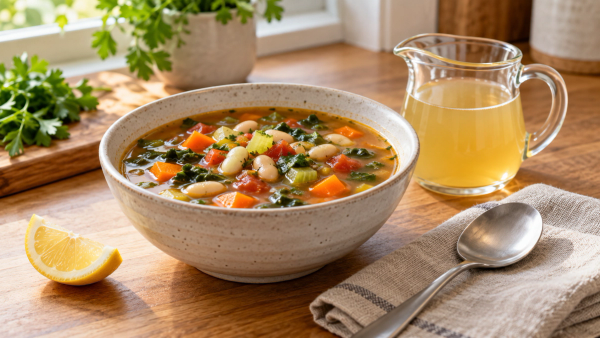
- Pantry bets I accept: hot dal-rice, fresh chapati if available, sealed curd only if it is cool and not swollen, tea or soup served hot.
There’s also the emotional side, which nobody puts on a menu
#Food during delays is not just nutrition. It’s mood management. I’ve seen strangers share thepla with students, someone pass around homemade laddoos because the train had stopped for too long, and one uncle offer his pickle to half the coach like he was running a community kitchen. Pantry food rarely creates that kind of moment, though it does create collective bargaining: “Bhaiya, four veg, two extra rice, one tea, come here first!” Platform food creates adventure. Pantry food creates relief.
And sometimes, honestly, you need both. You eat pantry lunch because it is practical, then at the next long halt you get hot chai and a local snack because your soul needs scenery. I don’t like travel advice that turns everything into strict rules. Food travel is partly about appetite, partly about judgement, and partly about luck. Some of the best things I’ve eaten were not “recommended” anywhere. They were just there, steaming in the rain, and I was hungry enough to notice.
My final verdict, after too many wet platforms
#If you’re travelling in the monsoon and your train is delayed, don’t pick a team blindly. Rail pantry is better when you need predictability, when the train isn’t stopping properly, when you’re tired, or when you want a hot basic meal without leaving your berth. Platform food is better when the station is busy, the food is being made in front of you, and you have enough halt time to choose calmly. The worst choice is panic food. I have eaten panic food. Panic food tastes like regret with chilli powder.
Carry backup snacks, watch for heat and freshness, be suspicious but not joyless, and let the journey feed you a little. Because that’s the thing about Indian train travel in the rains: it tests your patience, wets your shoes, delays your plans, and then hands you a cup of chai at exactly the right moment. And suddenly you forgive it. Mostly.
I still chase those meals, the unplanned ones between stations and storms. A pantry thali on a slow train, a vada pav under a leaking platform roof, idli at dawn with fogged-up glasses, lemon rice eaten from my lap while the coach rocks gently. That’s food travel to me. Not always pretty, not always safe if you’re careless, but full of flavour and stories. If you like these slightly messy food-and-journey thoughts, you’ll probably enjoy wandering through more travel bites and train-food stories on AllBlogs.in.