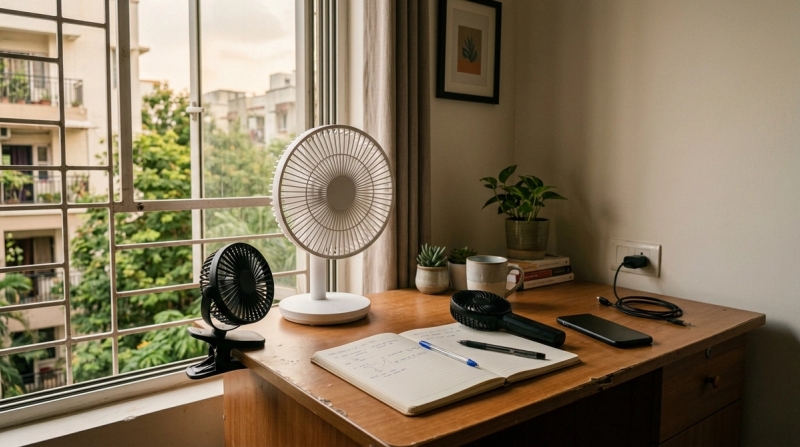
If you’re buying a rechargeable fan mainly for power cuts at home, go for a rechargeable table fan. It is the most practical option for bedrooms, study desks, kitchens and small rooms.
If you live in a hostel, use a bunk bed, or have almost no space on your desk, a clip fan will probably suit you better. For travel, buses, trains, queues, markets and quick face cooling, a handheld fan is the easiest to carry. A neck fan is useful only if you really want hands-free airflow while walking.
So, the short version is simple:
- Home power cuts: Rechargeable table fan
- Hostel or tight spaces: Clip fan
- Travel and commute: Handheld fan
- Walking outdoors hands-free: Neck fan
For most Indian homes, a rechargeable table fan should be the first choice. For daily commuting, a handheld fan is more useful.
Quick Summary: Which Rechargeable Fan Should You Buy?
#- Rechargeable table fan: Best for bedrooms, kitchens, study corners and short power cuts. It gives wider airflow and stable placement, but is not convenient to carry outside.
- Clip fan: Best for hostel beds, small desks, shelves and baby strollers when placed safely. It saves space and can be angled easily, but needs a proper edge to grip.
- Handheld fan: Best for commutes, queues, travel and quick heat relief. It gives direct airflow on your face, but you have to hold it.
- Neck fan: Best for walking, sightseeing and hands-free outdoor use. It keeps your hands free, but airflow is usually not very strong.
Simple rule: Buy a table fan for home, a clip fan for tight spaces, a handheld fan for outdoor heat, and a neck fan only if hands-free use matters.
Why a Rechargeable Fan Is So Useful in Indian Summers
#Power cuts in India are unpredictable. Sometimes the electricity goes for 15 minutes. Sometimes it goes for two hours. And sometimes the inverter is already busy running lights, Wi-Fi, charging points and basic appliances.
In hot and humid weather, even a short power cut can make a room feel uncomfortable very quickly. That’s where a USB rechargeable fan helps.
Of course, it is not an AC. It will not cool the whole room. But it keeps air moving near your bed, desk, kitchen counter or face when the ceiling fan stops. And during peak summer, that little bit of air can feel like a blessing.
The common mistake is buying only by looks. A tiny fan may look cute online, but may not help much during an actual power cut. A big rechargeable fan may work well at home, but you won’t want to carry it outside. A clip fan may be perfect for a hostel bed, but useless if there is no proper edge to attach it to.
So before buying, first ask yourself one question:
Where will I use this fan the most?
That answer will make the decision much easier.
Rechargeable Table Fan: Best for Home Power Cuts
#A rechargeable table fan is like a small desk fan with a built-in battery. You can keep it on a bedside table, study desk, stool, kitchen counter or office table.
Compared to handheld and neck fans, it gives wider and steadier airflow. You can place it somewhere and let it run without holding it.
If your main problem is power cuts at home, this is usually the best option.
Who should buy a rechargeable table fan?
#Buy this if you need a fan for:
- Sleeping during short power cuts
- Study tables or work desks
- Kitchen use during hot afternoons
- Small rooms, rented flats or hostel rooms
- Elderly family members who need steady airflow nearby
- Anyone who wants to place the fan and leave it running
A table fan is also easier to share. One person can use it while sleeping, and two people sitting close together may also get some air.
Who should avoid it?
#Avoid a rechargeable table fan if:
- You want something for daily travel
- You need a fan that fits inside a small handbag
- Your main use is walking outdoors
- You do not have a stable place to keep it
Even compact table fans take up some space. They are portable inside the house, but they are not pocket-friendly.
Best use case
#Keep it near your bed, study table or kitchen counter before the power cut starts. If power cuts are common in your area, charge it during the day. Don’t wait for the ceiling fan to stop and then start looking for it.
Clip Fan: Best for Hostels, Bunk Beds and Tiny Desks
#The clip fan vs table fan decision mostly comes down to space.
A clip fan has a clamp instead of a flat base. You attach it to the edge of a table, shelf, bed frame, bunk bed, stroller handle or any similar surface.
This makes it very useful when you don’t have free space to keep a normal fan.
Who should buy a clip fan?
#Buy a clip fan if you need cooling for:
- Hostel bunk beds
- Study tables with very little space
- Small work-from-home desks
- Shelves near the bed
- Baby strollers, but only if placed safely
- Shared rooms where table and floor space is limited
A clip fan is also good when you want airflow from a particular angle. You can fix it above desk level, near your pillow, or on the side of a shelf.
Who should avoid it?
#Avoid a clip fan if:
- You do not have a firm edge to attach it to
- Your table edge is too thick, rounded or slippery
- You want to move the fan around the room often
- You need broad airflow while sleeping
A clip fan is only as good as its clamp. If the grip is weak, or the surface is not right, it becomes annoying very quickly.
Best use case
#For hostel students, a clip fan can be better than a table fan because it does not take up desk space. For bunk beds, it is one of the most practical rechargeable fan options.
Handheld Fan: Best for Travel, Commutes and Quick Heat Relief
#A handheld fan for power cuts can be useful at home, but it is even better outside.
This is the fan you carry while waiting for a bus, standing in a queue, walking from the metro station, sitting in a local train, travelling in an auto, or dealing with a sweaty commute.
Handheld fans give direct airflow to one area, usually your face and neck. Because the fan is so close, it can feel quite powerful even though it cannot cool a room.
Who should buy a handheld fan?
#Buy a handheld fan if you need:
- Quick face cooling
- Something for travel and daily commute
- A small fan for handbags or backpacks
- Cooling during outdoor events
- Backup comfort during short power cuts
- A fan you can point exactly where you want
For people who sweat a lot while travelling, a handheld fan may be more useful than a bigger fan kept at home.
Who should avoid it?
#Avoid a handheld fan if:
- You want to sleep while using it
- You need both hands free
- You want airflow for more than one person
- You need cooling while typing, cooking or working for a long time
The problem is simple: you have to hold it. That is fine while travelling, but not great for a long study session, office work or sleeping.
Best use case
#Carry it fully charged during summer travel. It is very useful at crowded stations, bus stops, markets, railway platforms, outdoor queues and public events.
Neck Fan: Best Only When Hands-Free Use Matters
#A neck fan sits around your neck and blows air upwards towards your face and neck. It is useful when you are walking, carrying bags, sightseeing, clicking photos or doing something where holding a fan feels inconvenient.
But it is usually not the strongest option. If you are sitting in a hot room during a power cut, a table fan or handheld fan will generally feel better.
Who should buy a neck fan?
#Buy a neck fan if you need:
- Hands-free airflow while walking
- Cooling during travel days
- Something for sightseeing or outdoor movement
- A fan you can use while carrying bags
Who should avoid it?
#Avoid a neck fan if:
- You want strong, direct airflow
- You mostly sit at a desk or on a bed
- You do not like wearing gadgets around your neck
- You need a fan for sleeping or sharing
Best use case
#Use it when you are moving around in hot weather and cannot keep holding a fan. For pure cooling power, a handheld fan is usually better.
Comparison: Rechargeable Table Fan vs Clip Fan vs Handheld Fan vs Neck Fan
#- Rechargeable table fan: Best at home, desk, bedside or kitchen. Offers wider, steadier airflow, works hands-free and is the best sleeping option, but is poor for commuting.
- Clip fan: Best for bunk beds, shelves and tight desks. Saves space and works hands-free after clipping, but depends heavily on grip and surface shape.
- Handheld fan: Best for travel, commute and outdoor use. Gives strong direct air at close range, but is not hands-free and is not useful for sleeping.
- Neck fan: Best for walking and sightseeing. Works hands-free, but airflow is usually gentler and it is not ideal for power-cut sleep.
What to Check Before Buying a USB Rechargeable Fan
#A good portable fan buying guide for India should not just say, “Buy something small and rechargeable.” The small details matter, especially if you are buying the fan for real power cuts.
1. Choose the fan type first
#Don’t start only with battery capacity. First decide the fan style.
- For home power cuts, choose a table fan
- For hostel beds and tight desks, choose a clip fan
- For travel, choose a handheld fan
- For hands-free walking, choose a neck fan
Once the type is right, then compare battery, charging, size and other features.
2. Check battery capacity and runtime
#Brands often mention long runtime, but that is usually on the lowest speed. In real life, most people use medium or high speed during Indian summers.
Check:
- Battery capacity, if mentioned
- Runtime at different speed levels
- Charging time
- Whether the fan can be used while plugged in
Be realistic. A fan running on high speed will drain much faster than the headline claim.
3. Look at the charging port
#A USB rechargeable fan is easier to use if it has a common charging cable. USB Type-C is more convenient if your phone, earbuds and power bank already use it.
Try to avoid fans that need a very specific cable, unless you are good at keeping cables safe. Many of us are not.
4. Check build quality
#Look carefully at:
- Grill strength
- Blade protection
- Hinge or neck movement
- Clip grip, if it is a clip fan
- Base stability, if it is a table fan
- Button quality
- Plastic thickness
Portable fans get moved around a lot. Weak hinges, loose grills and poor clips become irritating after a few days.
5. Don’t ignore noise level
#For bedroom, office and hostel use, noise matters. A fan may sound okay for five minutes, but the same sound can irritate you at night.
If the brand mentions noise level, check it. If not, read user reviews carefully. Don’t rely only on star ratings. Look for comments about sleep, study and office use.
6. See if it is easy to clean
#Dust builds up quickly in Indian homes, especially near windows, roads and kitchens. A removable or easy-to-clean front grill is useful.
If the grill cannot be opened at all, cleaning the blades can become difficult.
7. Check safety and warranty
#For battery-powered products, avoid unknown models with no proper seller details, no warranty information and no clear safety details.
If certification or compliance information is listed, check it. Also check the return policy before ordering.
Step-by-Step Buying Checklist
#Use this checklist before buying any rechargeable fan for power cuts.
Step 1: Decide your main use
#Ask yourself where you will use the fan the most:
- Bedside during power cuts
- Study desk
- Hostel bunk
- Kitchen
- Office desk
- Commute
- Travel
- Outdoor walking
Don’t buy one fan expecting it to be perfect everywhere. It usually won’t be.
Step 2: Pick the right fan type
#- Mostly home use: rechargeable table fan
- No table space: clip fan
- Travel and commute: handheld fan
- Hands-free walking: neck fan
Step 3: Check size and placement
#For table fans, check if you have space near your bed or desk.
For clip fans, check if your table, shelf or bed frame has a proper edge.
For handheld fans, check whether it fits your bag.
For neck fans, check if you are comfortable wearing something around your neck.
Step 4: Read runtime details carefully
#Do not trust only “up to” claims. See if the brand mentions runtime by speed level. If not, assume the longest claim is for the lowest speed only.
Step 5: Check charging convenience
#See whether the fan uses a common USB cable. Also check whether the cable is included and whether you can charge it easily with your existing charger or power bank.
Step 6: Read noise and airflow reviews
#Ignore vague reviews like “nice product.” Look for comments that mention:
- Sleep use
- Study use
- Power cut use
- Fan noise
- Battery backup
- Air throw
- Charging issues
These reviews are much more useful than one-line ratings.
Step 7: Check cleaning and durability
#Look for a strong grill, stable stand or firm clip. If you live in a dusty area, easy cleaning should be a priority.
Step 8: Confirm return and warranty terms
#Rechargeable fans have batteries, motors and moving parts. A clear return window and warranty support matter more than saving a small amount.
Common Mistakes to Avoid
#1. Buying the smallest fan for a bedroom
#A tiny handheld fan cannot replace a bedside fan. If you want to sleep during power cuts, buy a rechargeable table fan or a well-placed clip fan.
2. Buying a clip fan without checking the surface
#Clip fans need a suitable edge. If your desk is too thick, rounded or slippery, the fan may not stay stable.
3. Expecting a portable fan to cool the room
#A rechargeable fan moves air. It does not reduce room temperature like an AC.
In a closed and overheated room, it will still move warm air. Ventilation helps a lot.
4. Trusting only the highest runtime claim
#Long runtime is usually at low speed. During Indian summer, you may use higher speed often, so the actual backup can be much lower.
5. Ignoring noise
#For travel, noise may not matter much. For sleeping, studying or office calls, it matters more than you think.
6. Leaving it unused and uncharged for weeks
#If you bought it for emergencies, keep it charged enough. A fan stored away with no charge may disappoint you exactly when the power goes out.
7. Buying only because it looks stylish
#Some fans look premium in photos but have weak airflow, bad clips or noisy motors. Match the design with actual use, not just looks.
Which One Should You Buy?
#If you are still confused, use this quick decision guide.
Buy a rechargeable table fan if:
#You want the most practical fan for Indian power cuts at home. This is the best choice for bedrooms, study tables, kitchens and small apartments.
Buy a clip fan if:
#You live in a hostel, sleep on a bunk bed, work on a cramped desk or need airflow from a specific angle without losing surface space.
Buy a handheld fan if:
#You travel daily, sweat during commutes, stand in queues often or want instant face cooling outdoors.
Buy a neck fan if:
#You walk a lot in hot weather and want hands-free airflow. It is convenient, but not the strongest option for sitting in one place.
For most Indian families, a rechargeable table fan should be the first buy. A handheld fan is a useful second fan for travel. A clip fan is smart for students and small rooms. A neck fan is more of a travel comfort gadget, not a proper power-cut solution for home.
Final Takeaway
#For Indian power cuts, start with a rechargeable table fan unless your room is too small or your main use is travel. A clip fan solves tight-space problems, a handheld fan helps during commutes, and a neck fan is useful only when hands-free cooling matters more than strong airflow.