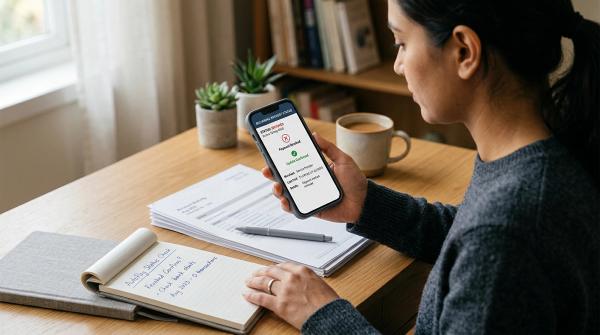

Quick answer: If a merchant says your refund is processed but the money has not reached your account, don’t panic. First, collect written proof from the merchant. Then ask for the correct tracking reference: ARN for card refunds, RRN for UPI refunds, and UTR for bank transfer refunds. Share that number with your bank, card issuer, or payment app through their official complaint channel. If the issue still remains unresolved, escalate only through official NPCI or RBI routes.
A refund that is “processed” but not credited can be really annoying.
The merchant says, “We have already refunded it.”Your bank says, “We can’t see anything.”You keep checking your statement, but the money is still missing.
This situation is common with online orders, cancelled bookings, UPI payments, debit card payments, and credit card refunds. The good news is that a missing refund is not always lost money. In many cases, the refund has left the merchant’s side but has not yet been posted by the bank or payment network.
The key is to stop chasing vague answers and start asking for the right reference number.
This guide explains what to do when your refund is processed but not credited, how to use ARN, RRN and UTR, and how to raise a proper bank complaint without falling for fake refund scams.
What does “refund processed” actually mean?
#When a merchant says your refund is processed, it usually means they have initiated or completed the refund from their side.
But that does not always mean the money has already reached your bank account, debit card account, credit card statement, or UPI-linked account.
A refund may pass through several systems before you see it:
- Merchant system
- Payment gateway
- Acquiring bank
- Card network or UPI system
- Your bank or card issuer
- Your final account or card statement
So the merchant may genuinely say, “Refund done,” while your bank may still say, “Refund not received.”
That gap is exactly why you need a proper payment reference number. A merchant order ID alone is often not enough for the bank to trace the refund.
Depending on how you paid, you should ask for:
- ARN for debit card or credit card refunds
- RRN for UPI refunds
- UTR for bank transfer refunds
ARN, RRN and UTR: what are they?
#ARN: for card refunds
#ARN stands for Acquirer Reference Number.
It is commonly used to trace debit card and credit card refunds, especially on card-network payments. If your card refund is not credited, the ARN can help your card-issuing bank locate the refund inside the payment network.
Think of ARN as an internal banking tracking number. It is not like a courier tracking link where you can enter the number and see live updates yourself. Usually, you need to give the ARN to your bank or credit card issuer, and they trace it from their side.
Ask for ARN if:
- You paid by debit card
- You paid by credit card
- The merchant says the card refund has been processed
- Your card refund is still not showing in your account or statement
RRN: for UPI refunds
#RRN stands for Retrieval Reference Number.
It is commonly used for UPI transactions and disputes. If your UPI refund is not received, the RRN helps your bank, UPI app, and NPCI identify the exact transaction.
Ask for RRN if:
- You paid through UPI
- Money was debited but the transaction failed
- The merchant says the UPI refund is done
- Your UPI-linked bank account has not received the money
- Your payment app shows a transaction reference or retrieval reference
UTR: for bank transfer refunds
#UTR stands for Unique Transaction Reference.
It is usually used for bank transfers such as NEFT or RTGS. Sometimes, instead of reversing the payment to the original method, a merchant may send the refund directly to your bank account. In that case, they may share a UTR.
Ask for UTR if:
- The merchant says the refund was sent by bank transfer
- The refund did not go back to your card or UPI account
- Your bank asks for a bank transfer reference number
- The merchant claims the money has already been transferred to your account
Quick guide: which reference number do you need?
#The simple rule is this:
If the bank cannot trace your refund using the merchant order ID, ask the merchant for the ARN, RRN or UTR.
Step-by-step checklist if your refund is processed but not credited
#Step 1: Collect proof from the merchant
#Before raising a complaint, collect all the basic details. This saves time and makes your case much stronger.
Keep these ready:
- Screenshot showing “refund processed,” “refund successful,” or similar status
- Original payment date
- Refund processed date
- Exact refund amount
- Merchant order ID
- Merchant refund ID, if available
- Payment method used: UPI, debit card, credit card, wallet, or bank transfer
- Merchant support ticket ID, if any
- Email or SMS confirming the refund
- Bank or card statement showing the refund has not been credited
Do not rely only on phone conversations. Try to get confirmation in writing through email, chat, ticket, or app support.
Step 2: Ask the merchant for ARN, RRN or UTR
#Once the merchant confirms the refund, ask for the tracking reference.
You can simply write:
Please share the ARN for this card refund. If it was processed through UPI or bank transfer, please share the RRN or UTR. My bank needs the reference number to trace the refund.
Ask for:
- ARN if you paid by debit card or credit card
- RRN if you paid by UPI
- UTR if the refund was sent by bank transfer
- Refund date
- Refund amount
- Merchant refund ID
- Payment gateway refund ID, if available
- Last four digits of the card or masked account details, if available
If the merchant does not share a reference number, ask them to confirm in writing that the refund has been processed and mention the route used for the refund.
Step 3: Check the correct account or statement
#This sounds obvious, but it is a very common source of confusion.
For UPI refunds, check the bank account that was linked to the UPI ID at the time of payment. If you later changed your primary UPI bank account, the refund may still go back to the old account.
For debit card refunds, check the bank account linked to that debit card.
For credit card refunds, check your credit card statement, unbilled transactions, recent credits, and outstanding balance. A credit card refund may reduce your bill instead of appearing as money in your savings account.
For cancelled transactions, check whether the original debit was reversed instead of a new refund entry appearing. Sometimes the transaction is adjusted in the final statement.
Step 4: Raise one official complaint with your bank or app
#Now raise a complaint through the proper channel.
Use only official options such as:
- Your bank’s mobile app
- Your bank’s net banking website
- Your card issuer’s app or website
- Your UPI app’s in-app help section
- Your payment app’s official support section
- Your bank branch, if you prefer offline support
Avoid:
- Random customer care numbers from Google search results
- Numbers posted in social media comments
- WhatsApp “refund support” numbers
- Screen-sharing apps
- Anyone asking for OTP, UPI PIN, CVV, card PIN, or password
- Unofficial complaint forms
If you are stressed and typing something like “bank refund complaint number” into search engines, slow down. Scammers often create fake helpline pages for exactly this situation.
In your complaint, clearly mention:
- Refund processed but not credited
- Payment method used
- ARN, RRN or UTR
- Original transaction date
- Refund processed date
- Exact amount
- Merchant name
- Merchant order ID
- Merchant refund ID, if available
- Screenshots from merchant
- Bank or card statement showing non-credit
Once the bank, card issuer, or app gives you a complaint ID, save it carefully. You may need it for escalation.
Step 5: For UPI refunds, use NPCI routes where applicable
#If the issue is related to UPI, your first complaint should usually be with your UPI app or bank. However, NPCI also provides official complaint and status-checking options for UPI-related issues where applicable.
Keep these details ready:
- UPI transaction ID
- RRN number
- Transaction date and time
- Amount
- Payer bank
- Payee details, if visible
- Complaint ID from your app or bank
Use only NPCI’s official website or the official help section of your bank or UPI app. Do not trust “NPCI helpline” numbers shared in comments, ads, or forwarded messages.
Step 6: Escalate to RBI if the bank does not resolve it
#If your bank or card issuer does not resolve the issue within the applicable grievance timeline, or if you receive an unsatisfactory response, you can escalate through RBI’s official complaint system.
This may include the RBI Complaint Management System (CMS) under the RBI Integrated Ombudsman Scheme.
Before escalating, keep these ready:
- Bank complaint ID
- Date of complaint
- Bank’s written response, if any
- Merchant refund proof
- ARN, RRN or UTR
- Account or card statement showing non-credit
- Transaction amount and date
- Merchant order ID and refund ID
RBI has rules around Turn Around Time and customer compensation for certain failed transactions in authorised payment systems. However, not every delayed merchant refund automatically qualifies for compensation. A failed UPI/card transaction and a normal product return refund may be treated differently.
If you are unsure, explain the facts clearly in your complaint and let the official channel decide how it should be classified.
What not to do when your refund is missing
#Missing refunds are a favourite trap for scammers because people are already worried and impatient.
Do not:
- Call random refund helpline numbers found online
- Trust phone numbers posted in social media replies
- Share OTP, UPI PIN, CVV, card PIN, password, or full card details
- Install remote access or screen-sharing apps
- Approve a UPI collect request to “receive” a refund
- Pay a “processing fee” to get your refund
- File multiple complaints with different information
- Delete transaction history or merchant chats
- Close the complaint before the refund actually appears
Remember this clearly:
You do not need to enter your UPI PIN to receive a refund. Your UPI PIN is used to send money, not receive money.
Sample complaint text for missing refund
#You can copy and edit this for your bank, card issuer, or payment app complaint:
I made a payment of ₹[amount] to [merchant name] on [date] using [UPI/debit card/credit card]. The merchant has marked the refund as processed on [refund date], but the amount has not been credited to my [bank account/card statement].Merchant order ID: [ID]Refund ID: [ID, if available]ARN/RRN/UTR: [number]Payment method: [details]Amount: ₹[amount]I am attaching merchant proof and my account/card statement showing that the refund has not been credited. Please trace the refund and provide a written update with a complaint reference number.
Keep the complaint simple and factual. Do not guess where the money is stuck.
When the merchant and bank blame each other
#This is very common.
The merchant says:
Refund has been processed from our side.
The bank says:
We have not received the refund.
That does not always mean one of them is lying. They may be looking at different stages of the refund journey.
Your job is to connect the two sides with proper proof:
- Merchant proof shows the refund was processed
- ARN, RRN or UTR helps the bank trace it
- Bank complaint ID creates an official record
- NPCI or RBI escalation can be used later if needed
The more organised your complaint is, the easier it becomes for the bank or payment app to investigate.
Official source checks used for this guide
#This guide was written with source-aware checks against RBI failed-transaction TAT guidance, NPCI UPI complaint-status guidance, and card-network refund tracing guidance explaining how ARN can help banks trace missing card refunds. Always use the latest official bank, NPCI, RBI, card issuer, or merchant communication for your exact case.
Final checklist before escalating
#Before you escalate the issue, make sure you have:
- Merchant refund proof
- Original transaction screenshot or statement
- Refund processed date
- Exact refund amount
- ARN for card refund
- RRN for UPI refund
- UTR for bank transfer refund
- Bank, card issuer, or payment app complaint ID
- Statement showing refund not credited
- Written response from bank or merchant, if available
A missing refund becomes much easier to trace when your complaint is clear, complete, and filed through official channels. Stay calm, keep the proof, avoid random helplines, and don’t close the matter until the money is actually visible in your account or card statement.
General education disclaimer: This article is for general educational information only. It is not legal, financial, tax, investment, loan, or banking advice. Payment rules, complaint processes, and official timelines may change. Always rely on official communication from your bank, payment app, NPCI, RBI, card issuer, or merchant for your specific case.