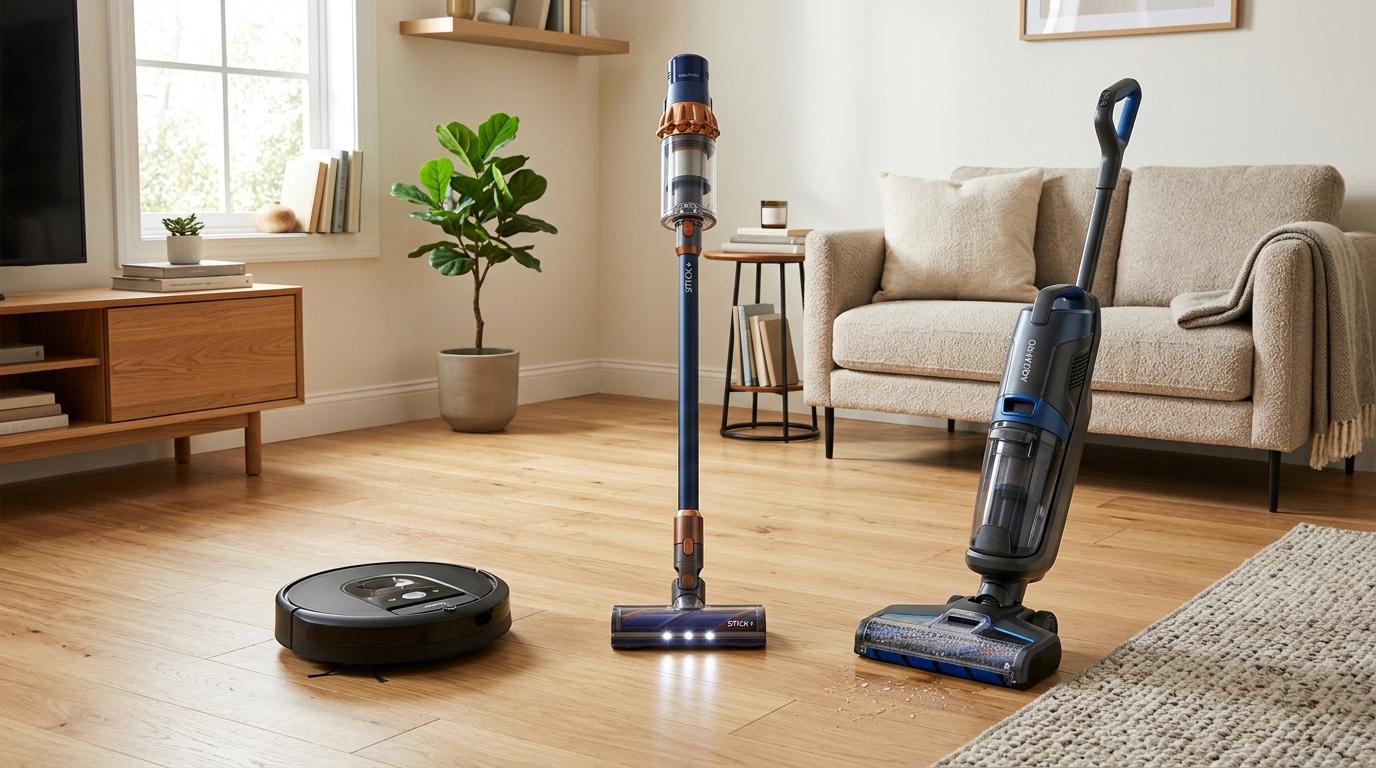
If you live in a small apartment and only want to buy one cleaning tool, a cordless stick vacuum is usually the safest bet.
It’s easy to grab, easy to store, and useful for more than just floors. You can use it on rugs, corners, sofa cushions, shelves, under furniture, and those random crumbs that somehow appear five minutes after you cleaned.
A robot vacuum is great if your floors stay fairly clear and you want regular cleaning with very little effort. A wet-dry vacuum makes more sense if your apartment is mostly hard flooring and you’re constantly dealing with spills, muddy shoes, pet paw prints, or sticky kitchen messes.
Category: Smart Buying & Reviews
The Short Answer
#Choose a cordless stick vacuum if:You want one flexible cleaner for floors, rugs, furniture, corners, shelves, and quick everyday messes.
Choose a robot vacuum if:Your apartment has an open layout, your floors aren’t usually cluttered, and you want cleaning to happen with minimal effort.
Choose a wet-dry vacuum if:Your apartment is mostly tile, laminate, sealed wood, or other hard flooring, and you want to vacuum and mop at the same time.
Still unsure?Start with a cordless stick vacuum. For most small apartments, it’s the most practical “only vacuum” to own.
Who This Guide Is For
#This guide is for anyone living in a studio, dorm room, rental, compact one-bedroom, shared flat, or small home where storage space is limited and every appliance needs to justify its existence.
Cleaning a small apartment is its own thing. You probably don’t want three machines, a bulky dock, spare mop pads, water tanks, filters, attachments, and charging cables taking over the one empty corner you have.
You’re not looking for the biggest vacuum on the market. You’re looking for the best vacuum for small apartment living — something that fits your floors, your storage, your habits, and your patience.
We’ll compare:
- A cordless stick vacuum
- A robot vacuum for apartments
- A wet-dry vacuum for small apartment hard floors
The goal is simple: choose the one you’ll actually use.
What to Think About Before Buying
#Before you get too deep into the robot vacuum vs cordless vacuum debate, take an honest look at your apartment.
Not the cleaned-up version you imagine when you’re shopping online. The real version. The one with a charging cable near the bed, shoes by the door, a chair that’s always slightly in the way, and maybe a rug that never lies completely flat.
1. Your floor type
#Your floors matter more than most fancy features.
- Mostly carpet or rugs: A cordless stick vacuum is usually the better choice.
- Mostly hard floors: A cordless stick vacuum or wet-dry vacuum can both work well.
- Hard floors with frequent spills: A wet-dry vacuum becomes much more useful.
- Low-pile rugs and open hard floors: A robot vacuum can be very convenient.
- Thick rugs or uneven thresholds: Some robot vacuums may struggle or get stuck.
Wet-dry vacuums are not designed for deep cleaning plush carpet. Robot vacuums can handle basic floor maintenance, but their performance depends heavily on rug height, thresholds, furniture clearance, and clutter.
2. Storage space
#In a small apartment, even a “compact” appliance can feel huge once it’s sitting in your room every day.
Ask yourself:
- Can it stand behind a door?
- Does it need to be wall-mounted?
- How big is the charging dock?
- Will the dock have to live in your bedroom or living room?
- Where will you put attachments, mop pads, filters, or tanks?
- Does anything need space to dry after use?
A slim cordless stick vacuum is usually the easiest to store. Robot vacuums can be compact, but models with auto-empty docks or mop-washing stations can take up more floor space than expected. Wet-dry vacuums may not be massive, but they do need room for storage, rinsing, and drying.
3. Clutter and layout
#Robot vacuums are happiest when your floor is ready for them.
If your apartment often has:
- Charging cables on the floor
- Shoes near the entrance
- Clothes, bags, or pet toys lying around
- Low furniture
- Narrow chair legs
- Small rugs or mats that shift around
A robot vacuum may need more rescuing than you’d like. In that case, a cordless stick vacuum can actually be faster because you’re in control. You can clean around things instead of preparing the room first.
4. Noise
#Noise matters more in apartments than it does in houses. Shared walls, downstairs neighbors, roommates, babies, pets, dorm rules — all of that changes how annoying a vacuum can be.
In general:
- Cordless stick vacuums can be loud, but cleaning sessions are usually short.
- Robot vacuums may sound less intense, but they run for longer.
- Robot self-empty docks can be surprisingly loud for a few seconds.
- Wet-dry vacuums often sound heavier because they’re moving water and debris.
If noise is a concern, look for adjustable suction settings and try to clean during normal daytime hours. Your neighbors may never thank you, but they’ll probably appreciate it.
5. Maintenance
#This is the part people tend to forget.
No vacuum is truly “buy it and ignore it.” Depending on the type, you may need to:
- Empty dust bins
- Wash or replace filters
- Pull hair out of brush rolls
- Clean robot wheels and sensors
- Wash mop pads
- Empty dirty water tanks
- Rinse wet-dry vacuum parts
- Let pieces dry before putting them away
Cordless stick vacuums are usually the most straightforward. Robot vacuums need regular brush, bin, wheel, and sensor cleaning. Wet-dry vacuums need the most immediate attention because dirty water left sitting in a tank can get disgusting fast.
Robot Vacuum vs Cordless Vacuum vs Wet-Dry Vacuum: Quick Comparison
#There isn’t one perfect answer for everyone. The right choice depends on whether you care most about flexibility, automation, or wet cleaning.
Cordless stick vacuum
- Best role: everyday all-round cleaning
- Cleans furniture: yes, with handheld mode or attachments
- Works on carpet: usually yes
- Handles wet spills: no
- Storage needs: low to medium
- Effort required: manual
- Maintenance: moderate
- Best for small apartments: most people
Robot vacuum
- Best role: automated floor maintenance
- Cleans furniture: no
- Works on carpet: sometimes, depending on rug type
- Handles wet spills: usually no, except limited mop models
- Storage needs: dock space needed
- Effort required: low during cleaning, but setup helps
- Maintenance: moderate
- Best for small apartments: clear, open layouts
Wet-dry vacuum
- Best role: hard-floor vacuuming and mopping
- Cleans furniture: usually no
- Works on carpet: not for regular carpet cleaning
- Handles wet spills: yes
- Storage needs: medium
- Effort required: manual
- Maintenance: higher after wet cleaning
- Best for small apartments: mostly hard-floor homes
Option 1: Cordless Stick Vacuum
#A cordless stick vacuum is the practical default for small apartments. It may not feel as exciting as a robot vacuum, and it may not mop like a wet-dry vacuum, but it solves the widest range of everyday cleaning problems.
You can use it on floors, rugs, under furniture, sofa cushions, shelves, corners, baseboards, and sometimes even ceiling cobwebs if the attachments allow it. In a small apartment, that kind of flexibility matters.
Why it works so well in small spaces
#A cordless stick vacuum is quick. You grab it, clean the mess, and put it back. No setup, no scheduling, no moving a dock, no rinsing dirty water tanks afterward.
That’s ideal when your entire cleaning session might only take five or ten minutes.
It’s also useful if your apartment has mixed surfaces. A studio might have tile in the kitchen, laminate in the main area, a rug by the bed, and fabric furniture. A robot vacuum only handles the floor. A wet-dry vacuum mainly focuses on hard floors. A cordless vacuum can deal with a little bit of everything.
Best for
#- Mixed floors, including hard floors and rugs
- Small apartments with limited storage
- People who want one cleaning device
- Sofa, mattress, curtain, and corner cleaning
- Quick crumbs, dust, and pet hair
- Renters who may move and need something adaptable
Avoid if
#- You really dislike vacuuming manually
- You have wrist, shoulder, or hand discomfort
- You want daily cleaning with almost no effort
- Your biggest issue is wet spills or sticky hard floors
What to look for
#When choosing a cordless stick vacuum, focus on the everyday stuff:
- Comfortable weight
- Easy bin emptying
- Useful attachments, not a huge pile you’ll never use
- Enough battery life for your apartment size
- Storage that actually works in your space
- A brush design that handles hair well, especially if you have pets
Don’t buy based only on maximum suction claims. In a small apartment, comfort, storage, ease of use, and quick access matter just as much.
Option 2: Robot Vacuum
#A robot vacuum is the most hands-off option. It’s great if you want your floors cleaned regularly without pulling out a vacuum every day.
It can be especially helpful for busy people, pet owners, or anyone who gets annoyed by visible dust, crumbs, or hair on the floor.
But it’s not magic. It needs the right apartment to be worth it.
Where robot vacuums shine
#A robot vacuum for apartments works best when the layout is open, predictable, and not too cluttered.
If your furniture has enough clearance, your rugs are low-pile, your thresholds aren’t too high, and your floor isn’t covered in cables or laundry, a robot vacuum can keep daily dust and hair under control.
It’s also nice if you want cleaning to happen while you’re working, studying, cooking, or out of the apartment.
The practical catch
#A robot vacuum cleans the floor. That’s basically the job.
It will not clean:
- Sofa cushions
- Shelves
- Window tracks
- Mattress surfaces
- Curtains
- Dusty furniture
- Tight corners as thoroughly as a handheld vacuum
- Stairs, if your apartment has them
So if you need one tool for your whole apartment, a robot vacuum may feel incomplete. That’s why the cordless stick vacuum vs robot vacuum decision usually comes down to this:
Do you want one flexible cleaner, or do you mainly want floor maintenance without much effort?
Best for
#- Open studio apartments
- People who hate daily vacuuming
- Pet hair maintenance on floors
- Busy schedules
- Low-clutter homes
- Hard floors and low-pile rugs
Avoid if
#- Your floor is usually cluttered
- You have lots of cables, mats, or tight furniture gaps
- You don’t have a good place for the dock
- You need to clean furniture, shelves, and corners often
- You expect it to fully replace all vacuuming
What to look for
#For a robot vacuum, pay attention to:
- Dock size
- Navigation style
- Ability to handle rugs and thresholds
- App and scheduling features you’ll actually use
- Dust bin access
- Replacement filter and brush availability
- Whether you truly need auto-empty or mopping features
A bigger dock is not always better in a small apartment. If the base station becomes something you’re constantly walking around, the convenience starts to fade.
Option 3: Wet-Dry Vacuum
#A wet-dry vacuum is the most specific option of the three. In the right apartment, it can be fantastic. In the wrong apartment, it can feel like too much work.
Unlike a regular vacuum, a wet-dry vacuum can pick up dry debris and clean wet messes from hard floors. Many upright wet-dry models are designed to replace a broom and mop for everyday hard-floor cleaning.
Where it makes sense
#A wet-dry vacuum for small apartment living makes sense if your place is mostly hard flooring and your messes are often wet, muddy, sticky, or food-related.
Think:
- Cooking splashes
- Muddy entryway marks
- Pet paw prints
- Spilled drinks
- Dust and crumbs on tile or laminate
- Sticky spots near the kitchen or dining area
For a kitchen-heavy studio or compact apartment with hard flooring throughout, a wet-dry vacuum can be genuinely useful.
The practical catch
#Wet-dry vacuums need cleaning after use. There’s no getting around it.
You’ll usually need to empty the dirty water tank, rinse parts, and let components dry. If you skip that, the machine can start to smell bad quickly.
That matters in a small apartment. You may only have a tiny bathroom sink, limited counter space, or nowhere convenient to leave parts drying.
Best for
#- Mostly hard-floor apartments
- Tile, laminate, sealed wood, or similar surfaces
- People who mop often
- Frequent kitchen messes
- Pet paw marks and wet debris
- Anyone trying to reduce broom and mop clutter
Avoid if
#- Your apartment is mostly carpeted
- You don’t want to clean tanks after use
- You have very limited sink access
- You need to clean furniture, shelves, or tight dry corners
- You want the lightest possible cleaning tool
What to look for
#When comparing wet-dry vacuums, look at:
- Tank size
- Weight when filled with water
- How easy the dirty water tank is to rinse
- Whether it has a self-cleaning cycle
- Storage and drying space
- Edge-cleaning ability
- Suitability for your specific floor type
Don’t buy a wet-dry vacuum just because it sounds like an all-in-one solution. It’s only “all-in-one” for certain hard-floor messes.
Which One Should You Buy?
#Here’s the simplest way to decide.
Buy a cordless stick vacuum if you want one device
#This is the best choice for most small apartments. It’s flexible, compact, and useful beyond floors. If you’re only buying one cleaning tool and your apartment has mixed surfaces, start here.
Best match: renters, dorm residents, studio apartments, mixed flooring, small homes with rugs, people who want simple storage.
Buy a robot vacuum if you want clean floors with less effort
#A robot vacuum is worth it if your layout is open and you can keep the floor reasonably clear. It’s especially helpful for regular dust and pet hair maintenance.
Best match: busy people, pet owners, open layouts, hard floors, low-pile rugs, people who like scheduled cleaning.
Buy a wet-dry vacuum if your main problem is hard-floor mess
#If you mop often and your apartment is mostly hard flooring, a wet-dry vacuum can save time. It’s especially useful around kitchens, entryways, and pet areas.
Best match: hard-floor studios, compact kitchens, spill-prone homes, pet paw cleanup, people who want vacuuming and mopping together.
Common Small Apartment Scenarios
#“I live in a dorm room.”
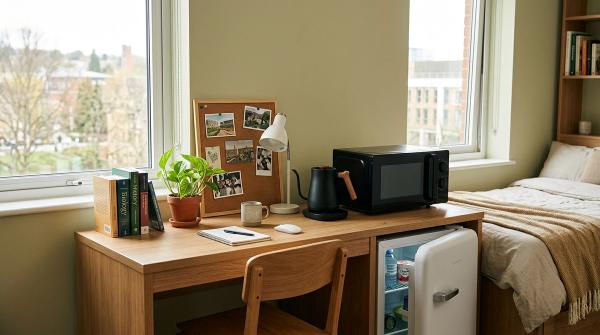
#Choose a cordless stick vacuum if you can store it easily. A dorm room usually needs quick cleaning around the bed, desk, rug, and corners.
A robot vacuum may not have enough clear floor space to be useful. A wet-dry vacuum only makes sense if you have hard floors and easy sink access.
“I have pets in a studio.”
#If pet hair mostly collects on the floor and your space is fairly open, a robot vacuum can help a lot with daily maintenance.
But if pet hair also ends up on the sofa, bed, rugs, curtains, or fabric chairs, a cordless stick vacuum is more useful. You’ll want something that can clean above the floor too.
“My apartment is mostly tile or laminate.”
#A cordless stick vacuum works well for dry dust, crumbs, and hair. A wet-dry vacuum is better if you also mop often or deal with wet messes.
A robot vacuum can help with daily dust if the layout is open enough and the floor stays reasonably clear.
“I have one small rug and mostly hard floors.”
#A cordless stick vacuum is still the safest all-round choice. A robot vacuum can work if the rug is low-pile and doesn’t move around easily.
A wet-dry vacuum may help with the hard floors, but it won’t replace proper rug cleaning.
“I hate cleaning.”
#A robot vacuum is the most hands-off option, but only if your apartment suits it.
If you have to pick up clothes, move cords, rescue it from under furniture, and clear the floor every time it runs, the benefit gets smaller fast.
Mistakes to Avoid
#1. Buying a huge dock without measuring
#Some robot vacuums and hybrid systems come with large docks. They may empty dust, wash mop pads, refill water, or dry components depending on the model.
That can be convenient, but it isn’t always small-apartment friendly.
Measure the space before buying. Also remember that the robot needs room to leave and return to the dock.
2. Ignoring weight
#A vacuum that looks fine online may feel annoying in daily use.
This matters especially with cordless stick vacuums and wet-dry vacuums. A wet-dry vacuum can feel much heavier once water is added.
If possible, check the weight before buying and think about how often you’ll actually want to pick it up or push it around.
3. Assuming a robot vacuum replaces everything
#A robot vacuum can maintain floors, but it cannot clean furniture, shelves, mattresses, curtains, stairs, or many tight corners.
If those jobs matter to you, you may still need a handheld vacuum or cordless stick vacuum.
4. Buying a wet-dry vacuum for carpeted rooms
#Wet-dry upright cleaners are best for hard floors. If your apartment is mostly carpet or rugs, a cordless stick vacuum is usually the better fit.
5. Forgetting about maintenance
#Every vacuum needs some care.
Wet-dry vacuums need rinsing. Robot vacuums need brush, wheel, bin, and sensor cleaning. Cordless vacuums need bin and filter maintenance.
If maintenance sounds annoying now, it’ll feel even more annoying after the novelty wears off. Choose the machine you’re actually willing to look after.
6. Paying for features you won’t use
#Small apartments don’t always need the most advanced setup.
You may not need a huge base station, ten cleaning modes, complex app controls, or premium mopping features.
Spend on the basics first: good cleaning performance for your floor type, easy storage, manageable noise, and simple maintenance.
Final Recommendation
#If you’re choosing just one tool, buy a cordless stick vacuum.
It’s the most balanced choice for small apartments because it handles floors, rugs, furniture, corners, and quick messes without taking up much room.
Choose a robot vacuum if your floor stays fairly clear and you want automated daily maintenance.
Choose a wet-dry vacuum if your apartment is mostly hard flooring and your biggest cleaning problem is wet, muddy, or sticky mess.
The best small apartment cleaning tool isn’t necessarily the most powerful one. It’s the one that fits your floors, your storage space, your noise limits, and your actual willingness to maintain it.