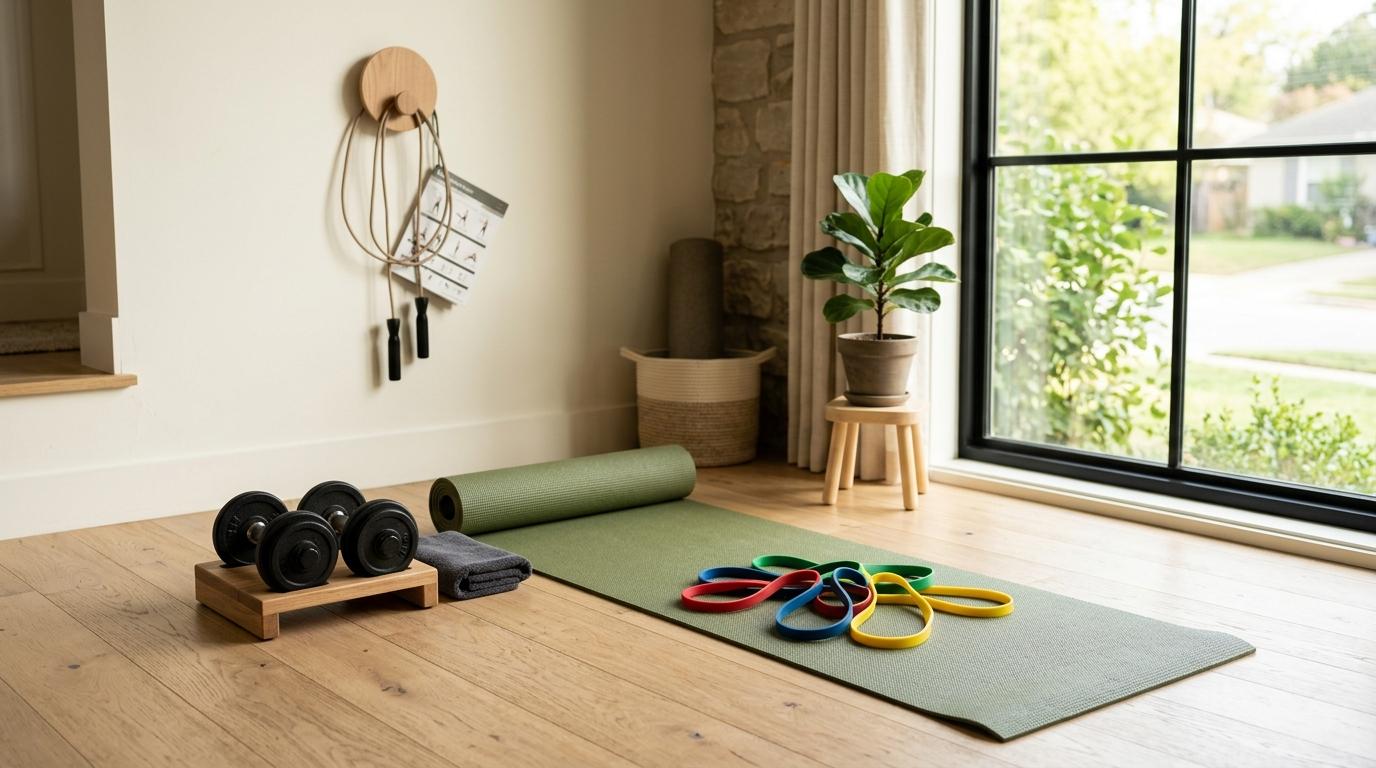
If you’re just starting to work out at home, the honest answer is this: adjustable dumbbells are probably the best first purchase if you can afford them and have a little space to store them.
They’re simple. They’re familiar. You can make exercises harder in a clear, measurable way. For beginner strength training, that matters a lot.
But that does not mean everyone should rush out and buy dumbbells today.
If money is tight, or you live in a small apartment, resistance bands are a great option. They’re cheap, light, easy to store, and surprisingly useful.
And if you haven’t actually built the workout habit yet? Don’t buy anything. Seriously. Start with bodyweight workouts first. Do them for a few weeks. If you’re still showing up, then you’ll have a much better idea of what equipment is worth buying.
Quick Answer
#Best overall buy: Adjustable dumbbellsPick these if you want the simplest, most straightforward way to build strength at home.
Best budget pick: Resistance bandsPick these if you want something affordable, compact, and easy to store.
Best “don’t spend money yet” option: Bodyweight trainingPick this if you’re still trying to make exercise a regular habit.
Best simple home setup: Adjustable dumbbells plus resistance bandsDumbbells handle most of your main strength work. Bands are great for warm-ups, rows, lighter exercises, travel, and extra variety.
Who This Guide Is For
#This guide is for beginners who want to get stronger at home without turning their living room into a gym.
Maybe you want to squeeze in a quick 15-minute workout before work. Maybe you’re doing a beginner workout after dinner. Maybe your “home gym” is really just a bedroom corner, a balcony, or a bit of floor space between the couch and the coffee table.
That’s completely fine.
The goal here is simple: help you figure out what’s actually worth buying, and what’s likely to end up shoved in a closet after two weeks.
This isn’t a guide for competitive lifters, athletes, or anyone needing medical rehab advice. It’s for regular people who want to start strength training at home in a realistic way.
The Simple Buying Decision
#If you’re comparing resistance bands vs dumbbells vs bodyweight, here’s the easiest way to think about it.
Buy nothing yet if:
#- You haven’t worked out consistently at home before.
- You’re not sure what kind of workouts you actually enjoy.
- You want to test the habit before spending money.
- You’ve bought fitness gear before and barely used it. No judgment. It happens.
Start with the basics:
- Bodyweight squats
- Incline push-ups or regular push-ups
- Lunges
- Glute bridges
- Planks
- Step-ups
- Simple mobility work
You don’t need equipment to start. You need a routine you’ll actually repeat.
Buy resistance bands if:
#- You have very limited space.
- You want something portable.
- Your budget is tight.
- You want a low-pressure way to add resistance.
- You like the idea of fitness equipment that fits in a drawer or bag.
Bands are useful, especially for beginners. Just know they feel different from weights. The resistance changes as the band stretches, so tracking progress is not always as clean or exact as it is with dumbbells.
Buy dumbbells if:
#- You want simple, no-fuss strength training equipment.
- You have room for a small storage spot.
- You want clear progression over time.
- You like knowing exactly how much weight you’re lifting.
For most beginners, adjustable dumbbells make more sense than buying several fixed pairs. They take up less space and give you room to grow stronger.
Buy both if:
#- You have the budget.
- You want a compact but flexible home setup.
- You want dumbbells for your main exercises and bands for warm-ups, rows, accessory work, or travel.
You do not need both right away. But together, they make a very solid beginner home gym setup without taking over your house.
What to Think About Before Buying Anything
#Before you add equipment to your cart, pause for a minute.
The best home workout equipment for beginners is not always the thing that looks most impressive online. It’s the thing you’ll still use after the first week.
1. Your actual workout space
#Be realistic about your space.
Do you have a corner where equipment can stay out? Or does everything need to disappear after every workout?
If your workout area is also your bedroom, living room, or shared family space, resistance bands may be easier to live with. You can toss them in a drawer and they’re gone.
If you have a safe little corner where weights can sit, adjustable dumbbells become much more practical.
2. Your current workout habit
#This is probably the most important question:
Have you already been doing home workouts without equipment?
If not, bodyweight training is not a “less serious” option. It’s the test run.
You can learn how to squat, hinge, push, brace your core, and move with control before spending a dollar. That foundation will help no matter what equipment you eventually buy.
3. Your budget
#Don’t stretch your budget just because a fitness ad made something look essential.
Bands usually cost much less than dumbbells. Dumbbells, especially adjustable ones, cost more upfront but can last for years.
The right choice is the one you can afford without feeling annoyed or guilty about it later.
4. Your tolerance for clutter
#Some people don’t care if dumbbells sit in the corner. Other people hate seeing equipment out in the open. That matters more than you might think.
Resistance bands can fit in a drawer, closet, backpack, or storage bin. Dumbbells need a stable spot. Fixed dumbbells need even more room if you start collecting multiple pairs.
If the equipment annoys you every time you see it, you probably won’t love using it.
5. Your progression plan
#Strength training works best when you can gradually make things harder.
With dumbbells, progression is usually simple:
- Use more weight
- Do more reps
- Add another set
- Move with better control
- Slow the exercise down
With bands, progression works too, but it’s less exact. You might use a thicker band, shorten the band, step farther away from the anchor point, or combine bands.
With bodyweight training, progression usually means changing the exercise variation, adding pauses, slowing the tempo, or doing more reps.
All three can work. Dumbbells just make progress easier to measure.
Resistance Bands vs Dumbbells vs Bodyweight: Side-by-Side Comparison
#Here is the practical comparison before you buy:
- Upfront cost: Bodyweight is free, resistance bands are usually the lowest-cost equipment option, and dumbbells usually cost more upfront.
- Space needed: Bodyweight and bands need very little room. Dumbbells need a safe storage corner.
- Portability: Bodyweight and bands travel well. Dumbbells are not practical for travel.
- Resistance style: Bodyweight uses your body against gravity, bands use variable tension, and dumbbells use a fixed external load.
- Ease of progression: Dumbbells are usually easiest to progress because the weight is clear. Bands and bodyweight exercises can progress too, but the steps are less exact.
- Best use: Bodyweight is best for building the habit, bands are best for budget and small spaces, and dumbbells are best for long-term beginner strength training at home.
- Main limitation: Bodyweight can become too easy, bands are harder to measure, and dumbbells cost more and need storage.
Option 1: Bodyweight Training
#Bodyweight training is the best place to start if you’re not sure you’ll stick with home workouts.
It’s free. It needs almost no space. And it teaches you how to move your body well.
A simple routine with squats, lunges, push-ups, incline push-ups, planks, step-ups, and glute bridges can do a lot for a beginner. You can build confidence, improve coordination, and get used to showing up regularly.
The downside is that bodyweight training can become harder to progress, especially for your legs.
At first, bodyweight squats might feel challenging. After a while, they may feel too easy unless you add more advanced variations, pauses, tempo work, or higher reps. That’s when equipment starts to help.
Best for:
#- Absolute beginners
- People testing a home workout routine
- Anyone with no budget for equipment right now
- People who want to build consistency first
- Anyone who feels overwhelmed by buying fitness gear
Avoid if:
#- Basic bodyweight exercises already feel too easy
- You want a simple way to keep adding resistance
- You get bored quickly with exercise variations
- You want more measurable progress
Good beginner use:
#Start here if you’re unsure.
Do bodyweight workouts for two to four weeks. If you’re still doing them, then think about what would make your workouts better.
That way, you’re not buying equipment because you’re excited for one afternoon. You’re buying it because it solves a real problem.
Option 2: Resistance Bands
#Resistance bands are one of the best budget-friendly options for home workouts.
They’re light, cheap, portable, and easy to hide away. If you live in a small apartment, travel often, or don’t want equipment sitting around, bands make a lot of sense.
They’re also useful for exercises that can be awkward with bodyweight alone, especially pulling movements like rows, pull-aparts, and face pulls.
The main thing to understand is that bands do not feel like dumbbells.
Bands create variable tension. The more they stretch, the harder they get. That can be useful, but it also means an exercise might feel easy at the start and much harder near the end.
That’s not bad. It’s just different.
Best for:
#- Tight budgets
- Small apartments
- Shared spaces
- Travel workouts
- Beginners who want compact equipment
- Adding pulling exercises at home
- Warm-ups and lighter accessory work
Avoid if:
#- You want the easiest possible way to track progress
- You dislike adjusting equipment or setting up anchors
- You want something that feels like traditional weights
- You don’t want to think much about positioning
What to look for:
#- Multiple resistance levels
- Comfortable handles if you prefer handle-style bands
- A sturdy feel, not thin or flimsy material
- Easy storage
- Clear setup instructions
- A door anchor if you want more exercise options
Important safety note:
#Bands can snap back if they slip, break, or are anchored badly.
Check them for small tears or wear. Don’t wrap them around sharp surfaces. Make sure they’re secure before you start pulling.
It’s not complicated, but you do need to pay attention.
Option 3: Dumbbells
#Dumbbells are usually the best overall purchase if you’re ready to invest in beginner home workout equipment.
They’re simple in the best possible way.
You pick them up, do the exercise, and put them down.
The weight is clear, which makes progress easier to track. If you used 15-pound dumbbells for eight reps last week and you can do ten reps this week, you improved. If you eventually move to 20-pound dumbbells, that’s even easier to see.
That kind of feedback is motivating.
This is where dumbbells beat resistance bands for many beginners. They remove some of the guesswork.
Adjustable dumbbells are especially useful at home because they replace several pairs of fixed dumbbells. Fixed dumbbells can work, but one light pair often becomes limiting quickly.
Your shoulders might need lighter weights, while your legs and hips may need much heavier weights. Adjustable dumbbells give you more options without filling your room with equipment.
Best for:
#- Beginners who want clear strength progress
- People with a small storage corner
- Full-body home workouts
- Long-term strength training at home
- Anyone who likes simple equipment
Avoid if:
#- The upfront cost is too high
- You move often and don’t want heavy gear
- You have no safe place to store weights
- You’re not consistent with basic workouts yet
What to look for:
#- A weight range that gives you room to progress
- A secure adjustment system
- A comfortable grip
- A shape that feels stable during exercises
- A storage setup that won’t create clutter or tripping hazards
So, Which Should You Buy?
#Here’s the practical answer.
If you’re brand new:
#Start with bodyweight training.
Do not buy anything yet. Build the habit first. Once you’ve proved to yourself that you’ll actually work out at home, buying equipment becomes a much smarter decision.
If you want the cheapest useful equipment:
#Buy resistance bands.
They’re not perfect, but they’re affordable, compact, and versatile enough for many beginner workouts.
If you want the best long-term beginner setup:
#Buy adjustable dumbbells.
They’re easier to progress with, easier to understand, and useful for a wide range of strength exercises.
If you want the most flexible compact setup:
#Buy adjustable dumbbells plus resistance bands.
This gives you the best of both: simple strength training with dumbbells, plus the portability and variety of bands.
Bodyweight vs Dumbbells: When Should You Upgrade?
#The bodyweight vs dumbbells question usually comes down to one thing: progression.
Bodyweight training is enough when the exercises still challenge you and you’re still learning good control.
It starts to become limiting when you can do lots of reps easily and the only way to make things harder is to use more complicated variations.
That’s where dumbbells help.
For example, bodyweight squats are great at first. But once they feel easy, holding dumbbells can make the same movement challenging again without needing to learn a fancy new squat variation.
The same idea applies to:
- Lunges
- Split squats
- Hip hinges
- Glute bridges
- Presses
- Rows
- Carries
You do not need to rush the upgrade. But if you’re consistent and your workouts feel too easy, dumbbells are usually the cleanest next step.
Resistance Bands vs Dumbbells for Beginners: The Real Difference
#The biggest difference is not whether bands or dumbbells “work.”
They both can work.
The real difference is how they feel and how easy they are to progress.
Dumbbells give you a fixed external load. A 20-pound dumbbell is a 20-pound dumbbell. That makes training easier to track.
Resistance bands change tension as they stretch. Some people love this because it can feel smooth and joint-friendly. But it also makes the exact resistance harder to measure.
For beginners, that matters.
Simple tracking helps you stay motivated because you can actually see your progress. Dumbbells make that very obvious. Bands still work, but they require a little more feel and adjustment.
Common Mistakes to Avoid
#1. Buying equipment before building the habit
#This is the big one.
New equipment can feel motivating for a few days. But motivation fades fast.
If you haven’t done any home workouts yet, start with bodyweight training first. Let the habit come before the shopping.
2. Buying only one very light pair of dumbbells
#One light pair might be fine for a few exercises, but it can become limiting quickly.
Your legs, hips, and back are usually stronger than your shoulders and arms. So one small pair may be too heavy for some exercises and too light for others.
If you choose dumbbells, adjustable dumbbells usually make more sense than a single fixed pair.
3. Assuming bands and dumbbells feel the same
#They don’t.
A band chest press and a dumbbell chest press might train similar muscles, but they feel different. Bands get harder as they stretch. Dumbbells provide a fixed load.
Neither one is automatically better for everyone. They’re just different tools.
4. Buying a large machine first
#Big machines can look impressive. Some are useful.
But they’re usually not the best first purchase for beginners with limited space, budget, or time.
Start simple. You can do a lot with bodyweight exercises, bands, dumbbells, or a mix of the three.
5. Ignoring storage
#If your equipment is annoying to set up, move, or put away, you may stop using it.
Before buying anything, decide exactly where it will live.
If you don’t have an answer, wait.
Final Recommendation
#If you want one clear answer in the resistance bands vs dumbbells debate, choose adjustable dumbbells if you can afford them and store them safely.
They’re the most straightforward option for beginner strength training at home.
If dumbbells feel too expensive or bulky right now, buy resistance bands. They’re compact, affordable, beginner-friendly, and useful for plenty of exercises.
If you’re not exercising consistently yet, buy nothing. Start with bodyweight training. Prove the habit first. Then spend money when you know what you actually need.
The best equipment is not the fanciest option. It’s the one that fits your space, budget, and routine well enough that you actually use it.