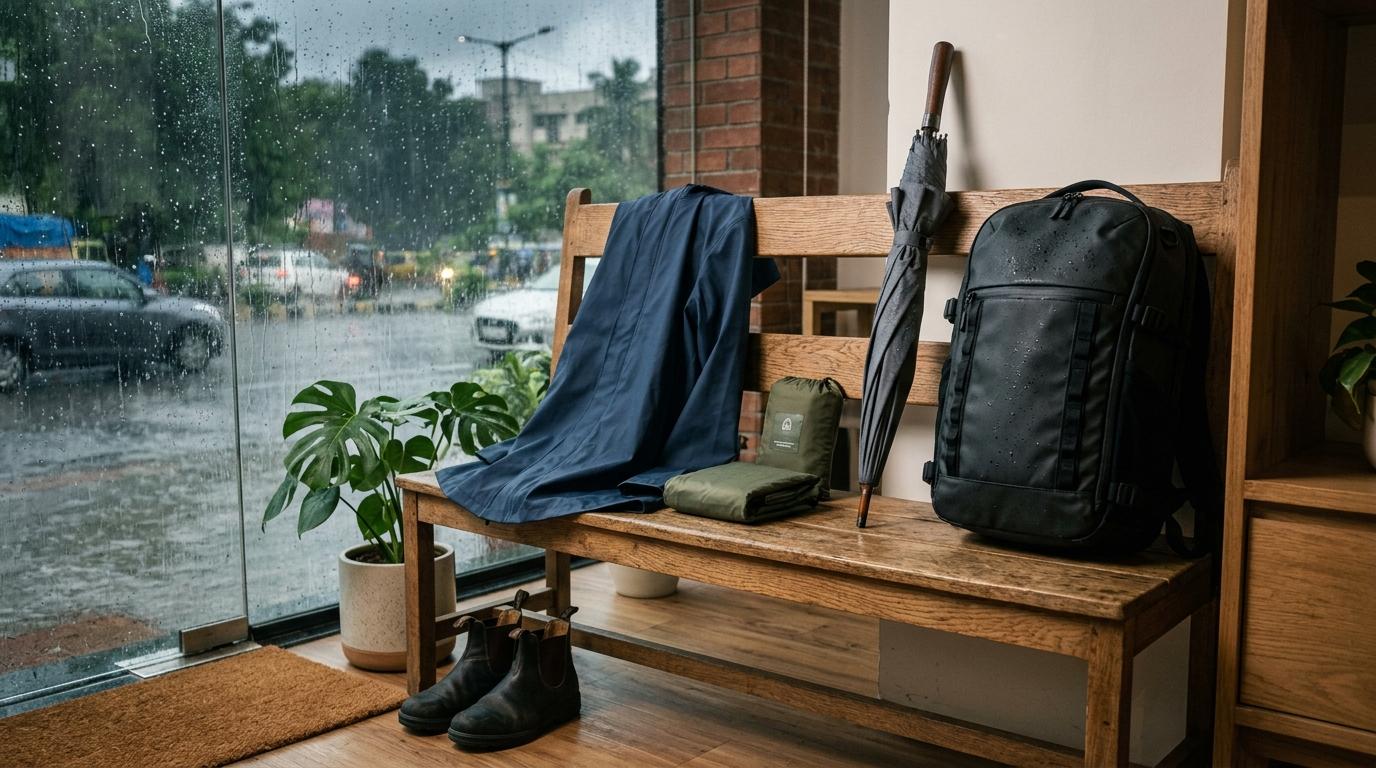
Choosing between a raincoat, poncho, and umbrella for the Indian monsoon sounds simple until you are actually stuck in the rain with a laptop bag, wet jeans, and no place to dry anything.
The truth is, there is no one perfect option for everyone.
If you ride a scooter or bike, a two-piece raincoat makes the most sense. If you take the metro, bus, cab, auto, or local train, a sturdy umbrella is usually enough. And if you carry a big backpack or college bag every day, a poncho can be more useful than it looks.
The best rain gear is not the fanciest one online. It is the one that fits your daily commute.
Short Answer
#Best for scooters and bikes:Go for a fitted two-piece raincoat. It gives better coverage and is much safer than loose rainwear in wind.
Best for metro, bus, cab, auto, and office commutes:A strong 2-fold or 3-fold umbrella is usually the most practical choice. It is easy to carry, open, close, and keep near your desk.
Best for college students and backpack users:A poncho works well because it can cover both you and your bag. It is also quick to wear when rain starts suddenly.
Best single choice for most public-transport commuters:A good umbrella, unless you have a long walk or your route gets heavy sideways rain.
Best single choice for two-wheeler riders:A two-piece raincoat. Not a poncho, and definitely not an umbrella.
Useful related guides on AllBlogs
#If you are building a full monsoon commute setup, also read:
- Backpack Rain Cover vs Waterproof Backpack for Monsoon
- Best Monsoon Travel Shoes in India: Quick-Dry vs Waterproof
- Monsoon Helmet Visor Guide for Indian Riders
- Monsoon Packing List for India Trips
Who This Guide Is For
#This guide is for office commuters, college students, daily public-transport users, two-wheeler riders, and anyone who wants practical monsoon commute rain gear without getting lost in product claims.
If you have ever reached office with wet trousers, had your umbrella flip inside out on a windy bridge, or worn a cheap raincoat and still felt wet because of sweat, this is for you.
This is not a brand list. No fake “top 10” ranking. No random star ratings.
This is a simple, real-world comparison for Indian commutes: crowded buses, metro stations, autos, railway footbridges, office laptop bags, college backpacks, two-wheelers, and those sudden downpours that arrive just when you step out.
Raincoat vs Poncho vs Umbrella: What Is the Real Difference?
#When people search for raincoat vs umbrella in India, they usually think only about staying dry.
But Indian monsoon commuting is not just about rain. It is also about humidity, crowding, traffic splash, wind, walking distance, and whether you have a bag with you.
Before buying anything, think about these questions:
- How far do you walk every day?
- Do you ride a scooter or motorcycle?
- Do you carry a laptop bag, backpack, or college bag?
- Is your route windy or open?
- Do you use crowded public transport?
- Do you need both hands free?
- Do you sweat a lot inside rainwear?
- Do you have space to dry wet rain gear after reaching?
Once you answer these honestly, the right choice becomes much clearer.
Option 1: Raincoat
#A raincoat gives the best protection when you are directly exposed to heavy rain. In India, most people usually choose either a two-piece raincoat, which includes a jacket and pants, or a long coat-style raincoat.
For two-wheeler riders, a two-piece raincoat is usually the better choice. It protects both your upper and lower body and stays more secure while riding.
A long raincoat can be fine for walking, but in heavy rain your legs may still get wet, especially because of road splash.
Who Should Buy a Raincoat?
#Buy a raincoat if:
- You ride a scooter, bike, or motorcycle during the monsoon.
- You walk long distances in heavy rain.
- Your route has open roads where rain comes from the side.
- You need both hands free.
- You deal with road splash from cars, buses, or autos.
- You want the most coverage among the three options.
For two-wheeler riders, a raincoat is the most sensible option. An umbrella is obviously not usable while riding, and a loose poncho can flap around too much in wind.
Who Should Avoid a Raincoat?
#A raincoat may not be the best choice if:
- Your commute is mostly metro, bus, cab, or auto with only a short walk.
- You hate feeling hot and sweaty in humid weather.
- You need to remove rainwear quickly before entering a train, lift, or office.
- You do not have space to hang or dry wet rainwear after reaching.
Raincoats protect well, but they can feel uncomfortable in Indian humidity. If your commute is short and mostly covered, a raincoat may feel like too much effort.
Pros of a Raincoat
#- Gives the best body coverage.
- Keeps both hands free.
- Works better than an umbrella in sideways rain.
- Best option for two-wheeler commutes.
- Protects better against road splash.
Cons of a Raincoat
#- Can feel hot and sweaty.
- Takes time to wear and remove.
- Can be awkward in crowded public transport.
- Needs proper drying after use.
- May not fit well over a backpack or laptop bag.
Option 2: Poncho
#A poncho is a loose waterproof layer that you wear over your head. It does not usually have fitted sleeves like a raincoat. Its biggest advantage is simple: it can cover both you and your bag.
That makes a poncho for monsoon commute especially useful for students, backpack users, and people who want quick protection during sudden showers.
It may not look as neat as a raincoat, but when the rain starts suddenly and you have a bag full of books, clothes, or a laptop, a poncho can be very practical.
Who Should Buy a Poncho?
#Buy a poncho if:
- You carry a large backpack, college bag, or laptop bag.
- You want something quick to wear when it suddenly rains.
- You walk short to medium distances.
- You find fitted raincoats too hot.
- You want emergency rain protection that can stay in your bag.
Ponchos are especially useful for college students. A normal raincoat may protect your body but leave your backpack exposed. A poncho can cover both together.
Who Should Avoid a Poncho?
#A poncho may not be right for you if:
- You ride a scooter or motorcycle at speed.
- Your route is very windy.
- You often walk through waterlogged streets.
- You need proper leg protection.
- You want neat, office-friendly rainwear.
Ponchos can flap badly in wind. On a two-wheeler, that loose fabric can become distracting and unsafe. Also, your lower legs and shoes can still get wet.
Pros of a Poncho
#- Very quick to wear and remove.
- Covers backpacks better than most fitted raincoats.
- Feels more breathable because it is loose.
- Good as emergency rain gear.
- Easy to keep in a college bag, tote, or office bag.
Cons of a Poncho
#- Flaps in wind.
- Not ideal for fast two-wheeler use.
- Does not protect lower legs properly.
- Can look bulky or messy.
- Not great for sideways rain.
Option 3: Umbrella
#An umbrella is the classic Indian monsoon item for a reason. It is simple, portable, affordable, and does not make you sweat like a raincoat.
For many office commuters who use the metro, bus, cab, auto, or local train, an umbrella is the easiest everyday option.
The main issue is wind. A weak umbrella can turn inside out on railway footbridges, open roads, sea-facing areas, wide crossings, and exposed platforms. So for Indian monsoon use, frame strength matters more than colour or design.
Who Should Buy an Umbrella?
#Buy an umbrella if:
- Your commute involves metro, bus, cab, auto, or train.
- You only need rain protection for the last-mile walk.
- You wear office clothes and do not want to sweat under a raincoat.
- You need something easy to close before entering a vehicle or building.
- You walk through crowded areas where raincoats feel inconvenient.
For most public-transport users, a good umbrella is the most practical daily choice. You can close it quickly, shake off some water, and carry it without too much trouble.
Who Should Avoid Only Using an Umbrella?
#Do not depend only on an umbrella if:
- You ride a two-wheeler.
- Your commute needs both hands free.
- Your route gets very windy.
- You often face sideways rain.
- You walk near heavy traffic and deal with road splash.
- You need to protect a large backpack.
An umbrella protects your head and upper body, but during a proper downpour, your shoes, trousers, bag sides, and lower body can still get wet.
Pros of an Umbrella
#- Easy to use.
- Does not trap heat like a raincoat.
- Good for short walks.
- Convenient for office, metro, bus, and cab users.
- Easy to close before entering indoor spaces.
Cons of an Umbrella
#- Uses one hand.
- Weak umbrellas struggle in strong wind.
- Does not protect well from sideways rain.
- Does not protect legs and shoes properly.
- Cheap frames can bend, break, or flip inside out.
What to Check Before Buying Rain Gear
#Before buying any rainwear for Indian monsoon use, check a few practical things. Small details can make a big difference during daily commuting.
1. Waterproof, Not Just Water-Resistant
#This is important.
Water-resistant gear may handle light drizzle, but it can soak through in heavy rain. For daily monsoon commuting, especially if you walk or ride, look for something that clearly says waterproof.
This matters most for raincoats and ponchos. If you regularly face proper downpours, water-resistant fabric is not enough.
2. Raincoat and Poncho Material
#Cheap raincoats are often made from thick PVC-like material. They may block rain, but they can feel hot, sticky, and uncomfortable in humid weather.
For daily commuting, nylon or polyester with waterproof coating is usually more comfortable than thick, rubbery rainwear.
Also check how the material feels. If it is too stiff, too noisy, or too heavy, you may not enjoy wearing it every day.
3. Seam Sealing
#A raincoat or poncho can leak through the stitching if the seams are not sealed.
Turn it inside out and check the stitched areas. If the seams have waterproof taping or sealing, that is a good sign. If it is just plain stitching, water may enter through the needle holes during heavy rain.
4. Hood Fit
#A hood should sit properly around your face.
If it is too loose, it may fall back in wind. If it is too tight, it may block side vision. This is especially important if you are walking near traffic.
For two-wheeler riders, remember that a raincoat hood is not a replacement for a helmet. Your helmet visor and rainwear both matter.
5. Bag Space
#If you carry a laptop bag or backpack, try the raincoat with the bag on.
Do not assume it will fit. A raincoat that feels perfect without a bag may become tight at the shoulders once you wear your backpack. It may also leave part of the bag exposed.
If your bag is large, either size up carefully or consider a poncho.
6. Umbrella Frame Strength
#For umbrellas, do not judge only by canopy size or colour. Check the frame.
A sturdier frame is more useful than a fancy print. Fiberglass ribs are generally more flexible in wind than cheap metal spokes. A vented or double-canopy design can also help by allowing wind to pass through more easily.
7. Fold Size
#A straight umbrella can be stronger, but it is not always convenient in crowded public transport.
A very compact 5-fold umbrella is easy to carry, but it may feel weaker in heavy wind. For many commuters, a 2-fold or 3-fold umbrella is the practical middle option. It fits in most bags without feeling too fragile.
8. Drying and Storage
#Think about what happens after you reach office, college, or class.
A wet raincoat needs space to dry. A poncho may drip if you stuff it directly into your bag. An umbrella is easier to shake and keep aside, but even that needs a cover or a place to drain.
Your rain gear should be easy to manage after use, not just during use.
Which One Should You Buy Based on Your Commute?
#If You Ride a Scooter or Bike
#Buy a two-piece raincoat.
This is the easiest decision. For two-wheelers, a raincoat gives better coverage and keeps your hands free. Avoid loose ponchos because they can flap in the wind. An umbrella is not an option while riding.
Look for a fitted jacket and pants, sealed seams, a secure hood, and enough room to move comfortably.
If You Use Metro or Local Train
#Buy a sturdy umbrella for most days.
A raincoat can be irritating in packed public transport because you have to manage wet fabric in a crowded space. An umbrella is easier to close before entering the station or train.
If your walk to the station is long or very exposed, you can keep a light poncho or raincoat as backup.
If You Commute by Bus or Auto
#An umbrella is usually the easiest choice.
You can open it for the walk to the stop, close it before boarding, and carry it without much trouble. If your bus stop has no shelter or your area gets heavy rain, a poncho can also help, especially if you carry a bag.
If You Walk Long Distances
#Choose a raincoat if the rain is heavy and regular. Choose an umbrella if the rain is light and the route is crowded.
For long walks in serious rain, an umbrella alone may not protect your clothes, legs, shoes, or bag properly. A raincoat gives better coverage, but it can feel hot. If you carry a backpack, a poncho may be more comfortable.
If You Are a College Student
#A poncho is often the most useful option.
It covers your backpack, is easy to carry, and works well for sudden showers between bus stops, college gates, hostels, and classrooms.
But if your commute includes a scooter or bike, choose a raincoat instead.
If You Wear Formal Office Clothes
#An umbrella is usually better for short commutes.
It does not crush your outfit or make you sweat as much as a raincoat. But if your route has heavy rain and long walking stretches, keep a raincoat or poncho as backup.
If Your City Gets Sudden, Unpredictable Rain
#Carry a compact umbrella or poncho.
For places where rain appears without warning, quick access matters. A compact umbrella or foldable poncho is easier to keep in your everyday bag than a full raincoat.
Common Mistakes to Avoid
#1. Buying Rainwear Without Thinking About Your Bag
#This is one of the most common mistakes.
A raincoat may fit perfectly when you try it without a bag. But once you wear your laptop backpack, it may feel tight or leave your bag exposed.
If you carry a bag daily, check the fit with the bag. If your bag is bulky, a poncho may make more sense.
2. Choosing Water-Resistant Gear for Heavy Rain
#Water-resistant does not mean waterproof.
It may work for drizzle, but not for a proper monsoon downpour. For serious rain, especially if you walk or ride, choose waterproof rainwear with sealed seams.
3. Buying the Cheapest Umbrella During an Emergency
#A roadside emergency umbrella may save you for one shower, but it may not survive wind well.
If you depend on an umbrella daily, buy one with a stronger frame. The worst time to discover weak spokes is on a windy railway bridge, open crossing, or bus stop.
4. Ignoring Sweat and Humidity
#Many people buy the thickest raincoat thinking it will give the best protection. Then they realise it feels like wearing a plastic cover in humid weather.
Rain protection matters, but comfort matters too. If you sweat a lot, look for lighter material, ventilation, or a slightly looser fit.
5. Wearing a Poncho on a Fast Two-Wheeler Commute
#Ponchos are useful for walking, but loose fabric is not ideal on a moving two-wheeler.
It can flap, distract you, and feel unstable in wind. For scooters and motorcycles, a fitted two-piece raincoat is the better choice.
Final Recommendation
#If you want the simplest buying rule, use this:
- Two-wheeler commute: Buy a two-piece raincoat.
- Metro, bus, cab, auto, or office commute: Buy a sturdy umbrella.
- College, backpack, or emergency rain protection: Buy a poncho.
- Long walks in heavy rain: Buy a raincoat, or a poncho if bag coverage matters more.
- Short last-mile walks: Buy an umbrella.
For most Indian public-transport users, a good umbrella is the easiest everyday choice. For riders, a raincoat is the clear winner. For students and backpack-heavy commuters, a poncho is often the most convenient backup.
There is no single winner in the raincoat vs poncho vs umbrella debate. The right choice is the one that matches your actual commute.